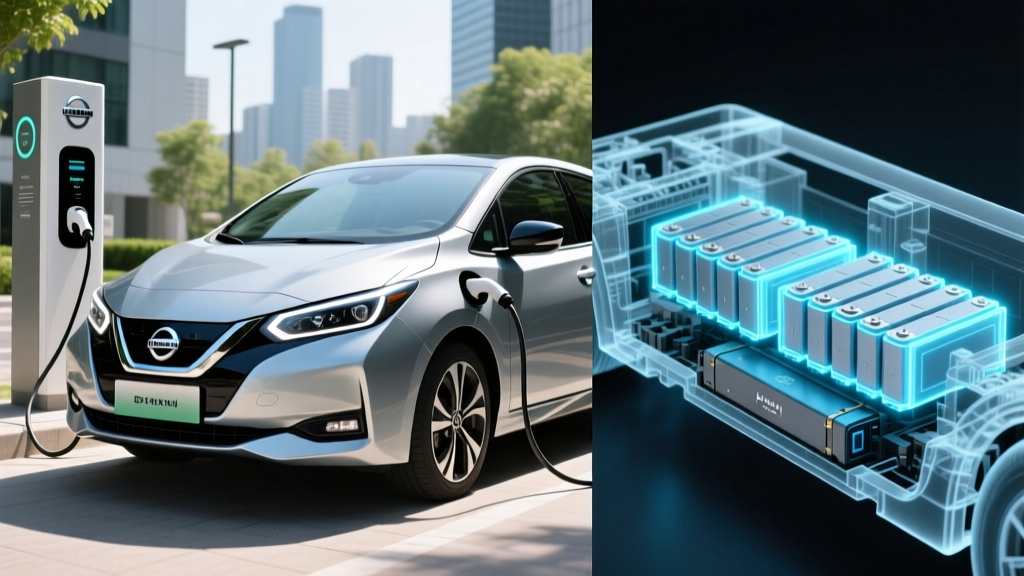
The Nissan Leaf holds a unique place in EV history: it's one of the longest-running mass-market electric vehicles in the world, first launched for the 2011 model year. That longevity makes it an invaluable case study for battery durability. If you own a Leaf, are considering a used one, or simply want real-world data on how EV batteries age, the Leaf's track record offers more than a decade of evidence. This guide breaks down the life of the Nissan Leaf battery with hard numbers — degradation curves, warranty specifics, replacement costs, and practical strategies to extend battery health.
Nissan Leaf Battery Specs: Chemistry, Capacity, and Generations
Before examining degradation, it's essential to understand what's under the floor. The Leaf has used two primary battery packs across its production run:
- 24 kWh pack (2011–2017): Lithium manganese oxide (LMO) chemistry in early models, transitioning to a laminated lithium-ion cell design. EPA-rated range started at 73 miles (2011) and climbed to 107 miles by the final first-gen year.
- 30 kWh pack (2016–2017): An incremental upgrade for the first-generation body, offering an EPA-estimated 107 miles.
- 40 kWh pack (2018–present): Second-generation Leaf with NMC (nickel manganese cobalt) chemistry. EPA range: 149 miles.
- 62 kWh pack (Leaf Plus, 2019–present): Higher-density NMC cells. EPA range: 212–226 miles depending on model year and trim.
All Leaf packs use NMC-type chemistry — not the LFP (lithium iron phosphate) chemistry found in some newer EVs like the Tesla Model 3 Standard Range or base BYD models. This distinction matters for longevity, as we'll explore below.
| Model Years | Battery (kWh usable) | Chemistry | EPA Range | Max DC Charge Rate |
|---|---|---|---|---|
| 2011–2015 | 24 kWh | LMO / Li-ion | 73–84 mi | ~50 kW (CHAdeMO) |
| 2016–2017 | 30 kWh | NMC-type | 107 mi | ~50 kW (CHAdeMO) |
| 2018–present | 40 kWh | NMC | 149 mi | ~50 kW (CHAdeMO) |
| 2019–present (Plus) | 62 kWh | NMC | 212–226 mi | ~100 kW (CHAdeMO) |
Sources: fueleconomy.gov, Nissan USA specifications.
A critical note on charging: the Leaf uses a CHAdeMO DC fast-charging connector, not the CCS or NACS connectors now standard on most new EVs. As the North American charging network shifts decisively toward NACS (Tesla's standard), CHAdeMO infrastructure is shrinking. This doesn't affect battery chemistry directly, but it affects ownership practicality for fast-charging on road trips.
Real-World Degradation: What the Data Shows
Battery degradation is measured as the percentage of original capacity lost over time. For the Leaf, we have unusually rich real-world data thanks to the car's 15-year production run and active owner communities that log State of Health (SoH) readings obsessively.
Typical Nissan Leaf Battery Degradation Curve
Based on aggregated owner reports, fleet data, and testing from sources including Recurrent Auto and LeafSpy community logs:
- Year 1–2: 2–5% capacity loss (initial settling — common to all lithium-ion cells)
- Year 3–4: 8–12% total loss from new
- Year 5–6: 12–18% total loss
- Year 7–8: 15–22% total loss
- Year 10+: 20–30%+ total loss (highly variable based on climate and usage)
The first-generation Leaf (24 kWh) had a well-documented vulnerability: passive air cooling. Unlike the active liquid thermal management systems in Tesla, Hyundai, and most modern EVs, the Leaf relies on natural convection to shed battery heat. This design choice makes the pack more susceptible to heat-related degradation, particularly in hot climates like Arizona, Texas, and the Southeast.
Owners in Phoenix, for example, have reported 24 kWh packs dropping to 70% capacity (a loss of 30%) within 5–6 years — reducing an already modest 84-mile EPA range to roughly 59 usable miles. In temperate climates like the Pacific Northwest, the same packs have held 80%+ capacity at the 8-year mark.
The second-generation 40 kWh and 62 kWh packs (2018+) show improved durability, but they still lack active liquid cooling. Real-world data from Recurrent Auto's fleet analysis of over 5,000 Leafs indicates that 40 kWh packs average approximately 85–88% State of Health at the 5-year mark — better than the first generation, but behind liquid-cooled competitors like the Chevrolet Bolt EV and Tesla Model 3, which typically retain 90–93% SoH at equivalent age.
Understanding Battery Chemistry: NMC vs. LFP Trade-Offs
The Leaf's NMC chemistry is one of two dominant lithium-ion chemistries in EVs today. Here's how it compares to the increasingly popular LFP alternative:
| Attribute | NMC (Leaf, most EVs) | LFP (Tesla base, BYD) |
|---|---|---|
| Energy density | Higher (more range per kg) | Lower (~15–20% less) |
| Cycle life | ~1,000–2,000 cycles to 80% SoH | ~3,000–5,000 cycles to 80% SoH |
| Cold-weather performance | Better low-temp range retention | Greater range loss below freezing |
| Thermal stability | Good (requires management) | Excellent (inherently stable) |
| Cost per kWh | Higher (cobalt, nickel) | Lower (iron, phosphate) |
| Optimal daily SoC | 20–80% recommended | Can charge to 100% regularly |
For Leaf owners, the practical takeaway: NMC chemistry offers more range per pound but is more sensitive to charging habits and heat exposure. LFP's longer cycle life makes it inherently more durable, which is why manufacturers like Tesla recommend daily 100% charging for LFP packs but only 80% for NMC. The Leaf's lack of liquid cooling amplifies NMC's thermal sensitivity — a double disadvantage in hot climates.
Nissan Leaf Battery Warranty: What's Covered
Nissan provides two layers of battery warranty coverage for the Leaf:
| Warranty Type | Coverage Period | Threshold / Terms |
|---|---|---|
| Lithium-Ion Battery Capacity Warranty | 8 years / 100,000 miles | Capacity must remain above 9 bars out of 12 on the dashboard capacity gauge (approximately 70–75% of original capacity) |
| EV System Coverage | 5 years / 60,000 miles | Covers inverter, charger, and related high-voltage components |
The 9-bar threshold is important context. Nissan's dashboard displays battery capacity as a bar graph with 12 bars. Dropping below 9 bars (i.e., falling to 8 bars or fewer) within the warranty period triggers a warranty replacement or refurbishment. In practice, this means Nissan guarantees roughly 70–75% capacity retention at 8 years/100,000 miles.
Compared to industry standards, this is a typical warranty. Most EV manufacturers — including Tesla, Hyundai, Kia, and Ford — offer 8-year/100,000-mile battery warranties with capacity thresholds between 65% and 70%. Hyundai and Kia stand out with a slightly more generous 70% threshold over the same period. The Leaf's warranty is adequate but not exceptional, and the air-cooled design means some owners in hot climates approach that 9-bar threshold sooner than liquid-cooled competitors.
Battery Replacement Cost: When and How Much
If your Leaf's battery degrades beyond acceptable levels — or fails outright — replacement is possible but expensive relative to the vehicle's value. Here's what the market looks like as of 2026:
| Battery Pack | OEM New (Dealer) | Refurbished / Remanufactured | Typical Replacement Timeline |
|---|---|---|---|
| 24 kWh (2011–2017) | $6,500–$8,500 | $3,500–$5,500 | Rarely cost-effective; many owners retire the car |
| 30 kWh (2016–2017) | $7,000–$9,000 | $4,000–$6,000 | 8–12 years, climate-dependent |
| 40 kWh (2018+) | $8,000–$10,000+ | $5,000–$7,500 | Not yet widely needed; 10+ year expectation |
| 62 kWh (Plus, 2019+) | $9,500–$12,000+ | $6,500–$9,000 | Too new for widespread replacement data |
These figures include the battery module itself. Labor for installation typically adds $500–$1,500 depending on the shop. Independent EV repair specialists often offer better pricing than dealerships, and the aftermarket for refurbished Leaf packs has grown as first-generation Leafs age out.
When is replacement typically needed? Most Leaf batteries do not fail catastrophically. Instead, they degrade gradually until the reduced range becomes impractical for the owner's daily needs. A 24 kWh Leaf that started with 84 EPA miles and has degraded to 50–55 miles may no longer serve a 40-mile round-trip commute with margin for detours, climate control, and cold weather. That's the practical replacement trigger — not a hard failure.
It's worth noting: for a 2015 Leaf with a current resale value of $5,000–$8,000, an $8,000 OEM battery replacement rarely makes financial sense. Many owners in this situation opt to sell or trade in rather than replace. For newer 40 kWh and 62 kWh Leafs still under warranty, replacement cost is largely a theoretical concern.
Factors That Accelerate (or Preserve) Leaf Battery Life
The Leaf's air-cooled battery is more behavior-sensitive than liquid-cooled alternatives. Here's what matters most:
What Hurts Your Leaf Battery
- Frequent DC fast charging: Every CHAdeMO session generates significant heat with no active cooling to dissipate it. Owners who fast-charge daily show measurably faster degradation than those who primarily use Level 2. Nissan itself has documented "rapidgate" — charge-speed throttling after consecutive fast charges to protect the pack.
- Hot climate exposure: Parking outdoors in sustained 95°F+ heat is the single biggest degradation accelerator for the Leaf. Battery temperature doesn't drop just because the car is off.
- Sustained 100% State of Charge: Leaving an NMC pack at 100% for days stresses the cells. Charge to 100% only when you'll drive soon after.
- Deep discharges: Regularly driving to 0% or near-0% accelerates wear. Try to keep the pack above 10–15%.
What Preserves Your Leaf Battery
- Level 2 home charging as your primary method: Slower charging generates less heat. A 240V Level 2 charger at 6.6 kW (the Leaf's onboard charger max) is ideal for daily use.
- Charge to 80% for daily driving: Use the Leaf's charge timer or a smart EVSE to stop charging at ~80%. Reserve 100% for long trips.
- Garage parking in hot climates: Even an un-air-conditioned garage keeps battery temps 10–20°F lower than direct sun exposure.
- Moderate driving speeds: Sustained 80 mph highway driving generates more pack heat than 65 mph. The Leaf's lack of active cooling means driving style directly affects battery temperature.
- Preconditioning while plugged in: Use the Leaf's climate timer to warm or cool the cabin (and battery) while connected to shore power, reducing the load on the pack at startup.
Monitoring Battery Health: How to Check SoH on a Leaf
Nissan provides a basic but effective built-in health indicator: the capacity bar display on the far right of the instrument cluster. This 12-bar gauge shows the battery's maximum capacity relative to when it was new. A new Leaf shows 12 bars; degradation causes bars to drop over time.
For more granular data, the Leaf owner community relies heavily on LeafSpy Pro, a third-party app that connects to the car's OBD-II port via a Bluetooth adapter (typically an ELM327-compatible dongle, ~$15–$30). LeafSpy reads the battery management system (BMS) directly and reports:
- State of Health (SoH) percentage: A precise number (e.g., 87.3%) rather than the dashboard's coarse bar display.
- Individual cell voltages: Reveals cell imbalance — a sign of pack health issues.
- Battery temperature: Real-time pack temp in °F/°C — critical for Leaf owners since there's no active cooling.
- Charge/discharge power: Real-time kW draw or regen input.
If you're buying a used Leaf, a LeafSpy reading is non-negotiable. A seller who won't allow a LeafSpy check is a red flag. Expect to see SoH readings between 75–92% for 5–8 year old Leafs depending on climate and charging history. Anything below 75% on a car still under warranty should trigger a dealer visit for a warranty claim.
The Road Ahead: Solid-State Batteries and the Leaf's Future
Nissan has been vocal about its solid-state battery ambitions. The company has announced plans to bring solid-state cells to production by the late 2020s, targeting improved energy density, faster charging, and longer cycle life. However, as of 2026, solid-state EV batteries remain in pilot and prototype stages — no consumer vehicle currently on sale uses a solid-state traction battery.
Nissan's Alliance partner Renault has also been investing in solid-state research through partnerships, but realistic timelines for a next-generation Leaf (or Leaf successor) with solid-state cells are 2028–2030 at the earliest. These should be treated as forward-looking development targets, not imminent product features.
For current Leaf owners, the practical path forward is straightforward: maintain the existing pack with the care practices outlined above, monitor SoH with LeafSpy, and plan your next vehicle purchase around your battery's usable range trajectory rather than waiting for future chemistry breakthroughs.
Frequently Asked Questions
How long do Nissan Leaf batteries last in years and miles?
Most Leaf batteries last 10–15 years before degrading to a point where range becomes impractical for daily use. In terms of mileage, expect 100,000–150,000 miles before significant capacity loss (below 70–75% SoH), though hot climates and frequent fast charging can shorten this to 80,000–100,000 miles. The battery rarely "dies" — it gradually holds less energy.
How much does it cost to replace a Nissan Leaf battery?
A new OEM replacement battery from a Nissan dealer costs approximately $6,500–$12,000+ depending on pack size (24 kWh to 62 kWh), plus $500–$1,500 in labor. Refurbished packs from independent EV shops run $3,500–$9,000. For older first-gen Leafs, the replacement cost often exceeds the vehicle's resale value.
What does the Nissan Leaf battery warranty cover?
Nissan covers the Leaf's lithium-ion battery for 8 years or 100,000 miles against capacity loss below approximately 70–75% (displayed as fewer than 9 out of 12 capacity bars on the dashboard). If the battery drops below this threshold within the warranty period, Nissan will replace or refurbish the pack at no cost.
How do I check my Nissan Leaf battery health?
The dashboard capacity bar gauge gives a rough indication (12 bars = new, fewer bars = degradation). For precise data, use the LeafSpy Pro app with an OBD-II Bluetooth adapter to read exact State of Health percentage, cell voltages, and battery temperature directly from the battery management system.
Is NMC or LFP battery chemistry better for longevity?
LFP chemistry generally offers longer cycle life (3,000–5,000 cycles vs. 1,000–2,000 for NMC) and greater thermal stability, making it more durable over time. However, NMC offers higher energy density (more range per kilogram) and better cold-weather performance. The Leaf uses NMC. For most buyers, charging habits and climate matter more than the chemistry distinction alone.
Does fast charging damage the Nissan Leaf battery?
Frequent DC fast charging accelerates degradation in the Leaf specifically because its battery is passively air-cooled. Heat is the primary enemy of lithium-ion longevity, and fast charging generates significant heat. Occasional fast charging on road trips is fine, but daily fast charging will measurably reduce pack life compared to Level 2 home charging.
Should I buy a used Nissan Leaf in 2026?
A used Leaf can be an excellent value as a city commuter — particularly 2018+ models with 40 kWh or 62 kWh packs and remaining battery warranty. The critical step is verifying SoH with LeafSpy before purchase. Avoid first-gen 24 kWh Leafs from hot climates unless the price reflects the degraded range. Also factor in that CHAdeMO fast-charging infrastructure is declining as the industry moves to NACS.