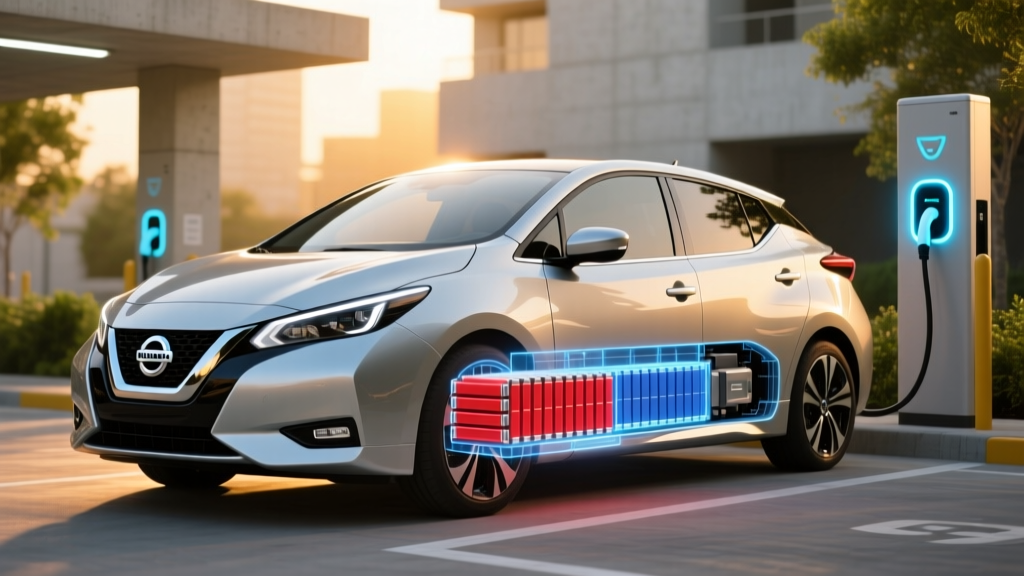
If you own a Nissan Leaf — or are considering a used one — the high-voltage traction battery is the single most expensive component in the vehicle. Searches for Nissan Leaf battery cost spike every time an early-generation Leaf owner hits the 100,000-mile mark, and for good reason: out-of-warranty replacements can rival the resale value of older models. But the full picture is more nuanced than sticker-shock headlines suggest.
This guide covers exactly what a Leaf battery replacement costs in 2026, how long these packs actually last based on real degradation data, what Nissan's warranty covers, and how to maximize your battery's State of Health (SoH) whether you drive the 40 kWh or 62 kWh variant.
How Long Does a Nissan Leaf Battery Last?
Nissan Leaf batteries use NMC (nickel-manganese-cobalt) lithium-ion chemistry across all model years. Unlike liquid-cooled packs from Tesla or Hyundai, the Leaf relies on passive air cooling — a design choice that keeps weight and cost down but makes the battery more susceptible to heat-driven degradation, particularly in hot climates or during repeated DC fast charging.
Based on aggregated owner data and third-party testing, here's what real-world Leaf battery degradation looks like:
| Milestone | Avg. Capacity Retained (40 kWh) | Avg. Capacity Retained (62 kWh) | Effective Range (EPA orig. → degraded) |
|---|---|---|---|
| Year 2 / ~30,000 mi | 93–96% | 94–97% | 149 mi → ~140–143 mi |
| Year 5 / ~75,000 mi | 84–90% | 87–92% | 149 mi → ~125–134 mi |
| Year 8 / ~100,000 mi | 76–84% | 80–87% | 149 mi → ~113–125 mi |
| Year 10 / ~130,000 mi | 70–78% | 74–82% | 149 mi → ~104–116 mi |
Sources: Nissan Leaf owner community data (MyNissanLeaf.com), fueleconomy.gov for original EPA ratings. Degradation varies significantly by climate and charging habits.
The 62 kWh pack (Leaf SV Plus and SL Plus) degrades more slowly in percentage terms partly because it has more total cells and a slightly improved thermal design introduced in the 2019+ generation. However, both packs share the passive-cooling limitation, and owners in Arizona, Texas, and the Middle East consistently report faster capacity loss than those in temperate Pacific Northwest or Northern European climates.
Real-world takeaway: Most Leaf batteries will deliver usable service for 10–15 years and 120,000–150,000+ miles before dropping below 70% capacity. Many owners never need a full replacement — they trade up or the car reaches end-of-life for other reasons first.
Nissan Leaf Battery Replacement Cost in 2026
If your Leaf's battery falls outside warranty coverage, here is what you can expect to pay for a replacement at a Nissan dealer or certified EV service center:
| Pack Size | Applicable Trims | Battery Part Cost (est.) | Labor & Programming | Total Installed Cost |
|---|---|---|---|---|
| 24 kWh (2011–2017) | S, SV (gen 1) | $4,500–$6,500 | $1,500–$2,500 | $6,000–$9,000 |
| 30 kWh (2016–2018) | SV, SL (gen 1.5) | $5,500–$7,500 | $1,500–$2,500 | $7,000–$10,000 |
| 40 kWh (2018–2025+) | S, SV (gen 2) | $6,500–$8,500 | $1,500–$2,500 | $8,000–$11,000 |
| 62 kWh (2019–2025+) | SV Plus, SL Plus | $8,500–$12,000 | $1,800–$3,000 | $10,300–$15,000 |
Estimates based on dealer quotes, independent EV shop data, and owner reports through early 2026. Prices vary by region and parts availability. Refurbished/remanufactured packs from third-party suppliers can reduce costs by 20–35%.
Key context: A 2018 Leaf S with the 40 kWh pack has a typical used-market value of $9,000–$13,000 in 2026. A full battery replacement at $8,000–$11,000 installed can approach or exceed the vehicle's value, making it a total-loss decision for some owners. This is why checking battery SoH before buying a used Leaf is non-negotiable.
Nissan does not currently offer a factory-certified refurbished battery program for the Leaf in the U.S., though some dealers source remanufactured packs through authorized parts channels. Independent EV shops like those in the Electrified Garage network may offer aftermarket options at lower cost.
Nissan Leaf Battery Warranty: What's Covered
Nissan provides two layers of battery warranty coverage for the Leaf. Understanding the distinction matters when evaluating whether a replacement is on you or on Nissan:
| Warranty Type | Coverage Period | What It Covers | Capacity Threshold |
|---|---|---|---|
| Lithium-Ion Battery Capacity Warranty | 8 years / 100,000 miles | Battery capacity falling below threshold | Below 9 bars out of 12 (≈ 66–70% of original capacity on gen 2; varies by generation) |
| Lithium-Ion Battery Component Warranty | 8 years / 100,000 miles | Defects in materials or workmanship; internal component failure | N/A — covers manufacturing defects |
Nissan's capacity warranty uses a bar system displayed on the dashboard: the battery capacity gauge shows 12 bars when new. If your Leaf drops to 8 bars or fewer (on the 40 kWh and 62 kWh gen 2 models), you may qualify for a warranty replacement or refurbishment. The exact bar-to-percentage mapping has shifted across model years, so consult your owner's manual or a Nissan dealer for your specific generation.
Important: The capacity warranty does NOT cover gradual degradation that stays above the bar threshold. A Leaf at 9 bars with 72% capacity is still within warranty tolerance, even though you've lost over a quarter of your original range. Additionally, damage from accidents, flooding, improper charging equipment, or unauthorized modifications voids coverage.
Factors That Accelerate Leaf Battery Degradation
The Leaf's passively cooled battery makes it more sensitive to abuse than liquid-cooled competitors. Here are the primary degradation drivers, ranked by impact:
High-Impact Factors
- Frequent DC fast charging (CHAdeMO 50 kW+): Each fast-charge session generates significant heat with no active cooling to dissipate it. Owners who DC fast-charge daily see measurably faster degradation — often 2–4% more capacity loss over 5 years versus Level 2-only charging.
- Hot-climate exposure: Sustained ambient temperatures above 90°F (32°C) accelerate chemical aging. Leaf batteries in Phoenix lose capacity roughly 1.5× faster than those in Seattle, all else being equal.
- Storing at high State of Charge (SoC): Parking a Leaf at 100% SoC for days or weeks — especially in heat — stresses NMC cells. The Leaf lacks a configurable charge-limit setting natively, though aftermarket solutions and timer-based charging can help.
Moderate-Impact Factors
- Deep discharges to 0%: Regularly draining the pack to empty stresses cells. Try to keep SoC between 20–80% for daily use.
- Aggressive driving in heat: High-current draws (hard acceleration, sustained high speeds) combined with hot ambient temps compound thermal stress.
- Model year and pack revision: The 62 kWh pack (2019+) has improved cell chemistry and slightly better thermal management than the original 24 kWh, translating to better long-term retention.
LFP vs. NMC: Understanding Leaf Battery Chemistry
All Nissan Leaf models use NMC (nickel-manganese-cobalt) cathode chemistry. As the broader EV industry shifts some models to LFP (lithium iron phosphate), it's worth understanding why and what the trade-offs mean for Leaf owners.
| Attribute | NMC (Nissan Leaf) | LFP (e.g., Tesla Model 3 RWD, some BYD models) |
|---|---|---|
| Energy density | Higher — more range per kg of battery | Lower — requires heavier pack for same range |
| Cycle life | ~1,000–2,000 full cycles to 80% SoH | ~3,000–5,000+ full cycles to 80% SoH |
| Cold-weather performance | Better low-temp discharge capability | Reduced range and slower charging in freezing temps |
| Cost per kWh | Higher (cobalt and nickel are expensive) | Lower (iron and phosphate are abundant) |
| Thermal stability | Good, but more prone to thermal runaway at extreme SoC/temp | Excellent — inherently more stable chemistry |
| Recommended daily SoC | 20–80% for longevity | Can charge to 100% regularly without significant harm |
Why it matters for Leaf owners: NMC gives the Leaf competitive range in a relatively compact package, but it demands more careful charging habits for longevity. If Nissan ever transitions the Leaf to LFP (as some competitors have for base trims), expect slightly less range but significantly longer cycle life and more tolerance for daily 100% charges. As of the 2026 model year, no such transition has been announced.
How to Check Your Leaf's Battery Health (SoH)
Monitoring your Leaf's State of Health is straightforward but requires knowing where to look:
1. Dashboard Capacity Bars
The simplest method: look at the battery capacity gauge on the far right of the instrument cluster. A new Leaf shows 12 bars. Each lost bar represents roughly 5–7% capacity loss, though the mapping isn't perfectly linear — the first bar often takes the longest to disappear. If you're buying a used Leaf, anything below 11 bars on a 3-year-old car or below 10 bars on a 5-year-old car suggests above-average degradation.
2. Leaf Spy Pro (OBD-II App)
For precise SoH data, the enthusiast-standard tool is Leaf Spy Pro paired with an OBD-II Bluetooth dongle. This app reads the battery management system (BMS) directly and displays:
- Exact State of Health percentage (e.g., 87.3%)
- Individual cell voltage readings (identifying weak or imbalanced cells)
- Total charge/discharge cycle count
- Battery temperature in real time
Leaf Spy is invaluable for used-car inspections. A seller claiming "95% battery health" can be verified in 60 seconds.
3. Dealer Diagnostic Report
Any Nissan dealer can pull a battery health report using the CONSULT diagnostic tool. Request this during routine service or a pre-purchase inspection. The report includes capacity retention percentage and any stored fault codes.
Emerging Battery Tech: What's Next Beyond the Leaf's NMC Pack
While current Leaf owners are working with proven NMC technology, the battery landscape is shifting rapidly. Here's what's on the horizon — with realistic timelines:
Solid-state batteries: Nissan has announced a pilot production line for all-solid-state batteries at its Yokohama plant, targeting commercialization around 2028–2029. Solid-state cells promise roughly 2× the energy density of current lithium-ion, faster charging, and improved safety (no liquid electrolyte = no thermal runaway risk). However, initial deployment will likely target premium models, not a value-oriented car like the Leaf. Expect solid-state to reach mainstream affordable EVs no earlier than 2030–2032.
Silicon-dominant anodes: Companies like Sila Nanotechnologies and Group14 are replacing graphite anodes with silicon composites, boosting energy density by 20–40%. These cells are entering production in 2025–2026 for select high-performance applications. Retrofitting an existing Leaf with future cell chemistry is not feasible — battery packs are engineered as integrated systems with the vehicle's BMS, cooling, and structural mounts.
Sodium-ion batteries: CATL and other manufacturers are scaling sodium-ion cells that eliminate lithium entirely. These offer lower energy density but dramatically lower cost and excellent cycle life. A future budget EV using sodium-ion could undercut the Leaf on price while offering 200+ mile range. This tech is entering Chinese-market vehicles in 2025–2026 but is unlikely to appear in U.S.-market Nissan products before 2028 at the earliest.
None of these technologies change the ownership calculus for a current Leaf. Your existing NMC pack, properly cared for, will deliver a decade or more of service.
Nissan Leaf Battery FAQ
How long do EV batteries last in years and miles?
Most modern EV batteries, including the Nissan Leaf's NMC pack, are designed to last 10–15 years or 120,000–200,000 miles before dropping below 70% of original capacity. The Leaf's passive cooling makes it somewhat more vulnerable to heat-driven aging than liquid-cooled competitors, but with proper care, 150,000+ miles at usable capacity is common. Data from fueleconomy.gov and owner surveys support this range.
How much does a Nissan Leaf battery cost to replace?
In 2026, a Nissan Leaf battery replacement costs approximately $6,000–$9,000 for the 24 kWh pack (2011–2017 models), $8,000–$11,000 for the 40 kWh pack (2018+), and $10,300–$15,000 for the 62 kWh pack (SV Plus/SL Plus). These are installed costs including parts, labor, and BMS programming. Third-party refurbished packs can reduce costs by 20–35%.
What does the Nissan Leaf battery warranty cover?
Nissan covers the Leaf battery with an 8-year / 100,000-mile warranty that includes both capacity loss (falling below the bar threshold, approximately 66–70% of original capacity) and manufacturing defects. If your battery drops to 8 bars or fewer on the dashboard gauge within the warranty period, Nissan will repair or replace it at no cost. Damage from accidents, misuse, or unauthorized modifications is excluded.
How do I maximize my Leaf's battery health?
Follow these practices for maximum longevity: (1) Use Level 2 (240V) home charging as your primary method — reserve DC fast charging for road trips. (2) Avoid parking at 100% SoC for extended periods, especially in heat. (3) Keep SoC between 20–80% for daily driving. (4) Park in shade or a garage in hot climates. (5) Use the Leaf's charge timer to finish charging just before you leave, rather than sitting at full charge overnight. (6) Monitor SoH with Leaf Spy Pro and address cell imbalances early.
Is LFP better than NMC for an EV battery?
Neither is universally better — it depends on your priorities. LFP offers longer cycle life (3,000–5,000+ cycles vs. 1,000–2,000 for NMC), lower cost, better thermal stability, and tolerance for daily 100% charges. NMC offers higher energy density (more range in a lighter, smaller pack) and better cold-weather performance. The Leaf uses NMC for its range-per-weight advantage. If Nissan switches to LFP in a future generation, expect slightly less range but a longer-lasting, more affordable pack.
Can I upgrade my older Leaf to a larger battery?
Technically, some owners have retrofitted 24 kWh Leafs with 40 kWh or even 62 kWh packs using aftermarket adapters and BMS reprogramming. However, this is not supported by Nissan, voids any remaining warranty, requires significant technical expertise, and may not be legal in all jurisdictions. For most owners, trading in for a newer, larger-battery Leaf is the more practical path.
Does the federal EV tax credit help with battery replacement?
No. The IRS §30D clean vehicle credit applies only to the purchase of a new qualifying EV or PHEV, not to battery replacements or repairs on existing vehicles. There is currently no federal tax credit specifically for EV battery replacement. Some states may offer assistance programs — check your state energy office for details.
Understanding the real Nissan Leaf battery cost picture means balancing replacement expense against the pack's actual lifespan. For most owners who charge primarily at home on Level 2, avoid extreme heat exposure, and monitor health with tools like Leaf Spy, the battery will outlast their ownership of the vehicle. For used-car shoppers, a pre-purchase SoH check is the single most important step before signing any paperwork.