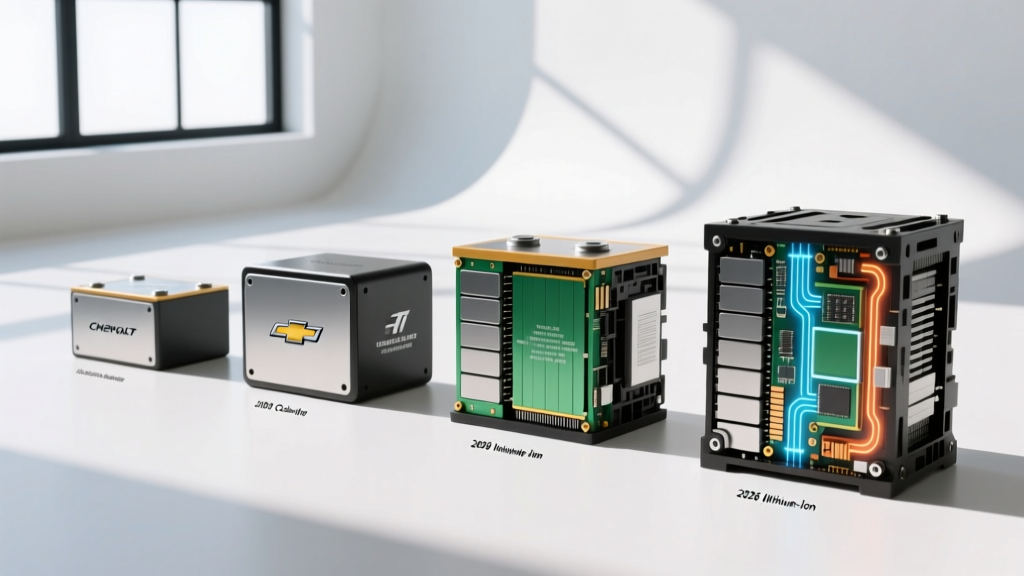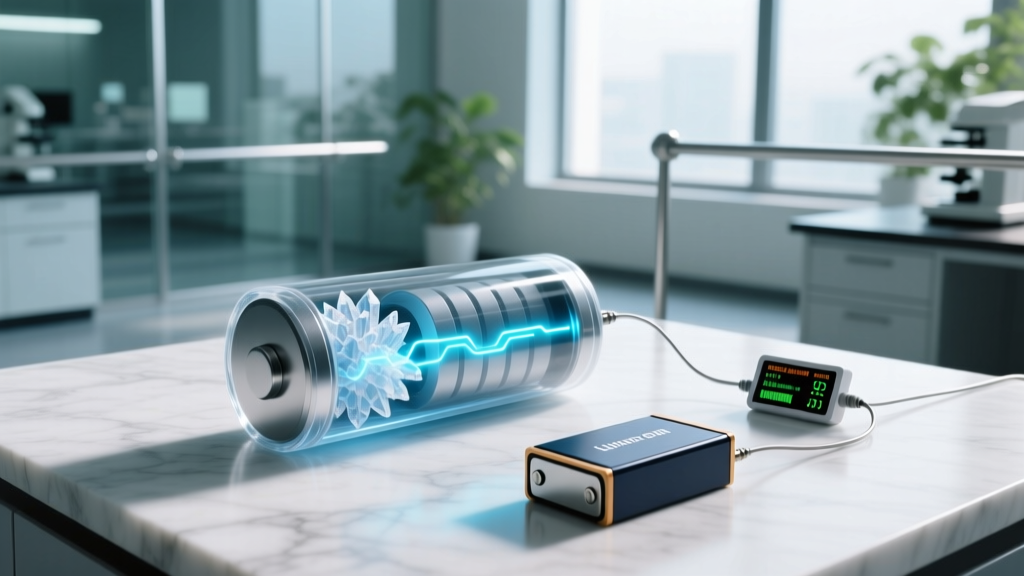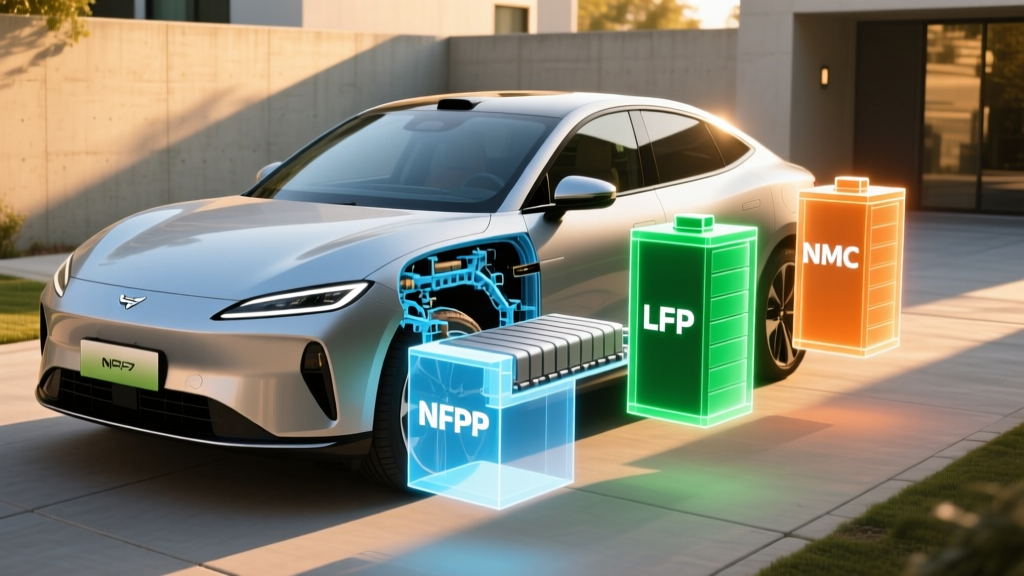
If you've been tracking EV battery headlines in 2025 and 2026, you've likely encountered the term NFPP battery — shorthand for sodium-ion iron phosphate phosphate (NaFePO₄) cathode technology. It's the latest chemistry to challenge the dominance of lithium-ion NMC and LFP cells, and automakers like BYD, CATL, and JAC have begun deploying it in select markets. But what does NFPP actually mean for range, longevity, and your wallet?
This guide unpacks NFPP chemistry in the context of the LFP and NMC batteries that power nearly every EV on US roads today. We'll cover real degradation data, warranty structures, replacement costs, and the care habits that determine whether your pack lasts 100,000 miles or 250,000.
What Is an NFPP Battery?
NFPP stands for sodium-ion iron-based polyanion phosphate cathode chemistry. Instead of lithium, the cell shuttles sodium ions between the cathode and anode during charge and discharge cycles. The cathode material — typically a sodium iron phosphate compound — gives the chemistry its name.
The appeal is straightforward: sodium is roughly 1,000 times more abundant in the Earth's crust than lithium, and it doesn't require the same mining supply chains concentrated in Australia, Chile, and China. For automakers racing to cut battery costs below $80/kWh at the cell level, sodium-ion chemistries offer a credible path.
However, NFPP cells currently trail LFP in energy density. As of early 2026, production NFPP cells from CATL and HiNa Battery deliver approximately 140–160 Wh/kg at the cell level, compared to LFP at 160–180 Wh/kg and NMC811 at 250–300 Wh/kg. That gap translates to roughly 10–20% less range for the same pack weight — a meaningful trade-off for long-range sedans, but less consequential for city EVs and compact crossovers where total pack size stays under 60 kWh.
| Attribute | NFPP (Sodium-Ion) | LFP (LiFePO₄) | NMC811 / NCA |
|---|---|---|---|
| Energy Density (Wh/kg) | 140–160 | 160–180 | 250–300 |
| Cycle Life (to 80% SoH) | 3,000–5,000 | 3,000–6,000 | 1,000–2,000 |
| Cold Performance (−20°C capacity retention) | ~88–90% | ~70–80% | ~75–85% |
| Thermal Runaway Risk | Very Low | Very Low | Moderate (requires BMS management) |
| Cell Cost (est. $/kWh, 2026) | ~$60–75 | ~$75–90 | ~$100–130 |
| Critical Mineral Dependency | None (sodium, iron) | Lithium, iron | Lithium, nickel, cobalt, manganese |
| Current US Availability | Not yet in US-market EVs | Tesla Model 3/Y RWD, Ford Mustang Mach-E SR, Rivian R1S/R1T Standard | Most long-range/AWD EVs |
The standout advantage for NFPP is cold-weather performance. Sodium-ion cells retain roughly 88–90% of their capacity at −20°C, significantly outperforming LFP's well-documented winter struggles. For EV owners in Minnesota, Maine, or Montana, that's a practical benefit that shows up as 20–40 extra miles of real-world winter range versus an equivalently sized LFP pack.
LFP vs NMC vs NFPP: Which Chemistry Is Right for You?
The honest answer depends on your driving pattern, climate, and budget. Here's the decision framework I use when advising buyers:
Choose NMC/NCA if: You need maximum range (300+ miles EPA) in a single charge, frequently road-trip, or want the lightest pack for performance handling. Examples: Tesla Model 3 Long Range (75 kWh NMC, 341 mi EPA), Hyundai Ioniq 5 Long Range AWD (77.4 kWh, 290 mi EPA).
Choose LFP if: You charge at home nightly, prioritize cycle longevity (the pack will likely outlast the car), and don't need 300+ miles. You can charge to 100% daily without accelerated degradation. Examples: Tesla Model 3 RWD (57.5 kWh LFP, 272 mi EPA), Ford Mustang Mach-E Select SR (70 kWh LFP, 250 mi EPA).
Wait for NFPP if: You live in a sub-freezing climate, want LFP-like longevity with better winter range, and are buying a compact or city EV where the energy-density penalty is manageable. As of 2026, no NFPP-equipped EVs are sold in the US market — availability is limited to Chinese-market models like the JAC Sehol E10X and select BYD prototypes.
How Long Do EV Batteries Actually Last?
The fear that EV batteries need replacement at 100,000 miles is not supported by fleet data. According to Recurrent Auto's 2025 analysis of over 15,000 vehicles, the average EV battery retains approximately 90–95% of its original capacity after 5 years / 75,000 miles, and roughly 83–90% after 8 years / 120,000 miles.
Degradation is not linear. Most packs experience a steeper drop in the first 1–2 years (roughly 3–5%), then settle into a slow, predictable decline of about 1–2% per year. Here's what that looks like across chemistries:
| Timeframe | NMC811 Avg SoH | LFP Avg SoH | NFPP (Projected) |
|---|---|---|---|
| Year 1 / 15,000 mi | 95–97% | 96–98% | 97–99% |
| Year 3 / 45,000 mi | 91–94% | 93–96% | 94–97% |
| Year 5 / 75,000 mi | 87–92% | 90–95% | 92–96% |
| Year 8 / 120,000 mi | 82–88% | 86–92% | 88–94% |
| Year 10 / 150,000 mi | 78–85% | 83–90% | 85–92% |
Note: NFPP figures are projected based on published cycle-life test data from CATL and HiNa Battery (2024–2025). Real-world fleet data is not yet available at scale. NMC and LFP figures sourced from Recurrent Auto and Geotab fleet studies.
For context, an NMC pack starting at 75 kWh usable would hold roughly 63–66 kWh at year 8. On a Tesla Model 3 Long Range, that translates to dropping from 341 EPA miles to approximately 285–300 real-world miles — noticeable but far from catastrophic.
What Does the Battery Warranty Actually Cover?
Federal law mandates a minimum 8-year / 100,000-mile battery warranty for all EVs sold in the US (10 years / 150,000 miles for California Air Resources Board states). But the details matter enormously, because the threshold at which a manufacturer must replace or repair the pack varies.
| Manufacturer | Warranty Term | Capacity Threshold | Chemistry Covered |
|---|---|---|---|
| Tesla (Model 3/Y RWD) | 8 yr / 120,000 mi | 70% retention | LFP |
| Tesla (Model 3/Y LR & Performance) | 8 yr / 120,000 mi | 70% retention | NMC/NCA |
| Hyundai / Kia | 10 yr / 100,000 mi | 70% retention | NMC |
| Ford (Mach-E, F-150 Lightning) | 8 yr / 100,000 mi | 70% retention | NMC / LFP |
| GM (Ultium platform) | 8 yr / 100,000 mi | 70% retention | NMC |
| Rivian | 8 yr / 175,000 mi | 70% retention | NMC / LFP |
| BMW | 8 yr / 100,000 mi | 70% retention | NMC |
The 70% threshold is industry standard, but it means a battery at 71% State of Health — which has lost nearly a third of its original capacity — is not considered a warranty claim. In practice, very few packs fall below 70% within the warranty period under normal use. Tesla's 2024 Impact Report showed that Model 3/Y batteries retained an average of 85% capacity at 150,000 miles.
How Much Does It Cost to Replace an EV Battery?
This is the question that generates the most anxiety — and the most misinformation. Let's ground it in real numbers.
| Vehicle | Pack Size (kWh) | Chemistry | Replacement Cost (Parts + Labor) | Typical Replacement Trigger |
|---|---|---|---|---|
| Tesla Model 3 RWD | 57.5 | LFP | $12,000–$16,000 | Rare before 200,000+ mi |
| Tesla Model Y Long Range | 75 | NMC | $14,000–$20,000 | Rare before 200,000+ mi |
| Hyundai Ioniq 5 | 77.4 | NMC | $14,000–$18,000 | Rare before 180,000+ mi |
| Ford F-150 Lightning Ext. | 131 | NMC | $22,000–$30,000 | Rare before 150,000+ mi |
| Chevrolet Bolt EV/EUV | 65 | NMC | $9,000–$14,000 | Post-recall, improved packs |
| Nissan Leaf (62 kWh) | 62 | NMC (passive air-cooled) | $8,000–$12,000 | 100,000–150,000 mi (earlier due to thermal mgmt) |
Several points of context matter here. First, most EV batteries outlive the vehicles they're installed in. The average age of a scrapped car in the US is roughly 15 years; fleet data shows the vast majority of liquid-cooled EV packs retain 75%+ capacity at that age. Second, replacement costs have dropped roughly 40% since 2020 as cell prices have fallen and third-party repair shops have begun offering module-level replacements (swapping only the degraded modules rather than the entire pack) for $4,000–$8,000.
The outlier is the Nissan Leaf with passive air cooling — its lack of active thermal management accelerates degradation in hot climates, making it one of the few EVs where mid-life battery replacement is a realistic budget item.
Factors That Actually Kill Your Battery (and How to Avoid Them)
Battery degradation is driven by three primary stressors: heat, high state of charge, and high charge/discharge rates. Here's how each one works and what you can practically do about it.
- Avoid sustained 100% SoC. Lithium-ion cells degrade fastest at the top and bottom of their charge range. For NMC/NCA packs, set your daily charge limit to 80–90%. LFP packs are more tolerant of 100% — Tesla and Ford explicitly recommend periodic 100% charges for LFP to recalibrate the BMS.
- Minimize DC fast charging when possible. Repeated 150+ kW charging sessions generate significant heat inside the cells. A 2024 Geotab study found that vehicles fast-charging more than 3 times per week showed approximately 2–3% additional degradation over 4 years versus those primarily using Level 2. Occasional road-trip fast charging is fine — it's the daily habit that adds up.
- Precondition before fast charging. Most modern EVs (Tesla, Hyundai E-GMP, GM Ultium, Ford) automatically warm the battery when you navigate to a DC fast charger. This brings cells to the optimal 30–40°C window, enabling faster charging and reducing lithium plating risk. If your EV doesn't auto-precondition, manually activate it 15–20 minutes before arrival.
- Don't leave the car at low SoC in extreme heat. A battery sitting at 10% SoC in a 105°F Phoenix parking lot for a week undergoes more stress than one sitting at 50% in mild weather. If you're traveling and leaving the car, aim for 40–60% SoC.
- Use Level 2 home charging as your daily driver. A 7–11 kW Level 2 charger adds 25–44 miles per hour of charging and generates minimal thermal stress. This is the sweet spot for battery longevity.
How to Check Your Battery's State of Health (SoH)
Most EVs don't display a simple "battery health percentage" the way a MacBook does. Here's how to monitor SoH across major platforms:
Tesla: No native SoH readout in the vehicle UI. Use third-party apps like TeslaFi or Stats that log energy consumption and calculate SoH from actual kWh delivered versus the original pack capacity. Alternatively, a Tesla Service Center can run a battery health test on request.
Hyundai / Kia: The dealer diagnostic tool (KDS/GDS) provides an SoH percentage. Some owners access it via OBD-II dongles paired with apps like Car Scanner or ABRP.
GM (Ultium): The myChevrolet/myCadillac app includes a battery health indicator. Dealer diagnostics provide a more granular readout.
Nissan Leaf: The dashboard displays "capacity bars" out of 12. A 12-bar Leaf is near original capacity; 11 bars indicates roughly 85–90% SoH; 10 bars or fewer suggests 75–85%.
Ford: The FordPass app shows estimated range based on current battery health. For a precise SoH figure, request a diagnostic at a Ford EV-certified dealer.
A good rule of thumb: if your real-world range has dropped more than 15% from what you experienced when new (controlling for weather and driving style), it's worth scheduling a dealer diagnostic to check for individual module imbalance or a cooling-system issue.
What's Next: Solid-State, Silicon Anodes, and NFPP's Path to the US
NFPP is one piece of a broader battery-technology wave expected to reach production vehicles between 2027 and 2030. Here's where the major emerging chemistries stand:
Solid-state batteries (Toyota, Samsung SDI, QuantumScape): These replace the liquid electrolyte with a solid ceramic or polymer layer, enabling the use of lithium-metal anodes for energy densities above 400 Wh/kg. Toyota has announced a solid-state battery for a 2027–2028 production EV with a claimed 750 km (466 mi) range and 10-minute fast charging. However, manufacturing yield and cost remain unsolved at scale. Realistic US-market availability: 2029 at the earliest, likely in premium models first.
Silicon-dominant anodes (Sila Nanotechnologies, Group14): Replacing graphite anodes with silicon can boost energy density by 20–40%. Sila's silicon anode material is in production for the Mercedes G-Class electric (2025) and is expected to reach mainstream EVs by 2027–2028. This is an incremental improvement to existing NMC cells, not a replacement chemistry.
NFPP / sodium-ion expansion: CATL's second-generation sodium-ion cells, announced in 2025, target 180 Wh/kg — closing the gap with LFP. If these cells reach cost parity and pass US crash/safety certification, we could see sodium-ion packs in US-market compact EVs or as the standard-range option in larger vehicles by 2028–2029. The IRS §30D tax credit's critical-mineral sourcing rules could actually favor sodium-ion chemistry, since sodium doesn't fall under the same foreign-entity-of-concern (FEOC) restrictions that complicate lithium and graphite supply chains.
None of these technologies are available in a US-market EV you can buy today. But they signal that the battery landscape in 2030 will look materially different — and more diverse — than the NMC/LFP duopoly of 2026.
Frequently Asked Questions
How long do EV batteries last in years and miles?
Most liquid-cooled EV batteries retain 80–90% of their original capacity at 150,000 miles and 10 years of age. Fleet data from Recurrent Auto and Geotab shows that packs from Tesla, Hyundai, GM, and BMW rarely require replacement before 200,000 miles under normal use. The Nissan Leaf (passive air cooling) is a notable exception, with measurable degradation often appearing by 100,000–120,000 miles in warm climates.
How much does an EV battery cost to replace in 2026?
Full pack replacements range from approximately $8,000 for a 62 kWh Nissan Leaf pack to $22,000–$30,000 for a 131 kWh Ford F-150 Lightning Extended Range pack. However, module-level repairs — replacing only the degraded segments — are increasingly available from independent EV shops for $4,000–$8,000. Most owners will never need either: the battery typically outlasts the vehicle.
What does the EV battery warranty cover?
All US-market EVs carry a minimum 8-year / 100,000-mile battery warranty (10 years / 150,000 miles in CARB states). The warranty guarantees that the battery will retain at least 70% of its original capacity. If degradation falls below that threshold within the warranty period, the manufacturer will repair or replace the pack at no cost. Damage from accidents, flooding, or unauthorized modifications is excluded.
How do I check and maximize my EV battery's health?
Monitor SoH through your vehicle's app (FordPass, myChevrolet), third-party telematics apps (TeslaFi, Car Scanner via OBD-II), or dealer diagnostics. To maximize longevity: charge to 80% daily for NMC packs (100% is fine for LFP), use Level 2 home charging as your primary method, precondition before DC fast charging, and avoid leaving the vehicle at very low or very high SoC in extreme temperatures.
LFP vs NMC — which battery chemistry is better?
Neither is universally better; they serve different needs. NMC offers higher energy density (250–300 Wh/kg vs. 160–180 Wh/kg), making it the right choice for long-range and performance EVs. LFP delivers superior cycle life (3,000–6,000 cycles vs. 1,000–2,000), can be charged to 100% daily without harm, and costs less per kWh — making it ideal for daily commuters who charge at home. If you road-trip frequently and need 300+ miles, choose NMC. If you commute 30–50 miles daily and want a pack that will likely outlast the car, choose LFP.
Will NFPP sodium-ion batteries be available in US EVs?
Not in 2026. NFPP/sodium-ion EVs are currently limited to the Chinese market (JAC, BYD, Chery). CATL's second-generation sodium cells targeting 180 Wh/kg could enable US-market introduction by 2028–2029, likely in affordable compact models or as a standard-range battery option. The lack of lithium or cobalt in the chemistry may simplify compliance with IRS §30D critical-mineral sourcing requirements, potentially giving NFPP a regulatory tailwind.