The high-voltage traction battery is the single most expensive component in any electric vehicle, and its chemistry dictates everything from real-world range to how the car handles a Minnesota winter. If you are shopping for an EV today or trying to maximize the lifespan of one you already own, understanding what is inside the pack matters more than the badge on the hood.
This guide breaks down the newest battery technology available in production EVs, compares the two dominant lithium-ion chemistries shipping in 2026 model-year vehicles, and separates marketing promises from engineering reality on emerging tech like solid-state cells. Every degradation figure and cost estimate below is grounded in fleet data, manufacturer disclosures, or third-party testing.
The Two Chemistries Dominating 2026 EVs
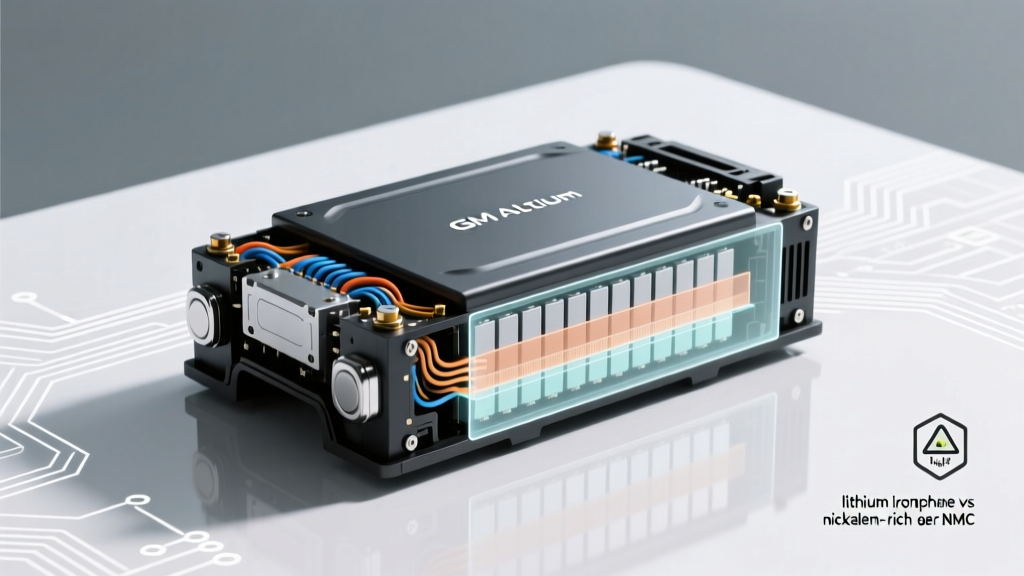
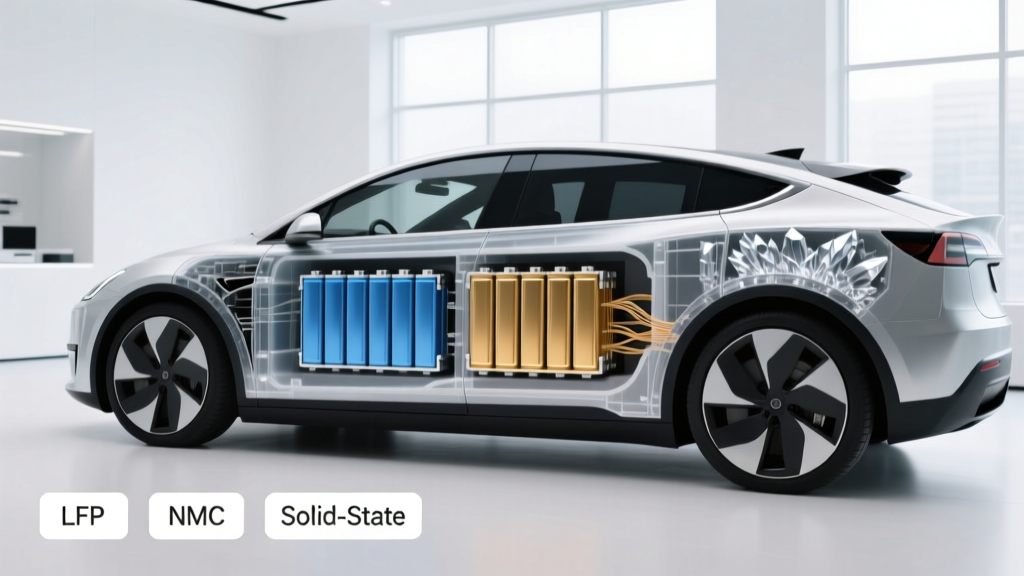
Every mainstream battery-electric vehicle sold in the United States today uses one of two cathode chemistries: lithium iron phosphate (LFP) or nickel manganese cobalt (NMC), with some manufacturers using nickel cobalt aluminum (NCA) variants. The chemistry choice affects energy density, cycle life, cold-weather performance, thermal stability, and ultimately the price you pay at the dealership.
| Attribute | LFP (Lithium Iron Phosphate) | NMC / NCA (Nickel-Based) |
|---|---|---|
| Energy Density (cell-level) | ~160–180 Wh/kg | ~230–280 Wh/kg |
| Typical Cycle Life | 3,000–5,000+ cycles to 80% SoH | 1,500–2,500 cycles to 80% SoH |
| Cold-Weather Performance | More range loss below 32°F; slower charge acceptance | Better low-temp conductivity; less range penalty |
| Thermal Stability | Excellent — higher runaway threshold (~270°C) | Good — but lower thermal runaway margin (~210°C) |
| Cost per kWh (pack-level) | ~$90–$110 | ~$120–$150 |
| Cobalt Content | None | Varies; trending toward low-cobalt formulations |
| Recommended Daily SoC | 100% is acceptable | 80% for daily use; 100% for trips only |
| Common 2026 Applications | Tesla Model 3/Y RWD, Ford Mustang Mach-E Select, Chevrolet Equinox EV | Hyundai Ioniq 5/6, Tesla Long Range, Rivian R1T/R1S, BMW iX |
The practical takeaway: LFP packs are heavier for a given capacity, which limits their use in long-range or performance trims where every kilogram counts. But LFP's superior cycle life and tolerance for daily 100% charging make it an excellent match for standard-range models and high-mileage drivers. NMC/NCA packs deliver more miles per pound and charge more readily in freezing weather, justifying the cost premium in long-range and AWD configurations.
How Long Do EV Batteries Actually Last?
The short answer, backed by fleet data across hundreds of thousands of vehicles: most modern EV traction batteries will outlast the useful economic life of the car they are installed in. "Outlast" here means retaining at least 70–80% of original capacity after 150,000–200,000 miles.
Typical Degradation Curve — Real-World Fleet Data
Aggregated data from sources including Recurrent Auto's fleet analysis of over 15,000 EVs shows the following average capacity retention trajectory:
- Year 1 / 15,000 mi: ~95–97% State of Health (SoH) — initial settling
- Year 3 / 45,000 mi: ~91–94% SoH — gradual linear decline
- Year 5 / 75,000 mi: ~88–92% SoH
- Year 8 / 120,000 mi: ~84–89% SoH
- Year 10 / 150,000 mi: ~80–86% SoH (NMC); ~85–92% SoH (LFP)
Key observation: degradation is not linear. The steepest loss occurs in the first 12–18 months (calendar aging and SEI layer formation), then the curve flattens significantly. A battery that has lost 5% in year one may lose only 1–2% per year thereafter.
LFP chemistries consistently show slower degradation in high-cycle-use scenarios — taxi fleets, daily commuters covering 60+ miles, and vehicles charged to 100% regularly. Tesla's 2025 Impact Report noted that Model 3/Y LFP packs retained an average of 88% capacity at 200,000 miles, compared to approximately 85% for NMC Long Range packs at the same mileage.
What Does the Battery Warranty Actually Cover?
Federal law in the United States mandates that EV manufacturers warrant the high-voltage battery for a minimum of 8 years or 100,000 miles (whichever comes first). California Air Resources Board (CARB) states extend this to 10 years or 150,000 miles. Most manufacturers meet or exceed the federal floor.
| Manufacturer | Warranty Period | Mileage Cap | Capacity Threshold | Chemistry Notes |
|---|---|---|---|---|
| Tesla (Model 3/Y RWD — LFP) | 8 years | 100,000 mi | 70% retention | LFP; covers defects + excessive degradation |
| Tesla (Long Range/Performance) | 8 years | 120,000 mi | 70% retention | NMC/NCA |
| Hyundai / Kia (E-GMP) | 10 years | 100,000 mi | 70% retention | NMC; industry-leading term |
| Ford (Mach-E, F-150 Lightning) | 8 years | 100,000 mi | 70% retention | LFP (Select) / NMC (Extended Range) |
| GM (Ultium platform) | 8 years | 100,000 mi | 70% retention (60% on some commercial) | NMC |
| Rivian (R1T/R1S) | 8 years | 175,000 mi | 70% retention | NMC; highest mileage cap in segment |
| BMW (iX, i4) | 8 years | 100,000 mi | 70% retention | NMC |
The critical detail is the capacity retention threshold. Most warranties guarantee the battery will retain at least 70% of its original usable capacity during the warranty period. If your 82 kWh pack drops below 57.4 kWh of usable energy (as measured by the BMS or a dealer diagnostic), you are entitled to a repair, module replacement, or full pack replacement at no cost. Some manufacturers replace only the degraded modules rather than the entire pack — this is normal and does not compromise safety or function.
Warranties cover defects in materials and workmanship plus excessive degradation. They do not cover damage from collisions, flooding, improper modifications, or use of the battery as a stationary storage device (unless V2H/V2G use is explicitly approved by the manufacturer).
EV Battery Replacement Cost: What Owners Actually Pay
Battery replacement outside of warranty is the scenario that generates the most anxiety — and the most misleading headlines. Here is what the data shows for 2026:
| Vehicle / Pack Size | Battery Capacity | Chemistry | Estimated Replacement Cost | Notes |
|---|---|---|---|---|
| Tesla Model 3 RWD | 60 kWh | LFP | $8,000–$12,000 | Module-level repair often $3,000–$5,000 |
| Tesla Model Y Long Range | 82 kWh | NMC | $12,000–$16,000 | Full pack; module repair ~$5,000–$8,000 |
| Hyundai Ioniq 5 | 77.4 kWh | NMC | $11,000–$15,000 | E-GMP modular pack; individual modules ~$1,500–$2,500 |
| Ford F-150 Lightning Ext. Range | 131 kWh | NMC | $18,000–$28,000 | Largest consumer pack; labor-intensive removal |
| Chevrolet Equinox EV | 85 kWh | NMC (Ultium) | $12,000–$16,000 | Ultium modular architecture allows partial replacement |
| Rivian R1T (Large Pack) | 128.9 kWh | NMC | $20,000–$27,000 | Complex pack; mostly dealer-only service |
Context that matters: according to fueleconomy.gov data and long-term ownership surveys, fewer than 2% of EVs have required a traction battery replacement within the first 10 years of service. The vast majority of replacements are covered under warranty. When they are not, module-level repair (replacing only the degraded cell groups) is increasingly available at a fraction of full-pack cost.
Pack costs have fallen from over $1,000/kWh in 2010 to approximately $100–$140/kWh at the cell level in 2026, according to BloombergNEF battery price surveys. Installed costs (including labor, coolant, diagnostics, and markup) typically run 1.5–2x the cell cost. As packs age out of warranty in larger numbers through the late 2020s, aftermarket and refurbished packs are expected to create a more competitive repair market.
Factors That Accelerate or Slow Battery Degradation
Battery longevity is not purely a function of mileage. Calendar age, temperature exposure, charging habits, and charge rate all influence the rate at which lithium-ion cells lose capacity. Here is the hierarchy of impact, based on peer-reviewed battery aging studies and fleet telemetry:
Battery Care Checklist — Maximize State of Health
- Avoid sustained high State of Charge (NMC only): For NMC/NCA packs, daily charging to 80% rather than 100% can reduce capacity loss by 30–40% over 5 years. LFP packs should be charged to 100% at least weekly for BMS calibration.
- Minimize DC fast charging frequency: Occasional road-trip fast charging is fine. Daily use of 150+ kW DC charging can add 1–3% additional degradation per year versus Level 2 home charging, primarily due to heat generation at high C-rates.
- Precondition before fast charging: Most modern EVs automatically precondition the battery when a DC fast charger is set as the navigation destination. This brings the pack to optimal temperature (~30–35°C), enabling faster charging and reducing lithium plating risk. Always use the car's built-in nav routing to chargers.
- Limit extreme heat exposure: Parking in direct sun in Phoenix or Las Vegas with a high SoC accelerates calendar aging. A shaded garage or thermal preconditioning while plugged in reduces this. Battery thermal management systems work harder (and consume energy) when parked hot.
- Don't baby it excessively: Storing an NMC pack at 50% SoC for months is fine for long-term parking, but daily driving should not be constrained by degradation anxiety. Modern BMS systems include top and bottom buffers (typically 3–5% of gross capacity) that protect the cells even when the display reads 0% or 100%.
- Use Level 2 for daily charging: A home Level 2 charger (7–11.5 kW) is the ideal daily charging method. It generates minimal heat, is convenient, and costs 50–70% less per mile than public DC fast charging.
How to Monitor Your Battery's State of Health
State of Health (SoH) is a percentage representing your battery's current maximum capacity relative to its original capacity when new. A new battery is 100% SoH; a battery that can now hold only 70 kWh of its original 80 kWh is at 87.5% SoH.
Most 2026 model-year EVs surface SoH data through the infotainment system or companion app, though the depth of information varies:
- Tesla: The in-car service menu (accessible via the software screen) displays a degradation graph showing range vs. odometer over time. Third-party apps like Tessie or TeslaFi pull SoH estimates from the vehicle's API.
- Hyundai/Kia: The EV-specific menu in the infotainment system shows a battery health indicator. Dealer diagnostics (via the KDS tool) provide a more granular SoH percentage on request.
- Ford: The FordPass app displays estimated battery health. A full diagnostic report is available at any Ford EV-certified dealer.
- GM (Ultium): The myChevrolet/myCadillac app includes a battery health indicator. OnStar diagnostics can generate a detailed report.
- OBD-II tools: Devices like the OBDLink SX paired with apps such as ABRP (A Better Route Planner) or Car Scanner can read BMS-reported SoH, cell voltage variance, and pack temperature on most EVs. This is the most transparent method for DIY-oriented owners.
When buying a used EV, always request a battery health report from the selling dealer or run an OBD-II diagnostic. A SoH below 85% on a vehicle with under 80,000 miles may indicate a warranty claim is warranted. According to IIHS and industry resale data, battery SoH is increasingly a factor in used-EV valuations, with high-SoH examples commanding a 5–10% premium.
The Newest Battery Technology on the Horizon
Production EV batteries in 2026 are mature, reliable, and cost-competitive — but the pipeline of next-generation technology is active. Here is a realistic assessment of what is coming and when, based on manufacturer roadmaps and pilot production timelines:
Solid-State Batteries
Solid-state cells replace the liquid electrolyte in conventional lithium-ion batteries with a solid conductor (ceramic, sulfide, or polymer). The theoretical benefits are substantial: 40–50% higher energy density, faster charging (potentially 10–80% in under 10 minutes), and improved safety due to the elimination of flammable liquid electrolyte.
Reality check: Toyota has announced a solid-state battery for a limited-production EV expected in 2027–2028, with initial volumes under 10,000 units. Samsung SDI has begun sample production of sulfide-based solid-state cells for automotive customers. Nissan and Honda have pilot lines running. However, manufacturing yield, cost (currently estimated at 3–5x conventional lithium-ion per kWh), and durability under thousands of charge cycles remain unsolved at scale. Widespread solid-state availability in mainstream EVs is not expected before 2030–2032.
Silicon-Dominant Anodes
Replacing graphite anodes with silicon can increase cell energy density by 20–40%. Silicon expands significantly during charging (up to 300% volume change), which has historically caused rapid degradation. Companies including Sila Nanotechnologies, Group14, and Enovix are shipping silicon-composite anode materials to battery manufacturers in increasing volumes.
GM's Ultium platform already uses a small percentage of silicon in its anode formulation. Expect silicon-dominant anodes to appear in premium EV cells by 2027–2028, with gradual trickle-down to mainstream packs through the early 2030s.
Sodium-Ion Batteries
Sodium-ion cells use abundant, inexpensive sodium instead of lithium. Energy density is lower (~120–160 Wh/kg), making them suitable for urban EVs with shorter range requirements. CATL has begun mass production of sodium-ion packs for the Chinese market. U.S. availability in production vehicles is not expected before 2028 at the earliest, and likely limited to entry-level city-car segments where cost matters more than range.
Lithium Iron Manganese Phosphate (LMFP)
Adding manganese to the LFP cathode boosts energy density by 15–20% while retaining LFP's cost and safety advantages. CATL and BYD are shipping LMFP cells in Chinese-market vehicles. U.S.-market EVs with LMFP packs are expected by 2027, likely in standard-range trims where the energy density improvement translates to meaningful additional range without a cost penalty.
LFP vs NMC: Which Should You Choose?
There is no universally "better" chemistry — only the chemistry that better fits your driving pattern, climate, and budget.
Decision Framework
Choose LFP if:
- You drive a standard-range model and do not need 300+ miles of EPA range
- You charge at home daily and want the convenience of setting charge limit to 100%
- You plan to keep the vehicle 8+ years or put on high annual mileage (20,000+ mi/yr)
- You live in a moderate climate (rarely below 20°F)
- Lower purchase price is a priority
Choose NMC/NCA if:
- You need maximum range (300–400+ miles EPA) for road trips or long commutes
- You regularly drive in cold climates (below 32°F for extended periods)
- You want the fastest DC charging speeds (NMC cells generally sustain higher charge rates at low SoC)
- You are buying a performance or AWD trim where energy density affects weight distribution
- You are comfortable managing SoC (charging to 80% daily, 100% only for trips)
Frequently Asked Questions
How long do EV batteries last in years and miles?
Based on fleet data from Recurrent Auto and manufacturer reports, the average EV battery retains 80–90% of its original capacity at 150,000 miles or 10 years. Many packs exceed 200,000 miles before dropping below the 70% warranty threshold. LFP chemistries tend to outlast NMC in high-cycle scenarios. Complete failure (the battery ceasing to function) is exceedingly rare — degradation is gradual, not catastrophic.
How much does an EV battery cost to replace?
Full pack replacement costs range from approximately $8,000 for a 60 kWh LFP pack (Tesla Model 3 RWD) to $28,000 for a 131 kWh NMC pack (F-150 Lightning Extended Range). Module-level repairs, where only the degraded cell groups are replaced, typically cost $3,000–$8,000. Fewer than 2% of EVs have required any battery replacement in the first decade of ownership, and the vast majority of those are covered under the 8-year/100,000-mile federal warranty minimum.
What does the EV battery warranty cover?
The federal minimum is 8 years or 100,000 miles (10 years/150,000 miles in CARB states). Coverage includes defects in materials and workmanship plus capacity loss below a specified threshold — typically 70% of original usable capacity. The warranty does not cover collision damage, flood damage, or degradation caused by unauthorized modifications. Check your specific owner's manual for exact terms, as they vary by manufacturer and model year.
How do I check my EV battery health?
Most 2026 EVs display a battery health indicator in the infotainment system or companion mobile app. For more detailed data (exact SoH percentage, individual cell voltage variance, pack temperature history), an OBD-II adapter paired with an app like Car Scanner or Tessie provides real-time BMS data. You can also request a formal battery health report from any authorized dealer during routine service.
Is LFP or NMC better for daily driving?
For daily commuting with home charging, LFP has a practical edge: you can charge to 100% every night without degradation concerns, cycle life is longer, and the chemistry is more thermally stable. NMC is better when you need maximum range, cold-weather performance, or the fastest DC charging. Neither chemistry is fragile — both will comfortably outlast 150,000 miles with normal use.
Does fast charging damage my EV battery?
Occasional DC fast charging (road trips, a few times per month) has a negligible impact on battery life. Daily exclusive use of 150+ kW DC fast charging can add approximately 1–3% additional annual degradation compared to Level 2 charging, primarily due to heat generation. Modern battery management systems actively limit charge rate when the pack is cold or near full to protect the cells. Preconditioning (navigating to the charger via the car's built-in system) mitigates most of the thermal stress.
Understanding battery technology is the single highest-leverage piece of knowledge an EV buyer or owner can have. The chemistry inside your pack determines your real-world range, your charging routine, your long-term costs, and ultimately how your car performs on a 20°F January morning. The newest battery technology in 2026 — refined LFP, high-nickel NMC, and modular pack architectures — has made EV batteries more durable and affordable than at any point in the industry's history. Solid-state and silicon anodes will push those boundaries further, but today's production cells are already engineered to outlast the car around them.