If you have shopped for an electric vehicle in the last year, you have likely noticed the spec sheets look different than they did even three years ago. Automakers are no longer defaulting to a single lithium-ion chemistry. Instead, they are offering a menu of options: lithium iron phosphate (LFP) packs in base trims, nickel manganese cobalt (NMC) cells in long-range models, and a wave of announced next-generation technologies promising even more. For buyers, this raises a practical question: which new type of battery actually matters for your daily driving, your wallet, and your long-term ownership experience?
This guide breaks down every battery chemistry currently in production for US-market EVs, the degradation data behind them, what warranties actually cover, and which emerging technologies are worth watching versus which are still years away from your driveway.
LFP vs. NMC vs. NCA: The Chemistry Breakdown That Matters Now
The two dominant chemistries in 2026 EV battery packs are LFP (lithium iron phosphate) and NMC (nickel manganese cobalt), with NCA (nickel cobalt aluminum) appearing primarily in Tesla and select Panasonic-supplied packs. Each has distinct engineering trade-offs that affect range, longevity, cold-weather performance, and price.
LFP cells use iron and phosphate in the cathode. They are cheaper to produce because they avoid expensive nickel and cobalt. They tolerate repeated charging to 100% state of charge (SoC) without significant degradation, and they offer longer cycle life — often exceeding 3,000 full cycles before reaching 80% capacity retention. The trade-off is lower energy density, meaning a heavier or physically larger pack for the same range. LFP also performs noticeably worse in freezing temperatures, with range losses that can exceed 30% in sub-20°F conditions compared to roughly 20-25% for NMC.
NMC cells deliver higher energy density, which translates to more range in a lighter, more compact pack. This is why long-range and performance trims almost universally use NMC or NCA chemistry. The trade-off is a shorter cycle life (typically 1,000–2,000 full cycles to 80% retention), higher cost due to nickel and cobalt content, and a recommended daily charge limit of 80% to preserve longevity. NMC handles cold weather somewhat better than LFP but still requires preconditioning for optimal charging in winter.
| Attribute | LFP (Lithium Iron Phosphate) | NMC (Nickel Manganese Cobalt) | NCA (Nickel Cobalt Aluminum) |
|---|---|---|---|
| Energy Density | Lower (~160 Wh/kg cell-level) | Higher (~220-260 Wh/kg) | Highest (~250-290 Wh/kg) |
| Cycle Life (to 80% SoH) | 3,000-5,000+ cycles | 1,000-2,000 cycles | 1,000-1,500 cycles |
| Daily Charge Recommendation | 100% OK daily | 80% daily; 100% for trips | 80% daily; 100% for trips |
| Cold-Weather Range Loss | Higher (30%+ below 20°F) | Moderate (20-25% below 20°F) | Moderate (20-25% below 20°F) |
| Cost (cell-level) | Lower ($80-100/kWh) | Higher ($110-140/kWh) | Higher ($110-140/kWh) |
| Typical Use in 2026 | Base trims, fleet vehicles, standard-range | Long-range, performance, most non-Tesla EVs | Tesla, select Panasonic packs |
| Thermal Stability | Excellent (less prone to thermal runaway) | Good (requires active thermal management) | Good (requires active thermal management) |
The bottom line: neither chemistry is universally "better." LFP wins on cost, longevity, and daily-charging convenience. NMC and NCA win on range-per-pound and cold-weather usability. Your choice should align with how you drive — a commuter who charges at home nightly may benefit more from LFP's durability, while a road-tripper covering 300+ miles in winter needs NMC's density and cold tolerance.
How Long Do EV Batteries Actually Last? Real Degradation Data
Battery degradation is not a cliff — it is a curve. Most EV packs lose capacity rapidly in the first year or two (typically 2-5%), then settle into a slow, linear decline for the remainder of their life. The data from high-mileage fleets and owner-reported telemetry tells a reassuring story.
According to long-term data compiled by Recurrent Auto, which tracks over 15,000 EVs in real-world conditions, the median battery at 100,000 miles retains approximately 90-93% of its original capacity. Tesla's own 2024 Impact Report (the most recent published data) showed that Model 3 and Model Y batteries retain roughly 85% capacity at 200,000 miles. Hyundai and Kia's 10-year/100,000-mile battery warranties reflect similar confidence in long-term durability.
Typical EV Battery Degradation Curve (Fleet-Average Data):
- Year 1 / 15,000 miles: 2-5% capacity loss (initial settling)
- Year 3 / 45,000 miles: 5-8% total loss
- Year 5 / 75,000 miles: 7-10% total loss
- Year 8 / 120,000 miles: 10-14% total loss
- Year 10 / 150,000 miles: 12-17% total loss
Sources: Recurrent Auto fleet data, Tesla Impact Report, manufacturer warranty thresholds. Individual results vary based on climate, charging habits, and chemistry.
It is worth emphasizing that the vast majority of EV batteries outlast the vehicles they are installed in. The average age of a scrapped vehicle in the US is roughly 12 years. An NMC pack losing 1-1.5% per year after the initial settling period will still hold 85-90% of its original capacity at that age. LFP packs, with their superior cycle life, often show even less degradation over the same timeframe.
What Does the Battery Warranty Actually Cover?
Federal law mandates that EV battery warranties cover a minimum of 8 years / 100,000 miles (10 years / 150,000 miles in California Air Resources Board states). But the details of what triggers a warranty claim vary significantly between manufacturers, and understanding the fine print matters.
| Manufacturer | Warranty Term | Capacity Retention Threshold | Notable Details |
|---|---|---|---|
| Tesla (Model 3/Y RWD, LFP) | 8 yr / 120,000 mi | 70% | Standard Range (LFP) gets higher mileage threshold |
| Tesla (Model 3/Y LR, Model S/X) | 8 yr / 120,000 mi | 70% | NMC/NCA Long Range and Performance trims |
| Hyundai / Kia | 10 yr / 100,000 mi | 70% | Among the longest terms; covers Ioniq 5, EV6, EV9 |
| Ford (Mustang Mach-E, F-150 Lightning) | 8 yr / 100,000 mi | 70% | Covers battery and electric drive components |
| GM (Chevrolet Equinox EV, Blazer EV, Silverado EV) | 8 yr / 100,000 mi | 60-70% (varies) | Ultium platform; verify specific model threshold |
| Rivian (R1T, R1S) | 8 yr / 175,000 mi | 70% | Highest mileage threshold among major OEMs |
| BMW (i4, iX, i7) | 8 yr / 100,000 mi | 70% | Includes battery conditioning system coverage |
The critical number is the capacity retention threshold. If your battery's State of Health (SoH) drops below this percentage within the warranty period, the manufacturer must repair or replace it at no cost. A 70% threshold means your 300-mile EPA-rated EV would need to fall below roughly 210 miles of range for a claim to apply — something that, based on current degradation data, is extremely unlikely under normal use.
Keep in mind that warranties typically exclude damage from accidents, flooding, improper modifications, or use of non-approved charging equipment. They also generally do not cover gradual capacity loss above the threshold — if your battery is at 72% after eight years, that is considered normal wear, not a defect.
How Much Does an EV Battery Cost to Replace?
This is the question that generates the most anxiety — and the most misinformation. Let's look at actual numbers.
| Vehicle / Pack Size | Battery Capacity | Chemistry | Estimated Replacement Cost |
|---|---|---|---|
| Tesla Model 3 RWD | ~60 kWh | LFP | $12,000 - $15,000 |
| Tesla Model Y Long Range | ~75 kWh | NMC | $15,000 - $20,000 |
| Hyundai Ioniq 5 | 77.4 kWh | NMC | $16,000 - $22,000 |
| Ford F-150 Lightning Extended Range | 131 kWh | NMC | $25,000 - $33,000 |
| Chevrolet Equinox EV | ~85 kWh | NMC (Ultium) | $16,000 - $21,000 |
| Rivian R1T (Max Pack) | ~149 kWh | NMC | $28,000 - $35,000 |
These figures include the battery pack and labor but can vary based on dealership vs. independent shop pricing, regional labor rates, and whether the pack is replaced as a single unit or serviced module-by-module (some manufacturers now support individual module replacement at a fraction of the full-pack cost).
The important context: most EV owners will never need a battery replacement. The data consistently shows that modern packs outlast the economic life of the vehicle. When replacements do occur, they are overwhelmingly covered under warranty. Out-of-pocket replacements are rare and typically involve high-mileage commercial use, accident damage, or vehicles well past their warranty period.
Five Factors That Actually Affect Battery Lifespan
Not all miles are equal when it comes to battery wear. Research from the National Renewable Energy Laboratory (NREL) and fleet data from companies like Recurrent and Geotab point to five primary factors that accelerate or decelerate degradation.
1. State of Charge Habits
For NMC/NCA packs, routinely charging to 100% and leaving the vehicle parked at full charge stresses the cathode. The sweet spot is 20-80% for daily use, with 100% reserved for road trips. LFP packs are an exception — manufacturers like Tesla and BYD recommend periodic 100% charges to allow the battery management system (BMS) to recalibrate cell balancing.
2. DC Fast-Charging Frequency
Occasional DC fast charging (1-2 times per week) shows negligible impact on modern packs with active thermal management. However, daily reliance on 150+ kW DC fast charging — especially without preconditioning — accelerates degradation by roughly 1-2% additional loss over 100,000 miles compared to primarily Level 2 charging. The heat generated during high-rate charging is the primary culprit.
3. Extreme Temperature Exposure
Prolonged exposure to high ambient temperatures (above 95°F) is more damaging than cold. Batteries parked at 100% SoC in Phoenix summer heat experience measurably faster degradation. Cold temperatures reduce range temporarily but do not cause permanent damage — though attempting to fast-charge a cold battery without preconditioning can cause lithium plating, a form of irreversible capacity loss.
4. Depth of Discharge
Regularly draining the battery to very low SoC (below 10%) before recharging increases stress. Shallow cycles (e.g., charging from 40% to 70%) are gentler than deep cycles (10% to 90%). This is one reason plug-in hybrids, which use smaller batteries in shallow cycles, often show excellent longevity.
5. Calendar Aging
Batteries degrade over time even when not driven. A vehicle parked for months at high SoC in warm conditions will lose capacity to calendar aging. If storing an EV for extended periods, aim for 50% SoC in a cool, shaded location.
How to Check and Monitor Your Battery's State of Health
State of Health (SoH) is the percentage of original capacity your battery currently holds. Monitoring it helps you track degradation trends and catch anomalies early.
Built-in tools: Some manufacturers provide SoH readouts directly in the vehicle's infotainment system or companion app. Hyundai's Bluelink and Kia Connect, for example, display battery health metrics. Tesla does not natively show SoH but provides range estimates that indirectly reflect capacity. BMW's iDrive includes a battery health display in newer models.
OBD-II diagnostics: For vehicles without a built-in SoH display, an OBD-II dongle paired with apps like Scan My Tesla, Leaf Spy (for Nissan Leaf), or ABRP (A Better Routeplanner) can read the BMS data directly. These tools pull real-time cell voltage, pack capacity, and degradation estimates from the vehicle's CAN bus.
Third-party services: Companies like Recurrent offer free battery health reports that compare your pack's degradation to a fleet average for your specific model and climate zone. Some dealerships can also run a full diagnostic and print a SoH certificate — useful if you plan to sell the vehicle.
DIY range test: Charge to 100% (for LFP) or your normal daily limit (for NMC), reset the trip meter, and drive a known route under consistent conditions. Compare your actual miles consumed to the energy used (kWh). Over time, a declining miles-per-kWh figure at consistent temperatures signals degradation.
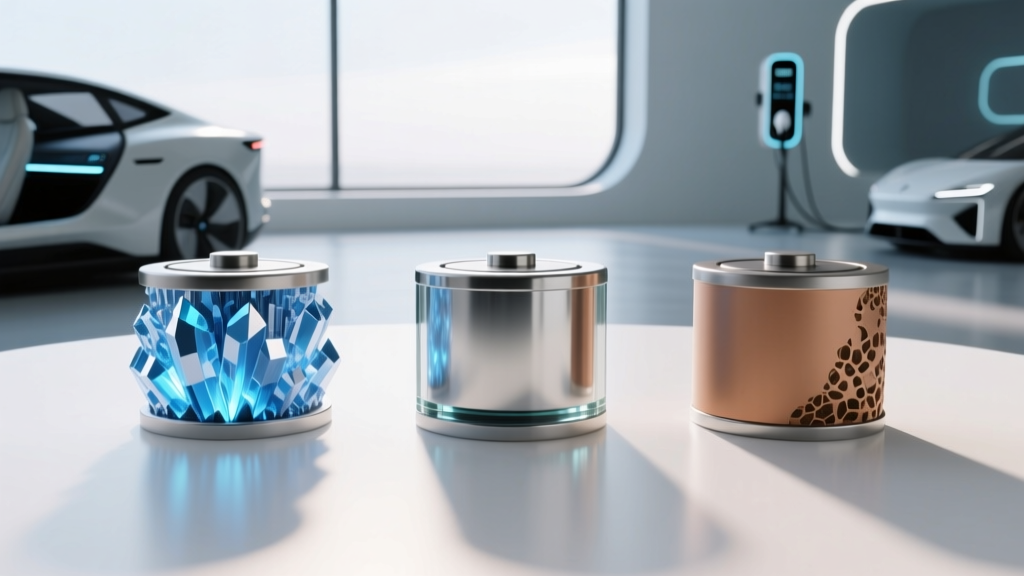
Solid-State, Silicon Anode, and Sodium-Ion: The New Type of Battery on the Horizon
If you follow EV news, you have seen headlines about solid-state batteries, silicon anode cells, and sodium-ion packs promising revolutionary improvements. Here is where each technology actually stands as of 2026 — and when you might see them in a vehicle you can buy.
Solid-state batteries replace the liquid electrolyte in conventional lithium-ion cells with a solid material (ceramic, sulfide, or polymer). The theoretical benefits are substantial: higher energy density (potentially 400+ Wh/kg at the cell level), faster charging, improved safety (no flammable electrolyte), and longer cycle life. Toyota has announced plans to commercialize solid-state cells in limited production by 2027-2028, with initial deployment likely in a luxury Lexus model. Samsung SDI and QuantumScape are also targeting 2027-2028 for automotive-grade production. However, manufacturing yield, cost, and scalability remain significant hurdles. Expect solid-state to appear in low-volume, premium vehicles first, with mainstream availability no earlier than 2030.
Silicon anode technology replaces the graphite anode in lithium-ion cells with silicon, which can store roughly 10 times more lithium ions per unit mass. Companies like Sila Nanotechnologies and Group14 are already supplying silicon-dominant anode materials to battery manufacturers. The 2026 Mercedes-Benz G-Class electric SUV (announced) is expected to feature a silicon anode pack from Factorial Energy, targeting a 25% energy density improvement over conventional NMC. This technology is closer to market than solid-state and may appear in several 2027-2028 model-year vehicles.
Sodium-ion batteries use abundant, inexpensive sodium instead of lithium. They offer lower energy density than LFP but cost significantly less and perform well in cold temperatures. CATL has begun volume production of sodium-ion cells in China, with initial applications in small city cars and energy storage. US-market availability is unlikely before 2028-2029, and initial use will probably be limited to entry-level EVs and fleet vehicles where cost matters more than range.
What this means for buyers today: None of these technologies are available in a vehicle you can purchase in the US right now. If you need an EV in 2026, today's LFP and NMC packs are mature, well-understood, and backed by extensive warranty coverage. Waiting for solid-state is not a practical strategy unless your purchase timeline extends to 2029 or beyond.
Frequently Asked Questions
How long do EV batteries last in years and miles?
Based on fleet data, most modern EV batteries retain 85-90% of their original capacity at 150,000 miles and 10+ years of use. LFP chemistry packs often exceed this. Complete battery failure before 200,000 miles is statistically rare. The vehicle's body, suspension, and interior are more likely to reach end-of-life before the traction battery does.
How much does an EV battery cost to replace out of warranty?
Replacement costs range from approximately $12,000 for a 60 kWh LFP pack (e.g., Tesla Model 3 RWD) to $33,000+ for a 130+ kWh NMC pack (e.g., F-150 Lightning Extended Range). However, the overwhelming majority of replacements occur under warranty at no cost to the owner. Out-of-pocket replacements are uncommon and typically involve vehicles well past their warranty term or with damage excluded from coverage.
What does the federal EV battery warranty mandate require?
US federal law requires a minimum warranty of 8 years / 100,000 miles for EV battery packs. In CARB states (California and states that follow California emissions standards), the minimum extends to 10 years / 150,000 miles. The warranty covers capacity loss below a manufacturer-defined threshold (typically 70% retention) as well as defects in materials and workmanship. Check your specific vehicle's warranty documentation for exact terms.
LFP vs NMC — which battery chemistry is better for me?
Choose LFP if you prioritize long-term durability, lower cost, the ability to charge to 100% daily, and you live in a moderate climate. Choose NMC/NCA if you need maximum range, frequently drive in cold weather, take regular road trips requiring fast charging, or want a lighter vehicle. Neither is objectively superior — the right choice depends on your driving patterns and climate.
Does frequent DC fast charging damage the battery?
Modern EV battery management systems with active liquid cooling handle occasional DC fast charging well. Fleet data shows that vehicles fast-charging 1-2 times per week degrade only marginally faster (roughly 1-2% more over 100,000 miles) than those using primarily Level 2 home charging. The risk increases with daily high-power (150+ kW) fast charging without battery preconditioning. If you can charge at home on Level 2 most nights, that remains the gentlest option.
Can I check my EV battery health myself?
Yes. Depending on your vehicle, you can use the manufacturer's app or infotainment display, connect an OBD-II diagnostic tool with EV-compatible software (such as Scan My Tesla or Leaf Spy), or request a health report from a dealership. Third-party services like Recurrent also offer comparative battery health analysis based on your model, mileage, and climate.
The EV battery landscape in 2026 is defined by mature, proven chemistries (LFP and NMC) that deliver reliable service well beyond 150,000 miles, backed by warranties that protect against the unlikely event of premature failure. The next generation — solid-state, silicon anode, sodium-ion — promises meaningful improvements but remains years away from mainstream availability. For buyers making a decision today, the practical path is straightforward: choose the chemistry that matches your driving pattern, follow basic care guidelines, and let the warranty handle the rest.