The Real State of New EV Battery Technology in 2026
If you're shopping for an electric vehicle today, the battery pack is the single most expensive and consequential component you're buying. It determines your range, your charging speed, how the car performs in winter, and what you'll face financially if something goes wrong a decade from now. The good news? New EV battery technology has advanced rapidly — chemistries are more durable, energy density keeps climbing, and costs per kilowatt-hour continue to fall. But marketing claims about "next-gen batteries" often outpace what's actually in production vehicles you can buy today.
This guide cuts through the hype with hard data: the chemistry trade-offs that matter right now, real degradation numbers from vehicles on the road, exact warranty terms by manufacturer, replacement cost ranges, and a clear-eyed look at what's coming next — including solid-state and silicon-anode cells. Whether you're comparing a Tesla Model 3 with an LFP pack to a Hyundai Ioniq 5 with NMC, or trying to decide if a battery swap is worth the anxiety, this is your reference.
LFP vs. NMC vs. NCA: Which Battery Chemistry Should You Choose?
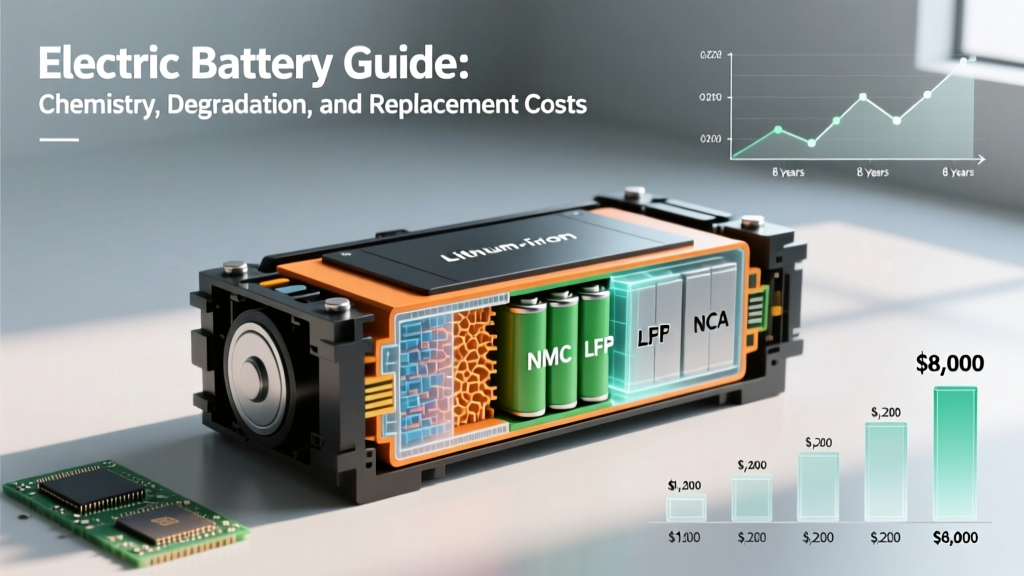
Not all lithium-ion batteries are the same. The cathode chemistry — the materials that store and release lithium ions — defines a battery's personality. In 2026, three chemistries dominate the U.S. EV market: LFP (lithium iron phosphate), NMC (nickel manganese cobalt), and NCA (nickel cobalt aluminum). Each has distinct trade-offs.
| Attribute | LFP (LiFePO₄) | NMC (Nickel Manganese Cobalt) | NCA (Nickel Cobalt Aluminum) |
|---|---|---|---|
| Energy Density | Lower (~160–180 Wh/kg cell-level) | Higher (~220–260 Wh/kg cell-level) | Highest (~250–280 Wh/kg cell-level) |
| Typical Use | Standard-range / base trims (Tesla Model 3 RWD, Ford Mustang Mach-E Select) | Long-range / performance trims (Hyundai Ioniq 5, VW ID.4 Pro S, BMW iX) | Tesla Long Range/Performance models, Rivian |
| Cycle Life | 3,000–5,000+ cycles to 80% capacity | 1,000–2,000 cycles to 80% capacity | 1,000–1,500 cycles to 80% capacity |
| Cold-Weather Performance | Weaker — more range loss below 32°F; slower charge acceptance when cold | Better low-temp performance; preconditioning helps significantly | Similar to NMC; preconditioning critical |
| Cost per kWh | Lower — no cobalt or nickel; ~$90–110/kWh pack-level (2026 est.) | Higher — commodity-sensitive; ~$120–145/kWh pack-level | Highest — nickel/cobalt exposure; ~$125–150/kWh pack-level |
| Recommended SoC Daily | 100% daily charging is fine (and recommended for BMS calibration) | 80% daily; 100% only for trips | 80% daily; 100% only for trips |
| Thermal Stability | Excellent — inherently more resistant to thermal runaway | Good — requires robust thermal management | Good — requires robust thermal management |
So, Which Is Better?
There's no universal winner. Choose LFP if you want maximum longevity, can charge at home daily to 100%, don't need the longest possible range, and live in a moderate climate. Choose NMC/NCA if you need maximum range per charge, regularly drive in cold weather, or want the fastest DC charging speeds. Tesla's Standard Range Model 3 uses a CATL-supplied LFP pack (~60 kWh usable) for 272 miles EPA, while the Long Range AWD uses NCA (~82 kWh usable) for 363 miles EPA — a textbook illustration of the energy-density gap.
How Long Do EV Batteries Actually Last? Degradation Data
The fear that an EV battery will "die" like a smartphone after two years is the most persistent myth in electric mobility. Real-world data tells a different story: modern EV traction batteries are engineered for 15–20+ years of service and typically outlast the vehicle's body and suspension components.
Typical Degradation Curve (Based on Fleet & Owner Data):
- Year 1 / ~12,000 mi: 2–4% capacity loss (initial "break-in" drop as the solid electrolyte interphase stabilizes)
- Year 3 / ~36,000 mi: 5–8% total loss
- Year 5 / ~60,000 mi: 8–12% total loss
- Year 8 / ~100,000 mi: 10–15% total loss
- Year 10+ / ~120,000–150,000 mi: 12–20% total loss (highly dependent on usage patterns)
Sources: Geotab fleet data analysis of 10,000+ EVs shows average annual degradation of ~1.8% per year across all chemistries, with LFP packs trending lower at ~1.2–1.5%/year. Tesla's own 2025 Impact Report states Model 3/Y batteries retain approximately 85% capacity after 200,000 miles.
Key insight: degradation is non-linear. The biggest drop happens in the first year or two, then the curve flattens considerably. A battery that has lost 8% in three years is very likely to still hold 80%+ at year ten. This is why manufacturer warranties are structured around the 70% retention threshold at 8 years — the vast majority of packs never reach that floor under normal use.
EV Battery Warranty Terms: What's Actually Covered?
Federal law mandates a minimum battery warranty of 8 years / 100,000 miles for EVs sold in the U.S. (California Air Resources Board states extend this to 10 years / 150,000 miles). But the details matter enormously — specifically, the capacity retention threshold that triggers a warranty claim.
| Manufacturer | Warranty Term | Capacity Threshold | Covers |
|---|---|---|---|
| Tesla (Model 3/Y LFP) | 8 yr / 100,000 mi | 70% retention | Defects + capacity below threshold |
| Tesla (Model 3/Y LR/Perf) | 8 yr / 120,000 mi | 70% retention | Defects + capacity below threshold |
| Hyundai / Kia | 10 yr / 100,000 mi | 70% retention | Defects + capacity below threshold |
| Ford (Mustang Mach-E) | 8 yr / 100,000 mi | 70% retention | Defects + capacity below threshold |
| BMW (iX, i4) | 8 yr / 100,000 mi | 70% retention | Defects + capacity below threshold |
| Rivian (R1T, R1S) | 8 yr / 175,000 mi | 70% retention | Defects + capacity below threshold |
| GM (Ultium-based) | 8 yr / 100,000 mi | 70% retention | Defects + capacity below threshold |
Note: Warranty covers the battery dropping below the stated threshold, not normal gradual degradation above it. Always check your specific model-year warranty booklet — terms can shift. Source: manufacturer warranty documentation, fueleconomy.gov EV technology overview.
EV Battery Replacement Cost: What You'll Actually Pay (and When)
Here's where honesty matters most. A full traction battery replacement is expensive — but it's also increasingly rare. The data shows that the vast majority of EV batteries outlive the car's useful economic life. Battery failure before 150,000 miles is uncommon, and when it does occur within the warranty period, it's covered.
| Vehicle | Battery Size (usable kWh) | Chemistry | Out-of-Warranty Replacement Est. |
|---|---|---|---|
| Tesla Model 3 RWD | ~60 kWh | LFP (CATL) | $8,000–$12,000 |
| Tesla Model Y Long Range | ~82 kWh | NCA (Panasonic) | $12,000–$16,000 |
| Hyundai Ioniq 5 Long Range | ~77.4 kWh | NMC (SK On) | $11,000–$15,000 |
| Ford Mustang Mach-E Ext. Range | ~91 kWh | NMC (SK On) | $14,000–$18,000 |
| Ford F-150 Lightning Ext. Range | ~131 kWh | NMC | $18,000–$25,000 |
| Rivian R1T Dual Motor (Max Pack) | ~149 kWh | NMC (Samsung SDI) | $20,000–$28,000 |
| Chevrolet Equinox EV | ~85 kWh | NMC (Ultium) | $12,000–$16,000 |
These figures include the battery module assembly and labor but can vary by region, dealer, and whether refurbished/remanufactured packs are available. Costs have been declining roughly 8–10% per year as cell prices drop and the refurbishment market matures. By the time a 2026 EV is actually out of warranty in 2034, replacement costs are projected to be 30–40% lower than today's estimates.
When is replacement typically needed? Most documented replacements occur between 120,000–200,000 miles, and the majority of those are due to individual cell or module failures (which can sometimes be repaired without a full pack swap) rather than total end-of-life degradation. High-mileage fleet vehicles (taxis, rideshare) are the most common candidates.
Factors That Accelerate (or Preserve) Battery Health
Battery longevity isn't purely a function of time — your habits matter. Here's what the chemistry and physics tell us:
What Hurts Your Battery
- Frequent DC fast charging above 150 kW: High C-rates generate heat and stress the anode. Occasional road-trip fast charging is fine; daily reliance on 250+ kW chargers accelerates degradation by an estimated 1–3% over the battery's life.
- Sustained high State of Charge (NMC/NCA): Storing an NMC or NCA battery at 100% for days or weeks accelerates electrolyte oxidation. Charge to 100% only when you'll drive soon.
- Deep discharges to 0%: Letting the battery sit at or near 0% SoC stresses the cells and can cause copper dissolution in the anode current collector.
- Extreme heat exposure: Prolonged parking in 100°F+ ambient temperatures without thermal management active degrades cells faster. Garage parking helps significantly in hot climates.
- Charging in extreme cold without preconditioning: Lithium plating can occur when charging a cold battery at high rates, causing permanent capacity loss.
What Preserves Your Battery
- Daily charging to 80% (NMC/NCA) or 100% (LFP): This keeps cells in their happy electrochemical zone.
- Level 2 home charging as your primary method: Slower charging (~7–11 kW) generates less heat and stress than DC fast charging.
- Using the vehicle's preconditioning feature: Before fast charging or in cold weather, preconditioning warms the battery to optimal temperature (~77–95°F / 25–35°C), improving charge acceptance and reducing plating risk.
- Moderate SoC for storage: If storing the vehicle for weeks, leave it at ~50% SoC and plugged in if possible so the thermal management system can maintain temperature.
- Regular driving: Batteries prefer use. Extended periods of sitting at any SoC are less ideal than regular cycling.
How to Check and Monitor Your Battery's State of Health
State of Health (SoH) is the percentage of original capacity your battery currently holds. A new battery is 100% SoH; one that has degraded to hold only 77 kWh of its original 84 kWh is at ~91.7% SoH. Monitoring this metric is essential for understanding your battery's trajectory.
Built-In Vehicle Tools
- Tesla: The service menu (accessible via the software screen) shows estimated battery capacity. Third-party apps like Tessie or Stats for Tesla pull this data via the API and track it over time.
- Hyundai/Kia: The infotainment system's EV diagnostics page shows battery health percentage on 2024+ models. The Hyundai Bluelink / Kia Connect app also provides SoH data.
- Ford: The FordPass app and in-vehicle diagnostics provide battery health estimates, though less granular than some competitors.
- BMW: The My BMW app includes a battery health certificate feature, particularly useful for resale documentation.
Third-Party and OBD-II Methods
For more precise readings, OBD-II dongles paired with apps like LeafSpy (Nissan Leaf), Car Scanner, or OBDeleven can read the battery management system's internal SoH estimate. Independent testing services (some dealerships, specialized EV shops) can also perform a controlled discharge test for a definitive measurement — this is increasingly common for used-EV pre-purchase inspections.
Emerging Battery Tech: Solid-State, Silicon Anode, and What's Next
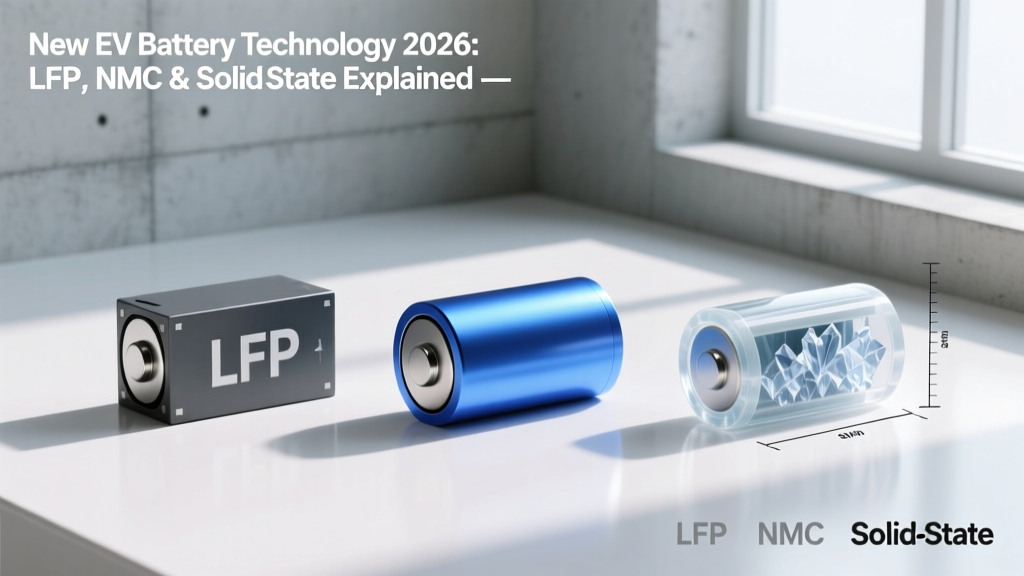
The most-searched new EV battery technology terms center on two innovations: solid-state batteries and silicon-anode cells. Both are real, both are in limited production somewhere, and neither is widely available in U.S.-market consumer EVs as of 2026. Here's the honest status:
Solid-State Batteries
Solid-state cells replace the liquid electrolyte with a solid material (ceramic, sulfide, or polymer), promising higher energy density (potentially 400+ Wh/kg at cell level), faster charging, and improved safety due to reduced flammability.
- Current status: Toyota has announced a solid-state battery pilot in limited fleet vehicles in Japan, targeting 2027–2028 for broader production. Nissan and Honda have similar timelines. QuantumScape (backed by Volkswagen) continues prototype validation with claimed 80% charge in under 15 minutes, but volume manufacturing remains unproven.
- Realistic U.S. consumer availability: 2029–2032 for premium segments, with cost-competitive mass production likely not until the mid-2030s.
- Caveat: Manufacturing yield, cost per kWh (currently 3–5x conventional lithium-ion), and supply chain scale-up remain unsolved challenges. Every "solid-state is coming next year" prediction since 2018 has slipped.
Silicon-Anode Batteries
Replacing graphite anodes with silicon can boost energy density by 20–40% because silicon can store roughly 10x more lithium ions per gram. The challenge: silicon swells ~300% during charging, which cracks the anode over repeated cycles.
- Current status: Sila Nanotechnologies (partnered with Mercedes-Benz and Panasonic) has begun limited production of silicon-dominant anode cells for the Mercedes G-Class electric (announced for 2026–2027). Group14 Technologies supplies silicon-carbon anode materials to battery manufacturers.
- Realistic timeline: Silicon-blend anodes (partial silicon mixed with graphite) are already appearing in 2025–2026 production cells, offering modest 5–15% energy density gains. Full silicon-dominant anodes are 2028+ for mainstream EVs.
Sodium-Ion Batteries
A lower-cost alternative using abundant sodium instead of lithium. CATL has begun shipping sodium-ion packs in Chinese-market EVs (e.g., Chery). Energy density is lower (~120–160 Wh/kg), making them best suited for affordable, shorter-range city cars. U.S. availability is uncertain and likely 2028+ if it arrives at all for consumer vehicles.
FAQ: EV Battery Technology Questions Answered
How long do EV batteries last in years and miles?
Based on fleet data from Geotab and manufacturer reports, most modern EV batteries retain 80–90% of original capacity after 100,000 miles and 8 years. Many will last 200,000+ miles before reaching the 70% warranty threshold. In practical terms, the battery will likely outlast the vehicle's other major components (suspension, interior, body panels).
How much does an EV battery cost to replace?
Out-of-warranty replacement costs range from approximately $8,000 for a smaller LFP pack (Tesla Model 3 RWD, ~60 kWh) to $25,000+ for a large NMC pack (Ford F-150 Lightning Extended Range, ~131 kWh). These costs are declining ~8–10% annually, and refurbished packs offer 30–50% savings over new OEM units. Within the 8-year/100,000-mile federal warranty period, replacement due to defect or capacity loss below 70% is covered at no cost.
What does the EV battery warranty actually cover?
Federal law requires at minimum 8 years / 100,000 miles of coverage (10 years / 150,000 miles in CARB states like California, New York, and others). The warranty covers manufacturing defects and capacity loss below a stated threshold — typically 70% of original capacity. It does not cover damage from accidents, improper modifications, or extreme abuse. Normal gradual degradation above the threshold is expected and not warrantable. Check IRS §30D guidelines for how battery sourcing also affects your federal tax credit eligibility.
How do I check my EV battery's health?
Most 2024+ EVs provide a State of Health (SoH) reading in the infotainment system or companion app. For more precise tracking, use OBD-II tools like Car Scanner or brand-specific apps (Tessie for Tesla, LeafSpy for Nissan). A professional battery health check at a dealership — involving a controlled discharge test — provides the most accurate measurement and is recommended before purchasing a used EV.
LFP vs NMC — which battery is better for me?
LFP is better if: you charge at home daily, want maximum cycle life (3,000–5,000+ cycles), prefer charging to 100% without worry, and don't need the absolute longest range. NMC/NCA is better if: you need maximum range (300+ miles), frequently drive in cold weather, want the fastest DC charging speeds, or take regular road trips. Neither is objectively superior — they serve different use cases. See the chemistry comparison table above for the full trade-off breakdown.
Does frequent fast charging damage my battery?
DC fast charging generates more heat and stress than Level 2 charging, which accelerates degradation slightly. However, modern battery management systems actively limit charge rates when the battery is too hot or too cold, and the impact is smaller than commonly feared. Geotab's data shows that vehicles fast-charging more than 3 times per week degraded only ~1–2% more over 5 years compared to those primarily using Level 2. Use fast charging for road trips without guilt; just don't rely on it as your only charging method if Level 2 is available.
Will solid-state batteries make current EVs obsolete?
Not anytime soon. Solid-state technology remains in pilot/prototype stages for consumer vehicles, with realistic U.S. market availability in premium segments no earlier than 2029–2032 and mass-market affordability likely in the mid-2030s. Current NMC and LFP batteries are mature, well-understood, and offer excellent longevity. Buying an EV today does not mean buying obsolete technology — today's packs are the most durable and energy-dense in EV history.