Why Nevada Lithium Matters for Your EV Battery
When you scan the spec sheet of a 2026 electric vehicle, the battery chemistry — LFP, NMC, NCA — tells you a lot about range, longevity, and charging behavior. But the raw materials behind those acronyms have a supply-chain story that directly affects price, availability, and even federal tax-credit eligibility under IRS §30D critical-mineral sourcing rules. A growing share of the lithium found in Nevada is feeding that pipeline, and understanding what it means for your next EV purchase requires separating geology from marketing.
Nevada hosts the only currently operating lithium mine in the United States — Silver Peak, operated by Albemarle in Clayton Valley — and several advanced-stage projects, including the Thacker Pass project (Lithium Nevada / Lithium Americas) which is moving toward production in the late 2020s. Domestic lithium sourcing matters for two practical reasons for EV buyers: it reduces exposure to volatile international supply chains (most lithium today comes from Australia and Chile), and it helps automakers satisfy the §30D critical-mineral requirement, which mandates that a specified percentage of battery minerals be sourced from the U.S. or a free-trade-agreement partner.
But lithium is just one input. The way it's refined and combined with other elements — nickel, manganese, cobalt, iron, phosphate — determines whether you end up with an LFP pack that can last 3,000+ cycles or an NMC pack optimized for maximum range per kWh. Let's break down exactly what's inside today's EV batteries, how long they last, and what it costs when they don't.
LFP vs NMC vs NCA: Battery Chemistry Trade-Offs
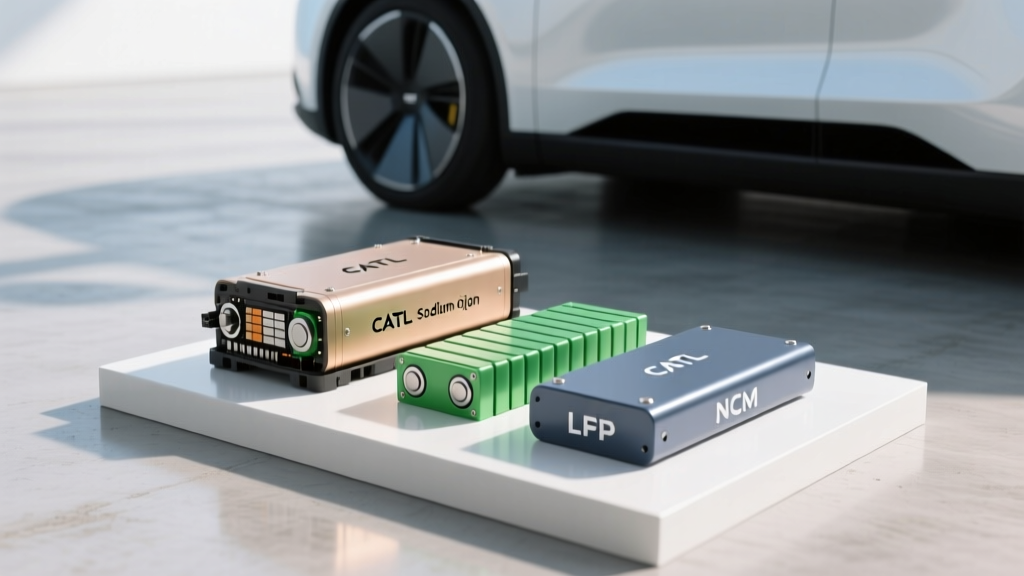
Every mainstream EV in 2026 uses a lithium-ion variant, but the cathode chemistry drives the real-world differences you'll feel in range, charging speed, cold-weather performance, and long-term degradation. Here's how the three dominant chemistries stack up:
| Attribute | LFP (Lithium Iron Phosphate) | NMC (Nickel Manganese Cobalt) | NCA (Nickel Cobalt Aluminum) |
|---|---|---|---|
| Energy Density | Lower (~160–180 Wh/kg cell-level) | Higher (~220–260 Wh/kg) | Highest (~250–280 Wh/kg) |
| Typical Cycle Life | 3,000–5,000+ cycles | 1,000–2,000 cycles | 1,000–1,500 cycles |
| Cold-Weather Performance | Moderate (more range loss below 32°F) | Better (thermal mgmt helps) | Good with active thermal mgmt |
| Cost per kWh | Lower (~$90–110/kWh pack-level, 2026 est.) | Higher (~$120–140/kWh) | Highest (~$130–150/kWh) |
| Cobalt Content | None | Yes (reduced in newer formulations) | Yes (small %) |
| Recommended Daily Charge | 100% OK — LFP tolerates full SoC | 80% preferred for daily use | 80% preferred for daily use |
| Common in (2026 models) | Tesla Model 3/Y RWD, Ford Mustang Mach-E Select (some), BYD, Rivian Standard | Hyundai Ioniq 5/6, VW ID.4, BMW iX, most long-range trims | Tesla Model S/X, some Lucid Air configs |
The practical takeaway: LFP is the longevity and value play — you sacrifice maybe 10–15% in energy density (meaning a slightly heavier or physically larger pack for the same range), but you gain dramatically longer cycle life and the convenience of charging to 100% daily without accelerating degradation. NMC and NCA deliver more range per pound, which matters for long-range trims and heavier vehicles, but they demand more careful state-of-charge management to maximize lifespan.
Nevada-sourced lithium can end up in any of these chemistries. The lithium itself is chemistry-agnostic — it's the cathode formulation that determines the trade-offs. However, domestic sourcing does influence your wallet indirectly through §30D tax-credit eligibility: vehicles whose batteries contain a higher percentage of U.S.- or FTA-partner-sourced critical minerals are more likely to qualify for the full credit, subject to MSRP caps ($55,000 sedans, $80,000 SUVs/trucks/vans), buyer income limits, and the point-of-sale transfer option.
How Long Do EV Batteries Actually Last?
The short answer: longer than most buyers expect, and in most cases longer than the rest of the car. But "how long" depends on what you mean — total failure is rare, while gradual capacity loss is normal and measurable.
Degradation Data: What the Numbers Show
Based on aggregated fleet data, owner reports, and manufacturer testing, here's what typical lithium-ion EV battery degradation looks like across major chemistries:
| Timeframe / Mileage | LFP Packs (Avg. Capacity Retained) | NMC/NCA Packs (Avg. Capacity Retained) |
|---|---|---|
| 1 year / ~12,000 mi | 97–99% | 95–98% |
| 3 years / ~36,000 mi | 94–97% | 90–95% |
| 5 years / ~60,000 mi | 91–95% | 87–93% |
| 8 years / ~100,000 mi | 88–93% | 82–90% |
| 10 years / ~120,000 mi | 85–91% | 78–87% |
Sources: fueleconomy.gov range data over model years, Geotab fleet battery-health studies, and manufacturer warranty disclosures. Individual results vary significantly based on climate, charging habits, and thermal management system quality.
A few patterns emerge from this data:
- The steepest degradation happens early. Most packs lose 2–5% in the first year or two, then the curve flattens considerably. This "break-in" loss is normal and not a sign of a defective battery.
- LFP degrades more slowly and more linearly. The iron-phosphate cathode is chemically more stable, which is why LFP packs in Tesla Model 3 RWD and similar vehicles routinely show 93%+ retention at 60,000 miles.
- NMC/NCA packs are more sensitive to heat and high SoC. A 2026 Hyundai Ioniq 5 with its 77.4 kWh NMC pack, regularly charged to 100% and parked in Arizona summers, will degrade faster than one kept between 20–80% SoC in a temperate garage.
- Most packs outlive the vehicle. At 85–90% capacity after 10 years, a 300-mile EPA-rated EV still delivers 255–270 miles — more than adequate for daily driving and most road trips.
What Does the Battery Warranty Actually Cover?
Federal law mandates a minimum 8-year/100,000-mile warranty on EV battery packs (10 years/150,000 miles in California and states that follow CARB standards). But the details — specifically the capacity-retention threshold and what constitutes a "defect" vs. "normal degradation" — vary by manufacturer.
| Automaker | Warranty Period | Capacity Threshold | Notes |
|---|---|---|---|
| Tesla (Model 3/Y LFP) | 8 yr / 100,000 mi | 70% retention | Covers defects + degradation below threshold |
| Tesla (Model 3/Y LR, S, X) | 8 yr / 120,000 mi (150k for S/X) | 70% retention | NMC/NCA packs |
| Hyundai / Kia | 10 yr / 100,000 mi | 70% retention | Among the longest coverage terms |
| Ford (Mach-E, F-150 Lightning) | 8 yr / 100,000 mi | 70% retention | Components + capacity loss |
| GM (Ultium-based: Equinox EV, Blazer EV, Silverado EV) | 8 yr / 100,000 mi | 70% retention (60% for Bolt-era) | Ultium packs carry 8/100k standard |
| Rivian | 8 yr / 175,000 mi | 70% retention | Higher mileage cap reflects truck/SUV use |
| BMW (iX, i4, i7) | 8 yr / 100,000 mi | 70% retention | Includes battery management system |
Key nuance: The 70% threshold means the manufacturer will replace or repair the battery only if capacity drops below 70% of original within the warranty window. Given the degradation data above, the vast majority of packs will never cross this line under normal use. If your NMC pack shows 85% at 80,000 miles, that's well within warranty compliance — and still functionally excellent.
EV Battery Replacement Costs: The Real Numbers
This is the question that generates the most anxiety, and the least accurate headlines. Here's the grounded reality for 2026:
| Vehicle / Pack Size | Estimated Replacement Cost (Parts + Labor) | When Typically Needed |
|---|---|---|
| Tesla Model 3 RWD (LFP, ~60 kWh) | $12,000 – $16,000 | Rarely before 200,000+ mi; many packs outlive the car |
| Hyundai Ioniq 5 (NMC, 77.4 kWh) | $15,000 – $20,000 | Very rare under 150,000 mi under warranty |
| Ford F-150 Lightning Ext. Range (~131 kWh) | $22,000 – $30,000 | Large packs degrade more slowly per cycle; uncommon need |
| Chevrolet Equinox EV (~85 kWh Ultium) | $14,000 – $19,000 | Ultium modular design allows partial module replacement |
| Lucid Air Grand Touring (~112 kWh) | $20,000 – $28,000 | Luxury segment; low production volume = higher parts cost |
| Nissan Ariya (~91 kWh) | $16,000 – $22,000 | Limited long-term data; Nissan historically conservative on thermal mgmt |
Several important context points:
- Full pack replacement is rare. Most out-of-warranty issues involve individual module or cell-group failures, which can be repaired for $2,000–$6,000 rather than a full swap. GM's Ultium architecture and similar modular designs make this increasingly feasible.
- Costs are declining. Pack-level pricing has fallen from ~$200/kWh in 2020 to roughly $110–140/kWh in 2026, and refurbished/remanufactured packs are becoming available through OEM programs and third-party specialists.
- Most EVs are scrapped for other reasons before the battery fails. Collision damage, electronics failures, or simple end-of-vehicle-life economics typically end a car's career long before the pack reaches end-of-life.
Factors That Accelerate (or Preserve) Battery Life
Battery degradation is not a single-variable equation. Here's what actually moves the needle, ranked roughly by impact:
High-Impact Factors
- Sustained high state of charge: Storing an NMC/NCA pack at 100% SoC for days or weeks accelerates cathode degradation. LFP is more tolerant, but the principle still applies. Fix: Set daily charge limit to 80% for NMC/NCA; 100% is fine for LFP daily use.
- Extreme heat exposure: Battery temperature above 95°F for prolonged periods — especially at high SoC — is the single biggest degradation accelerant. Vehicles with active liquid thermal management (Tesla, Hyundai E-GMP, GM Ultium) handle this far better than passively cooled packs. Fix: Garage when possible; precondition before fast-charging in hot weather.
- Exclusive DC fast-charging: Repeated high-power DC charging (150+ kW) generates internal heat and stress. Occasional road-trip fast-charging is fine; relying on it daily instead of Level 2 adds measurable degradation over years. Fix: Use Level 2 (7–19 kW) for daily charging; reserve DCFC for trips.
Moderate-Impact Factors
- Deep discharges: Regularly running the pack to 0% (or near it) stresses the anode. Most EVs have a buffer — the displayed 0% is not true 0% — but habitually arriving at empty still isn't ideal. Fix: Charge before dropping below 10–15%.
- Cold-weather fast-charging without preconditioning: Charging a cold battery at high power causes lithium plating on the anode, which is permanent capacity loss. Fix: Always use the vehicle's navigation-to-charger preconditioning feature (available on most 2026 models) or manually precondition.
Lower-Impact Factors
- Mileage alone: Calendar aging (time-based degradation) often matters as much as cycle aging (mileage-based). A 10-year-old EV with 40,000 miles can show similar degradation to one with 100,000 miles.
- Regenerative braking intensity: High regen settings don't meaningfully degrade the battery — the charge currents involved are well within design tolerances.
Battery Care Checklist for Maximum Longevity
- ☑ Set daily charge limit: 80% for NMC/NCA; 100% OK for LFP
- ☑ Use Level 2 home charging as your primary method
- ☑ Enable battery preconditioning before DC fast-charging sessions
- ☑ Avoid leaving the vehicle at 100% SoC for more than 24 hours
- ☑ Park in shade or a garage during sustained heat waves
- ☑ Don't store the vehicle long-term below 20% or above 80% SoC
- ☑ Install software updates — OEMs refine battery management algorithms over time
- ☑ Monitor SoH annually (see below) to catch anomalies early
How to Check Your Battery's State of Health (SoH)
State of Health (SoH) is the percentage of your battery's current maximum capacity relative to its original capacity when new. A 77.4 kWh pack at 92% SoH can now store about 71.2 kWh. Here's how to check it:
- In-vehicle displays: Tesla (via the Service menu or third-party apps like TeslaFi), Hyundai/Kia (via the EV battery diagnostics screen), and some BMW models show SoH directly or through estimated range vs. original.
- OBD-II dongles + apps: Tools like the OBDLink SX/MX paired with apps such as Car Scanner, ABRP (A Better Route Planner) battery health, or Leaf Spy (Nissan-specific) can pull SoH data from the battery management system (BMS).
- Dealer diagnostics: Any authorized service center can run a full battery health report. Request one during routine service or before a warranty claim.
- Third-party services: Companies like Recurrent Auto offer battery health reports based on connected-car data, often free for participating owners.
When to be concerned: If SoH drops more than 3–4% in a single year (outside the first-year break-in period), or if you notice sudden range drops, uneven cell voltages, or charging speed reductions, schedule a dealer diagnostic. These can indicate a failing module rather than normal degradation, and may be covered under warranty.
What's Next: Solid-State, Silicon Anodes, and Beyond
The battery landscape is shifting, but timelines matter more than headlines. Here's where emerging technologies actually stand as of 2026:
- Solid-state batteries: Toyota, Samsung SDI, and QuantumScape have demonstrated prototype cells with 30–50% higher energy density and faster charging. However, mass production at automotive scale remains in the 2028–2032 window. No 2026 production EV uses a solid-state pack. Expect initial deployment in limited-run or luxury models first.
- Silicon-dominant anodes: Companies like Sila Nanotechnologies and Group14 are supplying silicon-composite anode materials to manufacturers including Mercedes-Benz (for the upcoming G-Class EV) and others. Silicon anodes can boost energy density by 10–20% without changing cathode chemistry. Early production vehicles with partial silicon anodes are appearing in 2026–2027 model years.
- Sodium-ion batteries: CATL and BYD have begun producing sodium-ion packs for lower-cost, shorter-range EVs (primarily in China). Sodium-ion eliminates lithium entirely but offers lower energy density (~120–150 Wh/kg). U.S. availability is limited and likely 2028+ for any mainstream models.
- LFP improvements: Newer LFP formulations (sometimes called LMFP, adding manganese) are closing the energy-density gap with NMC while retaining LFP's cost and longevity advantages. Expect wider adoption in U.S. models through 2027.
Note: All forward-looking technologies above are marked with estimated timelines based on current manufacturer announcements and industry analysis. Production availability, pricing, and performance may differ from projections.
Frequently Asked Questions
How long do EV batteries last in years and miles?
Most modern EV batteries are designed to retain 70–90% of original capacity after 10 years or 150,000+ miles. LFP chemistries tend toward the higher end of that range. Complete failure before 200,000 miles is uncommon. The federal warranty minimum is 8 years/100,000 miles, and several automakers (Hyundai, Kia, Rivian) exceed this.
How much does it cost to replace an EV battery in 2026?
Full pack replacement ranges from roughly $12,000 for a ~60 kWh LFP pack (Tesla Model 3 RWD) to $30,000 for a ~131 kWh pack (F-150 Lightning Extended Range). However, full replacements are rare — most issues are resolved through individual module repairs at $2,000–$6,000, and the vast majority of packs outlive the vehicle's useful life.
What does the EV battery warranty cover?
Standard warranties cover both manufacturing defects and capacity loss below a threshold (typically 70% of original capacity) within 8 years/100,000 miles. Some brands offer 10 years (Hyundai/Kia) or higher mileage caps (Rivian at 175,000 miles). Normal degradation above the threshold is not covered, but is rarely a functional problem.
LFP vs NMC — which battery chemistry is better?
Neither is universally better; it depends on your priorities. LFP wins on longevity (3,000–5,000+ cycles), cost (~$90–110/kWh), and daily convenience (100% charging is fine). NMC wins on energy density (more range per pound) and cold-weather performance. If you want maximum range in a single charge, NMC is the current answer. If you want a pack that will last 15+ years with minimal degradation and lower cost, LFP is the stronger choice.
Does lithium found in Nevada go into U.S.-sold EVs?
Yes — Albemarle's Silver Peak mine in Nevada is the only operating U.S. lithium mine, and its output enters the domestic battery supply chain. Upcoming projects like Thacker Pass will increase domestic supply. Vehicles using domestically sourced lithium may have an advantage in meeting the §30D federal tax credit's critical-mineral sourcing requirements, though eligibility depends on the full battery supply chain, not a single material source. Always verify credit eligibility for your specific vehicle and tax situation via IRS guidance or a tax professional.
How do I check my EV battery health at home?
Use your vehicle's built-in diagnostics (if available), an OBD-II scanner with a compatible app (Car Scanner, TeslaFi, Leaf Spy), or request a health report from your dealer. Track SoH annually to establish a baseline and catch abnormal degradation early. Services like Recurrent Auto also provide free battery health tracking for participating owners.