Why Nevada's Lithium Deposits Matter for Your Next EV
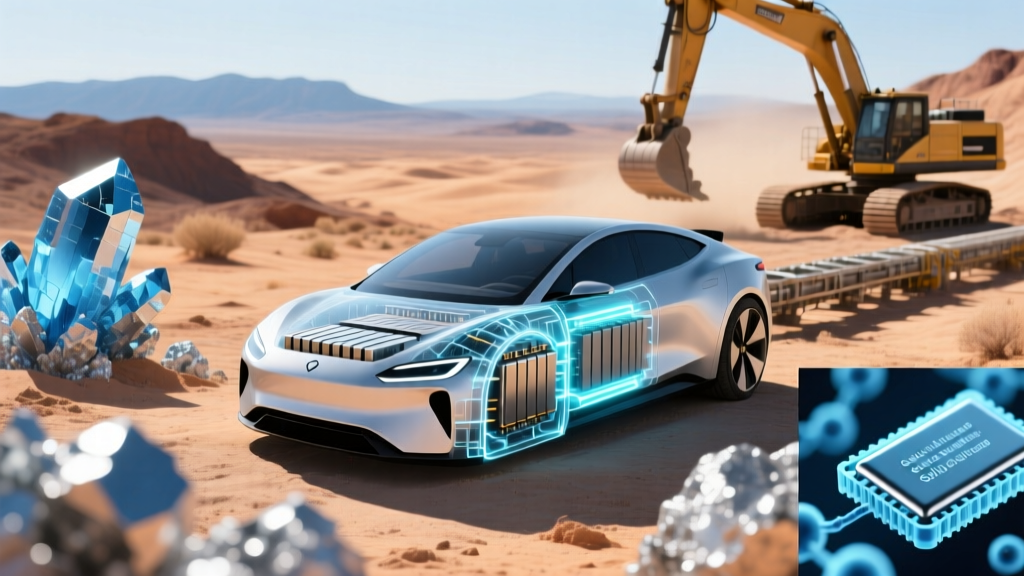
The Thacker Pass site in northern Nevada holds one of the largest known lithium deposits in the United States — an estimated 132 million metric tons of lithium-bearing clay. As of 2026, Lithium Nevada Corporation (a joint venture involving Lithium Americas) continues advancing extraction infrastructure at the site, with commercial production targeted to begin scaling in the late 2020s. For EV buyers, this matters for a concrete reason: where your battery's lithium comes from directly affects whether the vehicle qualifies for the federal §30D tax credit, what chemistry ends up in your pack, and how long the domestic supply chain can sustain affordable battery production.
This guide connects the dots between raw lithium sourcing — including Nevada's role — and the practical battery questions that actually affect your ownership experience: chemistry trade-offs, degradation rates, warranty coverage, replacement costs, and how to monitor and maximize battery health over the life of your EV.
How Lithium Moves From Nevada Clay to Your Battery Pack
The dominant extraction method at Thacker Pass involves mining lithium-rich hectorite clay, then processing it through acid leaching to produce battery-grade lithium carbonate or lithium hydroxide. This differs from the brine extraction used in South America's "lithium triangle" (Chile, Argentina, Bolivia) and the hard-rock spodumene mining common in Australia.
Under current IRS §30D rules, the critical-minerals requirement mandates that an increasing percentage of battery minerals be sourced from the U.S. or a free-trade-agreement partner. Domestic lithium from Nevada deposits directly supports automakers' ability to meet these thresholds. For 2026, the critical-minerals percentage requirement has tightened further compared to the phase-in schedule established in 2023, making North American sourcing strategically important for buyers seeking the full credit.
However, raw lithium is only one input. The cathode chemistry — how that lithium is combined with other elements — determines your battery's performance characteristics. And that's where the LFP versus NMC/NCA decision comes in.
Battery Chemistry Explained: LFP vs NMC/NCA Trade-Offs
Two cathode chemistries dominate the 2026 EV market. Lithium Iron Phosphate (LFP) uses iron and phosphate in the cathode; Nickel Manganese Cobalt (NMC) and Nickel Cobalt Aluminum (NCA) use various combinations of nickel, manganese, cobalt, and aluminum. Both rely on lithium ions shuttling between anode and cathode, but the cathode material fundamentally shapes the battery's behavior.
| Attribute | LFP (Lithium Iron Phosphate) | NMC/NCA (Nickel-based) |
|---|---|---|
| Energy density | ~160–180 Wh/kg (cell-level) | ~220–300 Wh/kg (cell-level) |
| Cycle life | 3,000–5,000+ cycles to 80% capacity | 1,000–2,000 cycles to 80% capacity |
| Cold-weather performance | Greater range loss below 32°F; slower charge acceptance in cold | Better low-temp charge/discharge; less range penalty |
| Cost per kWh | Lower — no cobalt or nickel | Higher — nickel and cobalt add material cost and supply-chain risk |
| Thermal stability | Excellent — higher onset temperature for thermal runaway | Good but lower thermal runaway threshold; requires more active management |
| State-of-charge recommendation | Can charge to 100% daily without significant degradation | Best kept at 80% daily; 100% for trips only |
| Typical 2026 applications | Tesla Model 3/Y Standard Range, Ford Mustang Mach-E Select (LFP trims), base trims of several Chinese-market imports | Long-range and performance trims across most brands; Hyundai Ioniq 5, Rivian R1T, BMW iX, etc. |
Which is better? Neither is universally superior. If you charge at home nightly and want a battery that tolerates daily 100% charges with minimal degradation over 15+ years, LFP is the pragmatic choice. If you need maximum range per charge, tow frequently, or live in a cold climate where winter range loss compounds, NMC/NCA's higher energy density and better cold performance justify the higher cost and more careful charging habits.
How Long Do EV Batteries Actually Last?
The short answer: longer than most buyers expect, and typically longer than the rest of the vehicle remains economically viable.
Real-world degradation data from fleets and long-term ownership studies shows a consistent pattern. Most modern liquid-cooled EV batteries lose roughly 5–8% of original capacity in the first two years (an initial "break-in" drop as the solid-electrolyte interphase layer stabilizes), then degrade at a much slower linear rate of approximately 1–2% per year thereafter.
Typical degradation trajectory (NMC, liquid-cooled, moderate climate):
- Year 1: ~3–5% loss
- Year 2: ~5–8% cumulative loss
- Year 5: ~10–13% cumulative loss
- Year 8: ~13–18% cumulative loss
- Year 10: ~15–22% cumulative loss
- Year 15: ~20–28% cumulative loss (if still in service)
LFP packs generally show even slower long-term degradation, with some fleet data (notably from Tesla's high-mileage ride-share vehicles and BYD's taxi fleets in China) showing under 15% loss at 200,000+ miles. Data published by fueleconomy.gov and independent testing groups like Recurrent Auto consistently confirm that the vast majority of EV batteries outlast the vehicle's useful economic life without requiring replacement.
So how long do EV batteries last in practical terms? Expect a modern liquid-cooled pack to retain 70–85% of original capacity at 150,000–200,000 miles. That's enough range for daily driving for the overwhelming majority of owners — and well beyond the point where other vehicle components (suspension, interior, body) typically prompt a trade-in.
What Does the Battery Warranty Cover?
Federal law mandates a minimum battery warranty of 8 years or 100,000 miles for EVs sold in the U.S. (10 years/150,000 miles in California and states that follow CARB standards). Most automakers meet or slightly exceed this floor.
| Automaker | Warranty Period | Capacity Retention Threshold |
|---|---|---|
| Tesla (Model 3/Y NMC Long Range) | 8 yr / 120,000 mi | 70% |
| Tesla (Model 3/Y LFP Standard Range) | 8 yr / 100,000 mi | 70% |
| Hyundai / Kia | 10 yr / 100,000 mi | 70% |
| Ford (Mach-E, F-150 Lightning) | 8 yr / 100,000 mi | 70% |
| GM (Ultium-based) | 8 yr / 100,000 mi | 70% (Bolt EUV legacy: 8/100k at 60%) |
| Rivian | 8 yr / 175,000 mi (R1T/R1S) | 70% |
| BMW | 8 yr / 100,000 mi | 70% |
| Volkswagen (ID.4) | 8 yr / 100,000 mi | 70% |
What triggers a warranty claim? If your battery's usable capacity drops below the stated threshold (typically 70% of original) within the warranty period, the manufacturer must repair or replace the pack — or enough modules within it — to bring capacity back above that threshold. Note that warranties cover defects and abnormal degradation, not cosmetic damage or damage from collisions, flooding, or unauthorized modifications.
The practical implication: if you buy a 300-mile EPA-range EV and the battery degrades to 210 miles of range (70%) within the warranty window, you're covered. Given the degradation data above, hitting that threshold within 8 years requires abnormally harsh use or a manufacturing defect — which is exactly what the warranty is designed to catch.
EV Battery Replacement Costs: What to Expect
Battery replacement remains a real but uncommon expense. The vast majority of EVs are retired or traded in before the pack requires full replacement. When replacement is needed — typically due to a manufacturing defect, physical damage, or very high mileage beyond the warranty period — costs vary significantly by pack size and chemistry.
| Vehicle / Pack Size | Chemistry | Estimated Replacement Cost (Parts + Labor) |
|---|---|---|
| Tesla Model 3 Standard Range (~57 kWh) | LFP | $8,000–$12,000 |
| Tesla Model Y Long Range (~75 kWh) | NMC | $12,000–$16,000 |
| Hyundai Ioniq 5 (~77.4 kWh) | NMC | $14,000–$18,000 |
| Ford F-150 Lightning Extended Range (~131 kWh) | NMC | $20,000–$28,000 |
| Rivian R1T Large Pack (~128 kWh) | NMC | $18,000–$25,000 |
| Chevrolet Equinox EV (~85 kWh) | NMC (Ultium) | $14,000–$19,000 |
These figures represent full-pack replacements at OEM pricing. Module-level repairs (replacing individual degraded or failed modules within the pack) can reduce costs substantially, and some independent EV repair shops now offer refurbished pack options at 40–60% of OEM new-pack pricing. As domestic production from sources like Nevada's lithium deposits scales up and cell manufacturing costs continue their long-term decline, replacement costs are expected to trend lower through the end of the decade.
For context: a 2026 NMC pack costs roughly $130–$160 per kWh at the cell level (down from $200+ per kWh just a few years ago), according to BloombergNEF battery price surveys. LFP cells are cheaper still, often in the $90–$120/kWh range. Installed pack costs (including BMS, cooling, enclosure, and labor) add 30–50% to the cell cost.
Factors That Accelerate Battery Degradation
Not all miles are equal when it comes to battery wear. The following factors have the most measurable impact on long-term capacity retention:
Battery Care Essentials for Maximum Longevity:
- Avoid sustained high State of Charge (SoC) on NMC/NCA: Daily charging to 100% on nickel-based chemistries accelerates cathode degradation. Set your charge limit to 80% for daily use and 100% only when you need full range for a trip. LFP owners can charge to 100% daily — the chemistry tolerates it well and actually benefits from periodic full charges for BMS calibration.
- Minimize DC fast-charging frequency: Occasional DC fast charging (50–350 kW) is fine, but daily reliance on high-power DC charging generates sustained heat that stresses cells. When possible, use Level 2 home charging (7–11.5 kW) as your primary method. Data from Recurrent Auto shows vehicles that fast-charge more than 90% of the time exhibit ~2–3% additional capacity loss over 4 years compared to primarily Level 2-charged vehicles.
- Manage extreme temperatures: Lithium-ion cells degrade faster when repeatedly exposed to high temperatures (above 95°F ambient, higher internally during fast charging). Precondition your battery before DC fast charging — most modern EVs do this automatically when you navigate to a charger. In hot climates, park in shade or a garage when possible. In cold weather, preconditioning also protects the battery by warming cells before accepting charge.
- Avoid deep discharges: Letting the pack sit at 0% SoC for extended periods stresses cells. If storing the vehicle for weeks, leave it at ~50% SoC and plugged in if possible so the thermal management system can maintain optimal temperature.
- Use the vehicle regularly: Batteries prefer moderate, regular cycling over long static storage. Driving and charging in normal patterns is better than letting the car sit unused for months.
How to Monitor Your Battery's State of Health
State of Health (SoH) is the metric that tells you how much capacity your battery retains relative to when it was new. Most 2026 EVs surface this data through the infotainment system or companion app, though the level of detail varies by manufacturer.
Native tools: Tesla's service menu (accessible through the app or touchscreen) provides estimated range at 100% SoC, which you can compare to the original EPA figure to estimate degradation. Hyundai and Kia's infotainment systems include a battery-condition screen. Ford's SYNC system provides battery health status. BMW's iDrive includes a traction-battery health indicator.
Third-party tools: For more granular data, OBD-II Bluetooth adapters paired with apps like OBDeleven (VW/Audi/Porsche), LeafSpy (Nissan Leaf), or Scan My Tesla can read individual cell voltages, pack-level SoH percentages, and charge/discharge cycle counts. Services like Recurrent and Geotab offer fleet and individual battery-health reports based on telematics data.
What to watch for: A sudden increase in degradation rate, significant cell-to-cell voltage imbalance (more than 50 mV difference between highest and lowest cells at rest), or a failure to reach full charge can indicate a module-level issue worth having diagnosed under warranty.
Emerging Battery Technologies: Solid-State and Beyond
Several next-generation battery technologies are in development, but none are commercially available in production EVs as of 2026. Here's a realistic timeline assessment:
Solid-state batteries replace the liquid electrolyte with a solid ceramic, polymer, or sulfide material. The theoretical advantages are significant: higher energy density (potentially 400+ Wh/kg at the cell level), faster charging, improved safety (no flammable liquid electrolyte), and longer cycle life. Toyota has announced plans for limited solid-state EV production in the 2027–2028 timeframe, and Samsung SDI has targeted 2027 for initial production. However, manufacturing yield challenges and cost remain substantial barriers. Widespread solid-state availability in mainstream EVs is more realistically a 2030+ proposition.
Silicon-dominant anodes (replacing graphite with silicon or silicon-carbon composites) promise 20–40% energy density improvements at the cell level. Companies like Sila Nanotechnologies and Group14 Technologies have begun supplying silicon-anode materials to battery manufacturers, and early applications in premium EVs may appear by 2027–2028. This is an incremental improvement rather than a paradigm shift, but it could meaningfully extend range without changing pack size.
Sodium-ion batteries are entering production in China for lower-cost, shorter-range applications (CATL has begun shipping sodium-ion packs in select models). They offer lower energy density than LFP but use abundant, inexpensive materials. U.S. adoption for passenger EVs is not imminent but could emerge for budget segments later this decade.
For 2026 buyers, these technologies are forward-looking context — not purchase-decision factors. Today's LFP and NMC packs, built with lithium that increasingly flows from domestic sources like Nevada's Thacker Pass deposits, offer proven performance, predictable degradation, and warranty coverage that makes long-term ownership low-risk.
Frequently Asked Questions
How long do EV batteries last in years and miles?
Most modern liquid-cooled EV batteries retain 70–85% of original capacity at 150,000–200,000 miles and 10–15 years. LFP chemistries tend to degrade more slowly than NMC/NCA. The majority of EV batteries outlast the vehicle's useful economic life without requiring replacement.
How much does an EV battery cost to replace?
Out-of-warranty replacement costs range from roughly $8,000 for a smaller LFP pack (e.g., Tesla Model 3 Standard Range, ~57 kWh) to $25,000–$28,000 for large NMC packs (e.g., Ford F-150 Lightning Extended Range, ~131 kWh). Module-level repairs can reduce costs. Under warranty, replacement is free if capacity falls below the threshold (typically 70%) within the coverage period.
What does the EV battery warranty cover?
Federal law requires a minimum of 8 years/100,000 miles (10/150,000 in CARB states). The warranty covers capacity loss below a specified threshold — usually 70% of original capacity — due to defects or abnormal degradation. It does not cover damage from accidents, flooding, or unauthorized modifications. Some automakers, like Rivian, offer extended mileage coverage (8 yr/175,000 mi).
How do I check and maximize my battery's health?
Monitor State of Health through your vehicle's native battery-health screen or third-party OBD-II tools like OBDeleven or Scan My Tesla. To maximize longevity: charge NMC/NCA to 80% daily (LFP can go to 100%), minimize daily DC fast-charging reliance, precondition before fast charging, avoid letting the pack sit at 0% or 100% SoC for extended periods, and park in moderate temperatures when possible.
LFP vs NMC — which chemistry is better for me?
Choose LFP if you want maximum cycle life, lower cost, the ability to charge to 100% daily, and don't mind slightly lower range per charge or greater cold-weather range loss. Choose NMC/NCA if you need maximum range, better cold-weather performance, or frequently tow. Both chemistries are proven and well-supported by 8–10 year warranties. The "better" choice depends entirely on your driving patterns and charging habits.
Will Nevada lithium deposits lower EV battery costs?
Domestic lithium production from sites like Thacker Pass reduces reliance on imported lithium and supports §30D tax credit eligibility by meeting critical-minerals sourcing requirements. Over time, a stable domestic supply chain is expected to moderate cell costs, though global lithium market pricing, refining capacity, and cathode manufacturing all influence the final pack price. The impact is structural and long-term rather than an immediate price drop.