Negative or Positive First When Disconnecting Battery: What EV Owners Must Know
If you've ever searched "negative or positive first when disconnecting battery," you've likely encountered advice meant for conventional gas cars. The rule for internal-combustion vehicles is straightforward: disconnect the negative (ground) terminal first to prevent accidental short circuits. But electric vehicles add a layer of complexity that most generic guides ignore — the high-voltage traction battery sitting beneath the floor, operating at 400V or even 800V.
This guide clarifies exactly what you can and cannot safely do with EV batteries, walks through real degradation data, compares LFP and NMC chemistries, and breaks down warranty coverage and replacement costs so you know what to expect over a decade of ownership.
The 12V Battery Disconnect Procedure for EVs
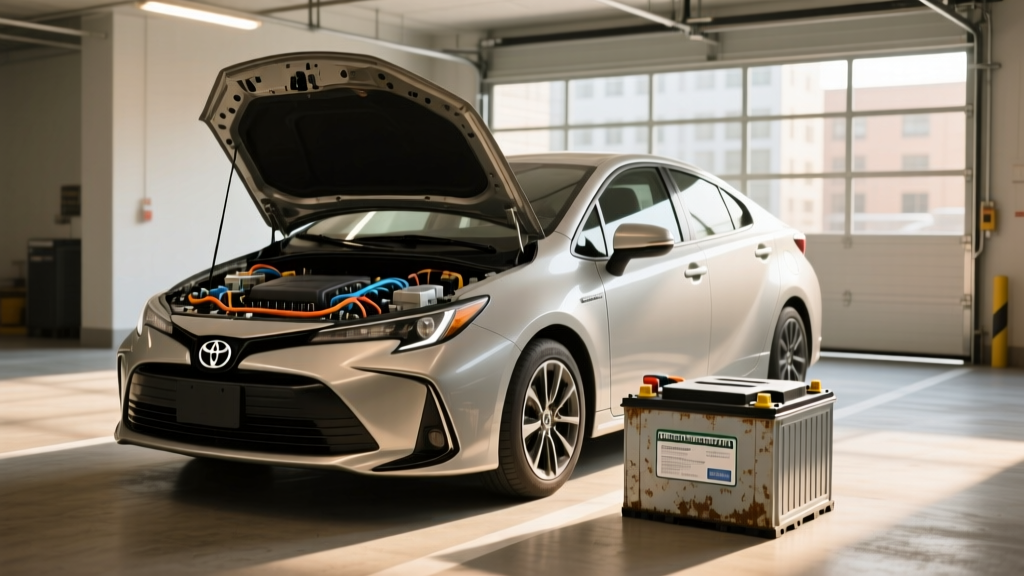
Every EV still carries a conventional 12V battery — typically a small lead-acid or lithium-iron-phosphate unit — that powers the vehicle's computers, lighting, infotainment, and the contactors that connect the main traction pack. When you need to disconnect it (for storage, electrical work, or replacement), the procedure mirrors that of a gas car:
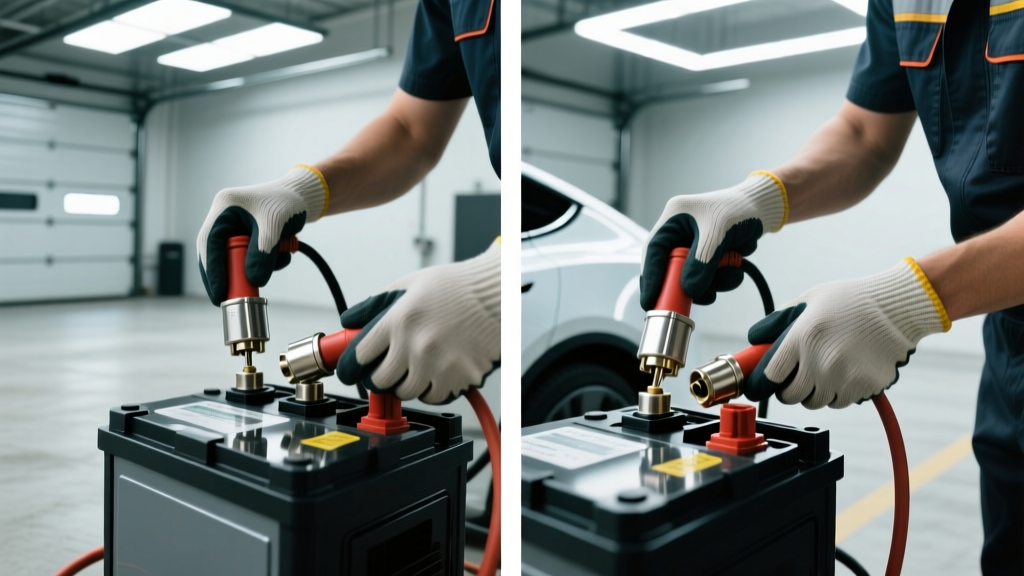
- Negative (ground) first. Use a 10mm wrench to loosen the negative terminal bolt. Removing ground first ensures that if your wrench accidentally touches the chassis while loosening the positive terminal later, no short circuit occurs.
- Positive second. Once the negative cable is safely tucked away from the terminal, remove the positive.
- Reconnect in reverse. Positive first, then negative last.
On EVs specifically, disconnecting the 12V battery will shut down all vehicle electronics, including the battery management system (BMS) that monitors the high-voltage pack. After reconnecting, expect a brief initialization period (30–60 seconds) before the vehicle is ready to drive. Some models may require a BMS reset procedure outlined in the owner's manual.
When Would You Disconnect the 12V?
Common scenarios include long-term storage (over 30 days), performing aftermarket electrical installations, or troubleshooting phantom drain issues. Tesla recommends keeping the vehicle plugged in during storage rather than disconnecting the 12V, as the vehicle's systems periodically wake to run thermal management on the traction pack.
LFP vs NMC Battery Chemistry: Trade-Offs That Matter
The high-voltage traction battery is the most expensive component in any EV. Its chemistry determines range, longevity, charging behavior, and cost. Two dominant chemistries power today's market:
| Attribute | LFP (Lithium Iron Phosphate) | NMC/NCA (Nickel Manganese Cobalt / Nickel Cobalt Aluminum) |
|---|---|---|
| Energy Density | ~160 Wh/kg (lower) | ~250–300 Wh/kg (higher) |
| Cycle Life | 3,000–5,000+ cycles | 1,000–2,000 cycles |
| Cold-Weather Performance | More range loss below 32°F (~15–25% loss) | Better cold retention (~10–20% loss) |
| State of Charge Flexibility | Can charge to 100% daily without harm | Best kept at 80% daily; 100% for trips only |
| Cost per kWh | ~$90–110/kWh (2026 pricing) | ~$120–150/kWh |
| Typical Applications | Tesla Model 3/Y RWD, BYD models, Ford Mustang Mach-E Select | Tesla Long Range, Hyundai Ioniq 5/6, Rivian, Lucid |
| Thermal Stability | Excellent (less prone to thermal runaway) | Good (requires more active cooling) |
Which is better? It depends on your use case. If you commute daily, can charge at home, and want maximum battery lifespan with minimal babysitting, LFP is the practical choice — charge it to 100% every night and don't worry. If you need maximum range per charge, frequently road-trip, or live in a cold climate where every mile counts, NMC/NCA delivers higher energy density at the cost of more careful SoC management.
How Long Do EV Batteries Actually Last?
The question "how long do EV batteries last" has a data-backed answer that's more reassuring than the fear-mongering suggests. Modern EV batteries are engineered to outlast the useful life of the vehicle itself.
- Tesla fleet data (2025 impact report): Model 3/Y batteries retain ~88% capacity at 200,000 miles.
- Geotab fleet study (2024): Average EV battery degradation across 10,000+ vehicles was 1.8% per year — meaning ~82% capacity at 10 years.
- Hyundai/Kia 8-year warranty: Guarantees ≥70% capacity retention, but real-world reports show most Ioniq 5 and EV6 packs retain 90%+ at 100,000 miles.
- Nissan Leaf (passive-cooled, older gen): Higher degradation at ~3–4% per year, illustrating why active thermal management matters.
The takeaway: a modern, actively cooled EV battery will typically lose 10–18% of its original capacity over 10 years or 150,000 miles. Most owners will sell or trade the vehicle before the battery reaches a point where replacement is necessary.
Factors That Accelerate (or Slow) Battery Degradation
Not all miles are equal when it comes to battery wear. Here's what actually moves the needle on State of Health (SoH):
- Minimize DC fast charging to ≤2 sessions per week. Frequent 150+ kW charging generates heat that accelerates cell degradation. Daily Level 2 (7–11 kW) home charging is gentler.
- Avoid storing at 100% SoC for extended periods. For NMC/NCA packs, store at 50–60% if leaving the vehicle unused for weeks. LFP packs tolerate 100% storage better.
- Precondition before fast charging. Most EVs automatically warm the battery when a Supercharger or DC fast station is navigated to. Cold batteries charge slower and experience more stress.
- Don't obsess over the 20–80% rule. While it's technically optimal, the difference in degradation between 20–80% and 10–90% is marginal over a vehicle's life. Use the full range when you need it.
- Park in shade or a garage in extreme heat. Sustained battery temps above 95°F accelerate chemical degradation. Active thermal management helps, but ambient temperature still matters.
- Keep tires properly inflated and minimize aggressive acceleration. Lower energy demand means less current draw, which means less heat in the cells.
EV Battery Warranty Terms: What's Actually Covered
Federal law mandates a minimum 8-year/100,000-mile warranty on EV battery packs (10 years/150,000 miles in CARB states like California, New York, and Massachusetts). But the details matter:
| Manufacturer | Warranty Period | Capacity Retention Threshold | Notes |
|---|---|---|---|
| Tesla (Model 3/Y) | 8 yr / 120,000 mi (Long Range); 8 yr / 100,000 mi (RWD) | 70% | Covers defects and capacity below threshold |
| Hyundai / Kia | 8 yr / 100,000 mi (10/150k in CARB states) | 70% | Transferable to second owner |
| Ford (Mach-E, F-150 Lightning) | 8 yr / 100,000 mi | 70% | Covers module-level replacement |
| BMW (i4, iX) | 8 yr / 100,000 mi | 70% | Extended to 10 yr in some markets |
| Rivian (R1T, R1S) | 8 yr / 175,000 mi | 70% | Longest mileage coverage among startups |
What the warranty covers: Cell defects, module failures, BMS malfunctions, and capacity loss below the stated threshold. It does not cover damage from accidents, flooding, improper modifications, or use outside manufacturer specifications.
What happens if capacity drops below 70%? The manufacturer will replace failed modules or the entire pack to bring capacity above the threshold. In practice, very few owners have needed warranty battery replacements — fueleconomy.gov notes that battery degradation in modern EVs has been significantly lower than early projections.
EV Battery Replacement Cost: The Real Numbers
If your battery does eventually need replacement outside of warranty — typically after 15+ years or 200,000+ miles — here's what to expect in 2026:
| Vehicle | Battery Size | Chemistry | Replacement Cost (Parts + Labor) |
|---|---|---|---|
| Tesla Model 3 RWD | 60 kWh | LFP | $10,000 – $13,000 |
| Tesla Model Y Long Range | 82 kWh | NMC | $14,000 – $18,000 |
| Hyundai Ioniq 5 | 77.4 kWh | NMC | $13,000 – $17,000 |
| Ford F-150 Lightning Ext. Range | 131 kWh | NMC | $22,000 – $30,000 |
| Chevrolet Bolt EV/EUV | 65 kWh | NMC | $9,000 – $14,000 |
| BMW iX xDrive50 | 111.5 kWh | NMC | $20,000 – $28,000 |
Context that matters: Battery cell prices have fallen from over $1,000/kWh in 2010 to approximately $100–140/kWh at the cell level in 2026, per BloombergNEF data. Module-level replacement (swapping individual failed modules rather than the entire pack) is increasingly common and can reduce costs by 50–70%. Most EVs will reach end-of-life from other mechanical or cosmetic issues before the battery needs full replacement.
How to Check and Monitor Battery Health (State of Health)
State of Health (SoH) is the percentage of original capacity your battery currently holds. A new battery is 100% SoH; a degraded battery at 85% SoH holds 85% of its original kWh. Here's how to monitor it:
Manufacturer Apps and In-Vehicle Displays
- Tesla: The mobile app does not display SoH directly, but you can calculate it by comparing actual range at 100% charge to the original EPA rating. Third-party tools like Tessie or Stats for Tesla provide SoH estimates.
- Hyundai/Kia: The infotainment system's EV menu shows battery health percentage on most 2024+ models.
- Ford: The FordPass app includes a battery health indicator for the Mach-E and Lightning.
- BMW: The iDrive system includes a battery health display under the EV settings menu.
Third-Party and OBD-II Methods
For vehicles without a built-in SoH display, OBD-II dongles paired with apps like LeafSpy (Nissan Leaf), ABRP (A Better Route Planner), or manufacturer-specific diagnostic tools can read the BMS-reported capacity. Many dealerships will perform a battery health check as part of routine service — request it if you're considering a used EV purchase.
DIY Calculation Method
Charge to 100%, note the displayed range, and divide by the original EPA range. Example: if your Ioniq 5 (EPA 303 miles) shows 275 miles at 100%, your approximate SoH is 275/303 = ~91%. This method isn't perfectly precise (displayed range factors in recent driving efficiency), but it's a reliable trend indicator over time.
Emerging Battery Tech: Solid-State and Silicon Anodes
The next generation of EV batteries is being developed now, but realistic timelines matter more than press-release promises:
- Solid-state batteries: Toyota, Samsung SDI, and QuantumScape are targeting 2027–2029 for limited production. Solid-state cells promise 30–50% higher energy density, faster charging (10–80% in under 10 minutes), and improved safety. However, manufacturing scale-up remains the major hurdle. Expect initial deployment in premium models at high prices before reaching mainstream vehicles around 2030–2032.
- Silicon anode batteries: Companies like Sila Nanotechnologies and Group14 are already supplying silicon-dominant anode materials that boost energy density by 10–20% over graphite anodes. The Mercedes G-Class 580e uses a silicon anode battery. Expect wider adoption in 2026–2028 model years.
- Sodium-ion batteries: CATL and BYD are producing sodium-ion packs for lower-cost, shorter-range EVs in China. These avoid lithium and cobalt entirely but offer ~30% lower energy density. US availability is uncertain before 2028.
For buyers in 2026: today's LFP and NMC batteries are mature, well-understood, and backed by extensive warranty coverage. Waiting for solid-state means waiting at minimum 3–5 years for meaningful US market availability.
Frequently Asked Questions
Do I disconnect negative or positive first on an EV?
Negative (ground) first, always — but only on the 12V auxiliary battery. The high-voltage traction battery (400V–800V) should never be disconnected by anyone without certified high-voltage training and proper safety equipment. Disconnecting the 12V will shut down vehicle electronics, including the BMS.
How long do EV batteries last in real-world use?
Modern EV batteries with active thermal management typically retain 82–90% of original capacity after 10 years or 150,000 miles. Tesla's fleet data shows ~88% retention at 200,000 miles. Most batteries will outlast the vehicle's useful life. According to data compiled by IIHS on alternative fuel vehicles, battery-related failures in modern EVs are rare.
How much does it cost to replace an EV battery?
Out-of-warranty replacement costs range from ~$9,000 for smaller packs (Chevrolet Bolt) to $22,000–$30,000 for large packs (Ford F-150 Lightning Extended Range). Module-level repairs can cut costs by 50–70%. Most owners never need a replacement — the battery typically outlasts other vehicle components.
What does the EV battery warranty cover?
Federal minimum is 8 years/100,000 miles (10 years/150,000 miles in CARB states). Warranties cover defects and capacity loss below 70% of original capacity. They do not cover accident damage, improper modifications, or use outside manufacturer guidelines. Check IRS.gov for current federal EV tax credit rules that also factor into purchase decisions.
LFP vs NMC — which battery chemistry should I choose?
Choose LFP if you want maximum cycle life (3,000–5,000+ cycles), can charge at home daily, don't need maximum range, and want the freedom to charge to 100% without worry. Choose NMC/NCA if you need the longest possible range per charge, frequently drive in cold weather, or take regular road trips where energy density matters. Both chemistries will easily last the life of the vehicle with normal use.
Does fast charging damage my EV battery?
Occasional DC fast charging is fine. Daily fast charging accelerates degradation by generating sustained heat in the cells. Studies show that vehicles fast-charged more than 3 times per week degrade roughly 1–2% faster per year than those primarily charged on Level 2. Preconditioning the battery (which most EVs do automatically when navigating to a charger) mitigates this by warming the cells to optimal temperature before high-power charging begins.