If you have been following battery technology headlines, you have likely encountered the Natron Energy sodium-ion battery and wondered whether it signals the end of lithium dominance. The short answer for EV buyers in 2026: sodium-ion is a fascinating and rapidly maturing chemistry, but lithium iron phosphate (LFP) and nickel manganese cobalt (NMC/NCA) still power virtually every new electric car you can buy today.
This guide unpacks what sodium-ion brings to the table, how it stacks up against the LFP and NMC packs currently in your EV shopping cart, and — critically — what the real-world data says about battery longevity, degradation, warranty coverage, and replacement cost. Whether you are choosing between an LFP Tesla Model 3 RWD and an NMC Hyundai Ioniq 5, or just trying to understand whether your battery will outlive your ownership, the numbers below will anchor your decision.
The Three Chemistries Competing for Your EV in 2026
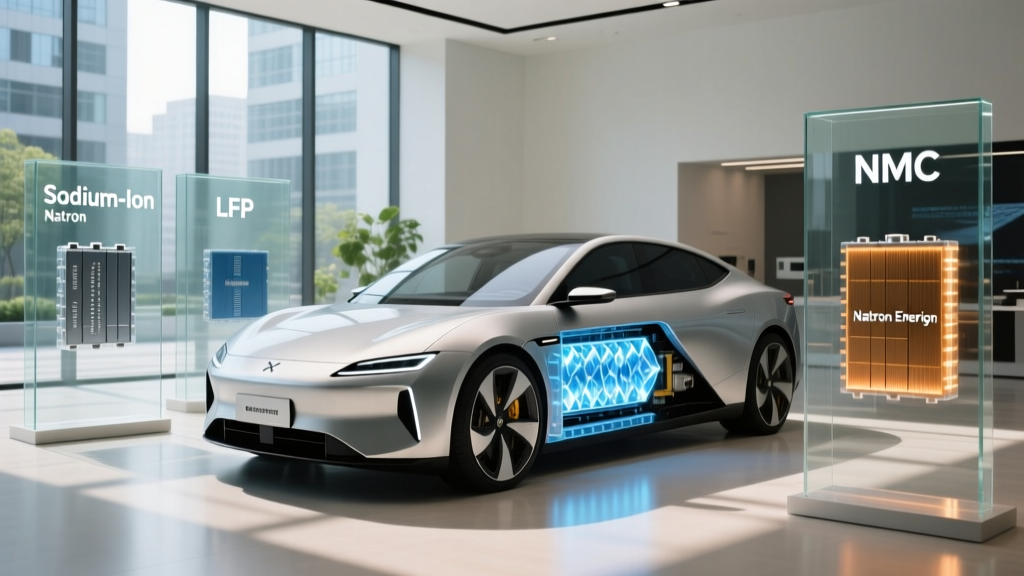
Before we get to Natron's sodium-ion cells, it helps to understand the two lithium chemistries that dominate today's EV market. They differ in energy density, cycle life, cold-weather behavior, cost, and thermal stability — and those differences directly affect your real-world range and long-term ownership cost.
| Attribute | LFP (LiFePO₄) | NMC / NCA | Sodium-Ion (Natron-style) |
|---|---|---|---|
| Energy density (cell-level) | 160–180 Wh/kg | 230–300 Wh/kg | 120–160 Wh/kg |
| Cycle life (to 80% SoH) | 3,000–6,000 cycles | 1,000–2,500 cycles | 5,000–10,000+ cycles (Prussian blue analog) |
| Cold-weather performance | Moderate loss; heat pump helps | Better low-temp discharge | Excellent; retains capacity below -20°C |
| Thermal runaway risk | Very low | Higher; requires robust BMS | Extremely low; can ship/charge at 0V |
| Raw-material cost pressure | Low (iron, phosphate) | High (nickel, cobalt) | Very low (sodium, abundant) |
| Current EV availability (2026) | Widespread (Tesla, BYD, Rivian EDV) | Widespread (Hyundai, GM, BMW, Ford) | Data-center & stationary storage; not yet in US consumer EVs |
| Fast-charge tolerance | Excellent; handles 100% SoC daily | Best kept 20–80% daily | Excellent; supports ultra-high C-rates |
What this means for buyers: LFP is the sweet spot for daily-driven, lower-trim EVs where long cycle life, low cost, and safety matter more than squeezing out the last 30 miles of range. NMC/NCA earns its place in long-range and performance trims where energy density is king. Sodium-ion, as pioneered by companies like Natron Energy, is currently finding its niche in grid storage, data centers, and heavy-duty applications where cycle count, safety, and fast charge/discharge matter more than weight. BYD and a handful of Chinese OEMs have begun putting first-generation sodium-ion packs into low-cost city cars, but a Natron-style sodium pack in a US-market consumer EV remains forward-looking as of 2026.
How Long Do EV Batteries Actually Last?
The fear that an EV battery will strand you with a $20,000 replacement bill at 80,000 miles is not supported by fleet data. Modern liquid-cooled lithium packs routinely exceed 200,000 miles before reaching the 70% state-of-health (SoH) threshold that most warranties define as end-of-life.
Real-world degradation data points worth knowing:
- Tesla fleet data (2023–2025 impact reports): Model 3 and Model Y packs show roughly 12% average capacity loss after 200,000 miles. LFP variants degrade slightly slower than NMC on average, but both comfortably outlast the typical first-ownership cycle.
- Geotab analysis of 10,000+ EVs: Average annual degradation across brands is about 1.8% per year, with a noticeable slowdown after the first two years (the so-called "knee" rarely appears before year 8–10 on liquid-cooled packs).
- Taxi and rideshare fleets (NMC, 200k+ miles): Hyundai Kona Electric and Chevrolet Bolt fleet units routinely reach 200,000–250,000 miles at 75–82% SoH when fast-charging is limited to 1–2 sessions per week.
Typical degradation curve (liquid-cooled NMC/LFP, moderate climate): ~2–3% loss in year 1, ~1.5–2% per year through years 2–6, then a gradual flattening. By year 10 / 150,000 miles, expect 82–88% SoH on most well-maintained packs. Catastrophic "knee" drop-offs are rare and typically tied to manufacturing defects covered under warranty, not normal wear.
This is where sodium-ion chemistry becomes interesting for the next generation of EVs. Natron's Prussian-blue-anode sodium cells are rated for well over 5,000 deep cycles — and in some lab configurations, over 50,000 cycles — with minimal capacity loss. Translated to a hypothetical 75 kWh EV pack, that is well over 1 million miles of theoretical service life, far beyond the mechanical life of the vehicle around it.
What the Battery Warranty Actually Covers
Federal law in the United States mandates that EV battery warranties cover a minimum of 8 years / 100,000 miles. California Air Resources Board (CARB) states push that requirement to 10 years / 150,000 miles, and several OEMs adopt that standard nationwide to simplify logistics. The warranty does not guarantee your original range — it guarantees that the pack will retain a specified percentage of its original capacity.
| Manufacturer / Model | Chemistry | Warranty Term | Capacity Retention Threshold |
|---|---|---|---|
| Tesla Model 3 RWD | LFP | 8 yr / 100,000 mi | 70% SoH |
| Tesla Model Y Long Range | NMC | 8 yr / 120,000 mi | 70% SoH |
| Hyundai Ioniq 5 / Kia EV6 | NMC | 10 yr / 100,000 mi | 70% SoH |
| Ford F-150 Lightning | NMC | 8 yr / 100,000 mi | 70% SoH |
| Rivian R1S / R1T | NMC (Samsung SDI) | 8 yr / 175,000 mi | 70% SoH |
| GM Ultium (Silverado EV, Blazer EV) | NMC | 8 yr / 100,000 mi | 70% SoH (some trims 60%) |
| BYD (global models, LFP Blade) | LFP | 8 yr / 100,000 mi (varies by market) | 70% SoH |
Warranties cover defects and abnormal degradation. They do not cover damage from collisions, flooding, aftermarket modifications, or (on some OEMs) repeated DC fast-charging above a stated frequency. Always read the fine print in your owner's manual — and keep records of charging habits if you plan to make a claim.
How Much Does an EV Battery Cost to Replace?
Replacement cost is the single most overstated fear in EV ownership. The reality: most packs never need replacement during the vehicle's useful life, and when they do, prices have been falling steadily as pack designs become more modular and the refurbishment market matures.
| Vehicle Class / Example | Pack Size | Replacement Cost Range | Typical Replacement Trigger |
|---|---|---|---|
| Compact EV (Chevrolet Bolt, Nissan Leaf) | 40–65 kWh | $6,500 – $11,000 | Rarely needed; mostly post-crash or defect |
| Midsize sedan/crossover (Tesla Model 3, Ioniq 5) | 60–84 kWh | $10,000 – $16,000 | Usually 180k+ miles or defect |
| Long-range / luxury (Model S, Taycan, iX) | 85–105 kWh | $15,000 – $22,000 | Rarely before 200k miles |
| Full-size truck/SUV (F-150 Lightning, Rivian, Hummer EV) | 100–215 kWh | $18,000 – $30,000 | Module-level repair often possible |
Two important caveats. First, modular packs (VW MEB, GM Ultium, Hyundai E-GMP) increasingly allow module-level repair — replacing a single faulty module for $2,000–$5,000 rather than the whole pack. Second, the growing refurbishment market means a remanufactured pack can cost 30–50% less than a new OEM unit. For context on current OEM warranty and service policies, the NHTSA and manufacturer owner portals are the authoritative starting points.
This is also where sodium-ion's value proposition sharpens. A Natron-style sodium pack, using iron, manganese, and sodium instead of nickel and cobalt, is projected to undercut NMC pack pricing by 30–40% at scale — and its dramatically longer cycle life means the per-mile battery cost over the vehicle's life could fall to a fraction of today's lithium chemistry. Those economics are why OEMs are watching sodium-ion closely for entry-level and commercial EVs later this decade.
Five Factors That Actually Determine Your Battery's Life
Chemistry sets the ceiling, but your habits decide how close you get to it. Here are the variables with the strongest measured impact on long-term SoH:
- State of charge habits: For NMC packs, keeping daily SoC between 20% and 80% roughly halves degradation rate compared to habitual 100% charges. LFP is the exception — Tesla, Ford, and BYD explicitly recommend periodic 100% charges to allow the BMS to rebalance cells, and LFP tolerates high SoC far better than NMC.
- DC fast-charging frequency: Occasional road-trip fast-charging is fine. Daily 150–350 kW DC sessions accelerate degradation measurably, mostly through heat accumulation. Precondition the battery (most EVs do this automatically when a charger is in the nav route) to reduce stress.
- Temperature extremes: Prolonged exposure to ambient heat above 95°F is more damaging long-term than cold. Garage parking in hot climates measurably extends pack life. Cold weather temporarily reduces range (10–30% in sub-freezing conditions) but does not permanently harm the pack if you avoid fast-charging a frozen battery — modern BMS prevents this.
- Depth of discharge: Shallow cycles (e.g., 30% → 70%) are easier on cells than deep cycles (5% → 95%). You do not need to baby the pack, but regularly running it to near-zero is unnecessary wear.
- Calendar aging: Even a parked EV loses capacity over time. A pack stored at 50% SoC in a cool garage ages slower than one stored at 100% in a hot driveway. If you leave the car for weeks, set a SoC target of ~50–60%.
How to Check and Monitor Your Battery's State of Health
Most 2026 EVs expose SoH directly through the infotainment system or companion app, but the depth of data varies by brand:
- Tesla: No native SoH percentage in the app, but third-party tools like Tessie or the in-car "Energy" screen over a full charge cycle give a reliable estimate. Service Mode (accessible on most models) shows pack health data.
- Hyundai / Kia (E-GMP): SoH percentage is visible in the EV settings menu on most 2023+ models.
- Ford (BlueCruise-era): The FordPass app and SYNC screen show estimated range at 100% SoC; comparing this to the original EPA figure over time is a practical SoH proxy.
- GM Ultium: The myChevrolet / myCadillac app surfaces a battery health indicator on supported models.
- OBD-II readers: Devices like OBDLink paired with apps such as ABRP or Car Scanner can pull raw BMS data, including individual cell voltages and true SoH — useful for used-EV buyers doing pre-purchase due diligence.
As a rule of thumb, if your 100% charge range has dropped more than 10–12% from new after 60,000+ miles, the pack is tracking toward the warranty threshold and worth a dealer check. Anything less is normal and no cause for concern.
What Comes After Lithium: Solid-State, Silicon Anode, and Sodium-Ion
Three next-generation technologies are frequently conflated in headlines, but their timelines and applications differ sharply:
- Solid-state batteries (Toyota, Nissan, QuantumScape, Samsung SDI) promise 30–50% higher energy density and faster charging than today's NMC. Toyota has announced limited 2027–2028 production for premium models, with cost parity with lithium-ion not expected until the early 2030s. Treat any "solid-state EV available now" claim as marketing — none are in US consumer hands as of 2026.
- Silicon-anode lithium-ion (Sila Nanotechnologies, Group14) is already entering production in 2025–2026, offering 10–20% energy-density gains by replacing graphite anodes with silicon composites. Expect it first in premium trims from Mercedes-Benz and Panasonic-supplied OEMs.
- Sodium-ion batteries — including the Natron Energy sodium-ion battery platform — target cost, safety, and cycle life rather than energy density. Natron's Prussian-blue architecture supports ultra-high C-rates (full charge in ~8 minutes in stationary applications) and over 50,000 cycles with minimal fade, making it ideal for grid storage, data-center UPS, and eventually commercial EVs where weight is less critical than total cost of ownership. BYD, CATL, and HiNA have placed first-generation sodium packs in Chinese-market micro-EVs; a US-market consumer EV with sodium-ion is plausible by 2028–2030, but not yet on sale.
For the buyer shopping today, the practical takeaway is that LFP and NMC are mature, well-understood, and covered by strong warranties. The chemistry revolution is coming, but it will not strand the EV you buy in 2026.
LFP vs NMC vs Sodium-Ion: Which Chemistry Should You Choose?
Choose LFP if: you want the longest cycle life, lowest cost per kWh, best daily-driver behavior (charge to 100% freely), and highest thermal safety — and you can live with ~10–15% less range than an equivalent NMC pack. Ideal for: Tesla Model 3 RWD, BYD Atto 3, Rivian EDV commercial vans, and most urban commuters.
Choose NMC/NCA if: you need maximum range or towing capacity, live in a very cold climate where NMC's low-temperature discharge edge matters, or want a performance-oriented trim. Ideal for: Tesla Long Range, Hyundai Ioniq 5 / Kia EV6, Ford F-150 Lightning Extended Range, BMW iX, and most premium EVs.
Wait for sodium-ion if: you are buying a commercial or fleet vehicle in the 2028+ timeframe, operate in extreme temperatures, or prioritize total lifetime cost over energy density. The Natron Energy sodium-ion battery and similar platforms are best understood as a successor chemistry for applications where cycle count and safety trump pack weight — not as a near-term replacement for your next personal EV.
Frequently Asked Questions
How long do EV batteries last in years and miles?
Most modern liquid-cooled EV batteries reach 200,000–250,000 miles and 12–15 years before hitting the 70% SoH threshold that OEMs define as end-of-life. Fleet data from Tesla, Geotab, and taxi operators consistently supports this range when basic care (avoiding daily 100% SoC on NMC, limiting routine fast-charging) is followed.
How much does an EV battery cost to replace?
Out-of-warranty replacement ranges from roughly $6,500 for a compact EV pack to $30,000 for a large truck or luxury pack in 2026. Most owners never pay this — the vast majority of packs outlast the vehicle, and modular designs increasingly allow $2,000–$5,000 module-level repairs instead of full replacement.
What does the EV battery warranty actually cover?
Federally mandated minimum is 8 years / 100,000 miles; CARB states require 10 years / 150,000 miles. The warranty guarantees the pack will retain at least 70% of its original capacity (some OEMs use 60–70%) and covers defects and abnormal degradation. It does not cover accident damage, flooding, or in some cases excessive DC fast-charging.
How do I check and maximize my EV battery's health?
Check SoH via your OEM app, infotainment EV menu, or an OBD-II reader pulling BMS data. Maximize life by keeping NMC packs in the 20–80% SoC window for daily use (LFP can charge to 100%), preconditioning before fast-charging, avoiding prolonged storage at 100% SoC, and garaging the vehicle in hot climates.
LFP vs NMC — which is better and why?
Neither is universally better. LFP wins on cost, cycle life, safety, and daily charging convenience, making it ideal for commuters and standard-range trims. NMC wins on energy density, cold-weather range retention, and performance, making it the right choice for long-range and towing applications. For the latest efficiency and range figures by model, the EPA's fueleconomy.gov database is the authoritative source.
Will the Natron Energy sodium-ion battery appear in EVs I can buy soon?
Not in US consumer EVs in 2026. Natron's sodium-ion platform is currently deployed in data-center and stationary storage applications where cycle life, safety, and ultra-fast charge/discharge matter more than energy density. Chinese OEMs (BYD, CATL) have begun placing first-generation sodium packs in low-cost city cars, and a US-market commercial or entry-level EV with sodium-ion is plausible by 2028–2030 — but any claim of availability today is premature.
Does fast-charging damage my EV battery?
Occasional fast-charging (road trips, a few times a month) causes negligible long-term harm on modern liquid-cooled packs. Daily 150–350 kW DC sessions measurably accelerate degradation, primarily through heat. Preconditioning the battery — which most EVs do automatically when navigating to a charger — significantly mitigates this effect.
The Natron Energy sodium-ion battery is a legitimate and important development in the broader battery landscape, and it deserves attention from anyone tracking where EV chemistries are headed. But for the buyer signing a purchase agreement in 2026, the decision still comes down to LFP versus NMC — and both are mature, well-warrantied, and more than capable of outlasting the car they live in.