Sodium-ion batteries have moved from lab curiosity to commercial production, and Natron Energy is at the forefront with its Prussian Blue sodium-ion cells. For EV shoppers accustomed to hearing only about lithium-ion options, the emergence of a Natron battery raises practical questions: Can it power an electric vehicle? How does it stack up against the LFP and NMC chemistries dominating today's EV market? And should you wait for it before buying your next EV?
The short answer: Natron's sodium-ion technology excels in specific niches — ultra-fast charging, extreme temperature resilience, and long cycle life — but its lower energy density keeps it out of mainstream passenger EVs for now. Here's a data-driven look at where Natron fits in the broader battery landscape and what it means for EV buyers in 2026.
What Is a Natron Battery? Sodium-Ion Chemistry Explained
Natron Energy, based in Santa Clara, California, manufactures batteries using Prussian Blue analog sodium-ion chemistry. Unlike lithium-ion cells that rely on lithium — a material subject to geopolitical supply constraints and price volatility — Natron's cells use sodium, one of the most abundant elements on Earth.
The key technical differentiator is Natron's electrode structure. Prussian Blue analogs have an open-framework crystal lattice that allows sodium ions to flow in and out rapidly without significant structural degradation. This translates into:
- Ultra-fast charge/discharge rates: Natron cells can handle continuous discharge at up to 25C and charge at rates that bring cells from 0–100% in under 8 minutes in controlled applications.
- Exceptional cycle life: Natron claims over 50,000 charge-discharge cycles at high depth of discharge — orders of magnitude beyond current lithium-ion automotive cells.
- Wide operating temperature range: Functional performance from –30°C to +60°C without the severe capacity loss lithium chemistries experience at temperature extremes.
- No thermal runaway risk: The aqueous-compatible chemistry and stable electrode structure make thermal runaway events essentially non-existent in Natron cells.
As of 2026, Natron's commercial shipments focus on data center backup power, industrial equipment, and EV fast-charging buffer stations — applications where power density (kW output) matters more than energy density (kWh stored). Natron began shipping from its Holland, Michigan factory in late 2024, making it the first commercial sodium-ion battery manufacturer in the United States.
LFP vs. NMC vs. Natron: Chemistry Comparison
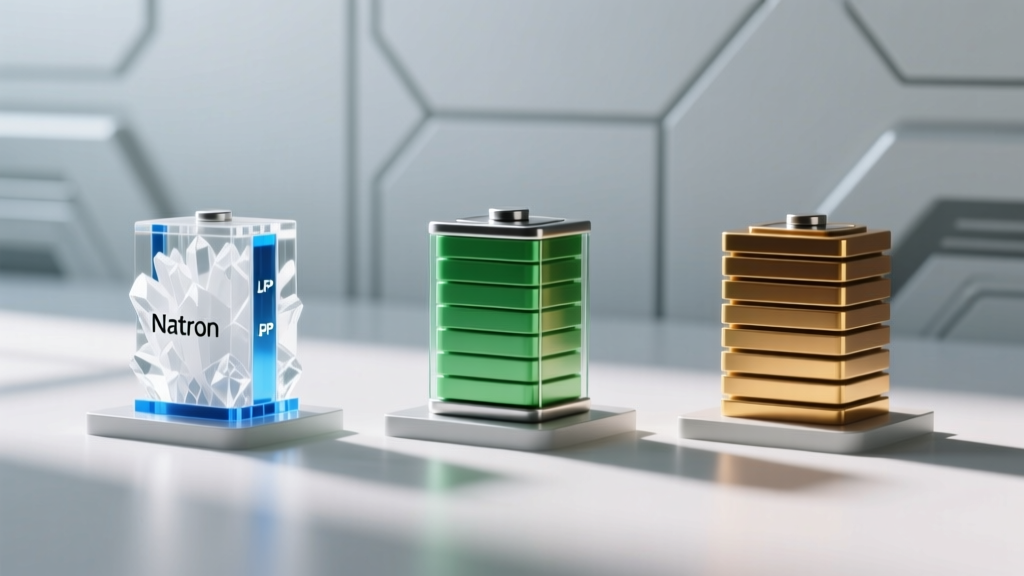
To understand where a Natron battery fits, you need to see it alongside the two lithium-ion chemistries powering virtually every EV on American roads. Here's how the three compare on the metrics that matter to EV owners:
| Metric | NMC/NCA (Lithium-Ion) | LFP (Lithium Iron Phosphate) | Natron (Sodium-Ion, Prussian Blue) |
|---|---|---|---|
| Energy density (cell-level) | 250–300 Wh/kg | 160–180 Wh/kg | ~70–100 Wh/kg (estimated) |
| Cycle life | 1,000–2,500 cycles | 3,000–5,000+ cycles | 50,000+ cycles (claimed) |
| Fast-charge capability | Up to ~3C (250 kW peak in large packs) | Up to ~3C (varies by pack) | Up to 25C continuous |
| Cold-weather performance | 20–40% range loss at –10°C | 25–45% range loss at –10°C | Minimal loss; rated to –30°C |
| Thermal runaway risk | Moderate (requires active BMS management) | Low (inherently stable cathode) | Negligible |
| Raw material cost risk | High (cobalt, nickel, lithium) | Moderate (lithium, iron) | Low (sodium, iron, manganese) |
| Current EV use (2026) | Widespread — Tesla, Rivian, Hyundai, BMW, GM | Widespread — Tesla Model 3 RWD, Ford Mustang Mach-E Select, BYD | Not in passenger EVs; data centers, charging buffers, industrial |
The trade-off is clear: Natron's sodium-ion cells sacrifice energy density to gain cycle life, charge speed, temperature resilience, and safety. For a passenger EV that needs 300+ miles of EPA range from a ~75–100 kWh battery pack, Natron's current energy density would require a pack two to three times heavier than an NMC equivalent — making it impractical for cars, trucks, and SUVs.
But for a DC fast-charging station that needs to buffer grid power and dump 350 kW into your EV in 15 minutes? That's exactly where Natron's chemistry shines, and it may indirectly improve your EV charging experience even if the battery never sits under your seat.
How Long Do EV Batteries Last? Degradation Data
One of the most persistent EV buyer concerns is battery longevity. The data, however, consistently shows that modern lithium-ion traction batteries outlast most owners' time with the vehicle.
Here's what real-world degradation looks like across chemistries:
| Chemistry / Vehicle Example | Typical Degradation at 100,000 Miles | Typical Degradation at 200,000 Miles | Notes |
|---|---|---|---|
| NMC — Tesla Model 3 Long Range | ~5–8% capacity loss | ~10–15% capacity loss | Data from Tesla Impact Reports and owner fleet tracking |
| LFP — Tesla Model 3 RWD | ~3–5% capacity loss | ~7–10% capacity loss | LFP degrades more slowly; Tesla recommends periodic 100% charges for calibration |
| NMC — Hyundai Ioniq 5 | ~5–7% capacity loss | ~12–14% capacity loss | Strong thermal management system helps longevity |
| NMC — Chevrolet Bolt EV/EUV (older generation) | ~6–10% capacity loss | ~12–18% capacity loss | Early Bolt packs showed slightly higher degradation; GM's 2024+ Ultium packs improved |
According to data aggregated by fueleconomy.gov and independent fleet studies, the average modern EV battery retains roughly 90–95% of original capacity at 100,000 miles. Most EV batteries will outlast the vehicle's useful economic life without needing replacement.
A Natron sodium-ion battery, if adapted for automotive use in the future, could theoretically push degradation figures to near-zero over a vehicle's lifetime given its 50,000+ cycle capability. But that remains a forward-looking proposition, not a current buying option.
What Does the EV Battery Warranty Cover?
Federal law mandates that EV battery warranties cover a minimum of 8 years or 100,000 miles. In California and states adopting CARB standards, that extends to 10 years or 150,000 miles. Most manufacturers exceed these minimums. Here's what the major warranties look like in 2026:
| Manufacturer | Warranty Period | Capacity Retention Threshold | Notes |
|---|---|---|---|
| Tesla | 8 years / 100,000–120,000 mi (varies by model) | 70% of original capacity | Model 3 LWD (LFP): 100k mi; Model S/X: 150k mi |
| Hyundai / Kia | 10 years / 100,000 miles | 70% of original capacity | Among the longest standard coverage in the US |
| GM (Ultium platform) | 8 years / 100,000 miles | 70% of original capacity (60% for Bolt-era) | Ultium packs use modular design for partial replacement |
| Ford | 8 years / 100,000 miles | 70% of original capacity | Covers Mustang Mach-E, F-150 Lightning |
| Rivian | 8 years / 175,000 miles (R1T/R1S) | 70% of original capacity | Higher mileage cap reflects truck/SUV use case |
The critical detail: warranties cover capacity loss below the stated threshold, not gradual degradation above it. If your 80 kWh pack drops to 57 kWh (below 70%), the manufacturer replaces or repairs it. If it drops to 58 kWh, you're within spec. In practice, warranty claims remain rare — most packs stay well above 70% through the warranty period.
How Much Does an EV Battery Replacement Cost?
If your battery degrades beyond warranty coverage — or suffers physical damage — replacement is expensive but increasingly less so as battery costs decline and modular designs allow partial repairs.
| Vehicle / Pack Size | Full Pack Replacement (2026 est.) | Module-Level Repair | Typical Replacement Trigger |
|---|---|---|---|
| Tesla Model 3 RWD (60 kWh, LFP) | $10,000–$14,000 | Not typically modular | Rare before 250k+ miles |
| Tesla Model Y LR (82 kWh, NMC) | $14,000–$18,000 | Limited module service | Rare before 200k+ miles |
| Hyundai Ioniq 5 (77.4 kWh, NMC) | $12,000–$16,000 | Module replacement possible | Rare before 200k+ miles |
| GM Ultium (various, 85–200+ kWh) | $14,000–$25,000 (size dependent) | Module-level replacement designed in | GM's modular design targets individual module swaps at ~$2,000–$4,000 each |
| Ford F-150 Lightning Ext. Range (131 kWh) | $20,000–$28,000 | Module service available | Largest consumer packs carry highest replacement cost |
The reality: most EV batteries never need replacement during original ownership. Battery cell prices have fallen from over $1,000/kWh in 2010 to roughly $100–130/kWh at the cell level in 2026, according to BloombergNEF data. Pack-level costs remain higher due to BMS, cooling, and structural integration, but the trend is downward. Manufacturers like GM and Hyundai are designing packs with replaceable modules, meaning a single failed module can be swapped for a fraction of a full pack cost.
Factors That Affect EV Battery Life
While modern battery management systems do most of the work, owner habits influence long-term degradation. Here are the factors with the most impact:
- State of charge habits: For NMC/NCA packs, keeping daily charge between 20–80% reduces stress. LFP packs are more tolerant — Tesla recommends charging LFP to 100% at least weekly for BMS calibration.
- DC fast-charging frequency: Occasional fast charging has minimal impact. Daily reliance on 150–350 kW DC charging accelerates degradation by 1–3% over a battery's lifetime compared to Level 2 home charging. Preconditioning the battery before fast charging (a feature in most modern EVs) mitigates this significantly.
- Extreme heat exposure: Sustained ambient temperatures above 95°F (35°C) accelerate chemical degradation. Active liquid cooling — standard in Tesla, Hyundai, GM Ultium, and most modern platforms — reduces this risk substantially. Vehicles without active thermal management (some older Nissan Leafs) degrade faster in hot climates.
- Extreme cold: Cold doesn't permanently damage batteries but temporarily reduces available capacity (20–40% range loss at –10°C). Charging a frozen battery without preconditioning can cause lithium plating, a permanent degradation mechanism. Most EVs prevent this via software locks on cold-soaked packs.
- High-mileage fast-cycling: Fleet vehicles that charge and discharge multiple times daily see faster degradation. For typical personal-use driving (30–50 miles/day, overnight Level 2 charge), degradation is minimal.
- Storage at extreme SoC: Leaving an EV parked at 100% or 0% SoC for weeks accelerates calendar aging. Store at 50–60% if parking for extended periods.
How to Check and Monitor Battery Health (SoH)
State of Health (SoH) is a percentage indicating how much capacity your battery retains compared to when new. A SoH of 92% means your 80 kWh pack now holds roughly 73.6 kWh of usable energy.
Here's how to check it:
- In-vehicle displays: Tesla shows battery health in the Service menu (via the touchscreen). Some Hyundai/Kia models display SoH through the infotainment system's EV diagnostics page. GM's Ultium-based vehicles include a battery health indicator in the myChevrolet/myCadillac app.
- OBD-II diagnostic tools: Third-party tools like LeafSpy (for Nissan Leaf), Scan My Tesla, and OBDeleven can read detailed battery data including individual cell voltages, total capacity, and SoH percentage.
- Manufacturer service centers: Any authorized dealer can run a full battery diagnostic and provide a certified SoH report — useful for resale or warranty claims.
- Third-party services: Companies like Recurrent Auto offer free battery health reports that compare your pack's degradation to a fleet of identical vehicles, giving you context on whether your degradation is normal or concerning.
For prospective used-EV buyers, a SoH check should be non-negotiable. A 2022 Model 3 Long Range with 45,000 miles and 94% SoH represents a healthy battery; one at 86% SoH warrants further investigation.
Where Natron and Sodium-Ion Fit in the EV Ecosystem
Natron Energy's sodium-ion batteries are not competing for the space under your EV's floor — at least not yet. Instead, they're reshaping the infrastructure that supports EV adoption:
- Fast-charging station buffers: A Natron pack at a charging plaza can absorb grid power slowly, then discharge at 350+ kW to your EV without requiring the site to have massive grid connections. This directly solves one of the biggest barriers to fast-charger deployment: grid upgrade costs that can exceed $500,000 per site.
- Data center UPS: Natron's first major market. The ultra-long cycle life and safety profile make sodium-ion ideal for backup power that cycles frequently.
- Heavy-duty and industrial vehicles: Forklifts, port equipment, and short-range commercial vehicles where weight is less critical and cycle life is paramount could adopt sodium-ion sooner than passenger cars.
For passenger EVs, the energy density gap remains the barrier. To match a Tesla Model Y's ~320-mile EPA range, a Natron-based pack would need to weigh roughly 1,500–2,000 lbs more than its NMC equivalent — an unacceptable trade-off for vehicle dynamics, efficiency, and tire wear.
Emerging Battery Tech: What's Next After Lithium-Ion?
Sodium-ion is one of several next-generation technologies in development. Here's a realistic timeline for the ones EV buyers should watch:
- Solid-state batteries: Toyota, Samsung SDI, and QuantumScape are targeting 2027–2030 for limited production. Solid-state promises 40–50% higher energy density and faster charging, but manufacturing scale-up and cost remain unsolved challenges. Toyota has announced a 2027–2028 target for initial deployment in limited models.
- Silicon-dominant anodes: Companies like Sila Nanotechnologies and Group14 are replacing graphite anodes with silicon composites, boosting energy density 20–40%. Mercedes-Benz's next-generation EQ models are expected to incorporate silicon-anode cells. Timeline: 2026–2028 for meaningful volume.
- Sodium-ion for EVs (beyond Natron): CATL in China has begun shipping sodium-ion packs for low-range urban EVs (200–250 km range). These vehicles are not sold in the US, but the technology is advancing. A US-market sodium-ion EV is plausible by 2028–2030, likely in an affordable compact with 200–250 miles of EPA range.
- Lithium-sulfur: Theoretical energy density is exceptional (500+ Wh/kg), but cycle life remains far too low for automotive use. Still a lab-stage technology with no credible production timeline.
None of these technologies are available in a 2026 model-year vehicle you can buy today. For current buyers, the choice remains NMC/NCA vs. LFP — and both are mature, proven, and well-warrantied.
LFP vs. NMC: Which Should You Choose?
If you're buying an EV in 2026, the chemistry question that actually matters is LFP vs. NMC. Here's the decision framework:
Choose LFP if:
- You want maximum battery longevity and can charge to 100% regularly without worry
- You're buying a standard-range or RWD model (Tesla Model 3 RWD, base Mustang Mach-E)
- You live in a mild climate where LFP's cold-weather disadvantage is manageable
- Lower purchase price matters more than maximum range
Choose NMC/NCA if:
- You need maximum EPA range (300+ miles) for road trips or long commutes
- You live in a cold climate and want better winter range retention
- You're buying an AWD or performance variant (most use NMC for energy density)
- You want the highest possible DC fast-charge speeds (NMC typically peaks higher)
Both chemistries are backed by 8-year/100,000-mile minimum warranties, and both will comfortably outlast a typical ownership period. The Natron battery and sodium-ion technology broadly represent the next wave of innovation — but for the EV in your driveway today, lithium-ion in either LFP or NMC form remains the proven choice.
How long do EV batteries last in years and miles?
Most modern EV batteries retain 85–95% of original capacity at 150,000–200,000 miles. In years, that translates to 12–20 years of typical use (12,000–15,000 miles/year). Full battery failure before 200,000 miles is uncommon with current NMC and LFP chemistries and active thermal management.
How much does an EV battery cost to replace?
Full pack replacement ranges from approximately $10,000 for a 60 kWh LFP pack to $25,000–$28,000 for a 130+ kWh NMC pack (like the F-150 Lightning Extended Range). Module-level repairs, available on platforms like GM Ultium, can cost $2,000–$4,000 per module. However, most batteries never require replacement during normal ownership.
What does the EV battery warranty actually cover?
Federal law requires a minimum 8-year/100,000-mile battery warranty (10 years/150,000 miles in CARB states). Coverage applies when capacity drops below the manufacturer's threshold — typically 70% of original capacity. The warranty covers defective cells, excessive degradation, and BMS failures. It does not cover damage from accidents, flooding, or unauthorized modifications.
How do I check my EV battery's State of Health?
Check SoH through your vehicle's built-in diagnostics menu (Tesla, some Hyundai/Kia models), the manufacturer's mobile app, an OBD-II diagnostic tool, or a dealer service visit. Third-party services like Recurrent Auto also provide fleet-comparison health reports. For used-EV purchases, always verify SoH before buying.
LFP vs. NMC — which chemistry is better for daily driving?
LFP offers longer cycle life, lower cost, and the ability to charge to 100% daily without degradation concerns — ideal for daily commuting and mild climates. NMC delivers higher energy density, better cold-weather performance, and faster peak charging — better for long-range driving and cold climates. Neither is universally "better"; the right choice depends on your driving pattern and climate.
Will Natron's sodium-ion battery ever be used in passenger EVs?
Not in the near term. Natron's current energy density (~70–100 Wh/kg at the cell level) is too low for 300+ mile passenger EVs without excessive weight. The technology is more likely to appear first in short-range commercial vehicles, charging infrastructure buffers, and industrial applications. A US-market sodium-ion passenger EV is possible by 2028–2030, likely from Chinese manufacturers like CATL or BYD with improved second- or third-generation cells.