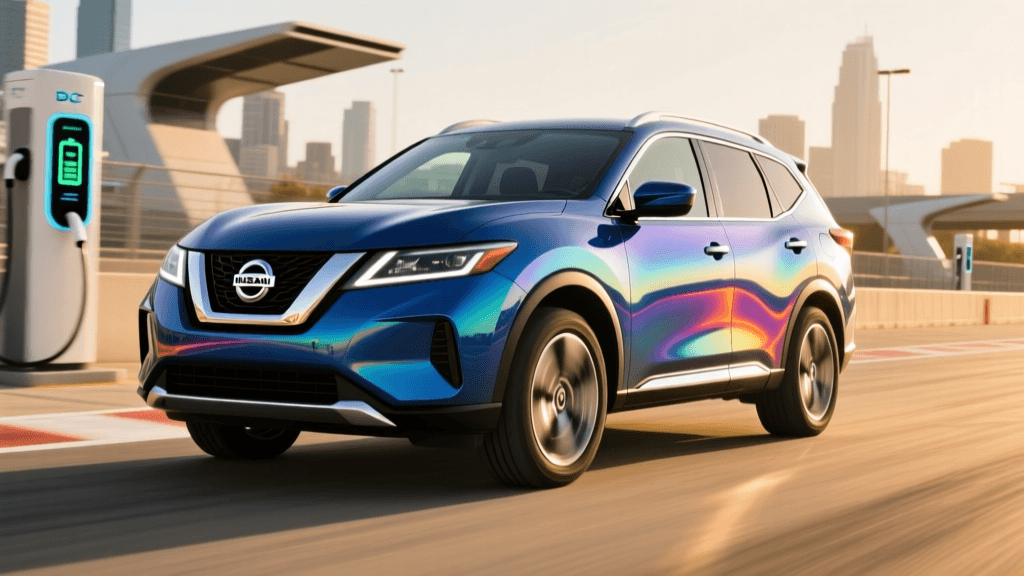
The DC Fast Charging Dilemma: Heat vs. Battery Health
For modern electric vehicle owners, DC fast charging (DCFC) is a double-edged sword. On one hand, it offers the incredible convenience of adding hundreds of miles of range in under thirty minutes, making cross-country road trips a reality. On the other hand, it introduces a persistent anxiety: is the immense heat and high current of fast charging permanently degrading the battery pack? To answer this, we must look beyond generic laboratory tests and examine real-world, long-term data. In this head-to-head product showdown, we are pitting two of the most popular EVs in history against each other to illustrate exactly how thermal management dictates long-term battery health: the Tesla Model 3 and the Nissan Leaf.
Head-to-Head: Tesla Model 3 vs. Nissan Leaf
The Tesla Model 3 and the Nissan Leaf represent two fundamentally different engineering philosophies regarding battery thermal management. By comparing these two vehicles, we can isolate the single most critical factor in DC fast charging degradation: heat dissipation. While both vehicles utilize lithium-ion chemistry, their approaches to keeping the battery cells within an optimal temperature window are worlds apart.
Contender 1: Tesla Model 3 (Active Liquid Cooling)
The Tesla Model 3 utilizes a sophisticated active liquid thermal management system. A glycol-based coolant is pumped through a network of micro-channels woven directly between the cylindrical battery cells. When you plug into a Supercharger, the vehicle's octovalve system and thermal management computers aggressively circulate this chilled liquid to pull heat away from the cells. Furthermore, the Model 3 features battery preconditioning; when the navigation system routes you to a Supercharger, the car actively warms the battery to the exact optimal temperature (around 104°F to 113°F) to minimize internal resistance and prevent lithium plating during the high-current charge.
Contender 2: Nissan Leaf (Passive Air Cooling)
Conversely, the Nissan Leaf relies on passive air cooling. The battery pack is sealed and relies on ambient air and the vehicle's movement to shed heat. There are no liquid cooling loops, no active chillers, and no battery preconditioning for fast charging. When a Leaf hits a DC fast charger, the massive influx of electrons generates significant internal resistance and heat. With no active way to shed this thermal load, the battery temperature spikes rapidly. This design flaw famously led to the 'Rapidgate' phenomenon, where the Leaf's battery management system (BMS) severely throttles charging speeds to prevent thermal runaway, drastically increasing charge times on road trips.
The Data: Long-Term Degradation Showdown
How do these two engineering choices translate to long-term battery health? Based on aggregated fleet data and independent analyses, the divergence in battery degradation between actively cooled and passively cooled EVs is stark, especially for drivers who rely heavily on DC fast charging.
| Metric | Tesla Model 3 (Liquid Cooled) | Nissan Leaf (Passive Air) |
|---|---|---|
| Primary Thermal Management | Active Liquid Glycol Loop | Passive Ambient Air |
| DCFC Preconditioning | Yes (Automatic via Nav) | No |
| Avg. Degradation at 50,000 Miles | ~3% to 5% | ~8% to 12% |
| Avg. Degradation at 100,000 Miles | ~6% to 9% | ~15% to 22% |
| Thermal Throttling on DCFC | Rare (Maintains peak kW) | Frequent (Rapidgate) |
| Expected Lifecycle to 70% SOH | 200,000+ Miles | 100,000 - 130,000 Miles |
As highlighted by real-world battery longevity data from Recurrent, vehicles equipped with active liquid cooling consistently maintain a higher State of Health (SOH) over time. The Nissan Leaf's lack of thermal management forces the battery to endure prolonged exposure to high temperatures during fast charging, which exponentially accelerates chemical degradation.
The Chemistry of Degradation: What Happens Inside the Cell
To understand why the Tesla's liquid cooling provides such a massive advantage, we must look at the electrochemical reality of lithium-ion cells under duress. Fast charging forces lithium ions to move rapidly from the cathode to the anode. This process generates heat. If that heat is not removed, two primary degradation mechanisms occur:
1. Lithium Plating
When a battery is charged too quickly, or charged while too cold, the lithium ions cannot intercalate (insert themselves) into the graphite anode fast enough. Instead, they accumulate on the surface of the anode and turn into solid metallic lithium. This is known as lithium plating. Not only does this permanently remove active lithium from the system (causing immediate capacity loss), but it can also form dendrites—microscopic spikes that can pierce the separator and cause a short circuit. The Tesla Model 3's preconditioning and active heating prevent this by ensuring the cells are warm enough to accept the ions rapidly.
2. Solid Electrolyte Interphase (SEI) Layer Thickening
Every lithium-ion cell has a protective layer on the anode called the SEI layer. High temperatures cause this layer to break down and reform, growing thicker with each cycle. A thicker SEI layer increases internal resistance, which in turn generates even more heat during subsequent charges, creating a vicious cycle of degradation. According to the U.S. Department of Energy, keeping EV batteries out of extreme temperature zones is the most effective way to slow SEI layer growth and preserve battery warranties.
Battery Chemistry: NMC vs. LFP in Fast Charging
The degradation showdown is further complicated by battery chemistry. Many newer Tesla Model 3 Standard Range vehicles utilize Lithium Iron Phosphate (LFP) chemistry, while Long Range models and older Nissan Leafs use Nickel Manganese Cobalt (NMC). LFP batteries are inherently more robust against thermal stress and can be charged to 100% daily without the severe degradation penalties associated with NMC batteries. However, LFP cells are highly susceptible to lithium plating if fast-charged in freezing temperatures. Therefore, the active thermal management in the Tesla is even more critical for LFP packs, as the car must actively heat the battery before allowing high-current DCFC in winter conditions. The Nissan Leaf's NMC chemistry is already sensitive to high-heat degradation; combining it with passive air cooling creates the worst-case scenario for long-term SOH.
Actionable Advice: Maximizing Battery Life on the Road
Whether you drive a thermally managed Tesla or a passively cooled Leaf, you can adopt specific habits to mitigate the effects of DC fast charging.
- For Tesla Owners: Always use the onboard navigation to route to Superchargers. This triggers the vital battery preconditioning sequence. If you are using a third-party charger (like Electrify America), manually turn on 'On-Route Battery Warmup' in the settings or navigate to a nearby Supercharger first, then change your destination to the third-party charger once preconditioning begins.
- For Nissan Leaf Owners: Avoid DC fast charging in the middle of a hot summer day. If you must road trip, charge early in the morning or late at night when ambient temperatures are lower. Never fast charge immediately after aggressive highway driving; let the car sit for 20 minutes to allow passive heat dissipation before plugging in.
- Universal Rule - The 80% Limit: As noted in Recurrent Auto's extensive study on DC fast charging, the most intense heat generation occurs during the final 20% of the charge cycle, when internal resistance peaks and the BMS tapers the current. Limiting your DCFC sessions to 80% or 85% drastically reduces thermal stress and saves you time at the charger.
- Avoid Extreme States of Charge: Try not to fast charge a battery that is sitting below 5% or above 90%. The internal resistance at the extreme top and bottom of the charge curve generates excessive, localized heat.
'The data clearly shows that it is not the fast charging itself that destroys batteries, but the mismanagement of the heat generated during the process. A well-cooled battery can handle hundreds of DC fast charges with minimal degradation.' — EV Battery Research Consensus
Final Verdict: Is Fast Charging Ruining Your EV?
The head-to-head showdown between the Tesla Model 3 and the Nissan Leaf proves that DC fast charging is not inherently bad for your EV battery—provided the vehicle is engineered to handle the thermal load. The Tesla Model 3's active liquid cooling and intelligent preconditioning allow it to absorb high-current charges repeatedly while maintaining a degradation curve that will easily outlast the vehicle's mechanical components. Conversely, the Nissan Leaf's passive air cooling leaves its battery vulnerable to heat-induced SEI thickening and capacity loss, serving as a cautionary tale for the industry. When shopping for your next EV, prioritize active thermal management systems above almost all other battery specifications. It is the single most critical feature for ensuring your battery survives the rigors of modern DC fast charging.