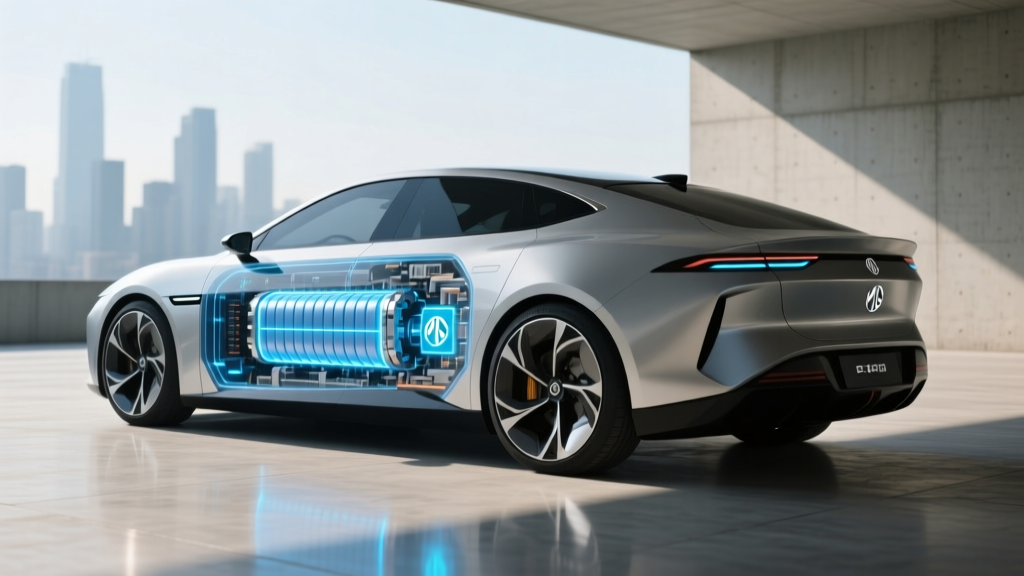
The MG semi-solid state battery has become one of the most discussed developments in EV battery technology. Announced by SAIC Motor — MG's parent company — in partnership with QingTao Energy, this next-generation cell promises higher energy density and improved safety compared to conventional lithium-ion packs. But where does it actually stand in 2026, and how does it compare to the LFP and NMC chemistries already powering millions of EVs on the road?
This guide breaks down the MG semi-solid state battery in the context of everything EV buyers and owners need to know about battery technology: chemistry trade-offs, real-world degradation data, warranty coverage, replacement costs, and how to maximize the lifespan of whatever pack is under your floor.
What Is the MG Semi-Solid State Battery?
The term "semi-solid state" refers to a battery cell that replaces the liquid electrolyte found in conventional lithium-ion batteries with a semi-solid or gel-like electrolyte. This is a stepping stone toward full solid-state batteries, which use an entirely solid electrolyte layer.
SAIC Motor and QingTao Energy have been co-developing this technology, with early production cells reportedly achieving energy densities above 360 Wh/kg at the cell level — significantly higher than the ~250–300 Wh/kg typical of current NMC cells. The MG semi-solid state battery is expected to debut in production vehicles under the IM Motors brand (SAIC's premium EV marque) before potentially filtering down to MG-badged models.
Key distinction: Semi-solid state batteries still contain some liquid electrolyte (typically 5–10% by weight). Full solid-state cells contain none. The semi-solid approach is considered more manufacturable at scale with current factory equipment, which is why it's reaching production sooner than pure solid-state designs.
As of early 2026, the MG semi-solid state battery remains in limited production and pre-commercial deployment. It is not yet available in any MG model sold in the United States or Europe. Buyers should treat all published specifications as preliminary until independent testing data is available from vehicles in customer hands.
EV Battery Chemistry Showdown: LFP vs NMC vs Semi-Solid State
To understand where the MG semi-solid state battery fits, you need to understand the two dominant chemistries in today's EV market: LFP (lithium iron phosphate) and NMC/NCA (nickel manganese cobalt / nickel cobalt aluminum).
| Attribute | LFP (Lithium Iron Phosphate) | NMC/NCA (Nickel-based) | Semi-Solid State (Emerging) |
|---|---|---|---|
| Cell energy density | 160–200 Wh/kg | 250–300 Wh/kg | 340–400 Wh/kg (reported) |
| Cycle life (to 80% capacity) | 3,000–6,000+ cycles | 1,000–2,500 cycles | 1,500–3,000 cycles (est.) |
| Cold-weather performance | Moderate — greater range loss below 32°F | Better low-temp discharge capability | Expected improvement (less electrolyte freezing risk) |
| Thermal runaway risk | Very low — most stable chemistry | Higher — requires robust thermal management | Lower than NMC — semi-solid electrolyte is less flammable |
| Cost per kWh (pack level) | ~$90–$110/kWh | ~$120–$150/kWh | Estimated $180–$250/kWh (early production) |
| Cobalt/nickel content | None — iron and phosphate only | Contains cobalt, nickel, manganese | Cathode chemistry varies; may use high-nickel cathode |
| Current availability (2026) | Widely available (Tesla Model 3 RWD, BYD, Ford) | Widely available (most long-range EVs) | Limited/pre-production (SAIC/IM Motors, NIO 150 kWh pack) |
LFP vs NMC — Which Is Better and Why?
There's no universal winner — it depends on your priorities:
- Choose LFP if: You want maximum cycle life, lower cost, better thermal safety, and you don't need the longest possible single-charge range. LFP is ideal for daily commuting and drivers who can charge at home regularly. Tesla's Model 3 RWD and BYD's entire lineup use LFP. One quirk: LFP batteries are harder for the battery management system (BMS) to estimate state of charge (SoC) accurately, so manufacturers often recommend periodically charging to 100% to recalibrate — unlike NMC, where 80% daily limits are preferred.
- Choose NMC/NCA if: You prioritize maximum range per charge, better cold-weather performance, and faster charging speeds. Most long-range and performance EVs (Hyundai Ioniq 5, BMW iX, Ford Mustang Mach-E Extended Range) use NMC. The trade-off is shorter cycle life and higher cost.
The MG semi-solid state battery aims to combine NMC-level energy density with improved safety and potentially longer cycle life — but at a cost premium that will likely restrict it to premium vehicles for several years.
How Long Do EV Batteries Actually Last?
The short answer: most EV traction batteries outlast the vehicles they're installed in. But the data matters more than the reassurance.
Real-World Degradation Data
Based on aggregated fleet data and independent testing, here's what typical degradation looks like across major chemistries:
Typical Capacity Retention Over Time (NMC batteries, liquid-cooled):
- Year 1 / 15,000 miles: ~2–4% loss (initial "break-in" degradation)
- Year 3 / 45,000 miles: ~5–8% total loss
- Year 5 / 75,000 miles: ~8–12% total loss
- Year 8 / 120,000 miles: ~10–15% total loss
- Year 10 / 150,000 miles: ~12–20% total loss (varies heavily by climate and charging habits)
LFP batteries typically show slower degradation — often retaining 90%+ capacity at 100,000 miles in moderate climates. Tesla's 2024 Impact Report noted that Model 3 RWD (LFP) batteries retained approximately 92% of original capacity at 100,000 miles.
The degradation curve is not linear. Most batteries lose capacity fastest in the first year or two, then the rate flattens considerably. This is why a 10-year-old EV battery with 85% remaining capacity is entirely plausible under normal use.
What Does the EV Battery Warranty Actually Cover?
Federal law in the United States mandates that EV batteries carry a minimum warranty of 8 years / 100,000 miles. In California Air Resources Board (CARB) states, that extends to 10 years / 150,000 miles for PZEV-classified vehicles. Most manufacturers exceed these minimums.
| Manufacturer | Warranty Period | Capacity Retention Threshold | Notes |
|---|---|---|---|
| Tesla (Model 3/Y RWD — LFP) | 8 yr / 120,000 mi | 70% | Long Range/Performance: 8 yr / 120,000 mi, 70% |
| Hyundai / Kia | 10 yr / 100,000 mi | 70% | Among the longest coverage periods |
| Ford (Mustang Mach-E, F-150 Lightning) | 8 yr / 100,000 mi | 70% | Covers battery pack and EV components |
| BMW | 8 yr / 100,000 mi | 70% | Applies to i4, iX, i7 lineup |
| BYD | 8 yr / 100,000 mi (varies by market) | 70% | Blade Battery (LFP) — some markets offer longer |
| GM (Ultium platform) | 8 yr / 100,000 mi | 70% | Covers Bolt EV/EUV, Blazer EV, Equinox EV, Cadillac Lyriq |
What triggers a warranty claim: If your battery's State of Health (SoH) drops below the stated threshold (typically 70% of original capacity) within the warranty period, the manufacturer must repair or replace the battery at no cost. This usually means replacing defective modules rather than the entire pack.
What's NOT covered: Damage from accidents, improper charging equipment, modifications, or complete neglect (e.g., leaving the vehicle at 0% SoC for extended periods causing cell damage). Normal degradation above the threshold is also not covered — a battery at 72% capacity after 9 years is functioning within warranty terms.
How Much Does It Cost to Replace an EV Battery?
This is the question that generates the most anxiety — and the most misinformation. Let's put real numbers to it.
| Vehicle / Battery Size | Battery Chemistry | Replacement Cost (Parts + Labor) |
|---|---|---|
| Nissan Leaf (40 kWh) | NMC (passive air cooling) | $6,500–$9,000 |
| Tesla Model 3 RWD (60 kWh) | LFP | $10,000–$14,000 |
| Tesla Model Y Long Range (75 kWh) | NMC | $12,000–$16,000 |
| Hyundai Ioniq 5 (77.4 kWh) | NMC | $13,000–$18,000 |
| Ford F-150 Lightning Extended Range (131 kWh) | NMC | $20,000–$30,000 |
| GMC Hummer EV (212 kWh) | NMC (Ultium) | $30,000–$40,000+ |
Context that matters: Battery replacement is rarely needed during the first 10–15 years of ownership. Data from fueleconomy.gov and manufacturer reports indicate that the vast majority of EV batteries never require full replacement — most outlive the vehicle's economic life. When replacements do occur, it's often due to manufacturing defects (covered under warranty) or collision damage (covered by insurance), not end-of-life degradation.
Additionally, module-level repair is increasingly common. Rather than replacing an entire pack, technicians can identify and swap out individual degraded modules for $2,000–$5,000, restoring most of the battery's original capacity.
Factors That Affect EV Battery Life (and What You Can Control)
Battery degradation is driven by chemistry, heat, and charge stress. Here's what matters most, ranked by impact:
Battery Care Best Practices
- Avoid sustained high SoC (NMC only): For NMC/NCA batteries, daily charging to 80% rather than 100% significantly reduces calendar degradation. LFP batteries are more tolerant of 100% SoC and often benefit from periodic full charges for BMS calibration.
- Minimize DC fast charging when possible: Frequent use of DC fast charging (especially above 150 kW) generates significant heat. Data from Geotab's fleet study of 6,300 EVs showed that vehicles fast-charging more than 3 times per month experienced slightly faster degradation — roughly 1–2% additional loss over 5 years compared to primarily Level 2 charging. This isn't catastrophic, but if you have home Level 2 access, use it as your primary method.
- Manage extreme temperatures: Battery degradation accelerates above 95°F ambient and below 15°F. Garage parking helps enormously. Preconditioning the battery before fast charging (a feature in most modern EVs) protects the cells by warming them to optimal temperature.
- Don't store at 0% or 100%: If leaving your EV unused for weeks, set the charge limit to 50–60%. Extended storage at full charge or near-empty accelerates calendar aging.
- Use the vehicle regularly: Batteries degrade less when they're cycled gently than when they sit idle for months. Regular driving with moderate SoC swings (e.g., 30%–80%) is ideal.
How to Check and Monitor Your Battery's State of Health
State of Health (SoH) is a percentage representing your battery's current maximum capacity relative to its original capacity when new. A new battery is 100% SoH; a battery that can now hold only 85 kWh of its original 100 kWh is at 85% SoH.
Methods for Checking SoH
- In-vehicle display: Many EVs (Tesla, Hyundai/Kia, BMW) now include a battery health indicator in the infotainment or service menu. Tesla added a battery health test in software updates that can be run from the service menu.
- OBD-II diagnostic tools: Devices like the OBDLink MX+ paired with apps such as EVNotify, LeafSpy (for Nissan Leaf), or ABRP can read detailed battery data including SoH, cell voltage variance, and individual module temperatures.
- Dealer diagnostic: Any authorized service center can run a full battery health report. Request this during routine service visits — it's typically free and takes 15–30 minutes.
- Third-party testing: Companies like Recurrent Auto provide battery health reports based on connected-car data, which can be valuable when buying or selling a used EV.
What to Watch For
Cell imbalance is a key indicator of battery health. If one module's voltage consistently deviates more than 20–30 mV from the pack average, it may indicate a failing cell group. Most modern BMS systems actively balance cells, so persistent imbalance warrants a dealer visit.
Emerging Battery Tech: Solid-State, Silicon Anodes, and Realistic Timelines
The MG semi-solid state battery is part of a broader wave of next-generation battery development. Here's where the technology stands with honest timelines:
- Semi-solid state (2024–2027): NIO's 150 kWh semi-solid pack (developed with WeLion) is the most commercially advanced example, offering a claimed 620-mile CLTC range in the ET7 sedan. SAIC/QingTao's cells target similar performance. These packs are in limited production but remain extremely expensive — NIO's 150 kWh pack costs roughly the price of an entire entry-level EV. Expect semi-solid tech in premium Chinese-market vehicles first, with Western-market availability likely not before 2028.
- Full solid-state (2028–2032+): Toyota, Samsung SDI, and QuantumScape continue to develop full solid-state cells. Toyota has announced a target of 2027–2028 for limited production. Manufacturing yield and cost remain the primary barriers. Realistic volume production for mainstream vehicles is likely a 2030+ proposition.
- Silicon anode batteries (2025–2028): Companies like Sila Nanotechnologies and Group14 are replacing graphite anodes with silicon to boost energy density by 20–40%. Mercedes-Benz's G-Class EV (2025) was among the first to use silicon anode cells. This technology is closer to mainstream adoption than solid-state and may reach volume production sooner.
- Sodium-ion batteries (2025–2027): CATL and BYD are producing sodium-ion cells for lower-cost, shorter-range EVs. Energy density is lower (~140 Wh/kg) but cost is significantly less than LFP. Expect these in budget city cars, not long-range vehicles.
For buyers in 2026, the practical takeaway is clear: today's LFP and NMC batteries are mature, well-understood technologies backed by extensive real-world data and strong warranties. The MG semi-solid state battery and its competitors represent genuine progress, but they remain years away from widespread availability at mainstream price points.
FAQ: EV Battery Technology Questions Answered
How long do EV batteries last in years and miles?
Most modern EV batteries are designed to last 15–20 years or 150,000–200,000 miles before reaching 70–80% of original capacity. Real-world data from fleets and consumer vehicles consistently shows that liquid-cooled NMC batteries retain approximately 85–90% capacity at 100,000 miles, while LFP batteries often exceed 90% at the same mileage. Complete battery failure before 150,000 miles is rare and typically covered under warranty.
Is the MG semi-solid state battery available to buy now?
No. As of 2026, the MG semi-solid state battery developed by SAIC and QingTao Energy is in limited pre-production and testing phases. It has appeared in select IM Motors vehicles in China but is not available in any MG-badged model in the US, Europe, or most export markets. Treat all published specs as preliminary.
Does fast charging damage my EV battery?
DC fast charging generates more heat than Level 2 charging, which modestly accelerates degradation. Geotab's fleet data shows roughly 1–2% additional capacity loss over 5 years for vehicles that fast-charge frequently (3+ times per month) versus those using primarily Level 2. Modern thermal management systems mitigate this significantly. Occasional fast charging on road trips has negligible long-term impact — it's daily fast charging in hot climates that has the most effect.
What happens when my EV battery degrades below 70%?
You'll notice reduced range — a vehicle originally rated for 300 miles EPA might deliver ~210 miles at 70% SoH. The car remains fully drivable. If this occurs within the warranty period (typically 8 years/100,000 miles), the manufacturer will repair or replace the battery at no cost. Out of warranty, you can continue driving with reduced range, pursue module-level repair ($2,000–$5,000), or replace the full pack ($10,000–$30,000+ depending on the vehicle).
Should I charge my EV to 100% every night?
It depends on your battery chemistry. For NMC/NCA batteries: no — set your daily charge limit to 80% and only charge to 100% before long trips. For LFP batteries: manufacturers like Tesla and BYD actually recommend charging to 100% at least once per week to help the BMS calibrate accurately. Check your owner's manual for chemistry-specific guidance.
Will solid-state batteries make current EVs obsolete?
Not anytime soon. Even when solid-state batteries reach volume production (realistically 2029–2032 for mainstream vehicles), current LFP and NMC batteries will remain competitive for most use cases due to their lower cost and proven reliability. Solid-state technology will initially appear in premium vehicles at premium prices, much like the MG semi-solid state battery today. Your current EV will not become obsolete — just as the introduction of turbocharged engines didn't make naturally aspirated engines worthless overnight.
Sources: EPA fueleconomy.gov for efficiency and range data; IRS irs.gov for current §30D tax credit rules affecting battery sourcing requirements; manufacturer warranty documentation from Tesla, Hyundai, Ford, BMW, and GM.