The Mercedes EQV Battery Warranty: What 8 Years and 160,000 km Actually Means
If you own or are considering a Mercedes-Benz EQV — the all-electric variant of the V-Class people mover — the high-voltage traction battery is likely your biggest long-term ownership question. Mercedes-Benz officially backs the EQV battery with an 8-year or 160,000 km (approximately 100,000 miles) warranty, whichever comes first. That warranty guarantees the battery will retain at least 70% of its original usable capacity over that period.
This is consistent with the broader Mercedes-EQ battery warranty framework and aligns with what most European and global EV manufacturers offer. But what does 70% retention mean in practice? How does the EQV's NMC battery chemistry hold up over time? And if something does go wrong out of warranty, what are you looking at in replacement costs?
This guide breaks down the EQV battery warranty in full context — including chemistry trade-offs, real-world degradation data, replacement economics, and the habits that will help your pack outlast the warranty by a wide margin.
| Specification | Value |
|---|---|
| Battery chemistry | NMC (Nickel Manganese Cobalt) |
| Total battery capacity | 90 kWh |
| Usable battery capacity | ~85 kWh (varies by model year) |
| WLTP range | ~363 km (225 mi) — EQV 300 |
| Real-world range (mixed) | ~280–310 km (175–195 mi) |
| Max DC fast charge rate | 110 kW |
| 10–80% DC charge time | ~45 minutes |
| Level 2 AC charge rate | 11 kW (onboard charger) |
| Battery warranty | 8 years / 160,000 km (100,000 mi) |
| Warranty capacity threshold | 70% of original usable capacity |
NMC Chemistry in the EQV: Why Mercedes Chose It and What It Means for You
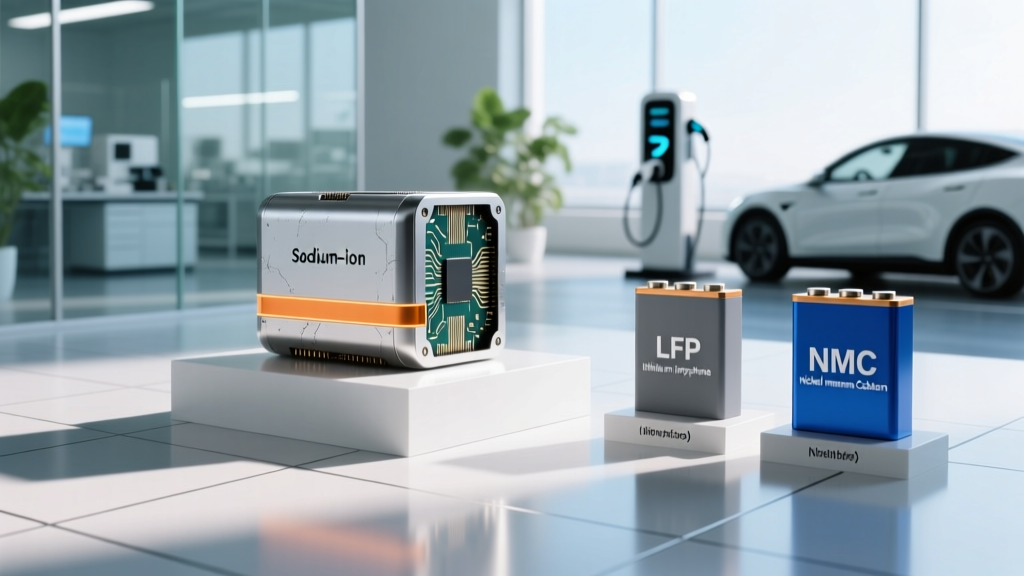
The Mercedes EQV uses an NMC (Nickel Manganese Cobalt) lithium-ion battery pack. This is the dominant chemistry in European and North American EVs for good reason: it offers the best balance of energy density and performance for a large, heavy vehicle like the EQV. But it's not the only option in the EV market, and understanding the trade-offs helps contextualize the warranty.
| Factor | NMC (EQV's Chemistry) | LFP (Lithium Iron Phosphate) |
|---|---|---|
| Energy density | Higher — more range per kg | Lower — heavier pack for same range |
| Cycle life | ~1,000–2,000 full cycles | ~3,000–5,000+ full cycles |
| Cold-weather performance | Better low-temp discharge | Reduced performance below 0°C / 32°F |
| Cost per kWh | Higher (cobalt/nickel pricing) | Lower (no cobalt, abundant iron) |
| Thermal stability | Good, requires active thermal mgmt | Excellent — inherently safer |
| Typical use case | Long-range, premium, large EVs | Standard-range, fleet, urban EVs |
| SoC recommendation | 20–80% daily for longevity | Can charge to 100% regularly |
For the EQV — a 2.6-tonne electric van designed for family and executive transport — NMC was the logical choice. The 90 kWh pack needs high energy density to deliver acceptable range in a vehicle with the aerodynamics of a brick. LFP, while longer-lived and cheaper, would require a significantly heavier pack to achieve the same range, worsening efficiency further.
The trade-off: NMC batteries degrade slightly faster than LFP and benefit from more careful state-of-charge management. This is precisely why Mercedes sets the warranty threshold at 70% — it accounts for the expected NMC degradation curve over 8 years of normal use.
EV Battery Degradation: Real Data on Capacity Loss Over Time
Every lithium-ion battery loses capacity over time. This is not a defect — it's electrochemistry. The question is how fast, and whether the EQV's degradation trajectory is likely to breach the 70% warranty threshold before year eight.
Based on aggregated fleet data from EQC owners (which shares a similar NMC architecture with the EQV), independent testing by Geotab's EV battery health study, and broader industry degradation models, here is what NMC battery degradation typically looks like:
Typical NMC Degradation Curve (Aggregated Fleet Data):
- Year 1: ~2–4% capacity loss (initial formation loss — steepest part of the curve)
- Year 2–3: ~1–2% per year (linear, slow degradation phase)
- Year 4–5: ~1–2% per year continued
- Year 6–8: ~1–1.5% per year
- Expected capacity at year 8: ~82–88% of original (well above 70% threshold)
Sources: Geotab fleet data (6,300+ EVs), Recurrent Auto battery reports, Mercedes-EQ owner forums.
The critical insight: most NMC batteries never reach the 70% warranty threshold under normal use. The degradation curve flattens significantly after the first year. A 2022 study by Recurrent Auto analyzing over 15,000 EVs found that the median EV retained approximately 88% of its original range after 5 years and 60,000 miles. Extrapolating to 8 years, most packs settle in the low-to-mid 80s percentage-wise.
For the EQV specifically, that means your 85 kWh usable capacity might realistically drop to around 70–75 kWh by year 8 — translating to roughly 240–270 km of real-world range instead of the original 280–310 km. Noticeable, but entirely livable for a vehicle primarily used for school runs, airport transfers, and city driving.
What the Mercedes EQV Battery Warranty Covers (and What It Doesn't)
Understanding the precise terms prevents unpleasant surprises. Here is the official framework:
| Item | Covered? | Details |
|---|---|---|
| Capacity below 70% within 8 yr / 160,000 km | Yes | Repair, module replacement, or full pack replacement at Mercedes discretion |
| Manufacturing defects in battery pack | Yes | Cell failures, BMS faults, cooling system defects |
| Gradual capacity loss above 70% | No | Considered normal wear — no claim even if within warranty period |
| Damage from accidents or collisions | No | Covered by collision/comprehensive insurance, not battery warranty |
| Water ingress / flood damage | No | Excluded as environmental damage |
| Unauthorized modifications or repairs | No | Third-party tampering voids warranty |
| 12V auxiliary battery | No | Separate warranty (typically 2–4 years) — distinct from HV traction battery |
| Charging equipment (cables, wallbox) | No | Separate accessory warranty |
A few nuances worth highlighting:
Module-level repair vs. full replacement: Mercedes, like most OEMs, will first attempt to diagnose and replace individual battery modules rather than swap the entire 90 kWh pack. The EQV battery is composed of multiple modules; if one or two degrade disproportionately, a targeted repair restores capacity without the cost and waste of a full replacement.
Warranty transferability: The Mercedes-EQ battery warranty is tied to the vehicle, not the original owner. If you buy a used EQV with 3 years and 50,000 km on the clock, you inherit the remaining 5 years / 110,000 km of battery coverage. This is critical for resale value.
Proof of capacity: If you suspect your EQV battery has dropped below 70%, a Mercedes dealer will perform an official State of Health (SoH) diagnostic using the vehicle's BMS (Battery Management System) data. This is the definitive measurement for warranty claims — third-party OBD2 readings are informative but not accepted for claims.
EV Battery Replacement Costs: EQV Context and Industry Benchmarks
This is where fear-mongering often takes over. Let's ground this in actual numbers and realistic timelines.
| Vehicle Class | Battery Size | Estimated Replacement Cost (USD) | Typical Need Timeline |
|---|---|---|---|
| Compact EV (e.g., Chevy Bolt) | 65 kWh | $14,000–$18,000 | Rarely needed; most packs outlive vehicle |
| Mid-size EV (e.g., Tesla Model 3) | 75–82 kWh | $16,000–$22,000 | Rarely needed within 15 years |
| Large EV / Van (e.g., Mercedes EQV) | 90 kWh | $20,000–$30,000 | Rarely needed; module repair more common |
| Luxury sedan/SUV (e.g., EQS, iX) | 100–120 kWh | $25,000–$40,000 | Very rare within vehicle lifespan |
For the EQV specifically, a full out-of-warranty pack replacement would likely fall in the $20,000–$30,000 range based on current NMC cell pricing and the pack's 90 kWh capacity. However, this scenario is statistically unlikely for the vast majority of owners, for several reasons:
- Battery prices continue to fall. NMC cell prices have dropped from ~$200/kWh in 2020 to roughly $100–120/kWh by 2025–2026, meaning a replacement in 2032 or 2034 will cost substantially less than today's estimates.
- Module repair is the norm. Individual module replacement typically costs $2,000–$5,000 and addresses most out-of-warranty capacity issues.
- Most EV batteries outlive their vehicles. The average passenger vehicle lifespan is 12–15 years. Data from Consumer Reports and fleet operators indicates that the majority of EV battery packs remain functional (above 70% SoH) well past 200,000 miles.
- Second-life and recycling markets are growing. Even a degraded EQV battery retains significant value for stationary energy storage or materials recovery.
The honest assessment: battery replacement is a legitimate cost risk for any EV, but it is not the financial catastrophe that anti-EV narratives suggest. For the EQV, the combination of an 8-year warranty, NMC durability data, and declining cell costs makes it a manageable long-term proposition.
How to Maximize EQV Battery Health: Practical Care Guidelines
NMC batteries are more sensitive to abuse than LFP, but they respond well to informed care. These habits will keep your EQV's battery well above the 70% threshold — and likely above 85% — through year 8 and beyond.
EQV Battery Care Checklist:
- Daily charging limit: Set to 80% for routine use. Reserve 100% charges for road trips where you need the full 363 km WLTP range.
- Avoid deep discharge: Try not to let SoC drop below 15–20%. The EQV's BMS has a buffer, but habitual deep cycling accelerates degradation.
- Minimize DC fast charging frequency: The EQV's 110 kW DC rate is moderate (not extreme), but daily fast charging still stresses NMC cells. Use Level 2 (11 kW AC) as your primary charging method.
- Precondition before fast charging: Use the Mercedes me app to precondition the battery when navigating to a DC charger. A warm battery (30–40°C) charges faster and with less cell stress.
- Park in shade or garages in extreme heat: Sustained high temperatures (above 35°C / 95°F ambient) accelerate NMC degradation more than any other factor. The EQV's active thermal management helps, but avoidance is better.
- Don't store at 100% SoC: If the EQV will sit unused for more than a week, aim for 50–60% SoC. High SoC + high temperature is the worst combination for lithium-ion longevity.
- Use the EQV's built-in charge scheduling: Set charging to complete just before departure, minimizing time spent at high SoC.
One often-overlooked factor: the EQV's active liquid thermal management system works continuously to keep the battery in its optimal temperature window. This is a significant advantage over passively-cooled packs (like early Nissan Leafs) and is a major reason why modern Mercedes-EQ batteries degrade more slowly than first-generation EVs.
Checking Your EQV's Battery State of Health (SoH)
State of Health (SoH) is the metric that tells you how much of your battery's original capacity remains. A new EQV battery is at 100% SoH; the warranty triggers at 70%.
How to check SoH on the EQV:
- Mercedes me app / MBUX system: Some model years display a battery health indicator in the vehicle settings or connected services menu. This is a simplified readout — useful for trend monitoring but not precise enough for warranty claims.
- Dealer diagnostic: A Mercedes-EQ service center can perform a full BMS readout, providing precise SoH percentage, individual module voltage variance, and internal resistance data. This is the gold standard and the only measurement accepted for warranty claims.
- OBD2 diagnostic tools: Third-party tools (such as OBD dongles paired with apps like Car Scanner or ABRP) can read BMS data from the EQV's CAN bus. These give a reasonable SoH estimate and are useful for monitoring between dealer visits, but readings vary in accuracy.
- Range-based estimation: Track your real-world range over time under consistent conditions (same route, similar temperature, similar driving style). A steady decline in achievable range correlates with SoH loss, though it's confounded by temperature and driving variables.
We recommend a dealer SoH check annually after year 3, or any time you notice a sudden range drop that can't be explained by cold weather or driving pattern changes.
Looking Ahead: Solid-State and Silicon-Anode Batteries
Mercedes-Benz has been vocal about its next-generation battery roadmap, including partnerships with Factorial Energy on solid-state battery technology. These developments are genuinely promising but remain forward-looking:
- Solid-state batteries: Mercedes has demonstrated prototype cells with energy density exceeding 390 Wh/kg (roughly double current NMC). However, production-scale solid-state packs are not expected in volume vehicles before 2028–2030. The EQV's current NMC pack will not be retrofitted with solid-state cells.
- Silicon-anode technology: Mercedes is incorporating silicon-dominant anodes in upcoming platforms (MMA architecture), promising 20–40% energy density gains. This is expected in new models from 2025–2027 onward, not as a retrofit for current EQV owners.
- Sodium-ion batteries: Emerging as a low-cost alternative for urban and fleet vehicles. Unlikely to appear in a premium van like the EQV, but relevant to the broader market.
For current EQV owners: these technologies confirm that battery costs will continue declining and energy density will continue improving. If you ever do need an out-of-warranty replacement in the 2030s, the pack will likely be cheaper and potentially more advanced than what's in your EQV today.
Frequently Asked Questions
How long do EV batteries last in years and miles?
Based on fleet data from Geotab, Recurrent Auto, and Consumer Reports, modern NMC batteries (like the EQV's) typically retain 80–90% of original capacity after 10 years or 150,000 miles. Most EV batteries outlast the vehicles they're installed in. The EQV's 8-year/160,000 km warranty at 70% retention is a conservative floor — not a prediction of end-of-life.
How much does a Mercedes EQV battery cost to replace?
A full out-of-warranty EQV battery replacement is estimated at $20,000–$30,000 based on current pricing for a 90 kWh NMC pack. However, module-level repairs ($2,000–$5,000) are far more common, and battery cell prices continue to decline. Full pack replacement is statistically rare within the vehicle's typical 12–15 year lifespan.
What does the Mercedes EQV battery warranty cover?
The official warranty covers capacity loss below 70% of original usable capacity within 8 years or 160,000 km, plus manufacturing defects (cell failures, BMS faults, cooling system issues). It does not cover gradual degradation above 70%, accident damage, flood damage, unauthorized modifications, or the 12V auxiliary battery.
How do I check and maximize my EQV battery health?
Check SoH via the Mercedes me app, OBD2 diagnostic tools, or an annual dealer BMS readout. Maximize longevity by charging to 80% daily, avoiding deep discharge below 20%, minimizing DC fast charging frequency, preconditioning before fast charges, and avoiding prolonged storage at 100% SoC or in extreme heat.
LFP vs NMC — which battery chemistry is better?
Neither is universally better; they serve different use cases. NMC (used in the EQV) offers higher energy density and better cold-weather performance, making it ideal for long-range and large vehicles. LFP offers longer cycle life, lower cost, and better thermal stability, making it ideal for standard-range and fleet vehicles. For a heavy van like the EQV, NMC was the correct engineering choice.
Does frequent DC fast charging damage the EQV battery?
Frequent DC fast charging accelerates NMC degradation compared to Level 2 AC charging, but the effect is moderate with the EQV's 110 kW peak rate (which is relatively conservative). Occasional fast charging on road trips is fine; daily reliance on DC fast charging will measurably increase capacity loss over 5–8 years. The EQV's active thermal management mitigates much of the heat stress.
Is the EQV battery warranty transferable to a second owner?
Yes. The Mercedes-EQ battery warranty is tied to the vehicle VIN, not the original purchaser. A second owner inherits the remaining warranty period and mileage. This supports stronger resale values for EQVs with documented battery health.