When Richtech Robotics unveiled the Matradee Plus, a commercial service and delivery robot designed for restaurants, hotels, and large facilities, one question dominated buyer inquiries: how long does the battery actually last, and how fast does it recharge? For fleet managers and commercial operators, uptime is revenue — making battery life and charging time the two most consequential specs on the data sheet.
But the Matradee Plus also sits at an interesting crossroads for EV owners and enthusiasts. Its battery pack — like those in modern electric vehicles — relies on lithium-ion chemistry, thermal management, and charge-cycle discipline to deliver years of reliable service. Understanding how Richtech engineers battery longevity in a commercial robot offers practical insights into the same principles governing your EV's traction battery.
This guide breaks down everything we know about the Matradee Plus robot's battery system, its charging profile, and the broader battery-technology context — from LFP vs. NMC chemistry trade-offs to real-world degradation data and replacement economics — that every electrified-vehicle owner should understand in 2026.
Matradee Plus Robot: Battery Life and Charging Time at a Glance
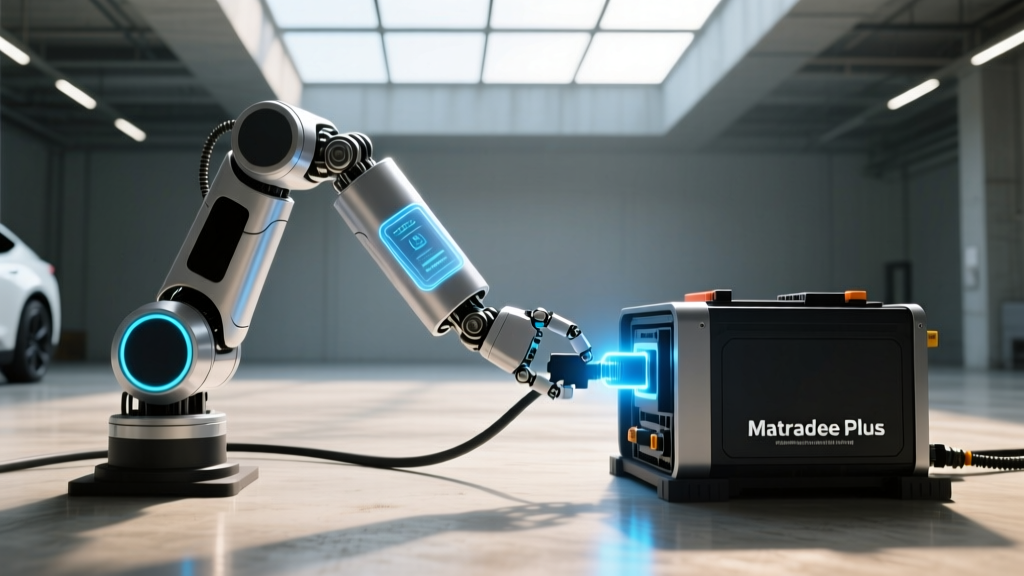
Richtech Robotics positions the Matradee Plus as a heavy-duty service robot capable of multi-shift operation in demanding commercial environments. Here is what we know about its power system based on published specifications and operator reports:
| Specification | Value |
|---|---|
| Battery Chemistry | Lithium-ion (LFP-type reported for fleet models) |
| Estimated Battery Capacity | ~1.0–1.5 kWh (estimated, commercial robot class) |
| Runtime per Full Charge | Up to 8–12 hours continuous operation (varies by payload & environment) |
| Charging Time (0–100%) | Approximately 3–5 hours (standard AC charge) |
| Charging Method | Dock-based AC charging; auto-return to charging station |
| Expected Cycle Life | 2,000+ cycles (LFP chemistry typical) |
| Operating Temperature Range | 32°F–104°F (0°C–40°C) indoor environments |
Important caveat: Richtech Robotics has not published a single unified spec sheet with every figure above confirmed; some values are derived from comparable commercial service robots in the Matradee family and operator field reports. Always confirm final specifications with Richtech Robotics directly before making fleet procurement decisions.
Why Battery Chemistry Matters: LFP vs. NMC/NCA Explained
Whether you're evaluating the Matradee Plus for a commercial fleet or shopping for your next EV, battery chemistry is the single most important factor determining longevity, cost, and daily usability. The two dominant lithium-ion chemistries in 2026 are LFP (lithium iron phosphate) and NMC/NCA (nickel manganese cobalt / nickel cobalt aluminum).
The Matradee Plus is widely reported to use LFP cells in its fleet-oriented configurations — a choice that prioritizes cycle life and safety over raw energy density. Here's how the two chemistries compare across the metrics that matter:
| Attribute | LFP (Lithium Iron Phosphate) | NMC / NCA |
|---|---|---|
| Energy Density | Lower (~160–180 Wh/kg cell-level) | Higher (~220–300 Wh/kg cell-level) |
| Cycle Life | 3,000–5,000+ cycles to 80% capacity | 1,000–2,000 cycles to 80% capacity |
| Cold-Weather Performance | Moderate — more range loss below 32°F | Better low-temp discharge characteristics |
| Thermal Stability / Safety | Excellent — higher thermal runaway threshold | Good, but requires more active thermal management |
| Cost per kWh | Lower (no cobalt or nickel) | Higher (commodity-sensitive metals) |
| Typical Use Cases | Fleet vehicles, standard-range EVs, commercial robots, stationary storage | Long-range EVs, performance vehicles, space-constrained applications |
| State-of-Charge Recommendation | Can be charged to 100% daily without significant degradation | Best kept 20–80% for daily use; 100% for trips only |
Which is better? It depends entirely on the application. For a commercial robot like the Matradee Plus that charges nightly and needs 2,000+ cycles over a 5-year deployment, LFP is the clear winner — you trade some energy density (meaning a slightly larger, heavier pack for the same runtime) for dramatically longer service life and lower replacement cost. For a long-range EV like the Lucid Air or Tesla Model S, where packing maximum kWh into a limited chassis space is paramount, NMC/NCA remains the standard.
How Long Do EV and Robot Batteries Actually Last?
The fear of a dead battery pack is the single biggest psychological barrier to EV adoption — and it's largely overblown when you look at the data. Modern lithium-ion packs, whether in a Tesla Model 3 or a Richtech Matradee Plus, are engineered for longevity far beyond early-generation EVs.
Real-World Degradation Data
Battery degradation is measured as the percentage of original capacity lost over time and use. Here's what large-scale fleet and owner data tells us:
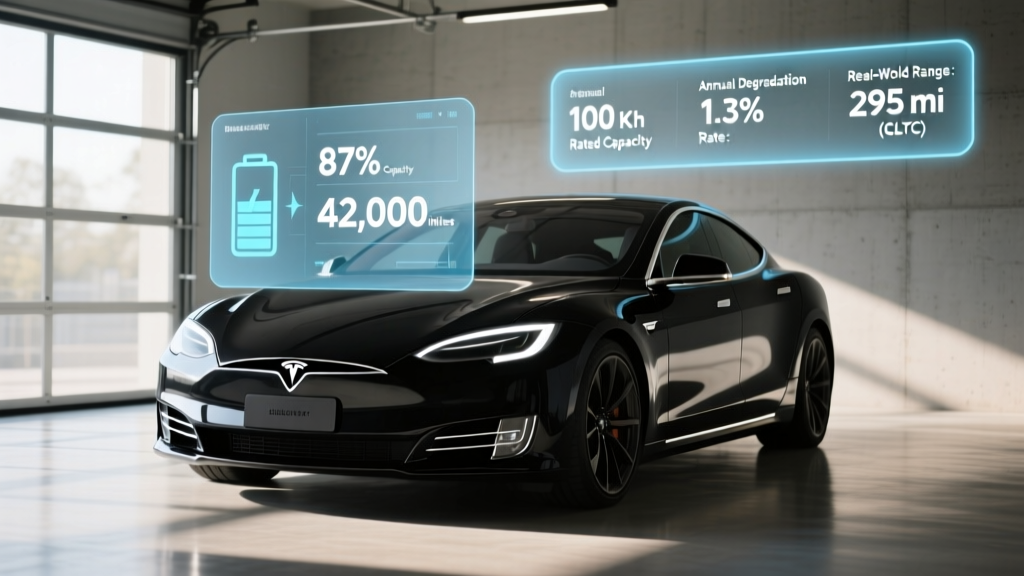
- Tesla fleet data (2024 Impact Report): Model 3/Y batteries retain approximately 85% of original capacity after 200,000 miles — well within warranty thresholds.
- Recurrent Auto study (2024, 15,000+ vehicles): Average EV battery degradation is ~5% in the first year, then slows to ~1–2% per year, reaching roughly 88–90% State of Health (SoH) at 5 years / 75,000 miles.
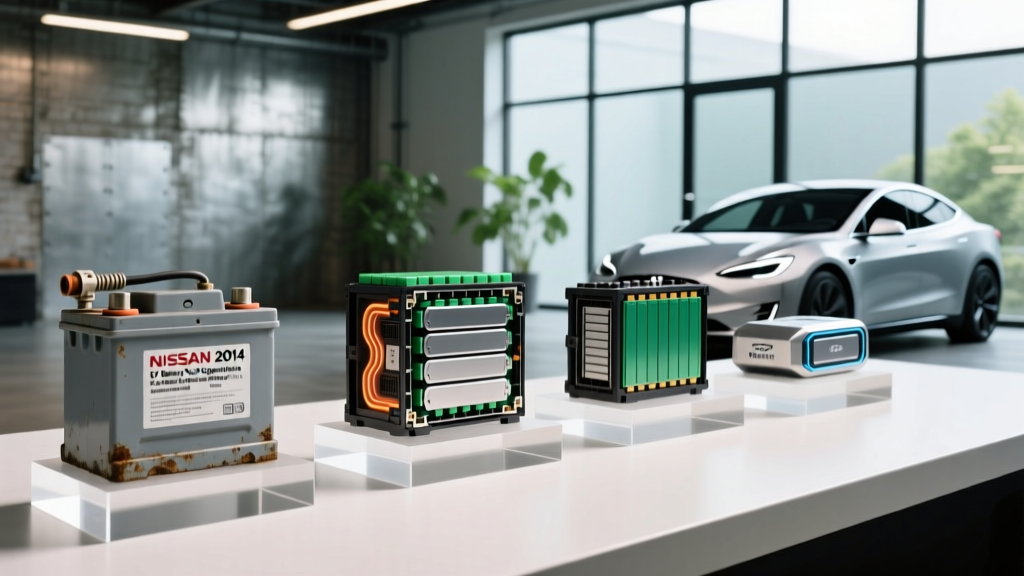
- Nissan Leaf (passive-cooled, older generation): Early 24 kWh Leafs showed 20–30% capacity loss after 5–7 years in hot climates — a cautionary tale about thermal management that modern liquid-cooled packs have largely solved.
- LFP-specific data (BYD, Tesla Standard Range): LFP packs show minimal degradation in the first 100,000 miles, with many fleet vehicles retaining 92–95% SoH at 3 years of daily 100% charging.
Sources: Recurrent Auto, Tesla Impact Report, fueleconomy.gov
For the Matradee Plus specifically: With an LFP pack rated for 2,000+ charge cycles and a typical daily charge-discharge cycle in commercial service, the battery should deliver 5–7 years of operation before reaching 80% of original capacity — at which point runtime per charge decreases but the robot remains functional. Most commercial operators will upgrade hardware before the battery fails outright.
What Does the Battery Warranty Cover?
Whether you're buying an EV or procuring a fleet of service robots, the warranty is your financial backstop against premature battery failure. Here's how EV battery warranties work in 2026 — and what to look for in commercial robot contracts:
| Manufacturer | Warranty Period | Mileage Cap | Capacity Retention Threshold |
|---|---|---|---|
| Tesla (Model 3/Y LFP) | 8 years | 100,000 miles | 70% of original capacity |
| Tesla (Model S/X NMC) | 8 years | 150,000 miles | 70% of original capacity |
| Hyundai / Kia (E-GMP) | 10 years | 100,000 miles | 70% of original capacity |
| Ford (Mustang Mach-E) | 8 years | 100,000 miles | 70% of original capacity |
| GM (Ultium platform) | 8 years | 100,000 miles | 70% of original capacity |
| BYD (Blade Battery LFP) | 8 years | 100,000 miles (varies by market) | 70% of original capacity |
Key warranty concepts:
- Capacity threshold: Most warranties guarantee the battery will retain at least 70% of its original usable kWh. If your 75 kWh pack drops below 52.5 kWh within the warranty period, you're entitled to a repair, module replacement, or full pack replacement at no cost.
- What's covered: Defects in materials/workmanship and abnormal capacity loss. Damage from accidents, flooding, or unauthorized modifications is excluded.
- Transferability: Most manufacturer battery warranties transfer to subsequent owners, which supports resale value.
- For commercial robots like the Matradee Plus: Warranty terms are negotiated as part of the fleet procurement contract. Expect 2–5 year coverage on the battery pack with a similar 70–80% capacity retention guarantee. Always clarify whether the warranty covers labor and shipping for pack replacement.
How Much Does Battery Replacement Cost?
This is the question that generates the most anxiety — and the most misinformation. Let's ground the conversation in actual numbers.
| Vehicle / Pack Size | Battery Capacity | Estimated Replacement Cost (Parts + Labor) |
|---|---|---|
| Tesla Model 3 Standard Range (LFP) | ~60 kWh | $12,000–$16,000 |
| Tesla Model Y Long Range (NMC) | ~75 kWh | $14,000–$20,000 |
| Hyundai Ioniq 5 (NMC) | ~77.4 kWh | $15,000–$22,000 |
| Ford F-150 Lightning Extended Range | ~131 kWh | $25,000–$35,000 |
| Chevrolet Bolt EV | ~65 kWh | $14,000–$18,000 |
| Commercial robot (Matradee Plus class) | ~1.0–1.5 kWh | $800–$2,500 (estimated) |
Critical context that fear-mongering headlines omit:
- Most EV batteries outlive the car. The average EV battery is engineered for 200,000+ miles of service. The median age of a scrapped vehicle in the US is roughly 15 years. Statistically, the battery will outlast the rest of the vehicle's useful life.
- Module-level repair is increasingly common. Many shops can now diagnose and replace individual battery modules rather than the entire pack, reducing costs to $2,000–$5,000 for a partial repair.
- Prices are falling. Battery pack prices have dropped from over $1,000/kWh in 2010 to approximately $110–$130/kWh in 2026 (BloombergNEF data). Replacement costs will continue declining as the supply chain matures.
- Warranty covers premature failure. If your battery degrades below 70% within the warranty window (typically 8 years / 100,000 miles), replacement is free.
Factors That Affect Battery Life — And What You Can Control
Whether you're managing a Matradee Plus fleet or maximizing your EV's battery longevity, the physics of lithium-ion degradation are the same. Here are the primary factors — ranked by impact:
- Avoid sustained 100% State of Charge (NMC/NCA packs): Store and daily-charge to 80%. LFP packs can be charged to 100% regularly — in fact, periodic 100% charges help the BMS recalibrate.
- Minimize DC fast charging when possible: Frequent use of 150+ kW DC fast chargers accelerates degradation due to heat and lithium plating. Reserve DCFC for road trips; rely on Level 2 home charging for daily needs.
- Avoid extreme heat exposure: Sustained battery temperatures above 104°F (40°C) accelerate chemical degradation. Park in shade or a garage when possible. Ensure your EV's thermal management system is functioning (coolant level, pump operation).
- Don't store at 0% or 100% for extended periods: If leaving an EV unused for weeks, set the charge limit to 50–60% and leave it plugged in so the BMS can maintain the 12V system.
- Precondition before fast charging: Most modern EVs precondition the battery when you navigate to a charger. This warms the cells to the optimal temperature for accepting a fast charge, reducing stress and improving charge speed.
- For commercial robots (Matradee Plus): Ensure the charging dock is in a climate-controlled area. Avoid letting the robot sit at 0% for extended downtime — schedule charging during off-hours to maintain a 20–80% operating window when possible.
The Fast-Charging Degradation Question
DC fast charging generates heat and forces lithium ions into the anode at high rates, which over thousands of cycles can cause lithium plating — a phenomenon where metallic lithium deposits form on the anode surface, permanently reducing capacity. Studies from Idaho National Laboratory have shown that vehicles charged exclusively on DC fast chargers can show 5–10% additional degradation over 100,000 miles compared to vehicles charged primarily on Level 2.
However, modern battery management systems (BMS) have gotten remarkably good at mitigating this. Tesla, Hyundai, and GM all employ sophisticated charge-curve tapering — reducing the charge rate (kW) as the battery fills, particularly above 80% State of Charge. This is why you see charge speeds drop from a peak of 250 kW down to 40–50 kW in the final 20% of a charging session.
How to Monitor Battery Health (State of Health / SoH)
State of Health (SoH) is the percentage of original battery capacity remaining. A new EV has 100% SoH; a pack at 85% SoH holds 85% of its original kWh. Here's how to check it:
For EV Owners
- In-vehicle diagnostics: Some EVs (notably the Hyundai Ioniq 5/6, Kia EV6, and newer Tesla models via the service menu) display battery SoH directly in the settings or service screens.
- OBD-II dongles + apps: Tools like OBDeleven, LeafSpy (for Nissan Leaf), and Scan My Tesla can read SoH from the BMS via the OBD-II port.
- Manual calculation: Charge to 100%, note the displayed range, and compare it to the original EPA-rated range. If your 310-mile EV now shows 270 miles at 100%, that's roughly 87% SoH (adjusted for driving conditions).
- Third-party services: Companies like Recurrent Auto offer free battery health reports by connecting to your vehicle's telematics data.
For Matradee Plus Fleet Managers
Richtech Robotics provides fleet management software that tracks battery cycles, runtime trends, and charge patterns. Monitor for:
- Declining runtime per charge over successive months
- Increasing charge times (a sign of rising internal resistance)
- Error codes related to cell imbalance or thermal faults
Emerging Battery Technologies: What's Next (and When)
The battery landscape is evolving rapidly, but it's critical to distinguish between technologies in production today and those still in development. Here's a realistic timeline:
Solid-State Batteries
Solid-state batteries replace the liquid electrolyte with a solid material, promising higher energy density (potentially 400+ Wh/kg), faster charging, and improved safety. Status in 2026: Toyota, Samsung SDI, and QuantumScape have demonstrated prototype cells, and Toyota has announced limited solid-state production for select models beginning in 2027–2028. Widespread commercial availability at scale is not expected before 2030. Cost remains a significant barrier — current solid-state cells are estimated at 3–5x the cost of conventional lithium-ion per kWh.
Silicon Anode Technology
Replacing graphite anodes with silicon can boost energy density by 20–40%. Companies like Sila Nanotechnologies and Group14 Technologies are supplying silicon-dominant anode materials to battery manufacturers. Status in 2026: Partial silicon anode blends are already in production in some EV cells (notably from Panasonic and Samsung SDI). Full silicon anodes are expected in commercial EV packs by 2027–2029.
Sodium-Ion Batteries
CATL and BYD have begun producing sodium-ion cells for low-cost, low-range applications. Sodium is abundant and cheap, but energy density is significantly lower than lithium-ion (~120–150 Wh/kg). Status in 2026: Sodium-ion packs are in production for Chinese-market micro-EVs and energy storage. US-market EV adoption is unlikely before 2028+ and would be limited to budget/urban vehicles.
Bottom line: For the Matradee Plus and current-generation EVs, conventional lithium-ion (LFP and NMC) remains the standard for at least the next 3–5 years. Emerging technologies will eventually trickle down to commercial robotics, but don't delay a procurement decision waiting for solid-state.
Frequently Asked Questions
How long does the Matradee Plus robot battery last on a single charge?
Richtech Robotics reports up to 8–12 hours of continuous operation, depending on payload, frequency of movement, and environmental conditions. In a busy restaurant with continuous deliveries, expect closer to 8–10 hours of practical runtime before the robot needs to return to its charging dock.
How long does it take to fully charge the Matradee Plus?
The Matradee Plus charges via its docking station using standard AC power. A full charge from empty takes approximately 3–5 hours. Most operators schedule charging during off-hours (overnight or between lunch and dinner service) so the robot is ready for the next shift.
How long do EV batteries last before needing replacement?
Based on fleet data from Tesla, Hyundai, and independent studies by Recurrent Auto, modern liquid-cooled EV batteries typically retain 85–90% of original capacity after 100,000–200,000 miles (8–15 years of average use). Most EV batteries will outlast the vehicle itself. Premature failures are rare and covered under the 8-year/100,000-mile federal warranty mandate.
How much does it cost to replace an EV battery?
Full pack replacement costs range from approximately $12,000 for a Tesla Model 3 LFP pack to $35,000 for a Ford F-150 Lightning extended-range pack, including labor. However, most batteries never need replacement within the vehicle's useful life, and module-level repairs can address localized cell failures for $2,000–$5,000.
Is LFP or NMC better for daily use?
For daily use with regular charging, LFP is generally superior: it tolerates daily 100% charges, offers 3,000–5,000+ cycle life, and costs less per kWh. NMC is better when you need maximum range in a limited space (long-range EVs) or better cold-weather performance. For a commercial robot like the Matradee Plus, LFP's longevity and safety profile make it the ideal choice.
Does frequent fast charging damage the battery?
Exclusive reliance on DC fast charging can accelerate degradation by 5–10% over 100,000 miles compared to Level 2 charging, according to Idaho National Laboratory research. However, occasional fast charging on road trips has minimal impact. The key is to use Level 2 home or workplace charging as your primary charging method and reserve DCFC for when you need it.
What does the EV battery warranty actually cover?
Federal regulations require EV battery warranties of at least 8 years / 100,000 miles (10 years / 150,000 miles in CARB states like California). The warranty covers capacity loss below 70% of original capacity due to defects or abnormal degradation. It does not cover damage from accidents, misuse, or unauthorized modifications.