When you research your next electric vehicle, you likely scrutinize range, charging speed, and price. But the single most expensive component in any EV — the high-voltage traction battery — often gets reduced to a single kWh number. Who actually built that battery, what chemistry is inside, and how will it age over a decade of ownership? Understanding the major battery manufacturers behind today's EVs, and the cell chemistries they produce, is essential for making an informed purchase and managing long-term ownership costs.
This guide maps the global battery supply chain to the vehicles on dealer lots in 2026, breaks down LFP versus NMC/NCA chemistry trade-offs with real degradation data, and gives you a practical framework for monitoring and maximizing your battery's State of Health (SoH).
The Major Battery Manufacturers Powering 2026 EVs
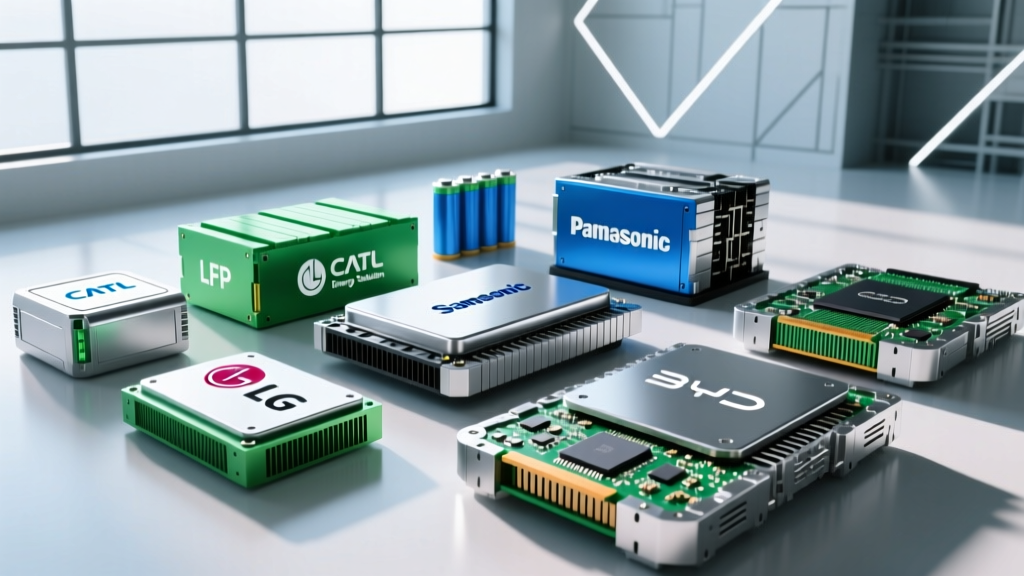
Five companies dominate global EV battery cell production, collectively supplying the vast majority of packs in vehicles sold in the United States. Each manufacturer has distinct chemistry specializations, major automaker partnerships, and manufacturing footprints that influence everything from your vehicle's range to its federal tax credit eligibility under IRS §30D battery-sourcing rules.
| Manufacturer | HQ | Primary Chemistries | Key U.S. OEM Partners (2026) | Notable U.S. Vehicles Supplied |
|---|---|---|---|---|
| CATL | China | LFP (Shenxing, Qilin), NMC | Tesla, Ford (licensed tech), BMW | Tesla Model 3/Y RWD, Ford F-150 Lightning (select trims) |
| BYD (FinDreams) | China | LFP (Blade Battery) | BYD (internal), Toyota (bZ3 in Asia) | Limited U.S. presence; BYD commercial vehicles |
| LG Energy Solution | South Korea | NMC (NCMA), LFP (emerging) | GM, Honda, Hyundai, Stellantis, Ford | Chevy Equinox EV, Cadillac Lyriq, Hyundai Ioniq 5/6, Ford Mustang Mach-E |
| Panasonic | Japan | NCA, NMC (4680 cells) | Tesla, Toyota | Tesla Model Y (Austin-built), Model 3 Long Range |
| SK On | South Korea | NMC (high-nickel) | Ford, Hyundai, BlueOval SK JV | Ford F-150 Lightning (extended range), Hyundai Ioniq 5 (select packs) |
Why this matters for buyers: The manufacturer and chemistry affect not just your driving experience but also your eligibility for the §30D federal tax credit. Under current IRS rules, battery components and critical minerals must meet escalating domestic-content and free-trade-partner sourcing thresholds. Batteries with significant Chinese-sourced critical minerals (common in CATL LFP packs) may disqualify a vehicle from the full credit. Always verify current-year eligibility on the IRS site or with a tax professional before purchasing.
LFP vs NMC/NCA: Chemistry Trade-Offs Explained
Every EV battery uses one of two dominant lithium-ion cathode chemistries: lithium iron phosphate (LFP) or nickel manganese cobalt / nickel cobalt aluminum (NMC/NCA). The chemistry determines energy density, cycle life, cold-weather performance, cost, and even the charging habits you should adopt. Here is how they compare head-to-head.
| Attribute | LFP (Lithium Iron Phosphate) | NMC / NCA (Nickel-based) |
|---|---|---|
| Energy Density | Lower (~160-180 Wh/kg cell-level) | Higher (~220-300 Wh/kg cell-level) |
| Typical EV Range Impact | Shorter range for same pack weight/volume | Longer range per kWh; enables 300+ mi packs |
| Cycle Life | 3,000-5,000+ full cycles to 80% capacity | 1,000-2,000 full cycles to 80% capacity |
| Calendar Aging | Slower degradation at high SoC; tolerates 100% daily charge | Faster degradation above 80% SoC; 50-80% daily window ideal |
| Cold-Weather Performance | Greater range loss in freezing temps (~30-40% at 20°F) | Better cold retention (~20-30% loss at 20°F) |
| DC Fast-Charging Tolerance | Handles frequent DCFC well; less heat sensitivity | More stress from repeated high-power DCFC sessions |
| Cost per kWh | Lower ($90-$110/kWh cell-level in 2026) | Higher ($120-$150/kWh cell-level in 2026) |
| Critical Mineral Concerns | No cobalt or nickel; iron and phosphate abundant | Cobalt, nickel sourcing raises ethical/supply-chain issues |
| SoC Estimation Accuracy | Flatter voltage curve makes SoC estimation harder | More linear voltage curve; easier SoC readout |
Which Chemistry Is Better for You?
There is no universal winner — the right choice depends on your driving pattern:
- Choose LFP if: You primarily commute under 100 miles daily, can charge at home every night to 100%, live in a mild climate, and prioritize long-term durability and lower cost. Tesla Model 3/Y RWD (CATL LFP) exemplifies this use case.
- Choose NMC/NCA if: You need maximum range for road trips, live in a cold-weather state where every mile of range matters in winter, or frequently drive long highway stretches between charges. Vehicles like the Hyundai Ioniq 5 Long Range (LG NMC, EPA 310 mi) or Tesla Model Y Long Range (Panasonic NCA, EPA ~330 mi) fit this profile.
How Long Do EV Batteries Actually Last?
The fear that an EV battery will fail like a smartphone battery after two years is one of the most persistent myths in electrification. Real-world data from fleets and long-term owners tells a very different story.
Typical Degradation Curve (Based on Fleet & Owner Data)
| Time / Mileage | Average Capacity Retained (NMC) | Average Capacity Retained (LFP) | Data Source Notes |
|---|---|---|---|
| Year 1 / ~15,000 mi | 96-98% | 97-99% | Initial break-in loss; steepest early drop |
| Year 3 / ~45,000 mi | 92-95% | 95-97% | Linear degradation phase begins |
| Year 5 / ~75,000 mi | 88-93% | 93-96% | Most vehicles still well above warranty threshold |
| Year 8 / ~120,000 mi | 82-88% | 89-94% | Warranty period ends; most packs still functional |
| Year 10 / ~150,000 mi | 78-85% | 86-92% | Range reduced but vehicle remains usable |
| Year 15 / ~200,000 mi | 70-80% | 82-90% | LFP packs often outlast the vehicle chassis |
Data synthesized from fueleconomy.gov long-term testing, Tesla Impact Reports, Recurrent Auto fleet data, and Geotab fleet studies. Individual results vary based on climate, charging habits, and thermal management system quality.
The key takeaway: most modern EV batteries are engineered to last the life of the vehicle. A 2026 NMC pack losing 15% capacity over 10 years still delivers usable daily range, and an LFP pack may barely notice the loss. Complete battery failure before 150,000 miles is rare and typically covered under warranty.
What Does the Battery Warranty Actually Cover?
Federal law mandates a minimum battery warranty of 8 years / 100,000 miles for EVs, but many automakers exceed this baseline, and the details of what constitutes a "warranty claim" vary. The critical metric is the capacity retention threshold — the percentage of original capacity below which the manufacturer will repair or replace the pack.
| Manufacturer (2026 Models) | Warranty Duration | Mileage Limit | Capacity Retention Threshold | Chemistry |
|---|---|---|---|---|
| Tesla (Model 3/Y RWD) | 8 years | 100,000 mi | 70% | LFP (CATL) |
| Tesla (Model 3/Y LR/Perf) | 8 years | 120,000 mi | 70% | NCA (Panasonic) |
| Hyundai / Kia | 10 years | 100,000 mi | 70% | NMC (LG/SK On) |
| GM (Ultium-based) | 8 years | 100,000 mi | 70% | NMC (LG Ultium Cells JV) |
| Ford | 8 years | 100,000 mi | 70% | NMC/LFP (SK On/CATL) |
| BMW | 8 years | 100,000 mi | 70% | NMC (Samsung SDI/CATL) |
| Volkswagen | 8 years | 100,000 mi | 70% | NMC (SK On/LG) |
What is covered: Defects in materials/workmanship and capacity loss below the stated threshold under normal use.
What is typically NOT covered: Damage from accidents, flooding, improper modifications, or use outside manufacturer guidelines (e.g., consistent 100% SoC storage on NMC packs against owner's manual advice).
EV Battery Replacement Cost: What to Budget For
If your battery degrades below the warranty threshold — or if you keep your EV well past the warranty period and eventually need a replacement — costs are significant but declining. In 2026, pack-level replacement costs (parts + labor) typically fall in these ranges:
| Battery Size / Vehicle Segment | Approximate Pack Cost (Parts) | Labor & Programming | Total Replacement Range | Example Vehicles |
|---|---|---|---|---|
| 50-60 kWh (compact/standard range) | $5,500 - $8,000 | $1,500 - $2,500 | $7,000 - $10,500 | Tesla Model 3 RWD, Chevy Bolt EV |
| 70-85 kWh (mid-size / long range) | $8,000 - $13,000 | $2,000 - $3,500 | $10,000 - $16,500 | Tesla Model Y LR, Hyundai Ioniq 5 LR, Ford Mustang Mach-E ER |
| 90-100 kWh (large / performance) | $12,000 - $18,000 | $2,500 - $4,000 | $14,500 - $22,000 | Tesla Model S/X, GMC Hummer EV, Rivian R1T (Max Pack) |
| 100-135 kWh (truck / heavy-duty) | $15,000 - $25,000 | $3,000 - $5,000 | $18,000 - $30,000 | Ford F-150 Lightning ER, Chevy Silverado EV |
When is replacement typically needed? For most owners, it is not. Data from Recurrent Auto and Geotab shows fewer than 5% of EVs require a full pack replacement under normal ownership within the first 12 years. When replacements do occur, they are often due to manufacturing defects (covered by warranty) or physical damage rather than age-related degradation. Many packs are now repairable at the module level — replacing a few degraded modules rather than the entire pack — for $2,000-$5,000, a cost that continues to fall as independent EV repair shops expand.
Factors That Accelerate (or Preserve) Battery Health
Battery longevity is not purely a function of time. Your daily habits have a measurable impact on the degradation rate. Here is what the data shows:
Battery Care Best Practices
- Daily SoC window (NMC): Set charge limit to 80% for daily driving; reserve 100% for road trips. LFP owners should charge to 100% at least weekly for cell balancing.
- Avoid prolonged low SoC: Do not leave any EV below 10% SoC for more than a few days. Deep discharge stresses cells.
- DC fast-charging frequency: Occasional DCFC (1-2x/week) has minimal impact. Daily DCFC at peak kW can accelerate degradation by 2-5% over 5 years compared to Level 2 home charging. Precondition the battery before fast charging (most EVs do this automatically when a DCFC is set as a navigation destination).
- Extreme heat exposure: Parking in direct sun in 100°F+ climates without thermal management active increases calendar aging. Garage or shaded parking helps. Vehicles with active liquid-cooled packs (most 2026 EVs) manage this better than passively cooled packs.
- Extreme cold charging: Avoid DC fast charging a cold-soaked battery (below 20°F). Always precondition. Charging a frozen battery causes lithium plating, which permanently reduces capacity.
- Storage for 2+ weeks: Leave NMC packs at ~50% SoC; LFP packs at ~50-60%. Avoid storing at 100% or below 20%.
- Regenerative braking settings: Standard or moderate regen settings produce no meaningful difference in battery wear versus low regen. Use whichever feels comfortable.
How to Monitor Your Battery's State of Health (SoH)
State of Health (SoH) is the percentage of original battery capacity remaining. Monitoring it helps you plan for the long term and detect abnormal degradation early.
Methods to Check SoH
- In-vehicle displays: Some 2026 EVs (notably Tesla via the Service menu, Hyundai/Kia via the infotainment system, and GM Ultium vehicles via the myChevrolet/myCadillac app) display an SoH percentage or battery health score.
- OBD-II diagnostic tools: Third-party apps like OBDeleven, Leaf Spy (Nissan Leaf), or Scan My Tesla read the BMS (Battery Management System) directly for precise SoH, cell voltage delta, and cycle count.
- Third-party services: Companies like Recurrent Auto provide free battery health reports by connecting to your vehicle's telematics data, comparing your degradation to a fleet of identical vehicles.
- Dealer diagnostic: Request a battery health check at your dealership, especially before the warranty expires. They can print a formal SoH report that serves as documentation for any warranty claim.
Red flags to watch for: A sudden drop in SoH (more than 3-4% in a single month), significant range loss that does not correlate with temperature, or individual cell groups showing voltage deltas above 50 mV during a full charge. These may indicate a defective module that is still under warranty.
Emerging Battery Technologies: What's Next (and When)
The battery landscape is evolving rapidly, but it is critical to separate laboratory announcements from production-ready technology. Here is a realistic timeline for the most-discussed next-generation battery technologies:
- Silicon-dominant anodes: Replacing graphite anodes with silicon can boost energy density by 20-40%. Companies like Sila Nanotechnologies and Group14 are in early production for 2026-2027 model-year vehicles. Expect limited availability in premium models first.
- Solid-state batteries: Promises higher energy density (~400+ Wh/kg cell-level), faster charging, and improved safety by replacing liquid electrolyte with a solid conductor. Toyota has announced a 2027-2028 production timeline for limited models; Samsung SDI and QuantumScape target 2028-2030 for broader availability. No solid-state EV is currently available for purchase in the U.S.
- Sodium-ion batteries: CATL and BYD have begun producing sodium-ion cells for low-cost, short-range EVs in China. U.S. availability is unlikely before 2028-2029 and would target budget segments with ~150-200 mile range.
- LMFP (lithium manganese iron phosphate): An evolution of LFP adding manganese for ~15-20% higher energy density while retaining LFP's cost and durability advantages. Expected in U.S.-market vehicles by 2027-2028 from CATL and Gotion.
For buyers in 2026, current LFP and NMC/NMC chemistries from the major manufacturers listed above remain the proven, warrantied, and widely available options. Next-generation chemistries will initially appear in limited-production or premium vehicles and take 3-5 years to reach mainstream price points.
Frequently Asked Questions
How long do EV batteries last in years and miles?
Most modern EV batteries are designed to last 15-20 years or 200,000+ miles before degrading to 70-80% of original capacity. NMC packs typically retain 82-88% capacity at year 8 / 120,000 miles, while LFP packs retain 89-94% over the same period. Complete failure before 150,000 miles is statistically rare (under 5% of vehicles).
How much does it cost to replace an EV battery?
Full pack replacement costs range from approximately $7,000 for a compact 50-60 kWh pack to $30,000 for a large 135 kWh truck pack, including labor. However, fewer than 5% of EVs need a full replacement under normal ownership. Module-level repairs ($2,000-$5,000) are increasingly common and more affordable. Most batteries outlast the vehicle itself.
What does the EV battery warranty cover?
Federal law requires a minimum 8-year / 100,000-mile warranty covering defects and capacity loss below a stated threshold (typically 70% of original capacity). Hyundai/Kia leads with 10 years / 100,000 miles. Warranties do not cover physical damage, accidents, or misuse. Always review your specific owner's manual for exclusions.
How do I check and maximize my EV battery health?
Check SoH via your vehicle's built-in display, an OBD-II diagnostic app, a third-party service like Recurrent Auto, or a dealer diagnostic. To maximize health: keep NMC daily SoC between 50-80%, charge LFP to 100% weekly for balancing, avoid daily DC fast charging when possible, precondition before DCFC in cold weather, and never store the vehicle at extreme SoC levels for extended periods.
LFP vs NMC — which battery chemistry is better?
Neither is universally better. LFP offers superior cycle life (3,000-5,000 cycles), lower cost, and tolerance for daily 100% charging, making it ideal for commuters with home charging in mild climates. NMC/NCA provides higher energy density for longer range, better cold-weather performance, and is the right choice for road-trip-heavy drivers or those in cold states. The best chemistry depends entirely on your driving pattern and climate.