The Real Answer on Tesla Battery Longevity
If you're researching the longevity of Tesla battery packs, the short answer is reassuring: data from Tesla's own fleet reports and third-party tracking shows most Tesla batteries retain 85–90% of their original capacity after 150,000 miles. That translates to roughly 10–15 years of typical driving before the pack dips below the 70% capacity threshold that triggers a warranty claim. Outright battery failure requiring full replacement is rare — far rarer than the internet forums suggest.
But "how long will it last" depends heavily on which chemistry your Tesla uses, how you charge it, and what climate you drive in. This guide breaks down the exact numbers, warranty protections, replacement costs, and daily habits that determine whether your Tesla's battery reaches 200,000 miles or needs attention sooner.
Tesla Battery Chemistry: LFP vs. NMC Explained
Tesla uses two distinct lithium-ion chemistries across its 2026 lineup, and the choice directly affects longevity, range, and how you should care for the pack.
| Attribute | LFP (Lithium Iron Phosphate) | NMC / NCA (Nickel Manganese Cobalt / Nickel Cobalt Aluminum) |
|---|---|---|
| Models using it | Model 3 RWD, Model Y RWD (Standard Range) | Model 3/Y Long Range & Performance, Model S, Model X, Cybertruck |
| Typical usable capacity | 57–60 kWh | 75–100 kWh |
| Energy density | Lower (~160 Wh/kg cell-level) | Higher (~250–270 Wh/kg cell-level) |
| Cycle life (to 80% SoH) | 3,000–5,000+ cycles | 1,500–2,500 cycles |
| Recommended daily charge | 100% daily is fine | 80% daily; 100% for trips only |
| Cold-weather performance | Moderate range loss (~25–35% at 20°F) | Better cold performance (~20–30% loss at 20°F) |
| Cost per kWh (pack-level) | Lower (~$100–110/kWh) | Higher (~$130–150/kWh) |
| Cobalt content | Zero | Contains cobalt & nickel |
The key takeaway for longevity: LFP packs degrade more slowly over time and tolerate frequent 100% charges, making them arguably the better choice for drivers who prioritize battery lifespan over maximum range. NMC/NCA packs deliver more range per charge but require more careful state-of-charge management to maximize life.
Tesla Battery Degradation: What the Data Actually Shows
Tesla publishes fleet degradation data in its annual Impact Report, and independent tracking from sources like Teslanorth and Recurrent Auto corroborate the trend. Here's what real-world Tesla battery degradation looks like across the fleet:
Typical Tesla Battery Degradation Curve (Fleet Average)
- Year 1 / ~12,000 mi: 2–4% capacity loss (initial formation loss)
- Year 3 / ~36,000 mi: 5–7% total loss
- Year 5 / ~60,000 mi: 7–10% total loss
- Year 8 / ~100,000 mi: 10–13% total loss
- ~150,000 mi: 12–15% total loss (fleet median)
- ~200,000 mi: 15–20% total loss (projected, based on current curve)
Source: Tesla 2024 Impact Report, Recurrent Auto battery data. Individual results vary based on charging habits, climate, and chemistry.
Two important nuances. First, degradation is non-linear — the steepest loss occurs in the first 10,000–20,000 miles, then the curve flattens significantly. Second, LFP-equipped Model 3 and Model Y vehicles tend to sit at the lower end of these ranges (closer to 10% loss at 150,000 miles), while older NCA packs in early Model S vehicles cluster at the higher end.
According to fueleconomy.gov, a 2026 Model 3 Long Range AWD carries an EPA range of 363 miles. With 12% degradation at 150,000 miles, you'd realistically see about 319 miles of EPA-equivalent range — still ample for daily driving and road trips.
Tesla Battery Warranty: What's Covered and for How Long
Tesla's battery warranty is one of the stronger protections in the EV industry, but the details matter. Here are the exact terms for 2026 models:
| Model | Warranty Period | Mileage Limit | Minimum Capacity Retention |
|---|---|---|---|
| Model 3 RWD (LFP) | 8 years | 100,000 miles | 70% |
| Model 3 Long Range / Performance | 8 years | 120,000 miles | 70% |
| Model Y (all trims) | 8 years | 120,000 miles | 70% |
| Model S | 8 years | 150,000 miles | 70% |
| Model X | 8 years | 150,000 miles | 70% |
| Cybertruck | 8 years | 120,000 miles | 70% |
If your battery's usable capacity drops below 70% within the warranty window (whichever limit comes first — years or miles), Tesla will replace or refurbish the pack at no cost. The warranty covers defects and excessive degradation but does not cover damage from accidents, flooding, or improper modifications. The drive unit (motor and inverter) is covered under the same terms.
Worth noting: the 70% threshold is conservative. Given the degradation data above, a typical Tesla battery would need to degrade roughly twice as fast as the fleet average to hit that threshold within the warranty period. Most owners will never file a battery warranty claim.
Tesla Battery Replacement Cost: What to Expect
If your battery fails outside the warranty window — or if you buy a used Tesla with a degraded pack — replacement is the fallback. Here's what it costs in 2026:
| Model | Battery Size | Chemistry | Replacement Cost (Parts + Labor) |
|---|---|---|---|
| Model 3 RWD | ~60 kWh | LFP | $12,000–$14,000 |
| Model 3 Long Range | ~79 kWh | NMC | $14,000–$17,000 |
| Model Y Long Range / Performance | ~79 kWh | NMC | $14,000–$17,000 |
| Model S | ~100 kWh | NMC/NCA | $18,000–$22,000 |
| Model X | ~100 kWh | NMC/NCA | $18,000–$22,000 |
| Cybertruck | ~123 kWh | NMC (4680 cells) | $20,000–$25,000 |
These figures include the battery pack and Tesla Service Center labor. Third-party EV repair shops may offer refurbished packs at 20–40% lower cost, though availability varies by region and model year.
Context on replacement timing: Most Tesla batteries outlive the vehicle's economic life. At 200,000 miles with ~85% capacity remaining, a Model 3 still has over 270 miles of range — more than most drivers need daily. Full battery replacement is typically only necessary after a manufacturing defect, physical damage, or extreme abuse. For the vast majority of owners, the battery is a non-issue over the car's life.
Factors That Affect Tesla Battery Lifespan
Not all Tesla batteries age equally. These factors have the biggest measurable impact on long-term capacity retention:
Battery Care Best Practices
- State of Charge (SoC) habits: For NMC/NCA packs, set daily charge limit to 80%. Reserve 100% for road trips. LFP packs should be charged to 100% at least weekly for accurate BMS calibration.
- Avoid prolonged storage at extremes: Don't leave the car sitting at 100% or below 10% for days. If storing, set to ~50% SoC.
- DC fast charging frequency: Occasional Supercharging is fine. Daily DC fast charging (especially at 250 kW) accelerates degradation slightly — expect 1–3% additional loss over 100,000 miles vs. predominantly Level 2 charging.
- Extreme temperatures: Tesla's thermal management system actively heats and cools the pack. In very hot climates (100°F+), garage parking and preconditioning help. In cold weather, always precondition before driving and before charging.
- Regen braking settings: Standard regen is fine for battery health. No evidence that one-pedal driving causes meaningful additional degradation.
- Software updates: Keep your Tesla updated. Tesla periodically refines BMS algorithms that optimize charging profiles and thermal management.
The single most impactful habit: avoid regularly charging NMC/NCA packs to 100% and letting them sit. A pack held at 100% SoC in 95°F heat for several hours undergoes accelerated calendar degradation. Charge to 100% only when you'll drive soon after.
How to Check and Monitor Your Tesla's Battery Health
Tesla doesn't display a single "State of Health" percentage in the vehicle UI the way some competitors do, but you can assess battery health through several methods:
Method 1: Range at 100% Charge
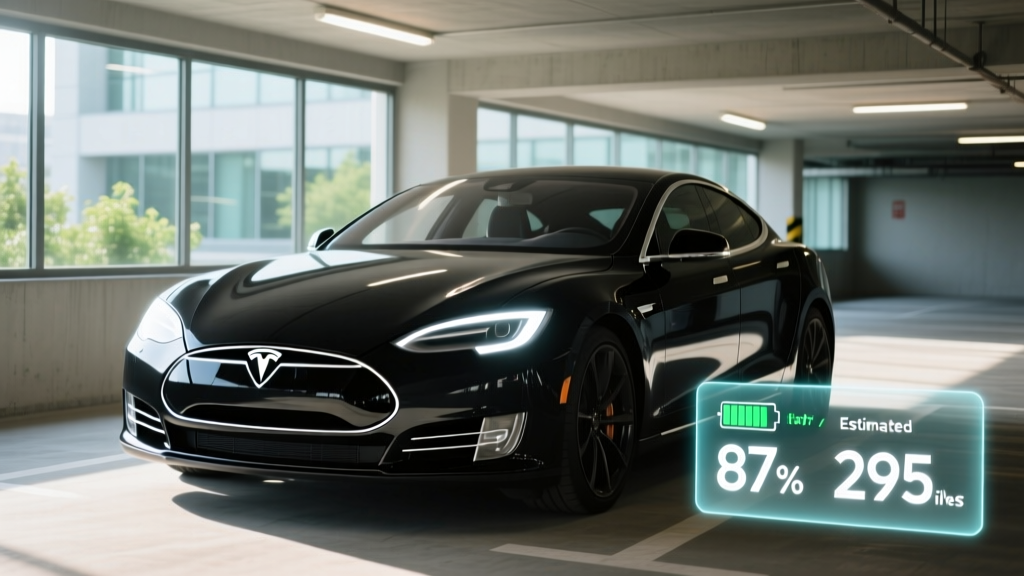
Charge your Tesla to 100% (or calculate from a lower charge using the displayed range and SoC percentage). Compare the displayed range to the original EPA rating. For example, if your 2024 Model 3 Long Range showed 341 miles EPA-new and now shows 307 miles at 100%, that's roughly 90% capacity retention — about 10% degradation.
Method 2: Energy Screen
Navigate to Controls → Apps → Energy → Trip. Track your average Wh/mi over a long trip at steady highway speeds (65–70 mph). Compare this to early ownership baselines. Rising Wh/mi at consistent speeds can indicate degradation, though tire condition and temperature also affect this number.
Method 3: Third-Party Apps
Apps like Tessie, Stats, and Recurrent Auto connect to your Tesla's API and track estimated battery health over time, logging charge sessions and projected range. Recurrent Auto also provides a battery health certificate useful when selling a used Tesla.
Method 4: Tesla Service Diagnostic
If you suspect unusual degradation, schedule a service visit. Tesla technicians can run a full battery health diagnostic that reads individual module voltages and overall pack capacity. This is the most accurate method and is typically free if done under warranty.
Future Battery Tech: What's on the Horizon for Tesla
Several next-generation battery technologies promise step-change improvements in longevity and energy density. Here's a realistic timeline assessment:
Silicon-dominant anodes: Companies like Sila Nanotechnologies and Group14 are shipping silicon-anode cells that boost energy density by 20–40%. Tesla's 4680 cells already incorporate some silicon in the anode. Expect incremental silicon content increases in 2027–2028 production cells, yielding modest range gains without major longevity trade-offs.
Solid-state batteries: Toyota, Samsung SDI, and QuantumScape have announced solid-state prototypes with 500+ mile range potential and faster charging. However, mass production at automotive scale remains unproven. Realistic availability in a Tesla vehicle: 2030 or later, likely starting in premium models. Do not delay a purchase waiting for solid-state.
Sodium-ion batteries: CATL has begun shipping sodium-ion packs in Chinese-market vehicles. These offer lower energy density but excellent cycle life and no critical minerals. Tesla has not announced sodium-ion plans for US models, but it's a plausible chemistry for a future entry-level vehicle.
For current buyers, today's LFP and NMC chemistries are mature, well-understood, and backed by real fleet data. The longevity of Tesla battery technology in 2026 is not speculative — it's measured across millions of vehicles on the road.
Frequently Asked Questions
How long do Tesla batteries last in years and miles?
Based on fleet data, most Tesla batteries retain 85–90% capacity at 150,000 miles (roughly 10–15 years of average driving). The pack typically remains functional well beyond 200,000 miles, though with 15–20% range reduction from new. Outright failure is uncommon.
How much does it cost to replace a Tesla battery?
Replacement costs range from approximately $12,000 for a Model 3 RWD (LFP, ~60 kWh) to $22,000+ for a Model S/X (~100 kWh). Cybertruck replacement may reach $25,000 due to its ~123 kWh 4680 pack. These costs apply only if the battery fails outside the 8-year warranty — and most never do.
What does the Tesla battery warranty cover?
Tesla warrants the battery and drive unit for 8 years and 100,000–150,000 miles (depending on model). If usable capacity drops below 70% within that period, Tesla replaces or refurbishes the pack at no charge. The warranty does not cover accident damage, flooding, or aftermarket modifications.
Is LFP or NMC better for battery longevity?
LFP (lithium iron phosphate) has a clear longevity advantage: 3,000–5,000+ charge cycles to 80% capacity vs. 1,500–2,500 for NMC. LFP also tolerates daily 100% charging without accelerated degradation. The trade-off is lower energy density (less range per kWh) and somewhat weaker cold-weather performance. For maximum battery lifespan, LFP is the better chemistry.
Does frequent Supercharging damage the Tesla battery?
DC fast charging at 250 kW generates more heat and stress than Level 2 home charging. Fleet data suggests exclusive DC fast charging may add 1–3% additional degradation over 100,000 miles compared to predominantly Level 2 charging. Occasional Supercharging on road trips has negligible impact. Tesla's preconditioning and thermal management mitigate much of the stress.
Should I charge my Tesla to 100% every day?
If your Tesla has an LFP battery (Model 3 RWD, Model Y RWD): yes, Tesla recommends charging to 100% at least weekly for accurate battery management system calibration. If your Tesla has an NMC/NCA battery (Long Range, Performance, Model S/X): set the daily limit to 80% and charge to 100% only before long trips.
How do I check my Tesla battery health?
Charge to 100% and compare displayed range to the original EPA rating — the percentage difference approximates your capacity retention. Third-party apps like Tessie or Recurrent Auto provide ongoing tracking via Tesla's API. For the most accurate reading, request a diagnostic at a Tesla Service Center.