If you have been following EV battery development, you have likely encountered the acronym soup of cathode chemistries: NMC, NCA, LFP, and now LMR. While lithium manganese-rich (LMR) cathode technology has generated significant research interest and limited commercialization in energy storage and specialty applications, most EV buyers in 2026 still encounter NMC/NCA and LFP packs on showroom floors. This guide explains what an LMR battery actually is, how it stacks up against the chemistries powering today's EVs, and what the data says about longevity, degradation, replacement cost, and care for whichever pack is under your floor.
What Is an LMR Battery?
An LMR (lithium manganese-rich) battery refers to a cathode chemistry where manganese is the dominant transition metal, often in a layered oxide structure sometimes designated as lithium-rich manganese-based cathode material. Researchers and cell manufacturers have explored LMR formulations because manganese is abundant, inexpensive, and thermally stable compared to cobalt-heavy cathodes. The theoretical appeal is a lower-cost, safer cell with decent energy density.
However, LMR cathodes have historically faced challenges with voltage fade (the operating voltage declines over hundreds of cycles) and lower first-cycle coulombic efficiency compared to mature NMC formulations. As of 2026, LMR chemistry remains largely in the research-to-pilot stage for automotive traction batteries. You will not find an LMR-labeled pack in a mainstream EV at a US dealership today. The chemistries you will actually choose between are NMC/NCA (nickel manganese cobalt / nickel cobalt aluminum) and LFP (lithium iron phosphate).
Cathode Chemistry Comparison: LMR vs. NMC vs. LFP
| Attribute | LMR (Lithium Manganese-Rich) | NMC / NCA | LFP (Lithium Iron Phosphate) |
|---|---|---|---|
| Energy Density (cell-level) | Moderate (~200–250 Wh/kg theoretical) | High (250–300+ Wh/kg) | Lower (160–200 Wh/kg) |
| Cycle Life | Moderate (voltage fade limits usable cycles) | Good (1,000–2,000 cycles to 80% SoH) | Excellent (3,000–5,000+ cycles to 80% SoH) |
| Thermal Stability | Good (manganese inherently stable) | Moderate (requires robust BMS/cooling) | Excellent (very resistant to thermal runaway) |
| Cold-Weather Performance | Moderate | Better at low temps than LFP | Reduced range & slower charging in cold |
| Cost (per kWh) | Potentially low (no cobalt/nickel) | Higher (nickel and cobalt exposure) | Lowest (iron and phosphate abundant) |
| EV Availability (2026) | Not in mainstream production EVs | Widely used (Tesla, Hyundai, BMW, VW, Ford) | Widely used (Tesla Model 3 RWD, BYD, Ford standard-range F-150 Lightning) |
LFP vs. NMC: Which Chemistry Should You Actually Choose?
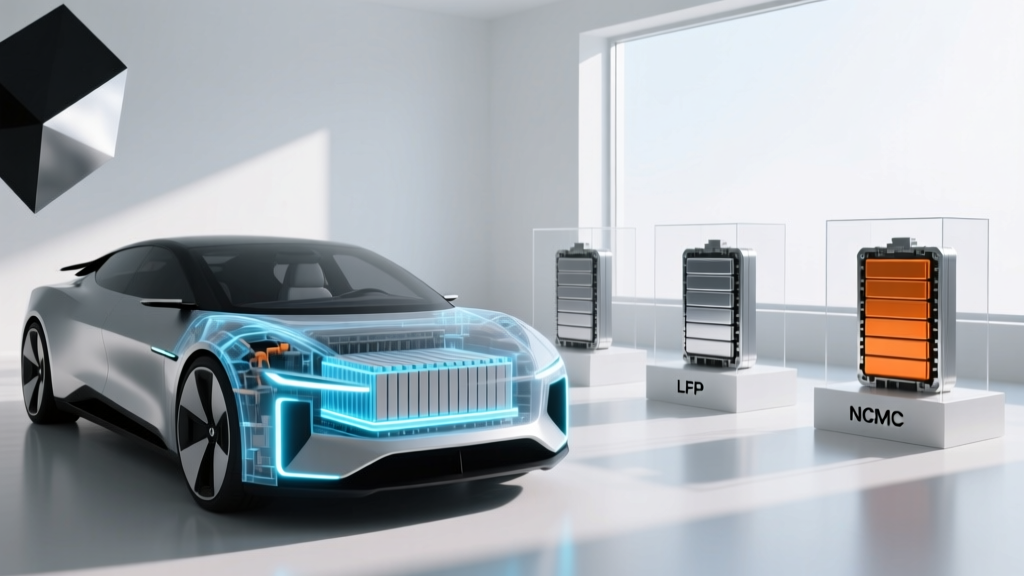
Since LMR is not yet a showroom option, the real decision for 2026 EV buyers is between NMC/NCA and LFP. Each has clear trade-offs that map to different ownership patterns.
Choose NMC/NCA if: you need maximum range from a given pack size, frequently drive in cold climates, or want the longest highway range per charge. Vehicles like the Hyundai Ioniq 5 (84 kWh NMC, EPA 305 mi) and the BMW i4 eDrive40 (81.5 kWh NMC, EPA 301 mi) leverage NMC's energy density to deliver strong real-world range. NMC cells also accept higher charge rates at low temperatures when preconditioned.
Choose LFP if: you prioritize longevity and lower cost over maximum range, can charge at home regularly (LFP packs tolerate and even benefit from being held at 100% SoC), and live in a moderate climate. The Tesla Model 3 Rear-Wheel Drive (60 kWh LFP, EPA 272 mi, MSRP ~$38,990) is the benchmark example. LFP's cycle life is exceptional — data from fleet operators shows less than 10% degradation after 200,000+ miles in many cases. LFP cells are also the safest chemistry against thermal runaway, according to testing by NHTSA-referenced standards.
How Long Do EV Batteries Last? Real Degradation Data
The single most persistent EV myth is that batteries need replacement every few years. The data tells a different story. Modern EV traction batteries are engineered to outlast the useful life of the vehicle in most cases.
Typical Degradation Curve (NMC and LFP)
| Timeframe / Mileage | NMC Average Capacity Retention | LFP Average Capacity Retention | Source Context |
|---|---|---|---|
| Year 1 / ~12,000 mi | ~95–97% | ~97–99% | Initial calibration drop |
| Year 3 / ~36,000 mi | ~90–94% | ~94–97% | Linear slow-degradation phase |
| Year 5 / ~60,000 mi | ~87–92% | ~92–96% | Fleet and owner-reported data |
| Year 8 / ~100,000 mi | ~82–88% | ~88–94% | Warranty threshold period |
| Year 10+ / 150,000+ mi | ~78–85% | ~85–92% | Long-term fleet data (Geotab, Recurrent) |
Note: Degradation is non-linear — most loss occurs in the first 12–18 months, then slows significantly. Real-world figures vary based on climate, charging habits, and thermal management quality. Data synthesized from fleet telematics studies and owner community reporting.
According to fleet data analyzed by companies like Geotab and Recurrent Auto, the average EV battery loses roughly 1.5–2.5% of capacity per year after the initial settling period. A 2023 study tracking over 10,000 EVs found that only a small fraction required battery replacement before 150,000 miles. For context, the average US vehicle stays on the road for about 12 years and 150,000–200,000 miles — and most EV packs are designed to retain at least 70–80% capacity over that span.
What Does the Battery Warranty Actually Cover?
Federal law mandates that EV batteries carry a minimum warranty of 8 years or 100,000 miles (whichever comes first). In California Air Resources Board (CARB) states, that extends to 10 years or 150,000 miles. Most manufacturers meet or exceed these minimums.
Battery Warranty Comparison: 2026 Models
| Manufacturer | Warranty Period | Capacity Retention Threshold | Notes |
|---|---|---|---|
| Tesla (Model 3/Y RWD — LFP) | 8 yr / 100,000 mi | 70% minimum | Long-range/AWD: 8 yr / 120,000 mi |
| Hyundai / Kia | 10 yr / 100,000 mi | 70% minimum | Among the longest coverage |
| Ford (F-150 Lightning, Mustang Mach-E) | 8 yr / 100,000 mi | 70% minimum | Components covered separately |
| BMW (i4, iX) | 8 yr / 100,000 mi | 70% minimum | Transferable to second owner |
| Volkswagen (ID.4) | 8 yr / 100,000 mi | 70% minimum | CARB states: 10 yr / 150,000 mi |
| Chevrolet (Equinox EV, Blazer EV) | 8 yr / 100,000 mi | 60–70% minimum (varies by model) | Check specific model terms |
What triggers a warranty claim: If your battery's State of Health (SoH) drops below the stated threshold (typically 70%) within the warranty period, the manufacturer must repair or replace the pack — usually by swapping failed modules rather than the entire battery. This is a capacity warranty, not a defect-only warranty. Normal degradation above the threshold is not covered.
How Much Does an EV Battery Cost to Replace?
This is the question that generates the most anxiety — and the most misinformation. Let's ground it in real numbers.
EV Battery Replacement Cost Estimates (2026)
| Vehicle / Pack Size | Full Pack Replacement (Out of Warranty) | Module-Level Repair | Typical Need Timeline |
|---|---|---|---|
| Tesla Model 3 RWD (~60 kWh LFP) | $8,000–$12,000 | $1,500–$3,500 per module | Rarely needed before 200k+ mi |
| Hyundai Ioniq 5 (~84 kWh NMC) | $12,000–$18,000 | $2,000–$4,000 per module | Rarely needed before 150k mi |
| Ford F-150 Lightning Extended (~131 kWh NMC) | $18,000–$28,000 | $3,000–$5,500 per module | Rarely needed before 150k mi |
| Chevrolet Bolt EV/EUV (~65 kWh NMC) | $9,000–$14,000 | $1,500–$3,000 per module | Post-recall packs show strong longevity |
| BMW iX xDrive50 (~111.5 kWh NMC) | $16,000–$25,000 | $2,500–$5,000 per module | Rarely needed before 150k mi |
Critical context: The vast majority of EV owners will never pay for a battery replacement. Packs are lasting well beyond 150,000 miles with manageable degradation. When issues do arise within the warranty window, the manufacturer covers the cost. Module-level repairs (replacing only the degraded cells or modules) are increasingly common and dramatically cheaper than full-pack swaps. Battery costs per kWh have also continued to decline — from over $1,200/kWh in 2010 to roughly $110–$140/kWh at the cell level in 2025–2026, according to BloombergNEF tracking.
Factors That Affect Battery Life (and What You Can Control)
Battery degradation is driven by electrochemical stress. Here are the factors ranked by impact, with actionable guidance:
Battery Longevity Checklist
- State of Charge (SoC) habits: For NMC/NCA packs, daily charging to 80% and avoiding sustained periods at 100% or below 10% significantly slows degradation. LFP packs are different — manufacturers like Tesla and BYD recommend charging to 100% at least weekly to allow the BMS to calibrate, and LFP chemistry tolerates high SoC far better than NMC.
- DC fast-charging frequency: Occasional DC fast charging (150–350 kW) is fine. However, exclusively relying on DCFC — especially at high rates without preconditioning — accelerates degradation due to heat and lithium plating risk. Aim for Level 2 home charging as your daily routine and reserve DCFC for road trips.
- Extreme temperatures: Sustained exposure to ambient temperatures above 95°F (35°C) accelerates calendar degradation. In cold weather (below 20°F / -7°C), always precondition the battery before fast charging to avoid lithium plating. Vehicles with active thermal management (liquid cooling/heating) handle this far better than passively cooled packs.
- Depth of Discharge (DoD): Shallow cycles (e.g., 30%–70% SoC) are gentler on NMC cells than deep cycles (5%–95%). You do not need to obsess over this, but avoiding frequent full discharges helps.
- Storage: If storing the vehicle for more than two weeks, leave NMC packs at roughly 50% SoC. LFP packs can be stored at higher SoC with less penalty. Avoid storing at 100% or near 0% in hot conditions.
How to Check and Monitor Battery Health (SoH)
State of Health (SoH) is the percentage of original battery capacity remaining. Here is how to monitor it:
- Manufacturer apps: Tesla, Hyundai, Ford, and BMW provide battery health indicators in their companion apps or vehicle settings menus. These are often simplified (e.g., "Good" / "Normal") rather than exact percentages.
- OBD-II diagnostic tools: Devices like the OBDLink SX paired with apps such as ABRP (A Better Route Planner) or LeafSpy (for Nissan) can read the BMS-reported SoH directly. This gives a more granular number, typically within 1–2% accuracy of actual capacity.
- Third-party services: Companies like Recurrent Auto offer free battery health reports that benchmark your pack against a fleet of identical vehicles. This is particularly useful when buying a used EV — request a battery health report before purchase.
- Manual range tracking: Charge to a known SoC (e.g., 100% for LFP, 90% for NMC), note the displayed range, and compare to the EPA sticker adjusted for that SoC. A significant and persistent drop over months (not day-to-day weather variation) signals degradation worth investigating.
According to fueleconomy.gov, the EPA range estimate assumes a fully charged battery under standardized test conditions. Real-world range will be 10–20% lower on the highway and 20–40% lower in extreme cold — this is normal and distinct from battery degradation.
Emerging Battery Technologies: Solid-State, Silicon Anodes, and Beyond
While LMR, NMC, and LFP define today's EV battery landscape, several next-generation technologies are in development. It is important to separate announced timelines from commercial reality:
- Solid-state batteries: Toyota, Samsung SDI, and QuantumScape have all announced pilot production or limited deployment targets for 2027–2030. Solid-state cells promise higher energy density (potentially 400+ Wh/kg at the cell level), faster charging, and improved safety by replacing the liquid electrolyte with a solid material. However, manufacturing scalability and cost remain unsolved at automotive volumes. Expect limited deployment in premium or low-volume models first — not mainstream availability before 2030 at the earliest.
- Silicon-dominant anodes: Companies like Sila Nanotechnologies and Group14 are supplying silicon-composite anode materials to cell manufacturers. Silicon can store roughly 10x more lithium than graphite, boosting energy density. Early deployments in 2025–2026 are limited to small percentages of silicon blended into graphite anodes. Full silicon-anode cells remain in development.
- Sodium-ion batteries: CATL and BYD have begun producing sodium-ion cells for low-cost, short-range EVs and energy storage in China. Sodium-ion chemistry uses no lithium, cobalt, or nickel, offering cost advantages but lower energy density (~140–160 Wh/kg). US-market availability in passenger EVs is not expected before 2028–2029.
- LMR evolution: Research into stabilized LMR cathodes continues, with groups addressing voltage fade through surface coatings and doping strategies. If solved, LMR could offer a compelling cobalt-free, nickel-free alternative for mid-range EVs. Realistic commercial deployment in US-market EVs remains 5+ years away.
All forward-looking technologies above are announced or in research stages. None are currently available in mainstream US-market EVs as of 2026. Specifications are preliminary and subject to change.
Frequently Asked Questions
How long do EV batteries last in years and miles?
Modern EV batteries are designed to last 15–20 years or 150,000–200,000+ miles while retaining 70–80% of original capacity. Fleet data from Geotab and Recurrent shows most packs outlive the vehicle they are installed in. Catastrophic failure (sudden, total loss) is extremely rare; degradation is gradual and predictable.
How much does an EV battery cost to replace out of warranty?
Full pack replacement ranges from roughly $8,000 for a 60 kWh LFP pack to $28,000 for a 131 kWh NMC pack in a large truck. However, most repairs are module-level ($1,500–$5,500) rather than full swaps. In practice, the vast majority of owners never pay for a replacement — the pack lasts the life of the car, or the warranty covers it.
What does the federal battery warranty cover?
Federal law requires a minimum 8-year/100,000-mile warranty on EV batteries (10 years/150,000 miles in CARB states). This covers capacity loss below a stated threshold (typically 70% of original capacity), as well as defects. It does not cover damage from accidents, flooding, or unauthorized modifications. Check your specific manufacturer's terms at irs.gov for related credit implications and your owner's manual for warranty details.
How do I maximize my EV battery's health?
For NMC/NCA: charge to 80% daily, use Level 2 home charging as your primary method, precondition before DC fast charging, and avoid sustained storage at 100% or near 0%. For LFP: charge to 100% at least weekly per manufacturer guidance, as LFP chemistry tolerates full charge well and the BMS needs it for calibration. For both: minimize exclusive reliance on DC fast charging, precondition in extreme cold, and avoid leaving the car parked at full charge in hot weather for extended periods.
LFP vs NMC — which is better for my situation?
Neither is universally better. NMC/NCA offers higher energy density (more range per kWh of battery weight), better cold-weather performance, and is the standard for long-range and performance EVs. LFP offers superior cycle life, lower cost, better thermal safety, and tolerance for 100% SoC — making it ideal for standard-range models, daily commuters who charge at home, and buyers prioritizing longevity over maximum range. If you need 300+ miles of EPA range and drive in cold winters, NMC is likely the right call. If you commute 40 miles daily, charge at home, and want a pack that will barely degrade over 10 years, LFP is hard to beat.
Is an LMR battery available in any EV I can buy today?
No. As of 2026, LMR (lithium manganese-rich) cathode chemistry is not used in any mainstream production EV sold in the United States. It remains primarily a research and pilot-stage technology. The chemistries available to buyers are NMC/NCA and LFP. If LMR voltage fade and efficiency challenges are resolved, it could emerge as a future option — but realistic timelines place commercial availability in US-market EVs at 2030 or later.