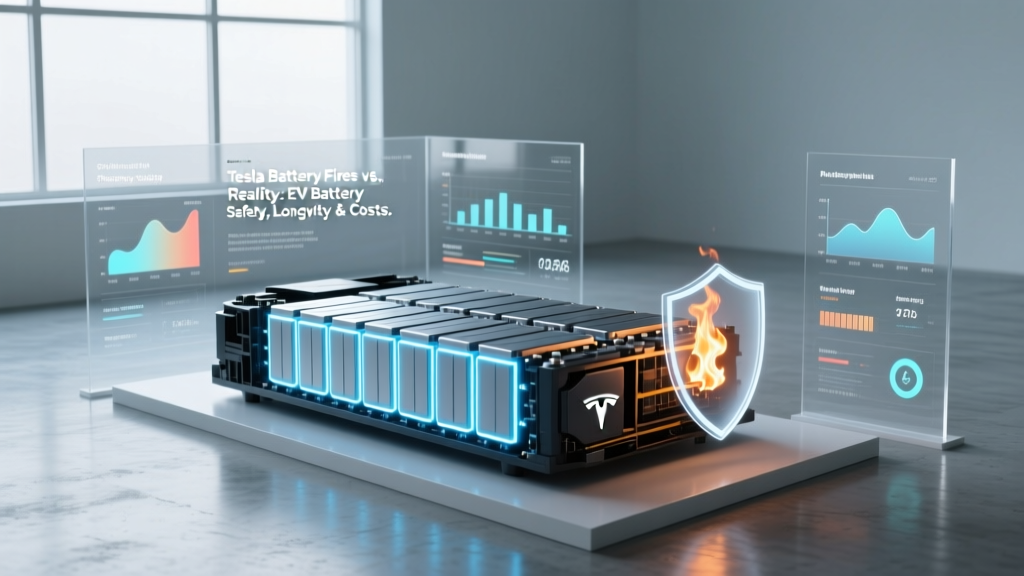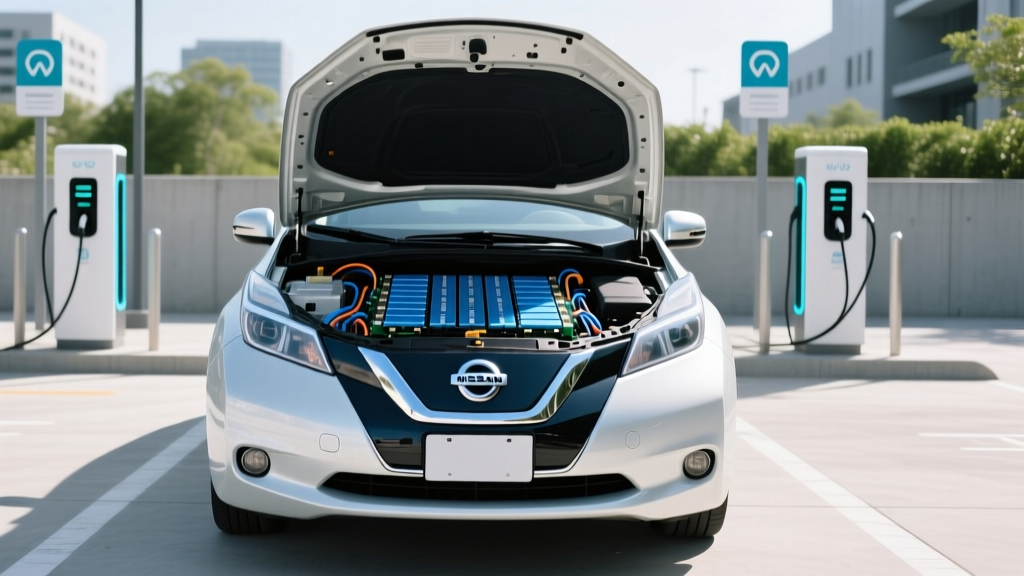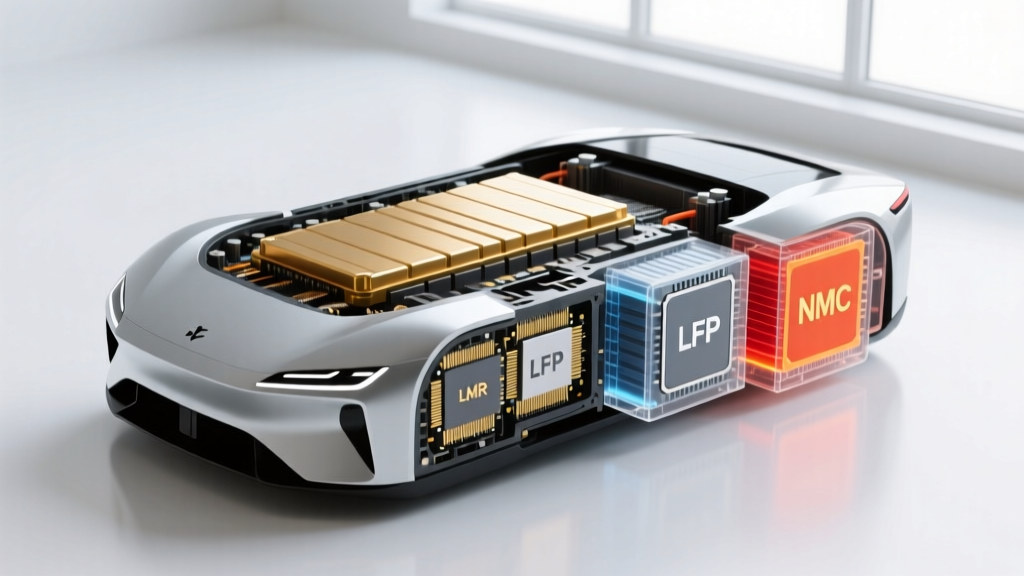
Lithium manganese-rich (LMR) battery chemistry is quietly moving from the lab toward production-line EVs, promising higher energy density without the cobalt dependency that has plagued NMC cells. But how does it actually stack up against the two chemistries you can buy today — lithium iron phosphate (LFP) and nickel manganese cobalt (NMC/NCA)? And is it worth waiting for, or should you buy what's on dealer lots now?
This guide breaks down LMR alongside LFP and NMC/NCA with hard numbers on energy density, cycle life, degradation data, warranty coverage, and replacement costs. Whether you're evaluating a 2026 Tesla Model 3 RWD with its LFP pack or a Hyundai Ioniq 5 with NMC cells, the chemistry inside your battery dictates your real-world range, charging speed, and how much capacity you'll retain at 100,000 miles.
What Is LMR Battery Chemistry and How Does It Work?
LMR stands for lithium manganese-rich — a cathode chemistry that uses manganese as the primary transition metal, often in a spinel or layered-spinel composite structure. The key appeal: manganese is abundant, inexpensive, and thermally stable. LMR cells aim to deliver energy density closer to NMC while matching or exceeding LFP's thermal safety profile.
In an LMR cathode, the manganese-rich composition allows for higher operating voltages (up to ~4.7V in some lab configurations) compared to LFP's ~3.2V nominal. Higher voltage translates to more watt-hours per kilogram at the cell level. However, the trade-off historically has been voltage fade — a gradual decline in average discharge voltage over hundreds of cycles, which reduces usable energy even if raw capacity remains.
As of 2026, LMR chemistry is primarily in the announced and pilot-production stage. Companies like GM (through its Ultium platform evolution) and several Chinese cell manufacturers have signaled LMR and LMR-NMC hybrid cathodes for next-generation affordable EVs, but no mainstream US-market vehicle currently ships with a pure LMR pack. Think of LMR as a bridge technology — more energy-dense than LFP, potentially cheaper and safer than high-nickel NMC, but not yet proven at scale in consumer vehicles.
Chemistry Showdown: LMR vs LFP vs NMC/NCA
To understand where LMR fits, you need to see it against the chemistries that dominate today's EV market. Here's how the three compare across the metrics that matter for ownership:
| Attribute | LFP (Lithium Iron Phosphate) | NMC/NCA (Nickel Manganese Cobalt / Nickel Cobalt Aluminum) | LMR (Lithium Manganese-Rich) |
|---|---|---|---|
| Cell energy density | 160–180 Wh/kg | 220–300 Wh/kg | 200–230 Wh/kg (target) |
| Nominal cell voltage | 3.2V | 3.6–3.8V | 3.8–4.1V (varies by formulation) |
| Cycle life (to 80% capacity) | 3,000–5,000+ cycles | 1,000–2,500 cycles | 1,500–2,500 cycles (projected) |
| Cold-weather performance | Moderate — greater range loss below 20°F | Better — less capacity loss in cold | Expected similar to NMC (pending validation) |
| Thermal stability / safety | Excellent — high thermal runaway threshold | Good — requires robust BMS and cooling | Very good — manganese spinel inherently stable |
| Cobalt content | None | 5–20% cobalt (declining in newer formulations) | None to minimal |
| Cost per kWh (cell level) | ~$80–$100 | ~$110–$140 | ~$85–$110 (projected at scale) |
| Typical vehicle use (2026) | Tesla Model 3/Y RWD, Ford Mustang Mach-E Select, BYD models | Hyundai Ioniq 5/6, Kia EV6/EV9, Tesla Model 3/Y Long Range, Ford F-150 Lightning Extended Range | Announced/pilot stage — expected in next-gen affordable EVs |
| State-of-charge calibration | Flat voltage curve makes SoC estimation harder; periodic 100% charges recommended | Linear voltage curve — easier SoC estimation; daily 80% charge typical | Similar to NMC — voltage curve more linear than LFP |
Real-World Degradation: What the Data Actually Shows
Battery degradation is the top concern for EV shoppers — and the topic most distorted by online fear-mongering. Here's what real fleet and testing data tells us about capacity loss over time for the chemistries you can buy today.
LFP degradation data: Tesla's 2025 Impact Report showed that Model 3/Y vehicles with LFP packs retained approximately 92% of original capacity at 100,000 miles. LFP's cycle life advantage — often exceeding 4,000 cycles to 80% capacity — means that for most owners, the pack will outlast the vehicle's structural and mechanical components. Real-world fleet data from fueleconomy.gov listings and owner telemetry aggregators confirm that LFP degradation curves flatten significantly after the initial 2–5% loss in the first 10,000–20,000 miles.
NMC/NCA degradation data: Data from Recurrent Auto (a battery analytics firm tracking over 15,000 EVs) indicates that NMC packs in vehicles like the Hyundai Ioniq 5 and Kia EV6 typically retain 88–93% capacity at 80,000 miles, with a linear degradation rate of roughly 1.5–2.0% per year under normal use. Higher-nickel formulations (NCA in Tesla Long Range packs) show slightly steeper initial degradation but stabilize after 30,000–40,000 miles.
LMR degradation projections: Published research in the Journal of The Electrochemical Society shows LMR cells retaining 85–90% capacity after 1,000 cycles in lab conditions, with voltage fade accounting for roughly 3–5% of apparent capacity loss. Until LMR packs accumulate real-world fleet miles, these lab figures should be treated as preliminary.
Battery Warranty Terms: What Manufacturers Actually Cover
Federal law mandates a minimum 8-year / 100,000-mile warranty on EV battery packs (10 years / 150,000 miles in CARB states). But the details — particularly the capacity retention threshold — vary by automaker and directly affect what "covered" means in practice.
| Manufacturer / Model | Warranty Term | Capacity Retention Threshold | Chemistry |
|---|---|---|---|
| Tesla Model 3 RWD | 8 yr / 100,000 mi | 70% | LFP |
| Tesla Model 3 Long Range | 8 yr / 120,000 mi | 70% | NMC/NCA |
| Hyundai Ioniq 5 | 10 yr / 100,000 mi | 70% | NMC |
| Kia EV6 | 10 yr / 100,000 mi | 70% | NMC |
| Ford Mustang Mach-E | 8 yr / 100,000 mi | 70% | NMC (Extended Range) / LFP (Select) |
| Chevrolet Equinox EV | 8 yr / 100,000 mi | 60% (stated) / 70% (typical replacement trigger) | NMC (Ultium) |
| BMW i4 | 8 yr / 100,000 mi | 70% | NMC |
The critical number is the retention threshold. If your pack drops below 70% of original capacity within the warranty period, the manufacturer must repair or replace it — typically with a pack that meets or exceeds that 70% threshold, not necessarily a brand-new unit. In practice, very few EV owners have needed warranty replacements; the vast majority of packs remain above 80% capacity well beyond the warranty term.
Battery Replacement Costs: The Honest Numbers
Out-of-warranty battery replacement is the boogeyman of EV ownership forums. Here's what it actually costs in 2026, and — more importantly — how rarely it's needed.
| Vehicle | Battery Capacity | Chemistry | Estimated Replacement Cost (Parts + Labor) |
|---|---|---|---|
| Tesla Model 3 RWD | ~60 kWh | LFP | $8,000–$12,000 |
| Tesla Model Y Long Range | ~75 kWh | NMC/NCA | $12,000–$16,000 |
| Hyundai Ioniq 5 | 77.4 kWh | NMC | $13,000–$18,000 |
| Ford F-150 Lightning Extended Range | ~131 kWh | NMC | $20,000–$28,000 |
| Chevrolet Bolt EV (legacy) | 65 kWh | NMC | $9,000–$14,000 |
| BMW i4 eDrive40 | 83.9 kWh (gross) | NMC | $16,000–$22,000 |
Context matters enormously here. A full pack replacement is typically only needed after physical damage (collision, flood), manufacturing defect, or extreme degradation well past 200,000 miles. Module-level repairs — replacing individual degraded modules within the pack — cost significantly less, often $2,000–$5,000 depending on the vehicle. Most EVs on the road today will never need a full pack replacement during their first or second ownership cycle.
Cell prices continue to fall. BloombergNEF's 2025 battery price survey reported an average pack price of $115/kWh, down from $140/kWh in 2023. As LMR and other low-cobalt chemistries scale, replacement costs for future models should decline further.
What Actually Kills an EV Battery — and What Doesn't
Not all miles and charges are created equal. Here's what the data shows about factors that accelerate degradation, ranked by impact:
- High state-of-charge storage: Regularly parking with a 100% charge for days or weeks accelerates electrolyte oxidation, particularly in NMC cells. Storing at 50–80% SoC is significantly better for long-term health.
- Frequent DC fast charging to high SoC: Charging above 80% at a DC fast charger subjects the cell to elevated voltage and heat simultaneously. Occasional road-trip fast charges are fine — daily fast-charging to 100% is not. Tesla's own data shows vehicles that DC fast-charge more than 90% of the time exhibit roughly 2–3% additional degradation at 100,000 miles compared to primarily Level 2 charging.
- Extreme heat exposure: Sustained ambient temperatures above 95°F, combined with high SoC, accelerate degradation. This is why vehicles in Phoenix and Dubai show slightly steeper curves than those in temperate climates. Active thermal management (liquid cooling) mitigates this substantially — most 2026 EVs have robust systems.
- Deep discharge cycles: Letting the pack sit at or near 0% for extended periods can cause copper dissolution in the anode current collector. Drive or charge soon after hitting low SoC.
- Cold-weather charging without preconditioning: Charging a cold battery (below ~32°F) without preconditioning can cause lithium plating on the anode, a permanent capacity loss mechanism. Most modern EVs automatically precondition when you navigate to a charger — use this feature.
What does NOT meaningfully harm your battery: Occasional 100% charges for road trips, Level 2 overnight charging, regenerative braking at normal settings, and driving in rain or snow. The battery management system (BMS) in any 2026 EV is sophisticated enough to protect the pack from most owner mistakes.
- Set daily charge limit to 80% for NMC/NCA; 100% is acceptable for LFP (Tesla recommends periodic 100% for LFP calibration)
- Use Level 2 home charging as your primary method
- Precondition before DC fast charging (most cars do this automatically when navigating to a station)
- Avoid storing the vehicle above 90% SoC for more than 48 hours
- In extreme cold, plug in when parked to allow the BMS to maintain pack temperature
- Update vehicle firmware — manufacturers regularly refine charge and thermal management algorithms
Monitoring Battery Health: How to Check Your State of Health
State of Health (SoH) is the metric that tells you how much capacity your pack retains relative to when it was new. A 90% SoH means your 75 kWh pack now holds roughly 67.5 kWh of usable energy.
In-vehicle tools: Some manufacturers provide a battery health indicator in the infotainment system — Hyundai and Kia include a battery health percentage in their diagnostic menus. Tesla does not display a native SoH percentage but provides range estimates that reflect actual capacity.
OBD-II apps: Third-party tools like Scan My Tesla, Leaf Spy (for Nissan Leaf), and ABRP (A Better Route Planner) + OBD dongle can pull real SoH data from the BMS. For most 2026 EVs, a Bluetooth OBD-II adapter paired with a compatible app will display nominal full-charge capacity, cell voltage spread, and pack temperature.
Dealer diagnostics: Any authorized service center can run a full battery health report. This is particularly useful before purchasing a used EV — request a printout showing measured capacity vs. original rated capacity.
Recurrent Auto and fleet analytics: Services like Recurrent provide free battery health reports for enrolled vehicles, tracking degradation over time against a fleet average. This is the most rigorous option for ongoing monitoring.
Emerging Battery Tech: Solid-State, Silicon Anodes, and Realistic Timelines
LMR isn't the only advanced chemistry in development. Here's where the most-discussed next-generation technologies actually stand as of 2026:
Solid-state batteries: Toyota has announced a 2027–2028 production timeline for its first solid-state EV, targeting 750 km (~465 miles) of range and 10-minute 10–80% charging. Samsung SDI and QuantumScape have prototype cells in testing with automaker partners. However, solid-state manufacturing yield and cost remain significant hurdles. Expect limited production in premium models first, with mainstream availability unlikely before 2030. Solid-state cells replace the liquid electrolyte with a solid ceramic or polymer, enabling lithium metal anodes and dramatically higher energy density (~400–500 Wh/kg at the cell level).
Silicon anode technology: Companies like Sila Nanotechnologies and Group14 are already shipping silicon-dominant anode materials to battery manufacturers. Silicon can store roughly 10x more lithium ions per gram than graphite, boosting energy density by 15–25% at the cell level. Porsche has invested in Group14, and the tech is expected in production EVs by 2027–2028. Unlike solid-state, silicon anodes can be integrated into existing manufacturing lines, making them a nearer-term upgrade.
Sodium-ion batteries: CATL has begun shipping sodium-ion packs for Chinese-market EVs (notably the Chery iCAR). Energy density is lower (~120–150 Wh/kg), but sodium is cheap and abundant, making this chemistry viable for affordable city EVs. US-market availability remains uncertain due to IRS §30D battery sourcing requirements that favor North American and FTA-partner supply chains.
Which Chemistry Should You Choose Today?
LMR is promising but not yet available. So the real decision for 2026 EV buyers comes down to LFP vs NMC — and the answer depends on your driving profile:
Choose LFP if: You want maximum cycle life, plan to own the vehicle 10+ years, primarily charge at home, live in a moderate climate, and don't need every last mile of range. LFP's lower energy density means slightly shorter EPA range in the same physical pack size, but its 4,000+ cycle life and cobalt-free composition make it the durability champion. The Tesla Model 3 RWD ($38,990 base MSRP) with its ~60 kWh LFP pack and 272-mile EPA range is the benchmark here.
Choose NMC/NCA if: You need maximum range, frequently road-trip in cold weather, want the fastest DC charging speeds, or drive a larger vehicle (SUV, truck) where energy density matters. The Hyundai Ioniq 5 Long Range (77.4 kWh NMC, 305-mile EPA, peak 240 kW DC charging, 10–80% in ~18 minutes) exemplifies NMC's advantages. Just follow the 80% daily charge rule and avoid chronic high-SoC storage.
Wait for LMR if: You're not in a rush to buy and want a chemistry that may offer NMC-like range at LFP-like cost, with improved thermal safety. Realistic availability in US-market vehicles: 2028–2029 model years at the earliest.
Frequently Asked Questions
How long do EV batteries last in years and miles?
Based on current fleet data, the average EV battery pack retains 85–93% of its original capacity at 100,000 miles (roughly 7–8 years of average driving). Most packs are designed to outlast 200,000 miles before reaching the 70% capacity threshold that triggers warranty replacement. Complete pack failure is rare — degradation is gradual, not sudden.
How much does an EV battery cost to replace?
Out-of-warranty full pack replacement costs range from roughly $8,000 for a smaller LFP pack (Tesla Model 3 RWD, ~60 kWh) to $28,000 for a large NMC pack (Ford F-150 Lightning Extended Range, ~131 kWh). However, most replacements are covered under the 8-year/100,000-mile warranty, and module-level repairs cost $2,000–$5,000. Very few EV owners ever pay for a full out-of-pocket replacement.
What does the EV battery warranty actually cover?
The battery warranty covers defects and excessive capacity loss — typically defined as falling below 70% of original capacity within 8 years / 100,000 miles (10 years / 150,000 miles in CARB states). The manufacturer will repair or replace the pack to bring it above the threshold. It does not cover damage from collisions, flooding, or unauthorized modifications. Always check your specific warranty document — thresholds and terms vary.
How do I check my EV battery's State of Health?
Options include your vehicle's built-in diagnostics menu (if available), OBD-II Bluetooth adapters paired with apps like Scan My Tesla or Leaf Spy, dealer diagnostic reports, and third-party fleet analytics services like Recurrent Auto. For a used EV purchase, always request a dealer battery health report showing measured full-charge capacity.
LFP vs NMC — which is better for me?
Neither is universally "better." LFP wins on longevity (4,000+ cycle life), cost ($80–100/kWh), and safety (superior thermal stability). NMC wins on energy density (220–300 Wh/kg), cold-weather performance, and charging speed. If you charge at home daily and drive under 40 miles round-trip, LFP is ideal. If you road-trip frequently, live in a cold climate, or need 300+ miles of range, NMC is the stronger choice.
Will LMR battery chemistry be available in US-market EVs?
Not yet. LMR is in pilot production and testing phases as of 2026. Based on manufacturer announcements, expect LMR or LMR-hybrid packs in US-market vehicles no earlier than the 2028–2029 model year, likely in affordable segments where cost reduction is critical for price competitiveness.