If you've been researching EV battery technology, you've likely encountered the familiar acronyms — NMC, NCA, LFP — and maybe a newer one: LMR batteries (lithium manganese-rich). As automakers diversify their battery supply chains and chemistries to cut costs, reduce reliance on critical minerals, and push energy density higher, understanding what's inside your EV's traction battery has never been more important.
This guide breaks down every major EV battery chemistry available or in development as of 2026, with hard data on degradation, replacement costs, warranty coverage, and practical care habits that extend battery life. Whether you're choosing between an LFP-equipped Tesla Model 3 and an NMC-powered Hyundai Ioniq 5, or you're simply curious about what LMR cathodes could mean for the next generation of EVs, this is your technical reference.
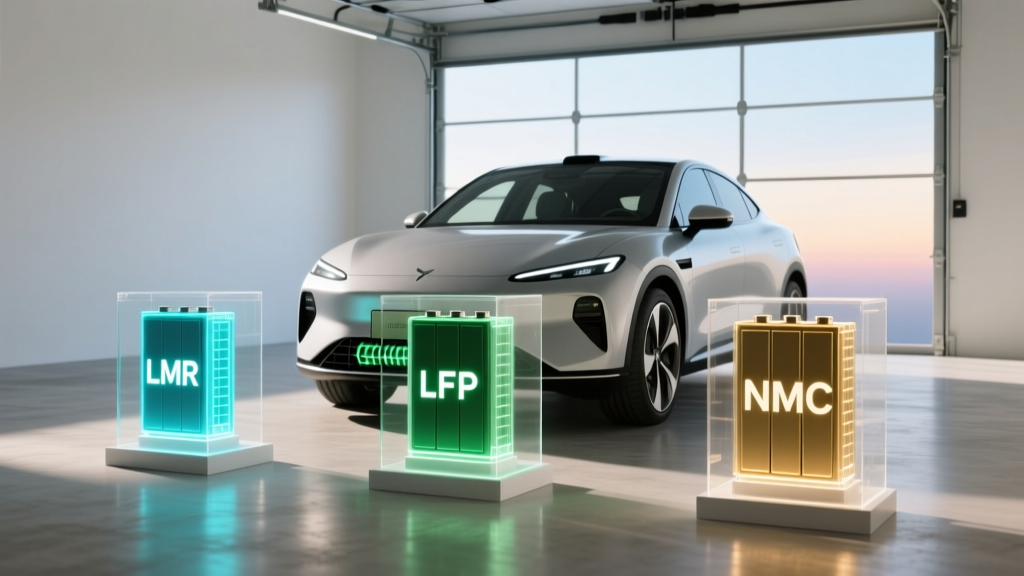
EV Battery Chemistries Explained: LMR, LFP, NMC, and NCA
Every lithium-ion EV battery uses a specific cathode chemistry that determines its energy density, cycle life, thermal stability, cold-weather performance, and cost. The anode is typically graphite, though silicon-blend anodes are emerging. Here's what each cathode type brings to the table:
NMC (Nickel Manganese Cobalt): The dominant chemistry in long-range EVs. High nickel content (e.g., NMC 811 — 80% nickel, 10% manganese, 10% cobalt) maximizes energy density, enabling vehicles like the Hyundai Ioniq 5 (77.4 kWh usable, EPA 305 mi) and BMW i4 (81.5 kWh, EPA 307 mi). Trade-offs include higher cost, cobalt supply-chain concerns, and slightly faster degradation compared to LFP.
NCA (Nickel Cobalt Aluminum): Used primarily by Tesla and Panasonic in high-performance applications. Offers energy density similar to NMC with excellent power delivery. Found in the Model S and Model X. Shares cobalt-dependency concerns with NMC.
LFP (Lithium Iron Phosphate): The cost champion. Zero cobalt, zero nickel. Lower energy density (roughly 15–20% less than NMC by weight) but superior cycle life — routinely exceeding 3,000 full charge cycles with minimal degradation. Standard-range Tesla Model 3 and Model Y vehicles use LFP, and it's expanding into affordable EVs like the base Chevrolet Equinox EV trims. The trade-off: weaker cold-weather performance and heavier packs for equivalent range.
LMR (Lithium Manganese-Rich / LMRO): A newer cathode family that substitutes expensive nickel and cobalt with abundant manganese while using an oxygen-rich structure to boost voltage and energy density compared to traditional LMO (lithium manganese oxide). General Motors' Ultium platform has explored LMR-NC (LMR blended with some nickel/cobalt) as a bridge chemistry. LMR aims to deliver NMC-like energy density at lower material cost. As of 2026, LMR remains largely in pre-production validation and limited fleet testing — it is not yet in mass-market consumer vehicles.
| Attribute | NMC (811) | NCA | LFP | LMR (Emerging) |
|---|---|---|---|---|
| Energy Density (Wh/kg, cell-level) | 250–300 | 250–290 | 160–200 | 220–270 (projected) |
| Cycle Life (to 80% capacity) | 1,000–2,000 | 1,000–1,500 | 3,000–5,000+ | 1,500–2,500 (est.) |
| Cobalt Content | Yes (5–10%) | Yes (~5%) | None | Minimal/None |
| Nickel Content | High (80%) | High (~80%) | None | Low to None |
| Cold-Weather Performance | Good | Good | Moderate (more range loss) | Good (projected) |
| Thermal Stability | Moderate | Moderate | Excellent | Good (projected) |
| Relative Cell Cost | $$$ | $$$ | $ | $$ (target) |
| Current Availability (2026) | Widely available | Available (Tesla/Panasonic) | Widely available | Pre-production / limited |
How Long Do EV Batteries Last? Real Degradation Data
The single most common question from prospective EV buyers: "How long will the battery last?" The answer, backed by fleet data, is reassuring — most modern EV traction batteries will outlast the vehicle's useful life.
Typical degradation trajectory: Lithium-ion batteries lose capacity fastest in their first year or two (roughly 2–5%), then the curve flattens significantly. Here's what the data shows across chemistries:
| Mileage | NMC/NCA (avg. capacity retained) | LFP (avg. capacity retained) |
|---|---|---|
| 50,000 mi / ~3 years | 93–96% | 96–98% |
| 100,000 mi / ~6 years | 88–93% | 93–96% |
| 150,000 mi / ~9 years | 83–89% | 89–94% |
| 200,000 mi / ~12 years | 78–85% | 85–92% |
Sources: Recurrent Auto fleet data (2024–2025), Geotab longitudinal study of 6,300+ EVs, manufacturer warranty claims. Individual results vary based on climate, charging habits, and thermal management system quality.
For context, a Tesla Model 3 Long Range (NMC, 75 kWh usable, EPA 341 mi) retaining 88% capacity at 100,000 miles would still deliver roughly 300 EPA-equivalent miles — more than adequate for most drivers. An LFP-equipped Model 3 RWD (60 kWh, EPA 272 mi) at the same mileage would retain around 258–261 miles.
According to data compiled by Recurrent Auto, the average EV battery loses only about 5–8% of its original capacity over the first 100,000 miles, and the rate of loss decelerates substantially after the initial break-in period.
EV Battery Warranty Coverage: What's Protected and for How Long
Federal law in the United States mandates that EV battery warranties cover a minimum of 8 years / 100,000 miles (10 years / 150,000 miles in California Air Resources Board states). However, the capacity-retention threshold — the point at which the manufacturer must repair or replace the battery — varies by automaker.
| Manufacturer / Model | Warranty Period | Capacity Threshold | Chemistry |
|---|---|---|---|
| Tesla Model 3/Y (LFP, RWD) | 8 yr / 100,000 mi | 70% | LFP |
| Tesla Model 3/Y (Long Range) | 8 yr / 120,000 mi | 70% | NMC |
| Hyundai Ioniq 5 / Ioniq 6 | 10 yr / 100,000 mi | 70% | NMC |
| Ford Mustang Mach-E | 8 yr / 100,000 mi | 70% | NMC |
| Chevrolet Equinox EV / Blazer EV | 8 yr / 100,000 mi | 60–70% (varies) | NMC (Ultium) |
| BMW i4 / iX | 8 yr / 100,000 mi | 70% | NMC |
| Rivian R1T / R1S | 8 yr / 175,000 mi | 70% | NMC |
What the warranty covers: Defects in materials or workmanship, and capacity loss below the stated threshold under normal use. It does not cover damage from accidents, flooding, improper modifications, or use of the vehicle as a stationary power source beyond the manufacturer's stated V2H/V2G limits.
Key nuance: The 70% threshold means a battery at 71% State of Health (SoH) — which still provides perfectly usable daily range — will not trigger a warranty claim. In practice, very few modern EV batteries fall below 70% within the warranty window unless there's a manufacturing defect.
EV Battery Replacement Cost: What to Budget and When You'd Need It
Battery replacement is the specter that haunts EV skeptics. Here's the reality: the vast majority of EV owners will never need a full battery replacement. The battery will likely outlast the car's body, suspension, and interior. But if you're buying a high-mileage used EV or planning to keep a vehicle for 15+ years, here's what the numbers look like.
| Vehicle | Battery Size (kWh usable) | Chemistry | Estimated Replacement Cost |
|---|---|---|---|
| Tesla Model 3 RWD | 60 | LFP | $8,000–$12,000 |
| Tesla Model Y Long Range | 75 | NMC | $12,000–$16,000 |
| Hyundai Ioniq 5 | 77.4 | NMC | $11,000–$15,000 |
| Ford Mustang Mach-E (Ext. Range) | 91 | NMC | $14,000–$20,000 |
| Chevrolet Bolt EV (2023 era) | 65 | NMC | $9,000–$14,000 |
| BMW iX xDrive50 | 105.2 | NMC | $18,000–$25,000 |
| Rivian R1T (Large Pack) | 128 | NMC | $20,000–$28,000 |
Costs have been trending downward. According to BloombergNEF's 2025 battery price survey, average pack-level prices fell below $115/kWh in 2025, with LFP cells dipping below $70/kWh. A decade ago, replacement packs cost $200+/kWh. If you do need a replacement in the 2030s, expect significantly lower prices than today's figures.
Module-level repair: Many modern packs (Hyundai E-GMP, GM Ultium, Tesla 4680 structural packs) allow individual module replacement rather than a full pack swap. A single failed module might cost $1,500–$4,000 to replace, restoring the pack to near-original capacity.
Factors That Affect EV Battery Lifespan
Not all miles are created equal when it comes to battery wear. These are the factors with the largest measurable impact on long-term State of Health:
- State of Charge (SoC) habits: Consistently charging to 100% and draining to 0% accelerates degradation, especially in NMC/NCA cells. The sweet spot is a daily range of 20–80% SoC. LFP cells tolerate 100% SoC better and Tesla recommends periodic full charges for LFP to recalibrate the BMS.
- DC fast-charging frequency: Occasional DC fast charging (50–250 kW) has minimal long-term impact. However, daily reliance on 150+ kW DC charging without preconditioning can add 1–3% extra degradation over 100,000 miles compared to predominantly Level 2 charging, per Geotab's fleet study.
- Extreme heat exposure: Sustained ambient temperatures above 95°F (35°C) — especially when combined with high SoC — are the single most damaging condition for lithium-ion cells. Vehicles with active liquid cooling (Tesla, Hyundai E-GMP, GM Ultium) manage this far better than passive-air-cooled packs (older Nissan Leaf).
- Extreme cold: Cold temperatures (below 20°F / -7°C) cause temporary range loss (15–30% reduction is normal) but do not cause permanent degradation unless you charge at high rates without preconditioning. Always use your vehicle's battery preconditioning feature before DC fast charging in cold weather.
- Calendar aging: Even a parked EV battery degrades slowly over time. A vehicle stored at 50% SoC in moderate temperatures will lose roughly 1–2% capacity per year from calendar aging alone.
- Thermal management system quality: Liquid-cooled packs with active thermal management consistently outperform passively cooled packs in degradation studies. This is a key reason to research the thermal system when buying used.
LFP vs NMC: Which Chemistry Is Better for Your Driving Needs?
There is no universally "better" chemistry — the right choice depends on your driving pattern, climate, and budget.
Choose LFP if:
- You primarily drive in moderate or warm climates
- You want maximum cycle life and plan to keep the vehicle 10+ years
- You charge at home nightly and don't need maximum range per charge
- Lower purchase price matters (LFP packs are $40–60/kWh cheaper at the cell level)
- You're comfortable with 5–10% more range loss in winter
Choose NMC/NCA if:
- You regularly drive in cold climates where every mile of range counts
- You need maximum range from a single charge (road trips, towing)
- You frequently use DC fast charging on long trips (NMC preconditioning and charge curves are generally more optimized for highway travel)
- You want the highest energy density in the lightest package
For the majority of US drivers covering 30–40 miles per day with home Level 2 charging, LFP is the economically rational choice. For frequent road-trippers, cold-climate drivers, or those who need 300+ miles of real-world range, NMC remains the stronger pick.
How to Monitor and Maximize Your EV Battery Health
Checking State of Health (SoH):
- In-vehicle BMS readout: Some vehicles (Tesla via the service menu, Hyundai/Kia via the infotainment engineering mode, BMW via the My BMW app) display battery health percentage directly.
- OBD-II diagnostic tools: Devices like the OBDLink MX+ paired with apps such as EVNotify, LeafSpy (Nissan), or Car Scanner can read the BMS-reported SoH, cell voltage delta, and pack temperature.
- Dealer diagnostic report: Requesting a battery health check during service gives you a manufacturer-certified SoH figure — useful for warranty claims and resale documentation.
- Third-party services: Companies like Recurrent and AVILOO offer remote battery health reports using telematics data, often generating a certificate useful for private-party sales.
Practical habits to extend battery life:
- Set your daily charge limit to 80% for NMC/NCA; 100% is acceptable for LFP but periodic full charges are recommended for BMS calibration.
- Use scheduled charging to finish charging just before departure — this minimizes time spent at high SoC.
- Enable battery preconditioning whenever navigating to a DC fast charger.
- In extreme summer heat, avoid parking at 100% SoC for extended periods; 50–60% is ideal for long-term storage.
- Don't stress about occasional 100% charges for road trips — the degradation from a few full charges per year is negligible.
What Are LMR Batteries and When Will They Reach EVs?
LMR (Lithium Manganese-Rich) cathodes represent a potential middle ground between LFP's low cost and NMC's high energy density. By leveraging manganese — abundant, inexpensive, and domestically available in the US — LMR chemistry targets energy densities in the 220–270 Wh/kg range at cell costs significantly below high-nickel NMC.
General Motors has been the most vocal proponent, having discussed LMR-NC (a blend incorporating some nickel and cobalt for conductivity) as a potential chemistry for future Ultium-based vehicles. The Department of Energy's Argonne National Laboratory, which holds key LMR patents, has licensed the technology to multiple cell manufacturers.
Realistic timeline: As of early 2026, LMR cells remain in advanced validation and pilot production. Industry analysts project initial limited automotive deployment in 2027–2028 model-year vehicles, with broader adoption possible by 2030 if cycle-life and voltage-fade challenges are fully resolved. LMR is not a chemistry you can buy in a production EV today.
Emerging Battery Technologies: Solid-State, Silicon Anodes, and Beyond
Beyond LMR, several next-generation technologies are in various stages of development:
Solid-state batteries: Replace the liquid electrolyte with a solid ceramic, polymer, or sulfide separator, promising higher energy density (400+ Wh/kg projected), faster charging, and improved safety. Toyota has announced a solid-state EV for 2027–2028, though it is expected to debut in limited, premium models. QuantumScape (backed by Volkswagen) continues prototype validation. Mass-market solid-state EVs are not expected before 2030 at the earliest.
Silicon-dominant anodes: Companies like Sila Nanotechnologies and Group14 are replacing graphite anodes with silicon blends, boosting energy density by 20–40% at the cell level. The Mercedes G-Class 580e (PHEV) uses a Sila anode as of 2025, and broader BEV adoption is expected by 2027–2028.
Sodium-ion batteries: Using abundant sodium instead of lithium, these cells are cheaper but significantly lower in energy density (~120–160 Wh/kg). CATL and BYD are deploying sodium-ion packs in Chinese-market city EVs. US-market adoption is uncertain and likely limited to low-range, budget segments if it arrives.
All of these technologies are forward-looking and not yet available in mainstream US-market EVs as of 2026. Buyers should make decisions based on currently proven chemistries (NMC, LFP) rather than waiting for next-generation cells that remain years from widespread availability.
Frequently Asked Questions
How long do EV batteries last in years and miles?
Most modern EV batteries retain 85–93% of their original capacity at 100,000 miles and 6–8 years of use. Based on fleet data from Recurrent Auto and Geotab, a well-maintained NMC or LFP battery can reasonably be expected to provide 200,000+ miles of service before dropping to 70–80% capacity. In practical terms, the battery will likely outlast the vehicle's body, interior, and suspension components.
How much does it cost to replace an EV battery?
Full pack replacement costs range from approximately $8,000 for a smaller LFP pack (e.g., Tesla Model 3 RWD, 60 kWh) to $25,000+ for large premium packs (e.g., BMW iX, Rivian R1T). However, most owners will never need a replacement. Module-level repairs — replacing individual failed cells or modules — cost $1,500–$4,000 and are increasingly common as packs are designed for serviceability. Cell prices continue to fall, so replacement costs in the 2030s will be significantly lower.
What does the EV battery warranty actually cover?
Federal law requires a minimum of 8 years / 100,000 miles of battery warranty coverage (10 years / 150,000 miles in CARB states). Coverage includes manufacturing defects and capacity loss below a specified threshold — typically 70% of original capacity. The warranty does not cover accident damage, environmental damage (flooding), or unauthorized modifications. Check your specific manufacturer's warranty terms, as thresholds and mileage limits vary.
How do I check my EV's battery health?
You can check State of Health (SoH) through: (1) your vehicle's built-in BMS display (available on Tesla, BMW, and some Hyundai/Kia models), (2) an OBD-II scanner with an EV-compatible app like Car Scanner or EVNotify, (3) a dealer diagnostic report, or (4) third-party telematics services like Recurrent. For used-EV purchases, always obtain a battery health report before committing.
Is LFP or NMC better for my EV?
LFP is better for cost-conscious buyers in moderate climates who want maximum longevity and don't need the longest possible range per charge. NMC is better for drivers in cold climates, frequent road-trippers, and anyone who needs maximum energy density. Neither is universally superior — the right choice depends on your climate, daily mileage, and ownership timeline.
Are LMR batteries available in EVs today?
No. As of 2026, LMR (lithium manganese-rich) batteries remain in pre-production testing and pilot validation. Companies like General Motors and cell manufacturers licensing Argonne National Lab patents are working toward production, but mass-market LMR-equipped EVs are not expected until 2027–2028 at the earliest. Buyers today should choose from proven NMC or LFP chemistries.
Does frequent DC fast charging damage my EV battery?
Occasional DC fast charging has minimal measurable impact on battery health. However, exclusive reliance on high-power DC charging (150+ kW) without preconditioning, combined with high ambient temperatures, can accelerate degradation by 1–3% over 100,000 miles compared to predominantly Level 2 home charging. The practical advice: fast-charge when you need to on road trips, but default to Level 2 for daily charging.
Sources: Recurrent Auto Battery Degradation Research, EPA Fuel Economy / fueleconomy.gov, Geotab EV Battery Longevity Study, BloombergNEF Battery Price Survey 2025, manufacturer warranty documentation.