If you follow EV battery news, you've likely seen headlines about lithium-sulfur batteries promising double the energy density of today's cells at a fraction of the raw-material cost. The pitch is compelling: swap expensive nickel and cobalt for cheap, abundant sulfur, and you get lighter packs with 400+ miles of range. But as of 2026, no production EV uses a lithium-sulfur pack, and the technology still faces fundamental cycle-life hurdles that keep it in the lab-to-pilot stage.
This guide breaks down where lithium-sulfur actually stands, how it compares to the LFP and NMC chemistries powering every EV you can buy today, and what real-world degradation, warranty, and replacement data tell us about current battery longevity. Whether you're shopping now or planning your next purchase, understanding the chemistry under your floor pan is the single most consequential spec most buyers overlook.
Today's EV Battery Chemistries: LFP vs. NMC vs. NCA
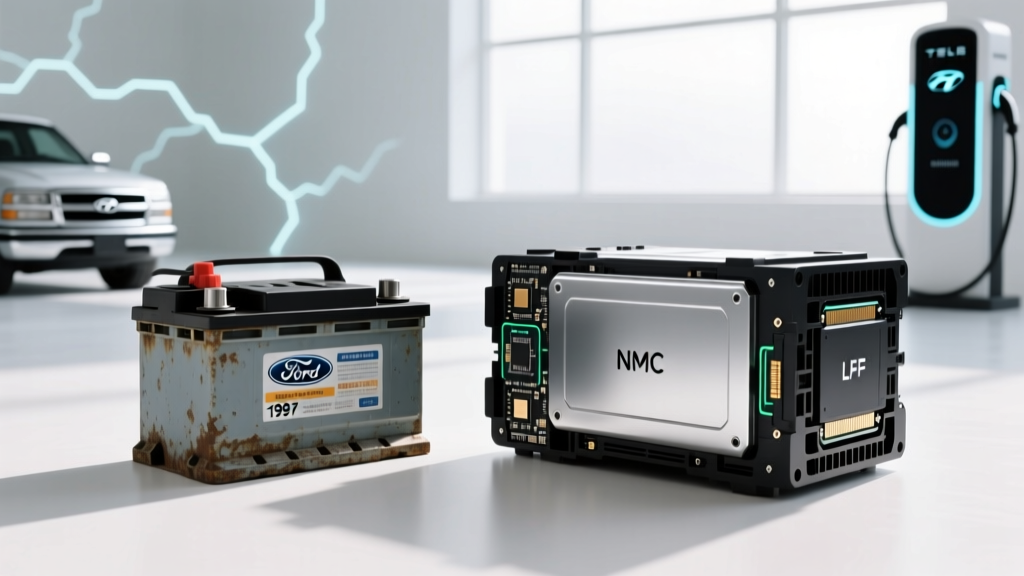
Every EV sold in the U.S. in 2026 uses one of three lithium-ion cathode chemistries: lithium iron phosphate (LFP), nickel manganese cobalt (NMC), or nickel cobalt aluminum (NCA). Each involves a different trade-off between energy density, cycle life, cost, and cold-weather behavior.
| Attribute | LFP (LiFePO₄) | NMC (Nickel Manganese Cobalt) | NCA (Nickel Cobalt Aluminum) |
|---|---|---|---|
| Energy density (cell-level) | 160–180 Wh/kg | 220–260 Wh/kg | 240–270 Wh/kg |
| Typical cycle life (80% retention) | 3,000–5,000+ | 1,000–2,000 | 800–1,500 |
| Cold-weather range loss (0°F vs 70°F) | ~30–38% | ~22–30% | ~22–28% |
| 100% SoC daily charging OK? | Yes — recommended for calibration | No — 80% daily limit advised | No — 80% daily limit advised |
| Key raw materials | Iron, phosphate (no Ni/Co) | Nickel, manganese, cobalt | Nickel, cobalt, aluminum |
| Cell cost (est. $/kWh, 2026) | ~$75–$90 | ~$100–$120 | ~$105–$125 |
| Notable 2026 applications | Tesla Model 3 RWD, Ford Mustang Mach-E Select, Rivian Standard | Hyundai Ioniq 5/6, VW ID.4, BMW iX | Tesla Model S/X, Lucid Air |
LFP dominates the value segment. Its lower energy density means heavier packs for a given range, but its exceptional cycle life (many cells exceed 4,000 cycles before hitting 80% capacity), tolerance for 100% state of charge, and cobalt-free supply chain make it ideal for standard-range vehicles. Tesla's Model 3 RWD (60 kWh LFP, EPA 272 mi, $38,990) is the highest-volume example.
NMC remains the mainstream choice for long-range and performance models where energy density matters. The Hyundai Ioniq 5 Long Range (84 kWh NMC, EPA 305 mi, peak 240 kW DC charging, 10–80% in ~18 minutes) exemplifies the chemistry's balance of range and charge speed.
NCA appears primarily in high-performance, low-volume applications where maximum energy density is paramount. Lucid's Air Grand Touring (112 kWh NCA, EPA 516 mi) leverages NCA's density to achieve the highest EPA range of any production sedan.
Lithium-Sulfur Batteries: The Promise and the Problem
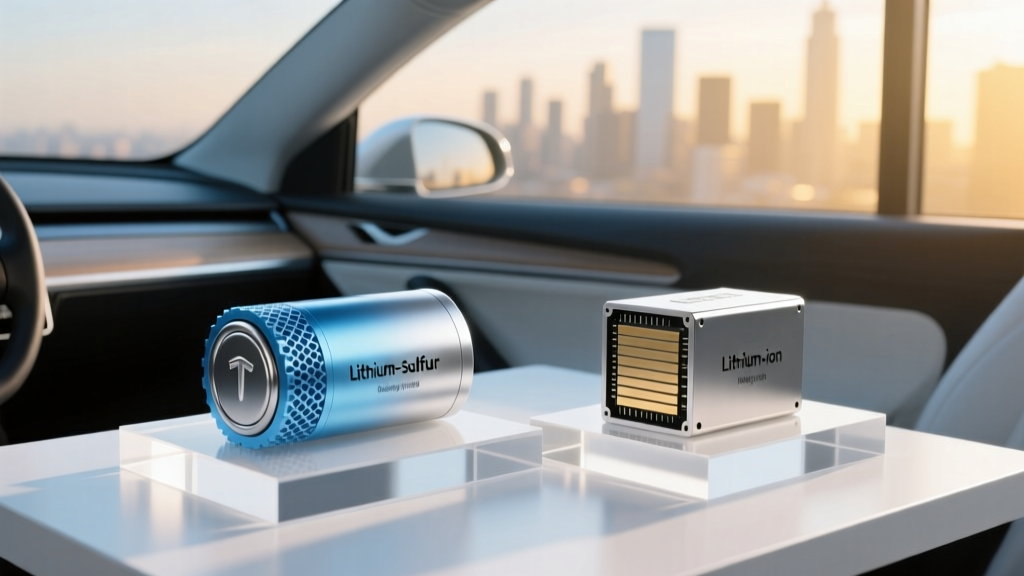
Lithium-sulfur (Li-S) replaces the metal-oxide cathode with elemental sulfur. The theoretical payoff is dramatic: sulfur is cheap (~$0.10/kg vs. nickel at ~$16/kg), abundant, and enables a theoretical energy density of 500–600 Wh/kg at the cell level — roughly 2–3× today's NMC. A pack-level energy density of 350+ Wh/kg would let a midsize sedan carry a 100 kWh pack weighing under 300 kg, unlocking 450–500 real-world miles without resorting to Lucid-size battery budgets.
The obstacle is cycle life. During discharge, sulfur undergoes a multi-step conversion reaction that produces soluble lithium polysulfides. These "shuttle" between electrodes, corroding the lithium-metal anode and progressively consuming active material. The result: most Li-S lab cells degrade to 80% capacity within 100–300 cycles — far below the 1,000+ minimum needed for automotive use (a 150,000-mile lifespan at 300 miles per cycle requires at least 500 full cycles with margin).
As of early 2026, companies like Oxis Energy successor entities, Lyten, and Sion Power have demonstrated prototype pouch cells exceeding 500–800 cycles in controlled lab conditions using engineered sulfur-carbon cathode structures and protective lithium-metal anode layers. Lyten has announced A-sample deliveries to European OEMs for evaluation, but no automaker has committed to a production timeline. Realistic volume production for automotive cells remains in the 2030–2033 window based on current pilot-line progress, according to industry analyses from BloombergNEF.
For buyers shopping in 2026, lithium-sulfur is not a reason to wait. The vehicles on showroom floors use mature, well-characterized chemistries with predictable degradation curves and strong warranty backing.
Real-World Battery Degradation: What the Data Shows
The fear of catastrophic battery degradation is the single most overblown concern in EV ownership. Large-scale fleet data consistently shows that modern lithium-ion packs lose capacity slowly and predictably, with most vehicles retaining well above their warranty threshold at end of coverage.
Degradation Data Snapshot (2024–2026 Fleet Studies)
- Tesla Model 3/Y (NMC/LFP fleet, ~250,000 vehicles): Average 8% capacity loss at 100,000 miles; 12% at 150,000 miles. Source: Tesla 2025 Impact Report.
- Hyundai/Kia E-GMP platform (Ioniq 5, EV6, NMC): ~6–9% loss at 80,000 miles based on Recurrent fleet data.
- Chevrolet Bolt EV/EUV (NMC, 65 kWh): ~5–7% loss at 75,000 miles; Bolt's conservative charge management and active thermal system contribute to strong retention.
- Nissan Leaf (passive air-cooled, pre-2026 LMO/NMC): Historically 12–18% loss at 80,000 miles — a cautionary example of thermal management's importance.
- LFP-specific (Tesla Model 3 RWD, BYD packs): ~4–6% loss at 80,000 miles; LFP's slower degradation partially offsets its lower initial energy density over time.
Two patterns emerge. First, the steepest degradation occurs in the first 10,000–20,000 miles (typically 2–4%), after which the curve flattens considerably. Second, vehicles with active liquid thermal management — which includes virtually every EV sold in the U.S. since 2020 except the base Nissan Leaf — show dramatically better retention than passively cooled packs.
For context, a 2026 Tesla Model Y Long Range (82 kWh NMC, EPA 320 mi) that loses 12% capacity at 150,000 miles still delivers ~282 EPA-equivalent miles. That's more range than most drivers use in a week of mixed commuting.
Battery Warranty Terms: What's Actually Covered
Federal law mandates that EV batteries carry a minimum warranty of 8 years / 100,000 miles (10 years / 150,000 miles in CARB states including California, New York, Massachusetts, and others). Most automakers exceed this baseline.
| Automaker / Model | Warranty Term | Capacity Retention Threshold | Chemistry |
|---|---|---|---|
| Tesla Model 3/Y Long Range | 8 yr / 120,000 mi | 70% | NMC |
| Tesla Model 3 RWD | 8 yr / 100,000 mi | 70% | LFP |
| Hyundai Ioniq 5 / Kia EV6 | 10 yr / 100,000 mi | 70% | NMC |
| Ford Mustang Mach-E | 8 yr / 100,000 mi | 70% | NMC / LFP |
| Rivian R1T / R1S | 8 yr / 175,000 mi | 70% | NMC / LFP |
| BMW iX / i4 | 8 yr / 100,000 mi | 70% | NMC |
| GM Ultium (Cadillac Lyriq, Chevy Blazer EV) | 8 yr / 100,000 mi | 70% | NMC |
The critical detail is the retention threshold: every manufacturer listed above defines a warranty claim as the pack falling below 70% of original capacity within the term. In practice, fleet data shows that fewer than 1% of modern liquid-cooled EV packs breach this threshold under normal use. A warranty replacement is statistically unlikely for the vast majority of owners.
Warranties cover defects and abnormal degradation, not damage from accidents, flooding, or aftermarket modifications. They also typically exclude capacity loss from sustained storage at 0% or 100% SoC against manufacturer guidance — so following the care recommendations below matters.
Battery Replacement Cost: The Real Numbers
If your pack does fail outside warranty — or you're buying a used EV with a degraded battery — replacement is the most expensive single repair an EV can require. Costs vary enormously by pack size, chemistry, and labor.
| Vehicle / Pack Size | Chemistry | Replacement Cost Range | Typical Need Trigger |
|---|---|---|---|
| Tesla Model 3 RWD (60 kWh) | LFP | $8,000–$11,000 | Collision damage, rare defect |
| Tesla Model Y LR (82 kWh) | NMC | $12,000–$16,000 | Collision damage, rare defect |
| Hyundai Ioniq 5 (84 kWh) | NMC | $13,000–$17,000 | Out-of-warranty degradation |
| Ford F-150 Lightning Ext. (131 kWh) | NMC | $20,000–$28,000 | Collision, fleet high-mileage |
| Chevrolet Bolt EV (65 kWh) | NMC | $9,000–$13,000 | Post-recall replacement, defect |
| Lucid Air (112 kWh) | NCA | $18,000–$24,000 | Rare, low-volume pricing |
These figures sound alarming in isolation, but context matters. According to data from Recurrent and warranty claim rates published by major OEMs, fewer than 2% of EV batteries require full replacement within the first 12 years of service. The majority of out-of-warranty replacements stem from physical damage (collision, ground strike) rather than degradation. For comparison, a gasoline vehicle's engine or transmission replacement runs $4,000–$8,000 and is far more common past 120,000 miles.
Module-level repair is increasingly available. Many packs (Hyundai E-GMP, GM Ultium, Tesla 4680 structural packs to a lesser extent) allow individual module replacement at $1,500–$4,000 per module rather than a full pack swap, reducing costs when only a subset of cells has degraded unevenly.
Factors That Accelerate (or Preserve) Battery Life
Battery degradation isn't random — it's driven by measurable electrochemical stressors. Understanding them lets you meaningfully extend pack life.
EV Battery Care Checklist
- Limit DC fast charging to road trips. Frequent 150+ kW DCFC sessions accelerate electrolyte decomposition. Research from the Idaho National Laboratory found that packs fast-charged exclusively degraded ~5% more over 50,000 miles than packs charged primarily on Level 2. Occasional DCFC is fine; daily DCFC is not.
- Set daily charge limits to 80% (NMC/NCA) or 100% (LFP). High state of charge stresses NMC/NCA cathodes. LFP's flat voltage curve actually benefits from periodic 100% charges for BMS calibration. Know your chemistry.
- Avoid sustained storage below 10% or above 90% SoC. If leaving the car for 2+ weeks, set the charge limit to 50–60%. Calendar aging accelerates at voltage extremes.
- Precondition the battery in cold weather. Most EVs (Tesla, Hyundai, Ford, Rivian) offer navigation-based preconditioning that warms the pack before you arrive at a DC fast charger. This reduces lithium plating risk and improves charge speed. Charging a sub-32°F pack at high power causes anode damage.
- Park in shade or a garage when possible. Sustained pack temperatures above 95°F accelerate calendar degradation. A garage in Phoenix is worth more for battery life than one in Seattle.
- Don't obsess over 100% avoidance. Occasional 100% charges before a road trip cause negligible additional wear. The damage comes from sitting at 100% for hours or days, not from reaching it briefly.
Monitoring Battery Health: How to Check SoH
State of Health (SoH) is the percentage of a battery's original usable capacity that remains available. A new pack is 100% SoH; one that has degraded to hold only 70 kWh of its original 80 kWh is at 87.5%.
Built-in tools: Tesla's app displays estimated range at 100% SoC, which serves as a proxy for SoH. Hyundai/Kia's infotainment system includes an EV battery-condition readout under the diagnostics menu. GM's Ultium vehicles show battery health via the myChevrolet/myCadillac app.
Third-party tools: Services like Recurrent provide SoH reports by analyzing your telematics data (with permission). For OBD-II-connected diagnostics, apps like LeafSpy (Nissan) and Tessie (Tesla) pull granular cell-level voltage data that reveals module imbalance — an early warning sign of degradation.
What to watch for: A sudden drop in estimated range at a given SoC (e.g., 80% showing 15 fewer miles than it did six months ago) warrants a dealer diagnostic check. Gradual, linear decline of 1–2% per year is normal and expected.
Beyond Lithium-Sulfur: Solid-State and Silicon Anodes
Lithium-sulfur isn't the only next-generation chemistry in development. Two other technologies are closer to production and worth tracking:
Solid-state batteries replace the liquid electrolyte with a solid ceramic or polymer, enabling lithium-metal anodes without the dendrite short-circuit risk. Toyota has announced a 2027–2028 production timeline for solid-state cells in limited-run vehicles, targeting 750 km (~465 mi) range and 10-minute 10–80% charging. Samsung SDI and QuantumScape have delivered prototype cells to OEM partners. However, manufacturing yield challenges and costs 3–5× current lithium-ion mean volume production for mainstream vehicles remains a 2030+ prospect.
Silicon-dominant anodes are the nearest-term improvement. Replacing graphite with silicon increases anode capacity by 20–40%, boosting pack energy density without changing cathode chemistry. Sila Nanotechnologies supplies silicon-composite anode material to Mercedes-Benz for the G-Class EV (2025), and Group14 Technologies supplies Porsche and other OEMs. Expect silicon-anode cells to become mainstream in premium EVs by 2027–2028, adding 10–15% range to existing NMC platforms without the cycle-life concerns of lithium-sulfur or solid-state.
Frequently Asked Questions
How long do EV batteries last in years and miles?
Modern liquid-cooled EV batteries with NMC or LFP chemistry routinely exceed 150,000–200,000 miles while retaining 80–88% of original capacity. In years, that translates to 12–18 years for the average U.S. driver (~13,500 miles/year per FHWA data). Most packs will outlast the vehicle's body, interior, and suspension components.
How much does an EV battery cost to replace?
Full pack replacement ranges from $8,000 for a 60 kWh LFP pack (Tesla Model 3 RWD) to $28,000 for a 131 kWh NMC pack (Ford F-150 Lightning Extended Range). However, fewer than 2% of packs require replacement within 12 years. Module-level repairs, when available, cost $1,500–$4,000.
What does the EV battery warranty actually cover?
Federally mandated minimum is 8 years/100,000 miles (10/150,000 in CARB states). Coverage triggers when capacity falls below 70% of original. Warranties cover manufacturing defects and abnormal degradation but exclude accident damage, flooding, and abuse from sustained storage at extreme SoC against manufacturer guidance.
How do I check and maximize my battery's health?
Check SoH through your vehicle's app, infotainment diagnostics menu, or third-party services like Recurrent. Maximize longevity by limiting DC fast charging to road trips, setting daily charge limits to 80% (NMC) or 100% (LFP), preconditioning in cold weather, and avoiding sustained storage at extreme SoC levels.
LFP vs NMC — which is better for me?
Choose LFP if you want maximum cycle life, can charge to 100% daily, live in a mild climate, and don't need 300+ miles of range. It's the longevity and value play. Choose NMC if you need long range (300+ mi), live in a cold climate where its lower range loss matters, or want faster DC charging speeds. Neither is universally "better" — they solve different use cases.
Should I wait for lithium-sulfur or solid-state batteries?
No. Lithium-sulfur remains in the pilot/prototype stage with cycle-life challenges unresolved for automotive use; realistic production is 2030–2033 at earliest. Solid-state is closer (Toyota targets 2027–2028 for limited runs) but will debut in low-volume, high-cost vehicles. Today's LFP and NMC packs are mature, well-warrantied, and supported by extensive real-world degradation data showing 12–18 year lifespans.