Why Lithium Purification Matters for Your EV Battery
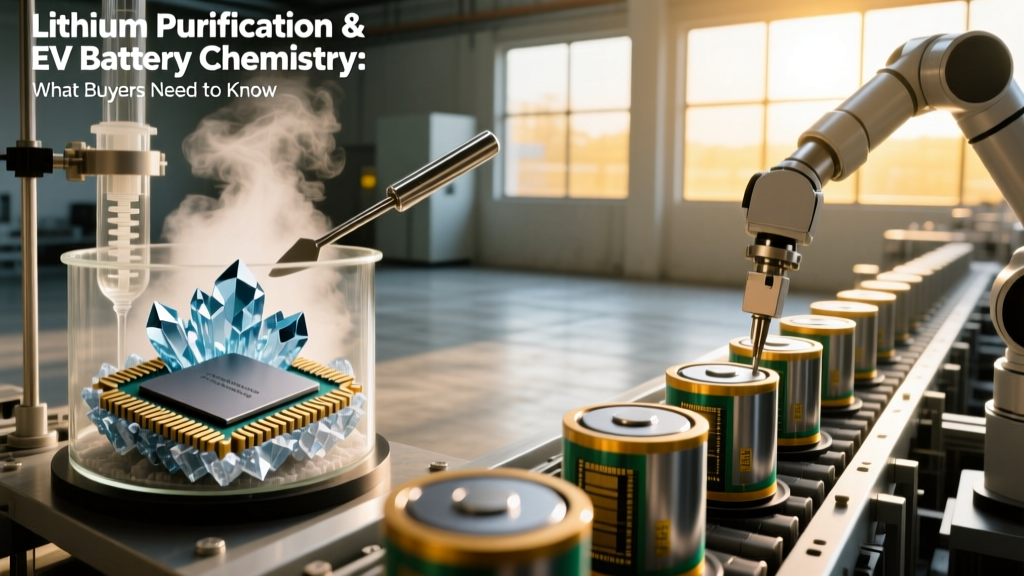
Before an EV battery ever reaches a car, its raw materials go through an exacting refining process. Lithium purification—the chemical and metallurgical steps that transform raw spodumene ore or brine into battery-grade lithium carbonate or lithium hydroxide—directly determines cell quality, longevity, and consistency. Battery-grade lithium must reach 99.5% purity or higher; even trace impurities like iron, calcium, or sodium can accelerate degradation, increase internal resistance, and reduce cycle life.
For EV buyers in 2026, this upstream process matters more than ever. The IRS §30D tax credit now ties eligibility to critical-mineral sourcing requirements, meaning where and how lithium is extracted and purified affects whether you qualify for up to $7,500 in federal incentives. Understanding battery chemistry—and the purification chain behind it—gives you a real edge when comparing models, evaluating warranty coverage, and planning long-term ownership.
This guide covers the chemistry choices automakers make (LFP vs. NMC/NCA), real degradation data, warranty terms, replacement costs, and how to monitor and maximize your battery's health over the life of the vehicle.
LFP vs. NMC/NCA: The Chemistry Decision
Two dominant lithium-ion chemistries power today's EVs. Lithium Iron Phosphate (LFP) uses an iron-based cathode; Nickel Manganese Cobalt (NMC) and Nickel Cobalt Aluminum (NCA) use nickel-rich cathodes. The lithium purification requirements differ: NMC/NCA cells typically demand lithium hydroxide (LiOH) refined to ultra-high purity, while LFP cells can use lithium carbonate (Li₂CO₃), which is somewhat less costly to purify. This cost difference cascades into the final cell price.
| Attribute | LFP (Lithium Iron Phosphate) | NMC / NCA (Nickel-based) |
|---|---|---|
| Energy Density | ~160–180 Wh/kg (cell level) | ~230–300 Wh/kg (cell level) |
| Cycle Life | 3,000–5,000+ cycles to 80% SoH | 1,000–2,000 cycles to 80% SoH |
| Cold-Weather Performance | Greater range loss below 32°F (~25–35% reduction) | Better cold performance (~15–25% reduction) |
| Thermal Stability | Excellent — less prone to thermal runaway | Good — requires more active thermal management |
| Cost (cell level) | Lower — no nickel or cobalt | Higher — nickel and cobalt price exposure |
| Typical Use Cases | Standard-range models, fleet vehicles, daily commuters | Long-range, performance, and AWD models |
| Charging to 100% SoC | Recommended periodically for BMS calibration | Generally advised to charge to 80% daily |
| Notable 2026 Examples | Tesla Model 3 RWD, Ford Mustang Mach-E Select (LFP option), BYD models | Hyundai Ioniq 5 Long Range, Tesla Model Y LR, Rivian R1T |
Which is better? It depends on your driving pattern. If you commute 30–50 miles daily, charge at home, and live in a moderate climate, LFP offers superior longevity and lower cost with fewer ethical supply-chain concerns (no cobalt). If you regularly take road trips exceeding 250 miles, need maximum range in a single charge, or live in a cold northern climate, NMC/NCA delivers the energy density you need. Neither chemistry is universally superior—they serve different use cases.
How Long Do EV Batteries Last?
The short answer: longer than most buyers assume. Data from fleet operators, manufacturer reports, and independent testing consistently shows that modern EV traction batteries retain 85–95% of their original capacity after 100,000 miles. Catastrophic failure (a battery that simply stops working) is rare; the real concern is gradual capacity loss that reduces range over time.
Typical Degradation Trajectory
| Milestone | Average Capacity Retained | Context |
|---|---|---|
| Year 1 / 15,000 mi | 95–98% | Initial formation loss; most pronounced in first few months |
| Year 3 / 45,000 mi | 90–95% | Gradual linear decline after initial drop |
| Year 5 / 75,000 mi | 87–93% | Still well above warranty threshold for most packs |
| Year 8 / 100,000 mi | 82–90% | Warranty coverage period ends for many models |
| Year 10 / 150,000 mi | 78–88% | Most packs remain functional; range reduction noticeable but manageable |
Sources: Geotab fleet data (2024–2025 analysis of 10,000+ EVs), Recurrent Auto battery health reports, manufacturer warranty disclosures. Individual results vary based on climate, charging habits, and chemistry.
LFP packs tend to show slower degradation over high cycle counts, which is why they're favored for high-mileage fleet and rideshare applications. NMC packs may degrade slightly faster per cycle but start with more range, so the absolute range remaining after 150,000 miles can be comparable. According to fueleconomy.gov, modern battery management systems (BMS) and liquid thermal management have significantly improved longevity compared to early-generation EVs from 2011–2016.
What the Battery Warranty Actually Covers
Federal law mandates a minimum 8-year / 100,000-mile warranty on EV battery packs for emissions-related compliance, and most manufacturers meet or exceed this baseline. The warranty covers capacity loss below a defined threshold—typically 70% of original capacity—and defects in materials or workmanship. It does not cover damage from accidents, flooding, or unauthorized modifications.
| Manufacturer | Warranty Period | Capacity Threshold | Notes |
|---|---|---|---|
| Tesla (Model 3/Y RWD — LFP) | 8 yr / 100,000 mi | 70% retention | LR/AWD models: 8 yr / 120,000 mi |
| Hyundai / Kia | 10 yr / 100,000 mi | 70% retention | Among the longest coverage in the industry |
| Ford (Mach-E, F-150 Lightning) | 8 yr / 100,000 mi | 70% retention | Covers battery and hybrid/electric components |
| GM (Ultium-based) | 8 yr / 100,000 mi | 70% retention | Some models offer extended coverage options |
| Rivian | 8 yr / 120,000 mi | 70% retention | Max and Dual-Motor packs covered |
| BMW | 8 yr / 100,000 mi | 70% retention | Includes high-voltage storage and modules |
Key detail: The 70% threshold means a 75 kWh pack must drop below ~52.5 kWh usable capacity for a warranty claim. In practice, very few modern packs degrade this quickly under normal use. If your battery does fall below threshold within the warranty window, the manufacturer typically replaces failed modules or the entire pack at no cost.
EV Battery Replacement Cost: What to Budget
Out-of-warranty battery replacement is the single biggest fear for prospective EV buyers. Here's the reality: full pack replacement is uncommon. Most degradation-related issues involve individual modules, which can be replaced for a fraction of the full-pack cost. But if a full replacement is needed, here's what you're looking at in 2026:
| Vehicle Category | Battery Size | Full Pack Cost (Parts + Labor) | Typical Replacement Trigger |
|---|---|---|---|
| Compact / Standard Range (e.g., Tesla Model 3 RWD, Chevy Bolt) | 50–65 kWh | $8,000 – $14,000 | Rare before 200,000 mi; accident or manufacturing defect |
| Mid-size / Long Range (e.g., Ioniq 5 LR, Model Y LR) | 75–85 kWh | $12,000 – $20,000 | Uncommon within first 10 years |
| Large / Truck / SUV (e.g., F-150 Lightning, Rivian R1T) | 100–135 kWh | $18,000 – $30,000 | Very rare; mostly collision damage |
| Module-Level Repair (any category) | Varies | $2,000 – $6,000 | Single module failure; more common than full-pack swap |
Prices have declined roughly 10–15% since 2023 due to improved lithium purification efficiency, scaled cell production, and increased competition among cell suppliers. For context, a conventional vehicle's engine or transmission replacement can cost $4,000–$8,000 and is far more likely to be needed within 150,000 miles than an EV battery replacement.
When is replacement typically needed? For the vast majority of owners, it isn't. Battery packs in 2024–2026 vehicles are engineered for 200,000+ mile lifespans. The cars will more likely be retired due to body damage, electronics obsolescence, or owner preference before the battery fails outright.
Factors That Accelerate Battery Degradation
Not all miles are equal when it comes to battery wear. The following factors have the most measurable impact on long-term State of Health (SoH):
Battery Care Essentials
- DC fast charging frequency: Occasional DC fast charging (1–2x per week) has minimal impact. Daily use of 150+ kW chargers, especially without battery preconditioning, accelerates degradation by 2–5% over 100,000 miles compared to primarily Level 2 home charging.
- State of Charge extremes: Regularly sitting at 100% SoC or dropping below 10% stresses NMC cells. For daily driving, a 20–80% charge window is optimal for NMC. LFP cells tolerate 100% SoC better and benefit from periodic full charges for BMS calibration.
- Extreme temperatures: Sustained exposure to ambient temperatures above 95°F accelerates chemical degradation. Cold below 20°F doesn't permanently damage cells but reduces available range temporarily and can cause lithium plating if fast-charging without preconditioning.
- High discharge rates: Repeated hard acceleration and sustained high-speed driving (85+ mph) generate heat that stresses cells over time. Track use voids most battery warranties.
- Storage at high SoC: Leaving an EV parked at 100% charge for weeks in hot weather is one of the worst things you can do. If storing, set the charge limit to 50–60%.
How to Monitor Your Battery's State of Health
State of Health (SoH) is the percentage of your battery's original usable capacity that remains available. A new 82 kWh pack at 92% SoH delivers roughly 75.4 kWh of usable energy. Here's how to check and track it:
In-vehicle displays: Some 2026 models (notably Hyundai/Kia EVs and certain Tesla software versions) display SoH or a battery health indicator in the settings menu. Tesla's app shows estimated range at 100% charge, which you can compare to the original EPA figure as a proxy.
OBD-II diagnostic tools: Devices like the OBDLink MX+ paired with apps such as Car Scanner or EV-specific tools (e.g., LeafSpy for Nissan, Teslalogger for Tesla) can read battery management system data including pack voltage, individual cell voltages, and estimated capacity. This gives a more precise SoH reading than the dashboard estimate.
Third-party battery health reports: Companies like Recurrent Auto and ALG (formerly Automotive Lease Guide) offer battery health certifications for used EVs. If you're buying a pre-owned EV, requesting a battery health report is as important as checking a Carfax for accident history.
Manual calculation method: Charge to 100% (for LFP) or note the displayed range at your standard charge limit. Divide current estimated range by original EPA range. A 310-mile EPA vehicle showing 280 miles at 100% is at roughly 90% SoH. This isn't perfectly precise—ambient temperature and driving style affect the estimate—but it's a useful trend tracker.
Emerging Battery Technology: What's Next
Several next-generation technologies aim to improve energy density, charging speed, and longevity beyond current lithium-ion capabilities. Here's a realistic timeline assessment:
Solid-state batteries: These replace the liquid electrolyte with a solid ceramic or polymer separator, promising 30–50% higher energy density, faster charging, and improved safety. Toyota has announced a solid-state battery targeting 2027–2028 production in limited models. Samsung SDI and QuantumScape are also advancing prototypes. However, manufacturing scalability remains the primary bottleneck—expect solid-state to reach mainstream, affordable EVs no earlier than 2029–2031. This is announced/forward-looking technology, not currently available in any production vehicle.
Silicon-dominant anodes: Replacing graphite anodes with silicon can increase energy density by 20–40%. Companies like Sila Nanotechnologies and Group14 are supplying silicon-carbon anode materials to cell manufacturers now. Expect incremental adoption in 2026–2028 model-year premium EVs, with broader rollout by 2029.
Sodium-ion batteries: Using sodium instead of lithium eliminates dependence on lithium purification entirely. CATL has begun producing sodium-ion cells for lower-cost, shorter-range applications. These are unlikely to appear in US-market long-range EVs before 2028 but may power budget city cars and stationary storage sooner.
Lithium-sulfur (Li-S): Offers theoretical energy density 3–5x current lithium-ion but suffers from rapid cycle-life degradation. Still in laboratory and early prototype stages; commercial EV application is likely 8–12+ years away.
Frequently Asked Questions
How long do EV batteries last in years and miles?
Modern EV batteries (2022–2026 production) are designed to retain 70–85% of original capacity at 150,000–200,000 miles or 10–15 years. Fleet data from Geotab and Recurrent shows average annual degradation of 1.5–2.5% per year under normal use. Most packs will outlast the vehicle's useful life or be retired for reasons unrelated to battery failure.
How much does an EV battery cost to replace?
Full pack replacement ranges from $8,000 to $30,000 depending on battery size and vehicle class (compact to large truck/SUV). However, most out-of-warranty repairs involve individual module replacements at $2,000–$6,000. Full replacements are rare and typically result from collision damage rather than degradation.
What does the EV battery warranty cover?
Standard warranties cover capacity loss below 70% of original capacity and manufacturing defects for 8 years / 100,000 miles (Hyundai/Kia extend to 10 years). They do not cover accident damage, flood damage, or modifications. Some manufacturers cover the entire high-voltage system including inverters and cabling.
How do I check and maximize my EV battery health?
Monitor SoH through your vehicle's battery settings, OBD-II diagnostic apps, or third-party health reports. To maximize longevity: favor Level 2 home charging over daily DC fast charging, keep NMC batteries in the 20–80% SoC range for daily use, precondition before fast charging in cold weather, and avoid prolonged storage at 100% SoC in hot climates.
LFP vs. NMC — which battery chemistry is better for me?
Choose LFP if you prioritize longevity (3,000–5,000+ cycles), lower cost, and daily commuting under 200 miles. Choose NMC/NCA if you need maximum range (300+ miles), better cold-weather performance, or frequently take long road trips. LFP tolerates regular 100% charging; NMC is best kept at 80% daily. Both chemistries rely on high-purity lithium refining—the quality of lithium purification directly impacts cell consistency and lifespan regardless of chemistry choice.
Does lithium purification quality affect my battery's lifespan?
Yes. Battery-grade lithium must reach 99.5%+ purity. Impurities like iron, sodium, and moisture increase internal cell resistance and accelerate side reactions that cause capacity fade. Reputable cell manufacturers (CATL, LG Energy Solution, Panasonic, Samsung SDI, SK On) enforce strict incoming-material quality controls. This is one reason cells from established suppliers tend to show more consistent degradation curves than cells from newer, less-proven producers.