Why Lithium Mining Matters for Tesla and Every EV Buyer
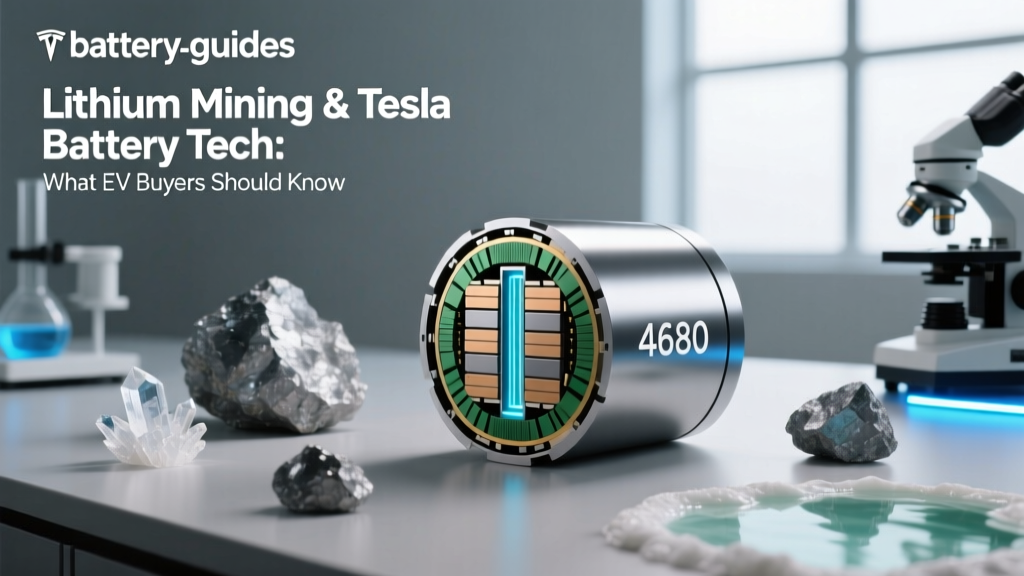
Searches around lithium mining Tesla often stem from two concerns: the environmental footprint of battery materials and the long-term durability of the pack sitting under your car. Both are fair questions, but the answers require separating geology from engineering. Lithium extraction — whether from Australian hard-rock mines (spodumene ore) or South American brine operations in Chile and Argentina — feeds the cathode chemistry that determines your EV's range, charging speed, and lifespan. Tesla sources lithium through long-term contracts with suppliers including Albemarle, Ganfeng Lithium, and its own Nevada-based clay extraction pilot, but the company has also pivoted heavily toward LFP (lithium iron phosphate) chemistry in standard-range models, which eliminates cobalt and nickel entirely and reduces reliance on the most contested supply chains.
For buyers, the mining conversation matters less than what chemistry ends up in your vehicle and how that chemistry ages over 100,000+ miles. This guide breaks down exactly that — with real degradation data, warranty terms, replacement costs, and actionable care habits.
LFP vs NMC vs NCA: The Chemistry Decision
Modern EV batteries use one of three dominant cathode chemistries. Understanding the trade-offs is the single most important battery decision you'll make at purchase.
| Attribute | LFP (Lithium Iron Phosphate) | NMC (Nickel Manganese Cobalt) | NCA (Nickel Cobalt Aluminum) |
|---|---|---|---|
| Energy Density (Wh/kg, cell-level) | 160–180 | 220–260 | 250–280 |
| Cycle Life (to 80% capacity) | 3,000–5,000+ | 1,500–2,500 | 1,500–2,000 |
| Cold-Weather Performance | Moderate (greater range loss below 32°F) | Good | Good |
| Cost per kWh (2026 est.) | $80–$100 | $110–$140 | $115–$145 |
| Cobalt/Nickel Required | No | Yes | Yes |
| Recommended Daily Charge Limit | 100% (benefits from full-charge calibration) | 80–90% for daily use | 80–90% for daily use |
| Typical Tesla Application | Model 3/Y Standard Range (CATL cells) | Model 3/Y Long Range | Model S/X, Cybertruck |
The practical takeaway: LFP sacrifices roughly 15–20% energy density for dramatically longer cycle life, lower cost, and a cobalt-free supply chain. If you commute daily and charge at home, LFP is arguably the superior ownership chemistry. NMC/NCA delivers the range needed for 300+ mile EPA ratings and better cold-weather buffer — worth it for road-trip-heavy drivers or those in northern climates. Tesla's split across its lineup reflects this: Standard Range vehicles get LFP; Long Range and Performance trims get NMC or NCA.
How Long Do EV Batteries Actually Last?
The fear that an EV battery will "expire" at 100,000 miles like a timing belt is not supported by fleet data. Based on aggregated owner reports and studies from sources like Geotab's EV battery degradation research, here is what realistic degradation looks like:
- Year 1–2 / 0–30,000 miles: 2–5% capacity loss (initial formation drop, then plateau)
- Year 3–5 / 30,000–75,000 miles: ~1–2% loss per year (linear, slow decline)
- Year 6–8 / 75,000–120,000 miles: Cumulative loss typically 10–15% from original capacity
- Year 10+ / 150,000+ miles: Most NMC/NCA packs retain 75–85%; LFP packs often retain 85–92%
Tesla's own 2024 Impact Report stated that Model 3/Y batteries showed approximately 12% average degradation at 200,000 miles. That aligns with what high-mileage owners on forums report: a noticeable but manageable range reduction, not a catastrophic failure. The key insight is that degradation is non-linear — a steep initial drop followed by a long, slow taper. Most EV batteries will outlast the vehicle's body and interior.
What the Battery Warranty Actually Covers
Federal law mandates a minimum 8-year/100,000-mile warranty on EV battery packs (10 years/150,000 miles in CARB states like California, New York, and Massachusetts). Here is how major manufacturers structure coverage:
| Manufacturer | Warranty Term | Capacity Retention Threshold | Coverage Scope |
|---|---|---|---|
| Tesla (Model 3/Y Standard) | 8 yr / 100,000 mi | 70% | Defects + degradation below threshold |
| Tesla (Model 3/Y LR, S, X) | 8 yr / 120,000 mi | 70% | Defects + degradation below threshold |
| Hyundai / Kia | 10 yr / 100,000 mi | 70% | Defects + degradation below threshold |
| Ford (Mustang Mach-E) | 8 yr / 100,000 mi | 70% | Defects + degradation below threshold |
| GM (Ultium-based) | 8 yr / 100,000 mi | 70% (some models 60% for capacity) | Defects + degradation below threshold |
Critical nuance: Warranties cover capacity falling below the stated threshold, not any degradation. A pack that drops to 72% at year 7 is functioning "within spec" even though you've lost 28% of your original range. Also, warranty claims typically result in module replacement or refurbishment, not a brand-new pack. The good news: needing a warranty claim is statistically rare. Out-of-warranty failures affect well under 5% of packs according to manufacturer reliability data.
EV Battery Replacement Cost: What to Budget (and When)
If your pack degrades beyond usability or suffers physical damage outside warranty, replacement costs depend heavily on battery size and chemistry. Here is the 2026 landscape:
| Vehicle / Pack Size | Chemistry | Replacement Cost Range (parts + labor) | Typical Replacement Trigger |
|---|---|---|---|
| Tesla Model 3 SR (~60 kWh) | LFP | $10,000–$14,000 | Post-warranty degradation or collision damage |
| Tesla Model Y LR (~75 kWh) | NMC | $14,000–$18,000 | Post-warranty degradation or collision damage |
| Ford F-150 Lightning Ext. (~131 kWh) | NMC | $22,000–$30,000 | Collision damage (degradation claims rare at current fleet age) |
| Hyundai Ioniq 5 (~77 kWh) | NMC | $13,000–$17,000 | Post-warranty or individual module failure |
| Chevy Bolt EV (~65 kWh) | NMC | $9,000–$13,000 | Mostly recall-related; post-warranty degradation |
These figures sound alarming, but context matters. The vast majority of EV owners will sell or trade their vehicle before a pack replacement is needed. LFP-equipped vehicles in particular may never need a replacement under normal ownership timelines — their cycle life exceeds 3,000 full cycles, which translates to well over 500,000 miles for most packs. Replacement is most commonly triggered by collision damage (covered by insurance) rather than end-of-life degradation.
Factors That Accelerate (or Preserve) Battery Health
Battery degradation isn't purely a function of time — your habits meaningfully shift the curve. Here is the hierarchy of impact:
High-Impact Factors
- Sustained high State of Charge: Storing an NMC/NCA pack at 100% for days or weeks accelerates electrolyte oxidation. Set daily charge limits to 80–90% and only charge to 100% before a road trip. (LFP is an exception — Tesla recommends periodic 100% charges for BMS calibration.)
- Extreme heat exposure: Repeatedly exposing the pack to ambient temperatures above 95°F without active cooling accelerates degradation. Tesla's liquid thermal management mitigates this substantially, but parking in shade or a garage still helps.
- Deep discharges to 0%: Letting the pack sit at or near 0% SoC causes copper dissolution in the anode current collector. Keep storage charge between 20–50%.
Moderate-Impact Factors
- DC fast-charging frequency: Exclusive use of DCFC (150+ kW) shows a measurable but modest degradation penalty — studies suggest roughly 1–3% additional loss over 100,000 miles compared to Level 2 charging. It's not catastrophic, but daily Level 2 home charging is gentler.
- Cold-weather charging without preconditioning: Charging a frozen pack without thermal preconditioning risks lithium plating on the anode. Always use your vehicle's preconditioning feature (Tesla navigates-to-charger preconditioning activates automatically).
Low-Impact Factors
- Regenerative braking intensity: Minimal effect on battery health; the charge rates during regen are well within safe C-rates.
- Occasional 100% charges (NMC): Fine if you drive soon after; the damage comes from sustained high SoC, not brief peaks.
How to Check and Monitor Battery State of Health (SoH)
Most EVs don't surface a simple "battery health percentage" the way a smartphone does. Here is how owners actually monitor SoH:
- Tesla: The service menu (accessible via the software screen) shows estimated range at 100% charge. Compare this to the original EPA-rated range — the percentage difference approximates your capacity loss. Third-party tools like TeslaFi or Stats log charge data to estimate SoH more precisely.
- Hyundai/Kia: The infotainment system's EV diagnostics page displays a battery health percentage directly — one of the most transparent implementations.
- OBD-II diagnostic tools: Apps like LeafSpy (Nissan Leaf), ABRP with OBD dongles, or manufacturer-specific scan tools can read BMS-reported SoH values. These are more accurate than range-based estimates.
- Dealer diagnostic: Requesting a battery health report during service visits gives you a manufacturer-certified SoH reading — useful for resale negotiations.
A good benchmark: if your 100%-charge estimated range has dropped more than 10% from new within the first 4–5 years, it's worth flagging to the dealer for warranty evaluation.
Emerging Battery Tech: Solid-State, Silicon Anodes, and Realistic Timelines
Headlines about solid-state batteries and silicon-anode cells are constant, but buyers should calibrate expectations:
- Solid-state batteries: Toyota, Samsung SDI, and QuantumScape have all announced pilot production, but mass-market automotive deployment at scale remains projected for 2028–2030+. Benefits include higher energy density (~400 Wh/kg cell-level potential), faster charging, and improved safety (no liquid electrolyte to ignite). Current limitations: manufacturing cost, interfacial resistance challenges, and scaling from lab to gigawatt-hour production.
- Silicon-anode cells: Already in limited production (Sila Nanotechnologies supplies Mercedes' G-Class EV; Group14 supplies Porsche). Silicon anodes boost energy density 10–20% over graphite but face expansion/contraction cycle-life challenges. Expect gradual adoption in premium models through 2027–2028.
- Sodium-ion batteries: CATL has begun production for lower-range Chinese-market EVs. Sodium-ion eliminates lithium entirely, reducing mining dependency, but trades 30–40% lower energy density. Viable for city cars and stationary storage; unlikely to appear in US-market long-range vehicles soon.
For buyers in 2026, today's LFP and NMC chemistries are mature, well-understood, and backed by extensive warranty coverage. Waiting for solid-state means waiting at least 3–5 years for limited availability at premium prices.
Frequently Asked Questions
How long do EV batteries last in years and miles?
Most modern EV batteries retain 75–90% of original capacity at 150,000–200,000 miles (roughly 10–15 years of average driving). LFP chemistry typically outlasts NMC/NCA by a meaningful margin. Catastrophic failure is rare; gradual capacity loss is the norm.
How much does an EV battery cost to replace in 2026?
Replacement costs range from approximately $9,000 for a Chevy Bolt pack to $30,000 for a Ford F-150 Lightning extended-range pack, including labor. Most owners will never need a replacement — packs routinely outlast the vehicle. Insurance covers collision-related replacements.
What does the EV battery warranty actually cover?
Federal minimum is 8 years/100,000 miles (10/150,000 in CARB states). Warranties cover manufacturing defects and capacity loss below a stated threshold (typically 70% of original capacity). They do not cover gradual degradation that stays above the threshold, cosmetic issues, or damage from accidents or misuse.
How do I check my EV's battery health?
Compare your vehicle's 100%-charge estimated range to its original EPA rating — the percentage difference approximates capacity loss. Some brands (Hyundai, Kia) display SoH directly in the infotainment system. OBD-II tools and apps like TeslaFi provide more granular data. Dealer service departments can run a certified diagnostic.
LFP vs NMC — which battery chemistry is better?
Neither is universally better. LFP wins on cycle life (3,000–5,000+ cycles), cost, cobalt-free sourcing, and the convenience of regular 100% charging. NMC wins on energy density (more range in the same pack size), cold-weather performance, and suitability for long-range trims. For daily commuters who charge at home, LFP is often the smarter choice. For road-trip-heavy drivers in cold climates, NMC is preferable.
Does lithium mining for Tesla batteries harm the environment?
Lithium extraction has measurable environmental impacts — water consumption in brine operations (Chile's Atacama region), energy use in hard-rock mining (Australia), and land disruption. However, per IEA lifecycle analyses, an EV's total lifetime emissions remain significantly lower than a comparable ICE vehicle even accounting for mining. Tesla's shift to LFP chemistry in standard-range vehicles reduces cobalt and nickel demand, and the industry is moving toward closed-loop battery recycling (Redwood Materials, Li-Cycle) to recover 90%+ of critical minerals from retired packs.
Should I avoid DC fast charging to protect my battery?
Exclusive DC fast charging shows a modest degradation penalty (1–3% extra loss over 100,000 miles) but is not damaging in normal use. If you have Level 2 home charging, use it for daily needs and reserve DCFC for road trips. Preconditioning your battery before fast charging (automatic in Tesla when navigating to a Supercharger) reduces stress by bringing the pack to optimal temperature.
Sources: EPA fueleconomy.gov, Tesla Impact Report, Geotab EV Battery Degradation Study, IEA Global EV Outlook, IRS §30D Clean Vehicle Credit guidelines.