The Looming Battery Tsunami and the Recycling Imperative
As the global transition to electric mobility accelerates, the automotive industry is approaching a critical inflection point. The first massive generation of electric vehicles (EVs) is nearing the end of its operational lifecycle, bringing with it a looming wave of end-of-life (EOL) lithium-ion batteries. According to the International Energy Agency (IEA) Global EV Outlook, the sheer volume of retired batteries will necessitate a robust, technologically advanced recycling infrastructure to prevent environmental hazards and secure critical mineral supply chains. Battery recycling is no longer just a waste management afterthought; it is a sophisticated technological deep dive that dictates the future sustainability of the entire EV ecosystem.
Understanding the complex processes involved in breaking down and recovering battery materials is essential for consumers, policymakers, and industry stakeholders. This guide explores the three primary technological pathways for EV battery recycling, evaluates their environmental impacts through lifecycle analysis, and provides actionable advice on how consumers can ensure their vehicle's battery is responsibly managed at the end of its life.
The Chemistry of the Problem: NMC vs. LFP
Before dismantling a battery, recyclers must understand its chemical makeup. The modern EV market is dominated by two primary cathode chemistries: Nickel Manganese Cobalt (NMC) and Lithium Iron Phosphate (LFP). NMC batteries contain high-value critical minerals like cobalt and nickel, making them economically lucrative to recycle. The high market value of these metals naturally incentivizes the recycling industry to recover them.
Conversely, LFP batteries, which are increasingly popular in standard-range vehicles due to their lower cost and longer cycle life, contain no cobalt or nickel. The primary materials—iron, phosphorus, and lithium—are significantly cheaper. Historically, the cost of recycling LFP cells exceeded the value of the recovered materials, making them an economic burden rather than an asset. However, recent advancements in extraction technology and shifting regulatory mandates are forcing the industry to develop economically viable recycling pathways for LFP chemistries, ensuring that all EV batteries, regardless of their chemical composition, can be processed sustainably.
Pyrometallurgy: The Traditional Smelting Approach
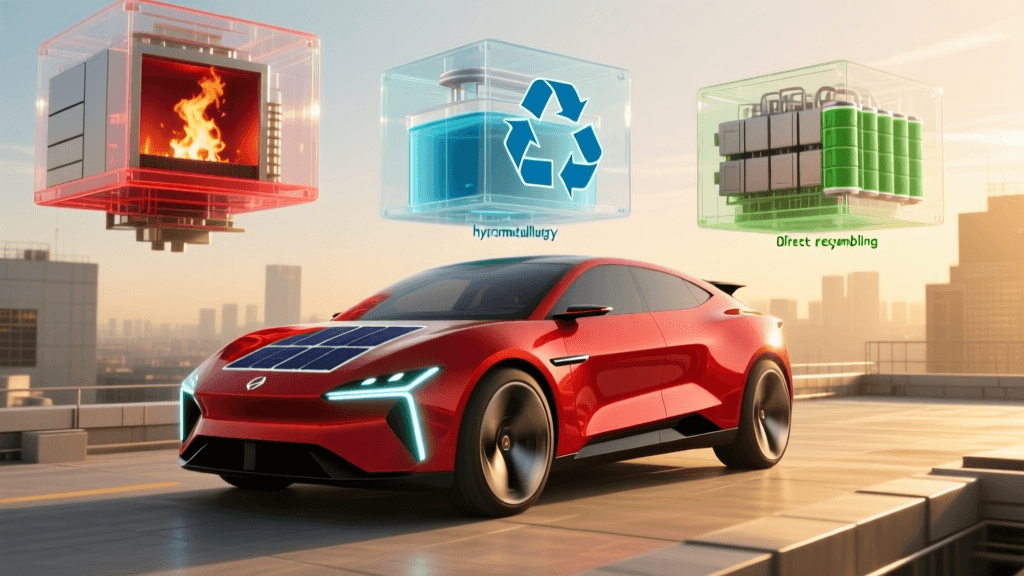
Pyrometallurgy, commonly known as smelting, is the oldest and most established method of battery recycling. In this process, entire battery modules or shredded battery fragments are fed into a high-temperature furnace, often exceeding 1,000°C to 1,500°C. The intense heat burns away the plastic separators, electrolytes, and organic solvents, while the metallic components melt and separate based on their density.
The primary output of pyrometallurgy is a mixed metal alloy containing cobalt, nickel, and copper, which is then sent to a refinery for further purification. However, this method has significant drawbacks. Lithium, aluminum, and manganese are typically oxidized and lost in the slag (the stony waste matter separated from metals during smelting). Furthermore, the extreme energy requirements of maintaining furnace temperatures result in a high carbon footprint. While pyrometallurgy is robust and can handle unsorted, contaminated battery scrap, its low overall material recovery rate and high environmental impact are pushing the industry toward more advanced alternatives.
Hydrometallurgy: The Industry Standard for High Recovery
Hydrometallurgy has emerged as the dominant commercial technology for modern EV battery recycling, championed by industry giants like Redwood Materials and Li-Cycle. This aqueous-based process begins with mechanical shredding of the battery cells in an inert atmosphere to prevent fires, producing a granular mixture known as 'black mass.' This black mass contains the valuable cathode and anode materials.
The black mass is then subjected to chemical leaching, typically using sulfuric acid combined with hydrogen peroxide as a reducing agent. This dissolves the target metals into a liquid solution. From there, the process utilizes solvent extraction and precipitation to selectively separate and recover individual metals with remarkable purity. According to the United States Environmental Protection Agency (EPA), advanced hydrometallurgical facilities can achieve recovery rates exceeding 95% for critical minerals like lithium, cobalt, nickel, and manganese. Because the process operates at much lower temperatures than smelting, it consumes significantly less energy and allows for the recovery of lithium, which is otherwise lost in pyrometallurgical slag.
Direct Recycling: The Holy Grail of Battery Tech
While hydrometallurgy breaks battery materials down to their elemental or salt forms, direct recycling aims to preserve the complex crystalline structure of the cathode active material (CAM). Pioneered by institutions like the Argonne National Laboratory's ReCell Center, direct recycling involves carefully extracting the black mass and separating the cathode powder from the anode and foil current collectors without destroying the cathode's chemical bonds.
Once separated, the degraded cathode material undergoes a 'relithiation' process. Because lithium is lost during the battery's operational life through the formation of the solid electrolyte interphase (SEI) layer, direct recycling reintroduces lithium ions back into the cathode lattice via hydrothermal or solid-state treatments. The revitalized cathode powder can then be fed directly back into the manufacturing of new battery cells. Direct recycling drastically reduces the energy, water, and chemical inputs required compared to hydrometallurgy, but it currently faces challenges in scaling commercially and requires strict sorting of battery chemistries, as mixing NMC and LFP powders ruins the output.
Comparative Analysis of Recycling Technologies
To understand the trade-offs between these methodologies, we must evaluate them across several critical metrics. The following table outlines the operational characteristics of the three primary recycling pathways.
| Recycling Method | Target Material Recovery | Energy Intensity | Commercial Maturity | Best Application |
|---|---|---|---|---|
| Pyrometallurgy | Co, Ni, Cu (Li & Al lost) | Very High (Smelting) | High (Established) | Mixed, contaminated scrap |
| Hydrometallurgy | Li, Co, Ni, Mn (95%+) | Moderate (Chemical) | High (Scaling rapidly) | High-volume NMC & LFP cells |
| Direct Recycling | Intact Cathode Material | Low (Relithiation) | Low (R&D / Pilot scale) | Sorted, single-chemistry scrap |
Environmental Impact and Lifecycle Analysis (LCA)
The environmental justification for EV battery recycling hinges on Lifecycle Analysis (LCA), which compares the ecological toll of mining virgin materials against the impact of recycling. Mining virgin lithium, cobalt, and nickel is an incredibly resource-intensive process. It involves massive earth-moving operations, high water consumption (particularly in brine extraction in South America), and significant greenhouse gas emissions from ore refining.
Hydrometallurgical recycling dramatically reduces these impacts. By recovering metals from black mass, recyclers bypass the mining and initial ore concentration phases. Studies indicate that producing battery-grade metals via hydrometallurgical recycling can reduce greenhouse gas emissions by up to 50% compared to virgin mining. Furthermore, it drastically reduces water usage and eliminates the toxic tailings associated with traditional mining operations. However, the environmental benefit is highly dependent on the energy grid powering the recycling facility; a recycling plant powered by renewable energy yields a vastly superior LCA compared to one reliant on coal-fired power.
Actionable Advice: How Consumers Influence the Loop
While the deep technology of battery recycling occurs in specialized facilities, consumers and fleet managers play a vital role in ensuring batteries actually reach these advanced plants. Here is how you can actively participate in the circular battery economy:
- Leverage OEM Take-Back Programs: Major automakers like Ford, Volvo, and Volkswagen have partnered with specialized recyclers (such as Redwood Materials and Li-Cycle) to create closed-loop supply chains. When replacing a degraded battery or retiring an EV, always route the battery through the manufacturer's official dealership or take-back network to guarantee it enters a certified hydrometallurgical facility rather than an unregulated scrapyard.
- Anticipate the Battery Passport: The European Union has mandated the introduction of 'Battery Passports' by 2027. This digital twin will track a battery's chemistry, health, and material origins. As this technology rolls out globally, use your vehicle's infotainment system or companion app to monitor your battery's health data, ensuring accurate valuation and routing when the vehicle is retired.
- Avoid Unauthorized Scrappers: Never sell an end-of-life EV or its battery pack to uncertified salvage yards. Improper dismantling can lead to electrolyte leaks, thermal runaway fires, and the loss of critical minerals to landfills. Always verify that the disposal facility holds ISO 14001 environmental management certification or regional equivalent credentials.
- Optimize Battery Lifespan First: The most environmentally friendly battery is the one that lasts the longest. Delay the need for recycling by adhering to optimal charging habits—keeping your NMC battery between 20% and 80% state-of-charge (SoC) for daily use, and avoiding repetitive DC fast-charging sessions, which accelerate cathode degradation and micro-cracking.
By understanding the sophisticated technology driving EV battery recycling and making informed decisions at the end of a vehicle's life, consumers can directly support the transition to a truly sustainable, closed-loop electric mobility ecosystem.