The race to secure domestic battery minerals has put a spotlight on every significant lithium deposit Nevada holds — from the established Silver Peak operation to the controversial Thacker Pass project. For EV buyers and owners, this isn't just a geology story. Where lithium comes from, how it's refined, and which battery chemistry it ends up in directly affects the price you pay, the range you get, and how long your pack lasts.
This guide connects the Nevada lithium supply chain to the battery sitting under your EV's floor. We'll cover the two dominant chemistries (LFP and NMC/NCA), real-world degradation data, warranty coverage, replacement costs, and the emerging tech that could reshape everything by the end of the decade.
Why Nevada Lithium Matters for Your EV Battery
Nevada sits on some of the largest lithium reserves in the United States. The Silver Peak mine, operated by Albemarle, has been producing lithium since the 1960s, while the Thacker Pass project — the largest known lithium deposit in the US — is advancing toward full production amid ongoing legal and environmental disputes.
Under current IRS §30D tax credit rules, vehicles must meet critical-mineral sourcing thresholds to qualify for the full $3,750 battery component credit. Domestically mined lithium from Nevada deposits helps automakers satisfy these requirements, potentially keeping more EVs eligible for point-of-sale incentives through 2026 and beyond.
But raw lithium isn't a finished battery. The mineral gets processed and routed into one of two dominant cell chemistries — each with distinct trade-offs for range, longevity, cost, and cold-weather behavior.
LFP vs NMC/NCA: The Chemistry Decision
Every EV battery on the US market in 2026 uses one of two lithium-ion cathode chemistries. Understanding the difference is the single most important battery-tech decision you'll make as a buyer.
| Attribute | LFP (Lithium Iron Phosphate) | NMC / NCA (Nickel Manganese Cobalt / Nickel Cobalt Aluminum) |
|---|---|---|
| Energy Density | ~160–180 Wh/kg (lower) | ~220–300 Wh/kg (higher) |
| Cycle Life | 3,000–5,000+ cycles to 80% SoH | 1,000–2,000 cycles to 80% SoH |
| Cold-Weather Performance | Weaker — greater range loss below 32°F | Better low-temp discharge capability |
| Cost per kWh | ~$80–$100 (2026 cell-level) | ~$110–$140 (2026 cell-level) |
| Thermal Stability | Excellent — lower thermal runaway risk | Good but requires more robust BMS |
| Charging to 100% Daily | Recommended by most OEMs | Generally discouraged (80% daily cap advised) |
| Cobalt / Nickel Content | None — uses iron and phosphate | Contains cobalt and/or nickel |
| Typical Use Cases | Standard-range models, fleet vehicles, budget EVs | Long-range, performance, premium models |
| Example Vehicles (2026) | Tesla Model 3 RWD, base Chevy Equinox EV, Ford Mustang Mach-E Select | Tesla Model Y LR, Hyundai Ioniq 5 LR, Rivian R1T, BMW iX |
Which is better? Neither is universally superior — it depends on your priorities. If you want maximum range and don't mind charging to 80% daily, NMC/NCA delivers more miles per kilogram of battery. If you want a pack that will outlast the car itself, can be charged to 100% without guilt, and costs less upfront, LFP is the pragmatic choice. The trade-off is slightly lower range for the same physical battery size and more noticeable range loss in freezing temperatures.
Nevada-sourced lithium feeds both chemistries. LFP cells require lithium carbonate or lithium hydroxide plus iron phosphate — no nickel or cobalt. NMC cells need lithium hydroxide plus nickel and manganese or cobalt compounds. As domestic refining capacity grows alongside Nevada mining, the cost gap between the two may narrow further.
How Long Do EV Batteries Actually Last?
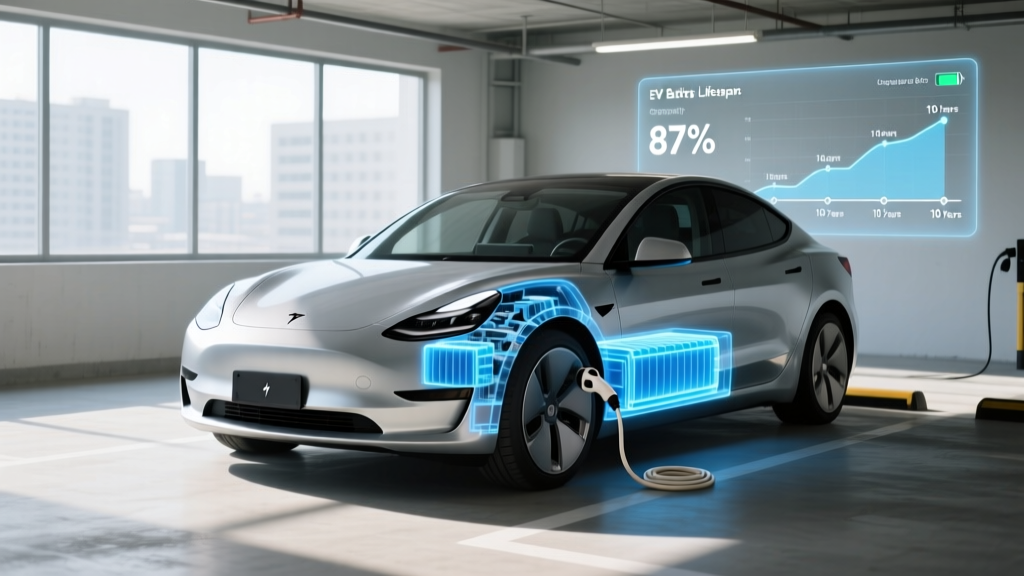
The fear that EV batteries need replacing every few years is not supported by fleet data. Most modern packs are engineered to outlast the vehicle's useful economic life.
Typical Degradation Trajectories (Fleet & Owner Data)
- Year 1–2: 2–5% capacity loss (initial formation loss is normal)
- Year 3–5: ~5–10% total loss; degradation curve flattens significantly
- Year 6–8: ~10–15% total loss for NMC; ~5–10% for LFP under similar conditions
- Year 10+: NMC packs averaging ~15–20% loss; LFP packs often still above 85% SoH
- High-mileage fleet data (Recurrent, Geotab): Tesla Model 3/Y packs showing ~88–92% SoH at 100,000 miles; Chevy Bolt packs at ~90–94% SoH at 80,000 miles
Sources: Recurrent Auto battery health reports, Geotab fleet degradation studies, owner-reported data on InsideEVs and Tesla Motors Club forums.
The key insight: degradation is not linear. Most capacity loss happens in the first 12–24 months as the solid electrolyte interphase (SEI) layer forms on the anode. After that, the curve flattens dramatically. A pack that has lost 8% in three years is unlikely to lose another 8% in the next three — it's more likely to lose 3–4%.
Real-world implication: a 2024 Tesla Model Y Long Range with an EPA-rated 330 miles that shows 92% battery health at 40,000 miles still delivers roughly 303 miles of rated range — and probably 260–280 miles in mixed real-world highway driving with climate control running.
What Does the Battery Warranty Actually Cover?
Federal law mandates a minimum 8-year / 100,000-mile battery warranty for EVs sold in the US (10 years / 150,000 miles in California Air Resources Board states). But the details vary by manufacturer, and the threshold for a "warranty claim" matters enormously.
| Manufacturer | Warranty Period | Mileage Cap | Capacity Retention Threshold | Notes |
|---|---|---|---|---|
| Tesla (Model 3/Y LFP) | 8 years | 100,000 mi | 70% | LFP packs historically degrade slower than threshold |
| Tesla (Model 3/Y LR NMC) | 8 years | 120,000 mi | 70% | Longer mileage cap on LR/AWD trims |
| Hyundai / Kia | 10 years | 100,000 mi | 70% | Industry-leading duration in non-CARB states |
| Ford (Mustang Mach-E, F-150 Lightning) | 8 years | 100,000 mi | 70% | Applies to both LFP and NMC trims |
| GM (Chevy, Cadillac EVs) | 8 years | 100,000 mi | 70% | Ultium platform; covers battery and drive components |
| BMW | 8 years | 100,000 mi | 70% | Covers high-voltage battery only |
| Rivian | 8 years | 120,000 mi | 70% | Module-level replacement when possible |
The critical number is the capacity retention threshold — typically 70%. If your battery's State of Health (SoH) drops below 70% of its original capacity within the warranty period, the manufacturer must repair or replace it at no cost. In practice, very few packs hit this threshold under normal use. The warranty is a safety net, not a prediction.
Important caveat: warranties cover defects and abnormal degradation. They typically do not cover damage from accidents, flooding, improper charging equipment, or modifications to the battery management system (BMS). Read your specific warranty booklet — the exclusions section is where the real details live.
EV Battery Replacement Costs: The Real Numbers
This is where fear-mongering runs rampant. Let's ground the conversation in actual figures.
| Vehicle | Battery Size | Chemistry | Full Pack Replacement Cost | Module-Level Repair |
|---|---|---|---|---|
| Tesla Model 3 RWD | ~60 kWh | LFP | $12,000–$16,000 | Not typically offered (full pack swap) |
| Tesla Model Y Long Range | ~82 kWh | NMC | $15,000–$20,000 | Limited module service at some centers |
| Hyundai Ioniq 5 Long Range | ~77.4 kWh | NMC | $14,000–$18,000 | Module replacement available (~$2,000–$4,000/module) |
| Ford F-150 Lightning Extended | ~131 kWh | NMC | $22,000–$30,000 | Module-level repair supported |
| Chevy Equinox EV | ~85 kWh | NMC (Ultium) | $14,000–$18,000 | GM supports module-level service |
| Rivian R1T (Large Pack) | ~135 kWh | NMC | $22,000–$28,000 | Module replacement (~$3,000–$5,000/module) |
When is replacement typically needed? For most owners, the answer is never. The vast majority of EVs are retired, sold, or totaled before the battery reaches end-of-life (defined as 70–80% SoH). Out-of-warranty full-pack replacements are most common in high-mileage fleet vehicles, early-generation EVs (2011–2017 Nissan Leaf, early Chevy Spark EV), or vehicles that suffered physical battery damage.
Module-level repair is a growing trend. Instead of replacing the entire pack, technicians swap individual degraded modules — reducing costs by 60–80%. Hyundai, GM, Rivian, and BMW all support module-level service on current platforms.
Factors That Accelerate (or Preserve) Battery Life
Not all miles are equal when it comes to battery wear. These are the variables you can actually control.
Battery Longevity Checklist
- Limit DC fast charging to road trips. Frequent use of 150+ kW DCFC sessions generates sustained high heat, accelerating SEI growth and electrolyte decomposition. Occasional fast charging is fine; daily fast charging adds measurable wear over years.
- Avoid sitting at 100% SoC for extended periods. For NMC/NCA packs, charge to 80% for daily use and only go to 100% when you'll drive immediately. LFP packs are the exception — most OEMs recommend periodic 100% charges for BMS calibration.
- Don't let the pack sit at very low SoC. Storing an EV below 10% SoC for weeks risks copper dissolution in the anode current collector. If storing, leave the car at 40–60% SoC.
- Precondition before fast charging. Most modern EVs do this automatically when you navigate to a charger. Cold batteries charge slowly and unevenly — preconditioning warms the cells to the optimal 25–35°C window.
- Moderate extreme-temperature exposure. Parking in shade during 100°F+ summers and in a garage during sub-zero winters reduces calendar aging. Active thermal management systems help, but they can't fully offset sustained ambient extremes.
- Use Level 2 (home) charging as your primary routine. Slow, steady 7–11 kW charging generates minimal heat and is the gentlest way to replenish the pack.
How to Monitor Your Battery's State of Health
State of Health (SoH) is the percentage of original capacity your battery can still hold. A new pack is 100% SoH; a pack that can only store 85 kWh of its original 100 kWh is at 85% SoH.
Methods to Check SoH
OEM Apps and In-Car Displays: Tesla's infotainment system shows battery health estimates in the Service menu. Hyundai's Bluelink app provides SoH readouts. GM's myChevrolet/myCadillac apps include battery health monitoring. These readings are calculated by the BMS and may lag behind actual capacity by a few percentage points.
Third-Party Diagnostics: Services like Recurrent and Geotab offer battery health reports that compare your pack against fleet averages. Some independent EV shops can pull detailed BMS logs via OBD-II adapters, showing individual cell voltages, internal resistance trends, and cycle counts.
Manual Range Tracking: The simplest method — charge to 100% (on an LFP vehicle or occasionally on NMC) and note the displayed range. Compare it to the EPA-rated range when new. A 2024 Ioniq 5 that showed 303 miles at 100% when new but now shows 282 miles has roughly 93% SoH, assuming similar tire condition and ambient temperature.
What to watch for: Sudden range drops, cells that consistently show voltage divergence greater than 50 mV from the pack average, or charging speeds that fall significantly below the vehicle's rated peak. These can signal a failing module rather than normal degradation and may warrant a warranty inspection.
What's Next: Solid-State, Silicon Anodes, and Realistic Timelines
Every few months, a headline promises that solid-state batteries will "change everything next year." Here's a grounded assessment from a 2026 vantage point.
Solid-state batteries replace the liquid electrolyte with a solid ceramic, sulfide, or polymer layer. The theoretical benefits are substantial: higher energy density (potentially 400–500 Wh/kg at the cell level), faster charging without thermal runaway risk, and longer cycle life. Toyota has demonstrated prototype cells and announced limited production intent for the late 2020s, but cost and manufacturing yield challenges remain significant. Realistic timeline for meaningful US-market availability: 2029–2032 in low-volume premium applications, with mainstream scale likely post-2032.
Silicon-dominant anodes are closer to reality. Companies like Sila Nanotechnologies and Group14 Technologies are supplying silicon-carbon composite anode materials that boost energy density by 10–20% over conventional graphite anodes. Some 2025–2026 model-year vehicles already incorporate partial silicon anode content. This is incremental but real improvement happening now.
Sodium-ion batteries are entering the conversation for lower-cost, lower-range applications. CATL has begun shipping sodium-ion packs for Chinese-market EVs. These use no lithium at all, potentially easing supply pressure on Nevada deposits and global lithium mines — but energy density remains well below LFP, limiting them to urban and budget vehicles.
None of these technologies will make your current EV's battery obsolete overnight. Battery chemistry transitions take 5–10 years from lab to mainstream production. The NMC and LFP packs in 2026 vehicles represent mature, well-understood technology with predictable degradation profiles and established recycling infrastructure.
Nevada Lithium and the Bigger Supply Chain Picture
The connection between Nevada's lithium deposits and your EV's battery health is indirect but meaningful. Domestic mining reduces reliance on supply chains dominated by China, Australia, and Chile. It supports the critical-mineral sourcing requirements that keep vehicles eligible for the §30D tax credit. And as refining capacity scales — with facilities like the planned Redwood Materials and Lithium Nevada Corp processing plants — it puts downward pressure on the per-kWh cost that ultimately determines your vehicle's sticker price and your battery's replacement cost.
For buyers in 2026, the practical takeaway is this: the battery in your EV is a mature, well-warrantied component that will almost certainly outlast your ownership. The chemistry choice (LFP for longevity and cost, NMC for range and cold-weather performance) matters more than where the lithium was mined. But a robust domestic supply chain keeps prices competitive and credit eligibility broad — and Nevada is at the center of that story.
Frequently Asked Questions
How long do EV batteries last in years and miles?
Based on fleet data from Recurrent and Geotab, most modern EV batteries retain 85–92% of original capacity at 100,000 miles and 6–8 years. LFP packs typically outperform NMC in cycle life, often exceeding 90% SoH at the same mileage. Full end-of-life (below 70% SoH) typically occurs beyond 200,000 miles or 15+ years for current-generation packs — well past most owners' holding period.
How much does it cost to replace an EV battery?
Full pack replacement ranges from roughly $12,000 for a 60 kWh LFP pack (Tesla Model 3 RWD) to $30,000 for a 131 kWh NMC pack (F-150 Lightning Extended Range). However, most owners never need a replacement. Module-level repairs, where supported, cost $2,000–$5,000 per module. Battery costs have been declining roughly 8–12% annually at the cell level, so out-of-warranty replacements in 2030 will likely cost significantly less than today's figures.
What does the EV battery warranty cover?
Federal minimum is 8 years / 100,000 miles (10/150,000 in CARB states). Coverage applies if the battery drops below the manufacturer's capacity threshold — typically 70% SoH — due to defect or abnormal degradation. It does not cover accident damage, improper charging, or modifications. Hyundai and Kia lead with 10-year / 100,000-mile coverage nationwide.
How do I check and maximize my EV's battery health?
Monitor SoH through your OEM app or by tracking displayed range at full charge versus the original EPA figure. Maximize longevity by favoring Level 2 home charging over frequent DC fast charging, keeping NMC packs between 20–80% SoC for daily use (LFP packs can be charged to 100%), preconditioning before fast charges, and avoiding prolonged storage at very high or very low states of charge.
LFP vs NMC — which battery chemistry is better for me?
Choose LFP if you prioritize longevity, lower cost, and the ability to charge to 100% daily without concern — ideal for commuters, fleet use, and warm-climate drivers. Choose NMC/NCA if you need maximum range, better cold-weather performance, or are buying a long-range/performance trim. Neither is "better" universally; the right choice depends on your driving patterns, climate, and ownership horizon.
Will Nevada lithium mining lower EV prices?
Domestic mining reduces transportation costs and import tariffs on raw lithium, and helps automakers meet §30D critical-mineral sourcing requirements. However, lithium is only one input — cell manufacturing, pack integration, and vehicle assembly costs also factor in. Expect modest downward pressure on battery costs rather than dramatic price cuts. The bigger impact is supply security and tax-credit eligibility preservation.