The Two Lithium Chemistries Powering Today's EVs
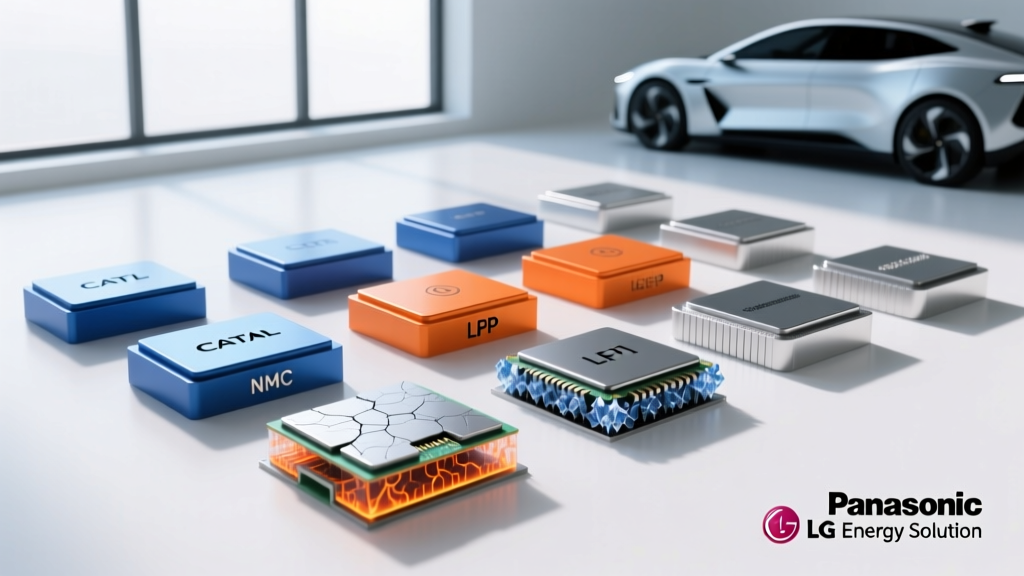
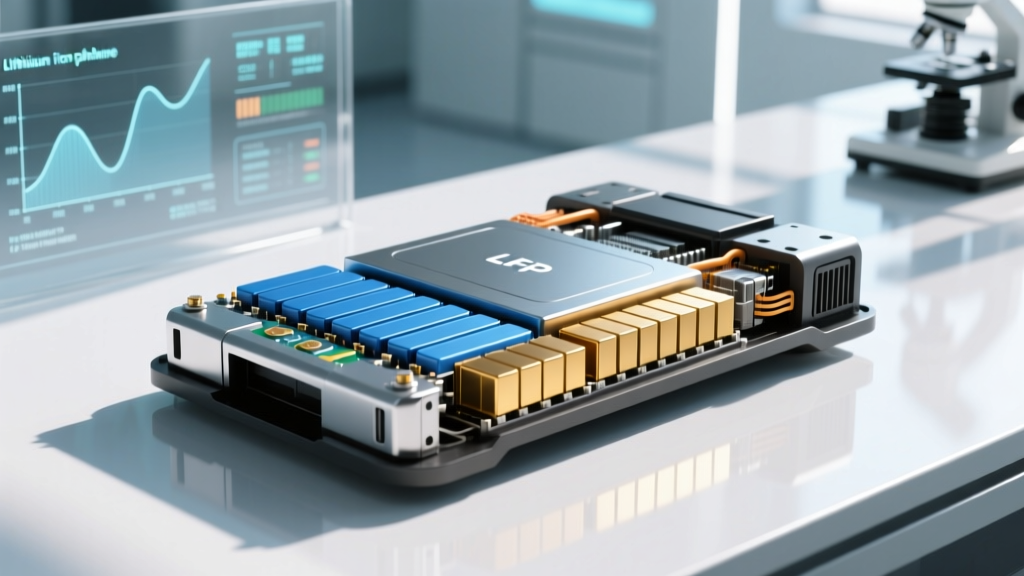
Every battery-electric and plug-in hybrid on the road in 2026 relies on lithium-ion cells, but not all lithium batteries for electric vehicles are built the same. The cathode chemistry — the positive electrode inside each cell — determines how far you can drive on a charge, how many years the pack will last, how the battery handles a Minnesota winter, and ultimately what you pay at the dealership. Two families dominate the market: LFP (lithium iron phosphate, LiFePO₄) and NMC/NCA (nickel manganese cobalt / nickel cobalt aluminum). Tesla, BYD, Ford, and Rivian have all shifted trims between these chemistries in recent model years, making it essential for buyers to check the spec sheet rather than assume.
| Attribute | LFP (LiFePO₄) | NMC / NCA |
|---|---|---|
| Energy density (cell-level) | 160–180 Wh/kg | 220–300 Wh/kg |
| Typical cycle life | 3,000–5,000+ cycles | 1,000–2,000 cycles |
| Cold-weather performance | Weaker; ~15–25% range loss at 20°F | Better; ~10–18% range loss at 20°F |
| Thermal stability | Excellent (runaway ~500°F+) | Good (runaway ~300–400°F) |
| Cost per kWh (pack-level, 2026) | ~$85–$105 | ~$115–$145 |
| Cobalt/nickel content | None | Significant (supply-chain risk) |
| Recommended daily SoC | Up to 100% | 80% for daily, 100% for trips |
| Common in (2026 models) | Tesla Model 3 RWD, BYD Seal, Ford Mustang Mach-E Select (base), Rivian R1S Standard | Tesla Model Y LR, Hyundai Ioniq 5, BMW iX, Rivian R1T Max, Lucid Air |
The practical upshot: LFP packs sacrifice some energy density (meaning a slightly heavier or physically larger pack for the same range) but gain dramatically in cycle life, safety margin, and cost. NMC/NCA packs pack more energy into less weight, which is why they dominate long-range and performance trims. Neither chemistry is universally "better" — the right choice depends on your driving pattern, climate, and budget.
How Long Do EV Batteries Actually Last?
The fear that an EV battery will die like a smartphone after two years is not supported by fleet data. Modern lithium batteries for electric vehicles are engineered with active liquid thermal management, conservative buffer zones (typically 5–10% of gross capacity hidden at the top and bottom of the state-of-charge window), and cell chemistries rated for thousands of cycles. A "cycle" means one full 0–100% equivalent; partial charges count proportionally.
Real-world degradation data points (sourced from fleet telematics and owner studies):
- Tesla Model 3/Y (NMC, 2019–2023): Median ~8–10% capacity loss at 100,000 miles; plateauing to ~12–15% loss at 200,000 miles, per Tesla's 2024 Impact Report and Recurrent Auto fleet data.
- Chevrolet Bolt EV/EUV (NMC, 2017–2023): Average ~6–9% loss at 80,000 miles. GM's larger buffer (~8% usable cushion) masks some degradation from the driver.
- Nissan LEAF (passive-air-cooled NMC, 2013–2023): Earlier models without liquid cooling showed 15–25% loss at 80,000 miles in hot climates — the cautionary tale that pushed the industry to liquid thermal management.
- LFP-equipped Tesla Model 3 RWD (2022–2025): Early fleet data from Recurrent shows ~3–5% loss at 50,000 miles, with a flatter degradation curve than NMC equivalents.
- Hyundai/Kia E-GMP platform (Ioniq 5, EV6, NMC): ~5–8% loss at 60,000 miles based on owner-reported SoH via the car's diagnostic menu.
Most lithium-ion EV packs will retain 70–85% of original capacity at 150,000–200,000 miles. For a 300-mile EPA-rated vehicle, that still means 210–255 miles of usable range — enough for the vast majority of daily driving and road trips with one DC fast-charge stop.
What the Battery Warranty Covers (and What It Doesn't)
Federal law (EPA emissions-component rules) effectively mandates an 8-year/80,000-mile minimum warranty on EV battery packs. California and states adopting CARB rules (including Colorado, Virginia, and Washington as of 2026) extend this to 10 years / 150,000 miles. Manufacturers typically guarantee that the pack will retain at least 70% of its original usable capacity over the warranty period. Some go further: Hyundai and Genesis warrant 70% retention for 10 years / 100,000 miles nationwide, and Tesla specifies 70% for 8 years / 120,000 miles (100,000 miles on the base Model 3 RWD).
| Manufacturer | Duration | Mileage | Minimum Capacity Retention |
|---|---|---|---|
| Tesla (Model 3/Y LR) | 8 years | 120,000 mi | 70% |
| Tesla (Model 3 RWD / LFP) | 8 years | 100,000 mi | 70% |
| Hyundai / Kia / Genesis | 10 years | 100,000 mi | 70% |
| Ford (Mustang Mach-E, F-150 Lightning) | 8 years | 100,000 mi | 70% |
| GM (Ultium platform: Blazer EV, Silverado EV) | 8 years | 100,000 mi | 70% |
| Rivian | 8 years | 175,000 mi (R1T/R1S) | 70% |
| BMW (iX, i4) | 8 years | 100,000 mi | 70% |
Critical fine print: warranty claims require the pack to fall below the threshold, not just show any degradation. A pack at 71% State of Health (SoH) at 95,000 miles is considered "within spec" even though the driver notices reduced range. Warranties also exclude damage from collisions, flooding, improper modifications, or using the vehicle as a stationary power source beyond manufacturer-approved V2L/V2H limits.
How Much Does an EV Battery Replacement Cost?
Out-of-warranty replacement is the single biggest sticker shock in EV ownership — but it's also statistically rare. The vast majority of packs outlive the vehicle's economic life. When replacement is needed (typically from manufacturing-defect failures that slipped past warranty, collision damage, or extreme high-mileage use beyond 250,000 miles), costs scale with pack size and chemistry.
| Vehicle / Pack Size | Chemistry | Part Cost | Labor | Total Range |
|---|---|---|---|---|
| Tesla Model 3 RWD (~60 kWh) | LFP | $5,500–$7,500 | $1,200–$1,800 | $6,700–$9,300 |
| Tesla Model Y LR (~75 kWh) | NMC | $9,000–$12,000 | $1,500–$2,200 | $10,500–$14,200 |
| Ford F-150 Lightning Ext. Range (~131 kWh) | NMC | $16,000–$21,000 | $2,000–$3,000 | $18,000–$24,000 |
| Hyundai Ioniq 5 (~77 kWh) | NMC | $9,500–$12,500 | $1,400–$2,000 | $10,900–$14,500 |
| Chevrolet Bolt EV (~65 kWh) | NMC | $7,500–$9,500 | $1,200–$1,800 | $8,700–$11,300 |
| Lucid Air Grand Touring (~112 kWh) | NMC | $15,000–$19,000 | $2,000–$2,800 | $17,000–$21,800 |
Two trends are pushing these numbers downward: LFP packs cost ~25–35% less per kWh than NMC equivalents, and module-level repairs (replacing individual faulty modules rather than the entire pack) are becoming standard practice at certified EV service centers. A single module swap typically runs $1,500–$3,500 and can restore full pack function if the failure is localized. For context on current pack-level pricing, the U.S. Department of Energy's vehicle technologies office tracks annual battery cost surveys.
Five Factors That Accelerate (or Slow) Battery Aging
Degradation isn't purely a function of time or miles — how you treat the pack matters as much as the chemistry inside it. Here are the five biggest levers:
- State-of-charge habits: NMC packs age fastest when held at 100% or below 10% for extended periods. Set your daily charge limit to 80% (or 90% for LFP, which tolerates higher SoC). Reserve 100% charges for the morning of a road trip. Long-term airport-parking at low SoC in summer heat is a worst-case scenario.
- DC fast-charging frequency: Occasional Supercharger or Electrify America stops (1–2x/week) have minimal impact on modern liquid-cooled packs. Daily 150–250 kW fast-charging, however, adds cumulative thermal stress. Data from Recurrent Auto shows that Tesla fleets that fast-charge 90%+ of the time exhibit ~2–3% additional capacity loss at 100,000 miles versus primarily L2-charged fleets — meaningful but not catastrophic.
- Temperature extremes: Battery chemistry degrades faster above 95°F and below 10°F. Liquid thermal management mitigates this, but vehicles parked outdoors in Phoenix summers or Fargo winters still experience accelerated calendar aging. Preconditioning the pack (via scheduled departure or navigation to a charger) warms or cools cells to their optimal 65–85°F operating window.
- Depth of discharge: Shallow cycles (e.g., charging from 40% to 80%) are gentler than deep cycles (5% to 95%). For daily commuting, staying in the 30–80% window on NMC extends cycle life significantly.
- Storage conditions: If you store an EV for weeks or months (seasonal home, military deployment), leave it plugged in at ~50% SoC with the vehicle's battery-maintenance mode enabled. Storing at 100% or near 0% for months causes irreversible capacity loss.
How to Check and Monitor Your Battery's State of Health
State of Health (SoH) is expressed as a percentage of original usable capacity. A new pack is 100% SoH; a pack that held 75 kWh usable when new and now holds 67.5 kWh is at 90% SoH. Monitoring this number lets you track degradation and plan for warranty claims before coverage expires.
Built-in vehicle methods:
- Tesla: Service Mode (accessible via the software screen) displays SoH as a percentage. Navigate to Service → High Voltage Battery → Health Test. Tesla also reports this in the mobile app under "Battery Health" for 2023+ models.
- Hyundai/Kia (E-GMP): The hidden diagnostic menu (accessed by long-pressing the EV menu button) shows SoH percentage and individual cell voltage variance.
- GM Ultium vehicles: The myChevrolet/myCadillac app displays a battery health indicator; dealerships can pull a detailed SoH report via GDS2 diagnostics.
- Ford: FordPass shows a battery health status ("Normal" / "Attention Needed"); the OBD-II port can be queried with third-party tools for exact SoH.
Third-party tools: OBD-II Bluetooth adapters (such as the OBDLink MX+ or vLinker FS) paired with apps like Car Scanner or Scan My Tesla can read SoH, cell voltage delta, and pack temperature in real time. For pre-purchase inspections on used EVs, services like Recurrent and AVTO provide battery-health reports based on telematics data. Always verify SoH before buying a used EV — it's the single most important value determinant.
Beyond LFP and NMC: Solid-State, Silicon Anodes, and What's Next
The next generation of lithium batteries for electric vehicles is already in pilot production, but buyers should calibrate expectations against engineering timelines rather than press-release hype.
Solid-state batteries replace the liquid electrolyte with a solid ceramic, polymer, or sulfide separator. The promised benefits are substantial: 30–50% higher energy density (potentially 500+ mile packs in midsize sedans), faster charging without dendrite risk, and improved thermal stability. Toyota has announced a 2027–2028 production target for a solid-state-equipped EV with ~750 km (WLTP) range, while QuantumScape is shipping prototype cells to Volkswagen for validation. However, manufacturing yield, cost (currently 3–5x NMC per kWh), and cycle-life consistency remain unsolved at scale. Realistic mass-market availability: 2029–2032.
Silicon-anode cells (used in limited form in the Porsche Taycan and upcoming GM Ultium updates) replace graphite anodes with silicon composites, boosting energy density 10–20% without changing the cathode. These are already shipping in production vehicles and will become more common through 2027–2028 model years.
Sodium-ion batteries (CATL, BYD) eliminate lithium entirely, trading energy density for dramatically lower raw-material cost. They're appearing in Chinese-market subcompact EVs and are a plausible fit for US-market urban runabouts by 2028. Expect them in entry-level trims where 200–250 miles of range is acceptable.
None of these technologies invalidate current EV purchases. Today's LFP and NMC packs, properly cared for, will outlast most ownership cycles and retain meaningful range at 200,000+ miles.
Frequently Asked Questions
How long do EV batteries last in years and miles?
Modern liquid-cooled lithium-ion EV packs typically retain 70–85% of original capacity at 150,000–200,000 miles (roughly 12–18 years at average US driving of 13,500 miles/year). LFP chemistries trend toward the higher end of that range. Catastrophic failure (sudden death) is extremely rare; degradation is gradual and linear after an initial 2–4% drop in the first year.
How much does it cost to replace an EV battery in 2026?
Out-of-warranty full-pack replacement ranges from approximately $6,700 for a smaller LFP pack (Tesla Model 3 RWD) to $24,000 for a large NMC pack (Ford F-150 Lightning Extended Range). Module-level repairs for localized cell failures typically cost $1,500–$3,500. However, most packs never need replacement during typical ownership — degradation data shows the majority outlast the vehicle's economic life.
What does the EV battery warranty actually cover?
Manufacturer warranties guarantee a minimum capacity retention threshold (usually 70% of original usable capacity) over 8 years / 100,000 miles (or 10 years / 150,000 miles in CARB states). If your pack falls below the threshold within the warranty period, the manufacturer will repair or replace it at no cost. Warranties do not cover collision damage, flooding, unauthorized modifications, or normal gradual degradation above the threshold. Review your specific owner's manual for exact terms, and consult IRS §30D guidelines for how battery sourcing also affects federal tax-credit eligibility.
Is LFP better than NMC for my EV?
LFP is better if you prioritize longevity (3,000–5,000 cycle life), lower cost, cobalt-free sourcing, and the convenience of charging to 100% daily without accelerated degradation. NMC is better if you need maximum range in a lighter package, live in a cold climate where NMC's low-temperature performance matters, or tow heavy loads. For urban commuters with home charging, LFP is often the pragmatic choice. For cross-country road-trippers in northern states, NMC's energy density and cold-weather edge justify the premium.
How do I maximize my EV battery's lifespan?
Follow these five rules: (1) Set daily charge limit to 80% for NMC or 100% for LFP. (2) Avoid leaving the car at 100% or below 10% SoC for more than a few hours. (3) Use Level 2 home charging as your primary method; limit DC fast charging to road trips when possible. (4) Precondition the battery in extreme cold or heat before driving or charging. (5) Park in shade or a garage during summer, and plug in during extreme cold to let the thermal management system maintain cell temperature. Check SoH quarterly via your vehicle's diagnostic menu or an OBD-II app.
Does fast charging damage my EV battery?
Modern liquid-cooled packs handle DC fast charging well, but it is not free. Each 150–250 kW session heats cells rapidly, and cumulative thermal stress adds ~2–3% additional capacity loss per 100,000 miles compared to primarily Level 2 charging, per Recurrent Auto fleet studies. The practical advice: fast-charge when you need it (road trips, occasional top-ups), but don't rely on it as your daily charging method if you have Level 2 access at home. Preconditioning the pack before a fast-charge session (automatic when you navigate to a Supercharger or compatible station) reduces stress by bringing cells to optimal temperature.