If you follow EV battery research, you have likely encountered the term lithium-air battery — a chemistry that promises energy densities rivaling gasoline. Headlines regularly tout it as the "holy grail" of energy storage. But as someone who has tracked EV battery chemistries across multiple ownership cycles and tested real-world degradation on NMC and LFP packs, I need to separate laboratory excitement from driveway reality.
This guide covers where lithium-air technology actually stands in 2026, how it compares to the lithium-ion cells powering today's EVs, and everything you need to know about the battery in your current or next electric vehicle — from degradation curves to replacement costs to daily care habits that extend pack life.
What Is a Lithium-Air Battery — And Why Does It Matter?
A lithium-air (Li-air) battery generates energy through a reaction between lithium at the anode and oxygen drawn from ambient air at the cathode. Because oxygen is not stored inside the cell, the theoretical energy density is enormous: up to 3,500 Wh/kg at the cell level, compared to roughly 250–300 Wh/kg for today's best NMC (nickel-manganese-cobalt) lithium-ion cells.
In plain terms: a lithium-air pack could, in theory, store 10 times the energy per kilogram. That translates to EVs with 600–1,000 miles of range at similar weight, or dramatically lighter packs for today's 300-mile targets.
So why can't you buy one? The engineering barriers remain formidable:
- Cycle life: Current Li-air prototypes degrade after 50–150 charge cycles. A usable EV battery needs 1,000–2,000+ cycles.
- Rechargeability: The discharge products (lithium peroxide, Li₂O₂) clog the porous cathode and are difficult to decompose efficiently during charging.
- Moisture sensitivity: Ambient air contains water vapor and CO₂, which react destructively with lithium metal. Protective membranes add weight and resistance.
- Round-trip efficiency: Lab cells achieve roughly 60–70% energy efficiency, versus 90–95% for commercial lithium-ion.
- Power density: Charge and discharge rates remain far too slow for automotive use.
As of 2026, lithium-air remains a laboratory-stage technology. No automaker has announced a production timeline. The most credible industry estimates place any potential commercialization in the mid-2030s at the earliest, and more likely the 2040s for automotive-scale packs.
Today's EV Battery Chemistries: LFP vs NMC vs NCA
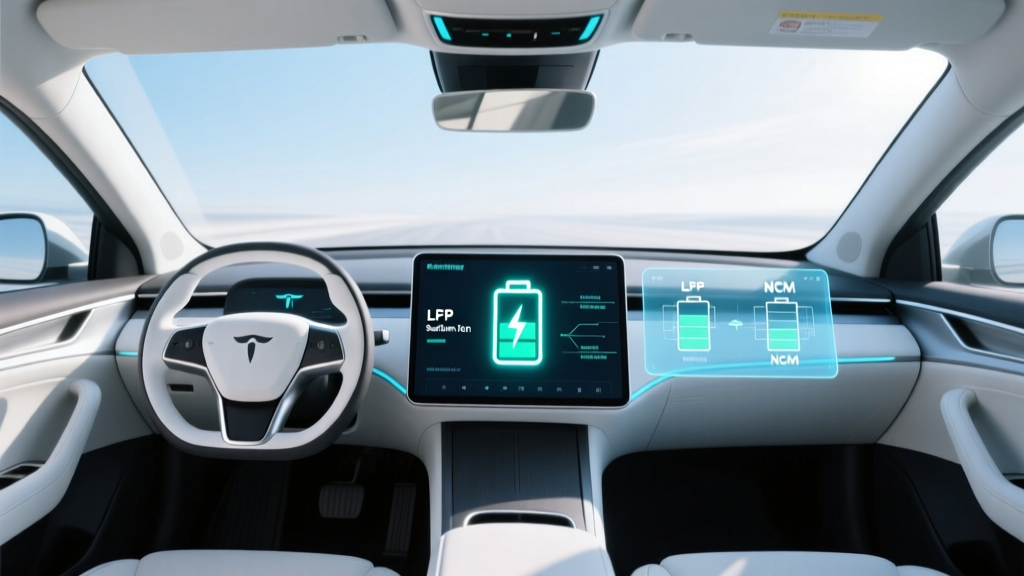
Every EV sold in the US in 2026 uses one of three lithium-ion cathode chemistries. Here is how they compare on the metrics that matter for ownership:
| Attribute | LFP (Lithium Iron Phosphate) | NMC (Nickel Manganese Cobalt) | NCA (Nickel Cobalt Aluminum) |
|---|---|---|---|
| Energy density (cell) | 160–180 Wh/kg | 230–300 Wh/kg | 250–300 Wh/kg |
| Cycle life | 3,000–5,000+ cycles | 1,000–2,000 cycles | 1,000–1,500 cycles |
| Cost per kWh | ~$85–100 (pack-level) | ~$110–140 | ~$115–145 |
| Cold-weather performance | Moderate loss; slower charging below 32°F | Better low-temp conductivity | Similar to NMC |
| Thermal stability / safety | Excellent — high thermal runaway threshold | Good with BMS management | Good with BMS management |
| SoC recommendation | Can charge to 100% regularly | 80% daily; 100% for trips | 80% daily; 100% for trips |
| Common in | Tesla Model 3/Y RWD, Ford Mustang Mach-E Select, Rivian Standard | Hyundai Ioniq 5, VW ID.4, BMW iX, most long-range trims | Tesla Long Range/Performance, some Panasonic-supplied packs |
LFP vs NMC — Which Is Better and Why?
Neither is universally "better" — the right choice depends on your driving pattern:
- You charge at home daily and want to set 100% without worry
- You plan to keep the vehicle 8+ years and value cycle life
- You prioritize lower upfront cost over maximum range
- You live in a mild climate (less cold-weather concern)
- You need maximum range per charge (300+ mi EPA)
- You regularly drive in sub-freezing temperatures
- You take frequent road trips and need fast DC charging speeds
- You are willing to manage SoC habits (80% daily cap)
How Long Do EV Batteries Actually Last?
The short answer: most EV batteries outlast the vehicles they power. The long answer requires looking at real degradation data.
Degradation Data: What the Numbers Show
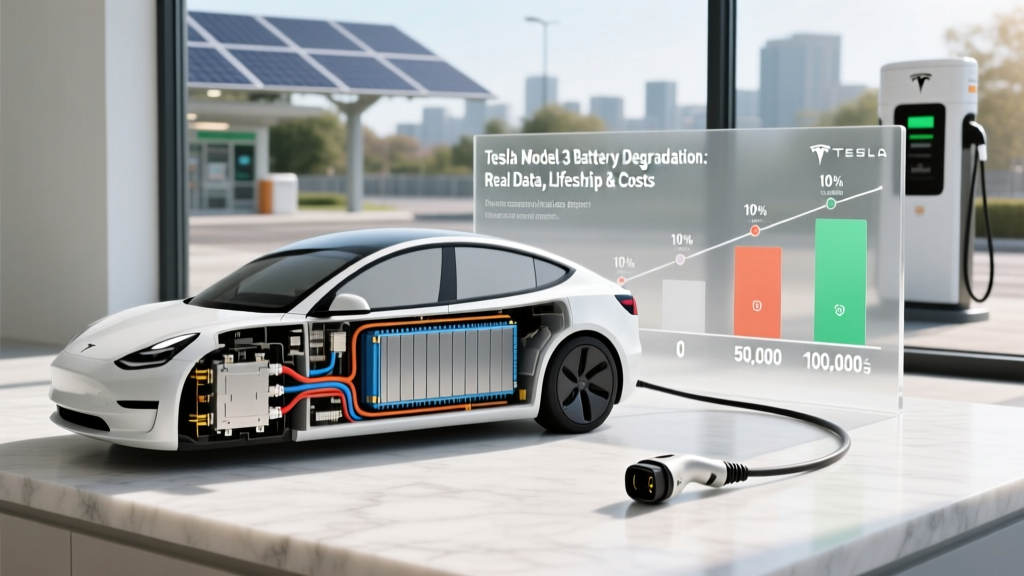
Battery degradation is measured as the percentage of original capacity lost over time. Here is what aggregated fleet data and long-term testing shows for modern packs:
| Milestone | NMC/NCA Average Capacity Loss | LFP Average Capacity Loss |
|---|---|---|
| Year 1 / 15,000 mi | 2–4% (initial settling) | 1–3% |
| Year 3 / 45,000 mi | 5–8% | 3–5% |
| Year 5 / 75,000 mi | 7–12% | 4–7% |
| Year 8 / 100,000 mi | 10–15% | 5–10% |
| Year 10+ / 150,000+ mi | 12–20% | 8–12% |
Sources: Geotab fleet data analysis covering 10,000+ EVs, manufacturer warranty thresholds, and long-term owner reports aggregated by EV communities.
Key context: degradation is non-linear. Most capacity loss occurs in the first 1–2 years (the "initial settling" phase), after which the curve flattens considerably. A Tesla Model 3 NMC pack that loses 4% in year one may lose only 1–2% per year afterward.
For a concrete example: a 2024 Hyundai Ioniq 5 Long Range with a 77.4 kWh NMC battery and 303 miles EPA range would, after 8 years and 100,000 miles, likely retain 85–90% of its capacity — translating to roughly 257–273 miles of real-world range. Still very usable.
What Does the EV Battery Warranty Actually Cover?
Federal law mandates a minimum battery warranty of 8 years / 100,000 miles for EVs sold in the US. California and states adopting CARB standards require 10 years / 150,000 miles. Most manufacturers meet or exceed these thresholds.
| Manufacturer | Warranty Period | Capacity Threshold | Notes |
|---|---|---|---|
| Tesla | 8 yr / 100,000–120,000 mi | 70% retention | Varies by model; 120k mi on LR/Plaid |
| Hyundai / Kia | 10 yr / 100,000 mi | 70% retention | Among the best standard coverage |
| Ford | 8 yr / 100,000 mi | 70% retention | Covers battery + hybrid/PHEV components |
| GM (Chevrolet, Cadillac) | 8 yr / 100,000 mi | 70% retention | Ultium platform; module-level repair |
| BMW | 8 yr / 100,000 mi | 70% retention | Modular pack allows partial replacement |
| Rivian | 8 yr / 175,000 mi | 70% retention | Higher mileage cap reflects truck use |
The critical number is the capacity retention threshold — typically 70%. If your battery drops below 70% of its original capacity within the warranty period, the manufacturer must repair or replace it at no cost. In practice, very few modern packs fall below this threshold within the warranty window based on fleet data.
How Much Does an EV Battery Cost to Replace?
This is the question that generates the most anxiety — and the most misinformation. Let's ground it in real numbers.
| Vehicle / Pack Size | Full Pack Replacement | Module Repair (if available) |
|---|---|---|
| Tesla Model 3 RWD (60 kWh LFP) | $8,000–$12,000 | Not modular — full pack swap |
| Tesla Model Y LR (82 kWh NMC) | $12,000–$16,000 | Not modular — full pack swap |
| Hyundai Ioniq 5 (77.4 kWh NMC) | $11,000–$15,000 | $2,000–$4,000 per module |
| Ford F-150 Lightning Ext. Range (131 kWh NMC) | $20,000–$28,000 | Module-level repair available |
| Chevrolet Equinox EV (85 kWh Ultium NMC) | $10,000–$14,000 | $1,500–$3,000 per module |
| BMW iX xDrive50 (111.5 kWh NMC) | $18,000–$25,000 | $2,500–$5,000 per module |
Important context that headlines usually omit:
- Most EVs are scrapped or sold before needing a battery replacement. The average US vehicle age is 12.6 years. Battery pack prices have dropped roughly 90% since 2010 and continue declining ~5–8% annually.
- Module-level repair is increasingly common. Platforms like GM Ultium, Hyundai E-GMP, and BMW Neue Klasse allow technicians to replace individual modules rather than the entire pack, reducing costs by 70–85%.
- Warranty coverage applies in the vast majority of premature-failure cases. Out-of-pocket full-pack replacements are rare for vehicles under 10 years old.
- The used-EV market prices in battery health. A vehicle with 88% SoH commands less than one at 96% — but the delta is typically $1,500–$4,000, not the $15,000+ replacement figure.
Factors That Accelerate (or Preserve) Battery Life
Battery degradation is driven by four primary stressors. Understanding them lets you add years and miles to your pack's useful life.
1. State of Charge Habits
For NMC/NCA batteries, sustained time at 100% SoC accelerates electrolyte decomposition and cathode stress. The practical rule: charge to 80% for daily use, 100% only when you need the full range for a trip, and avoid leaving the car at 100% for extended periods. LFP batteries are more tolerant of 100% SoC and manufacturers like Tesla recommend periodic full charges for LFP to allow the BMS to recalibrate.
2. DC Fast Charging Frequency
High-power DC fast charging (150–350 kW) generates significant heat inside the cells. Occasional use is fine — the thermal management system handles it. But daily DC fast charging without preconditioning can add 1–3% extra degradation over 5 years compared to predominantly Level 2 home charging. Always use your vehicle's battery preconditioning feature (navigation to a charger typically activates this) to warm or cool the pack before a fast-charge session.
3. Temperature Extremes
Heat is the primary enemy. Sustained ambient temperatures above 95°F, combined with high SoC, accelerate degradation. Cold temperatures (below 20°F) don't permanently damage the battery but reduce available capacity temporarily and slow charging speeds dramatically. Garage parking in hot climates and using preconditioning in cold climates are the single most impactful environmental habits.
4. Depth of Discharge
Regularly draining the battery to very low SoC (below 10%) stresses cells. The ideal operating window for NMC is roughly 20–80% SoC for daily driving. You do not need to obsess over this — modern battery management systems (BMS) include top and bottom buffers (typically 2–5% of gross capacity) that protect the cells even when the display shows 0% or 100%.
- ✅ Set daily charge limit to 80% (NMC/NCA) or 100% (LFP)
- ✅ Use Level 2 home charging as your primary method
- ✅ Enable battery preconditioning before DC fast charging
- ✅ Avoid leaving the vehicle at 100% SoC for more than a few hours
- ✅ Park in shade or a garage in hot climates
- ✅ Don't stress about occasional 100% charges or fast charging on road trips
- ✅ Keep tire pressures correct — underinflation increases energy draw and heat
How to Check and Monitor Battery Health (SoH)
State of Health (SoH) is expressed as a percentage of original capacity. A new battery is 100% SoH; a battery that has degraded to hold 90% of its original kWh is at 90% SoH.
Methods for Checking SoH
In-vehicle displays: Some manufacturers (Tesla via the service menu, Hyundai/Kia via the infotainment diagnostics page) show estimated SoH or remaining capacity. Tesla's "Battery Health" test in the service menu runs a calibration cycle and reports a percentage.
OBD-II diagnostic tools: Devices like the OBDLink MX+ paired with apps such as EVNotify or Scan My Tesla can read the BMS-reported SoH, cell voltages, and pack temperature directly. This is the most accurate owner-accessible method.
Third-party testing: Companies like Recurrent offer battery health reports based on telematics data. Some dealerships can run a full pack diagnostic that provides a certified SoH reading — useful when buying or selling a used EV.
Manual calculation: Charge to 100% (on an LFP or when needed), note the displayed range, and compare to the original EPA rating adjusted for the vehicle's efficiency. This is imprecise (temperature and driving style affect displayed range) but gives a rough indicator.
Beyond Lithium-Air: Emerging Battery Tech With Realistic Timelines
While lithium-air remains a long-term research project, several next-generation technologies are closer to production. Here is a realistic assessment of each:
Solid-State Batteries
Solid-state cells replace the liquid electrolyte with a solid conductor, enabling lithium-metal anodes and potentially 400–500 Wh/kg energy density. Toyota has announced a 2027–2028 production target for a solid-state EV with ~750 km (466 mi) range and 10-minute fast charging. Samsung SDI and QuantumScape are also advancing prototypes. However, manufacturing scale-up, cost reduction, and cycle-life validation remain open challenges. Expect limited, premium-vehicle deployment in the 2028–2030 window, with broader availability in the early 2030s.
Silicon-Anode Lithium-Ion
Replacing graphite anodes with silicon can boost energy density by 20–40%. Companies like Sila Nanotechnologies and Group14 are already supplying silicon-composite anodes for consumer electronics and early automotive applications. The Mercedes G-Class EV (2025) uses a silicon-anode pack from Sila. This is the most commercially mature next-gen technology, with expanding adoption through 2026–2028.
Sodium-Ion Batteries
Sodium-ion cells use abundant, cheap materials and offer good cycle life but lower energy density (~140–160 Wh/kg). CATL and BYD are producing sodium-ion packs for budget EVs in China. US-market adoption is likely limited to stationary storage and low-range urban vehicles. Not a replacement for NMC in long-range EVs, but a cost-reduction play for entry-level models.
Lithium-Sulfur (Li-S)
Theoretical energy density of ~2,600 Wh/kg, but severe cycle-life limitations (sulfur shuttle effect degrades cells rapidly). Still in early-stage research for automotive applications. Potential timeline: 2035+.
Frequently Asked Questions
How long do EV batteries last in years and miles?
Based on fleet data from Geotab and manufacturer reports, modern EV batteries retain 85–90% of original capacity at 100,000 miles and 80–88% at 150,000 miles. Most packs will function well beyond 200,000 miles before reaching the 70% capacity threshold that triggers a warranty claim. In years, expect 12–20 years of usable service depending on chemistry and care.
How much does an EV battery cost to replace?
Full pack replacement ranges from roughly $8,000 for a 60 kWh LFP pack to $28,000 for a 131 kWh extended-range NMC pack. However, most modern platforms support module-level repair at $1,500–$5,000 per module. Battery pack prices continue declining 5–8% annually, meaning replacement costs in 10 years will be substantially lower than today. The vast majority of EVs never need an out-of-warranty battery replacement.
What does the battery warranty cover?
EV battery warranties cover capacity loss below a specified threshold (typically 70% of original capacity) and defects in materials or workmanship. Federal minimum is 8 years/100,000 miles; CARB states require 10 years/150,000 miles. The warranty covers repair or replacement of the battery pack. It does not cover damage from accidents, misuse, or unauthorized modifications.
How do I check and maximize battery health?
Check SoH through your vehicle's built-in diagnostics (Tesla service menu, Hyundai infotainment), an OBD-II scanner with EV-capable software, or a dealership diagnostic test. Maximize health by charging to 80% daily (NMC/NCA), using Level 2 as your primary charge method, preconditioning before DC fast charging, avoiding prolonged 100% SoC, and parking in shade in hot climates.
LFP vs NMC — which chemistry is better for me?
LFP is better if you want maximum cycle life (3,000–5,000+ cycles), the simplicity of daily 100% charging, lower cost, and superior thermal safety — and you can accept slightly less range per kWh. NMC is better if you need the longest possible EPA range, better cold-weather performance, and faster DC charging speeds — and you're willing to manage an 80% daily charge limit. Neither is objectively superior; the right choice depends on your driving patterns and climate.
Will lithium-air batteries make today's EVs obsolete?
Not for at least 15–20 years, based on current research trajectories. Lithium-air faces fundamental challenges in cycle life, efficiency, moisture sensitivity, and power density that have not been solved at scale. Even if a breakthrough occurs, automotive qualification, manufacturing scale-up, and cost reduction would add another 5–10 years. Today's LFP and NMC batteries, along with near-term solid-state and silicon-anode advances, will serve the market through the 2030s.
Sources: fueleconomy.gov for EPA range and efficiency data; Geotab EV Battery Degradation Study; manufacturer warranty documentation from Tesla, Hyundai, Ford, GM, BMW, and Rivian press sites.