If you've researched hybrid and electric vehicle ownership, you've likely encountered the question: how long does the battery actually last? The lifespan of a Prius hybrid battery has become something of a benchmark in the electrified-vehicle world — Toyota's nickel-metal hydride (NiMH) and newer lithium-ion packs have earned a reputation for outlasting 200,000 miles with minimal degradation. But how does that track record compare to the high-voltage traction batteries in modern battery-electric vehicles (BEVs)?
This guide breaks down real degradation data, replacement economics, warranty coverage, and battery chemistry trade-offs — giving you the numbers you need to evaluate long-term ownership costs for both hybrids and full EVs in 2026.
How Long Do Hybrid and EV Batteries Actually Last?
The short answer: most electrified-vehicle batteries outlast the vehicles they're installed in. But the details matter, and they differ significantly between a Prius-style hybrid and a long-range BEV.
Prius Hybrid Battery Lifespan: The Track Record
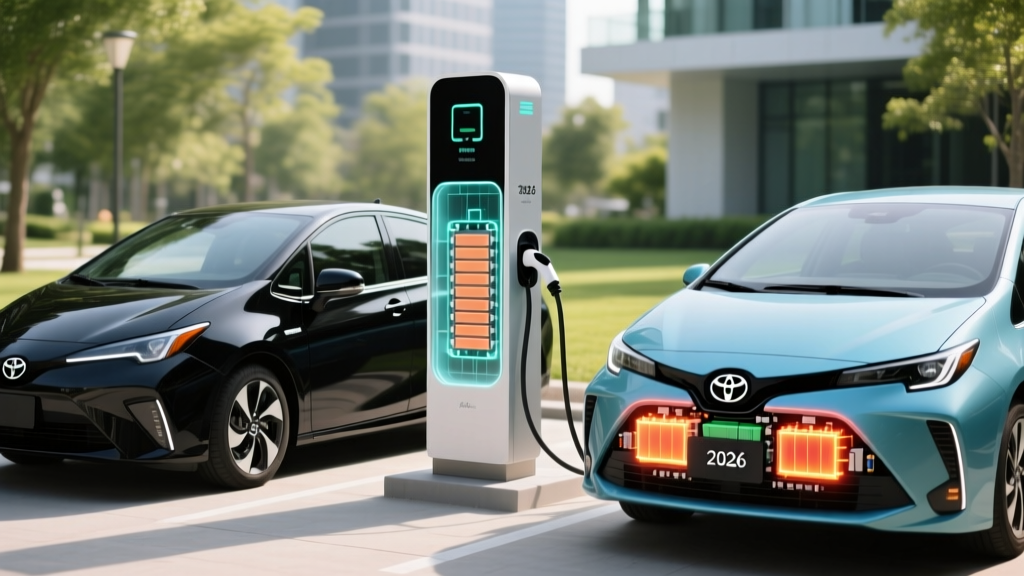
Toyota has been refining Prius battery durability since 1997. According to Toyota's official specifications and long-term fleet data, the Prius hybrid battery (whether the older 1.3 kWh NiMH pack or the newer 4.08 kWh lithium-ion pack in the 2023+ generation) is engineered to last the life of the vehicle. Real-world reports from high-mileage Prius owners and taxi fleets consistently show these batteries reaching 200,000 to 300,000 miles before needing replacement — often 15 to 20+ years of service.
The secret is buffer management. A Prius hybrid battery is tiny relative to how much power the car draws. Toyota's battery management system (BMS) restricts the usable state of charge (SoC) window to roughly 40%–80%, meaning the pack never experiences deep discharge or full-charge stress. This shallow cycling dramatically extends cycle life.
Modern BEV Battery Lifespan: What the Data Shows
Full electric vehicles carry much larger batteries — typically 60 to 100 kWh — and face different stress profiles. Data aggregated from fleet studies and owner reports indicates that modern NMC and LFP battery packs retain approximately 85%–92% of original capacity after 100,000 miles, with many packs projected to exceed 200,000 miles before dropping below 70% capacity.
Tesla's 2023 Impact Report noted that Model 3 and Model Y batteries retain roughly 85% capacity at 200,000 miles. Hyundai and Kia's E-GMP platform vehicles (Ioniq 5, EV6) have shown similar trajectories in early fleet data. LFP-equipped vehicles, particularly from manufacturers like Tesla (Standard Range) and BYD, are tracking even better — LFP chemistry tolerates more charge cycles before meaningful degradation.
- Year 1 / 15,000 mi: ~95–97% SoH (initial calendar degradation)
- Year 3 / 45,000 mi: ~92–95% SoH
- Year 5 / 75,000 mi: ~89–93% SoH
- Year 8 / 120,000 mi: ~85–90% SoH
- Year 12 / 180,000 mi: ~80–87% SoH (model-dependent)
Note: Degradation is non-linear — the steepest loss occurs in the first 12–18 months, then the curve flattens significantly. LFP packs typically show a flatter curve than NMC.
LFP vs NMC: Battery Chemistry Trade-Offs
Not all lithium-ion batteries are created equal. The two dominant chemistries in 2026 EVs are NMC (Nickel Manganese Cobalt) and LFP (Lithium Iron Phosphate). The Prius, notably, uses neither for its hybrid system — it relies on NiMH (older models) or a lithium-ion variant optimized for high power/low capacity. But for BEV buyers, the LFP vs NMC decision directly impacts lifespan.
| Attribute | LFP (LiFePO₄) | NMC / NCA |
|---|---|---|
| Energy Density | Lower (~160–180 Wh/kg cell) | Higher (~220–300 Wh/kg cell) |
| Cycle Life | 3,000–5,000+ cycles | 1,000–2,000 cycles |
| Cold-Weather Performance | Weaker — more range loss below 32°F | Better low-temp discharge capability |
| Cost per kWh | Lower (no cobalt/nickel) | Higher |
| Optimal Daily SoC | Can charge to 100% daily | Best kept 20%–80% daily |
| Common In (2026) | Tesla Model 3 RWD, BYD, standard-range models | Long-range / performance models, most legacy OEMs |
Which is better? It depends on your use case. If you prioritize maximum range and cold-weather performance, NMC delivers higher energy density. If you prioritize longevity, lower cost, and simpler daily charging habits (charging to 100% is fine), LFP is the stronger choice. For fleet and high-mileage drivers, LFP's superior cycle life is a decisive advantage.
Battery Warranty Coverage: What's Protected and for How Long
Federal law mandates that EV and hybrid battery warranties cover a minimum of 8 years / 100,000 miles (10 years / 150,000 miles in California and states adopting CARB standards). But the details of what triggers a warranty claim vary by manufacturer.
| Manufacturer | Coverage Period | Capacity Threshold | Notes |
|---|---|---|---|
| Toyota (Prius Hybrid) | 10 yr / 150,000 mi | Not publicly specified; case-by-case | Covers hybrid battery assembly |
| Tesla (Model 3/Y) | 8 yr / 100,000–120,000 mi | 70% retention | Varies by trim/drivetrain |
| Hyundai / Kia | 10 yr / 100,000 mi | 70% retention | Among the longest coverage |
| Ford (Mustang Mach-E) | 8 yr / 100,000 mi | 70% retention | — |
| GM (Ultium platform) | 8 yr / 100,000 mi | 70% retention (60% Bolt EUV) | Varies by model |
Key takeaway: The 70% capacity retention threshold is the industry standard for BEVs. This means the manufacturer will replace or repair the battery only if it degrades below 70% of its original capacity within the warranty window. Given that most packs retain 85%+ at 100,000 miles, warranty claims are uncommon in normal use. The Prius hybrid battery warranty, meanwhile, tends to be more generous in duration and is rarely invoked due to the pack's shallow-cycling design.
Battery Replacement Costs: Hybrid vs Electric Vehicle
This is where many buyers' anxiety peaks — but context is essential. The vast majority of electrified-vehicle owners will never need a battery replacement. When replacement is needed, it typically occurs well into the vehicle's second decade or beyond 200,000 miles.
| Vehicle / Battery Type | Battery Size | Replacement Cost (Parts + Labor) | Typical Need Timeline |
|---|---|---|---|
| Toyota Prius (Hybrid NiMH) | ~1.3 kWh | $2,000 – $4,000 | 200,000+ mi / 15+ years |
| Toyota Prius Prime (PHEV Li-ion) | ~4.08 kWh (usable) | $3,500 – $6,000 | 150,000+ mi / 12+ years |
| Tesla Model 3 (LFP, RWD) | ~57.5 kWh | $8,000 – $12,000 | 250,000+ mi projected |
| Tesla Model Y (NMC, LR) | ~75 kWh | $12,000 – $16,000 | 200,000+ mi projected |
| Hyundai Ioniq 5 (NMC) | 77.4 kWh | $12,000 – $18,000 | 200,000+ mi projected |
| Ford F-150 Lightning (Extended) | ~131 kWh | $20,000 – $30,000 | 200,000+ mi projected |
The Prius hybrid battery replacement is dramatically cheaper because the pack itself is tiny — you're replacing 1–4 kWh of capacity, not 75–130 kWh. For BEVs, the cost-per-kWh has been declining steadily (roughly $130–$150/kWh at the pack level in 2025, per BloombergNEF), but total replacement remains a significant expense. That said, out-of-warranty BEV battery failures before 150,000 miles are statistically rare — far rarer than transmission failures in comparable ICE vehicles over the same mileage.
For the Prius specifically, third-party reconditioned hybrid batteries are widely available for $1,000–$2,000, making replacement even more affordable if needed outside warranty.
Factors That Accelerate (or Extend) Battery Degradation
Battery longevity isn't just about chemistry — how you use and store the vehicle matters significantly. Here are the primary factors, ranked by impact:
Battery Longevity Checklist
- Extreme heat exposure: Sustained ambient temperatures above 95°F accelerate calendar degradation. Park in shade or a garage when possible. Battery thermal management systems help but aren't magic.
- Persistent high SoC: For NMC batteries, regularly sitting at 100% SoC (especially in heat) is the single worst habit for longevity. Set your charge limit to 80% for daily use. LFP owners can charge to 100% daily without concern.
- Frequent DC fast charging: Occasional fast charging is fine. Daily reliance on 150+ kW DC fast charging generates sustained heat in the cells and accelerates degradation over time. Use Level 2 home charging as your primary method.
- Deep discharge events: Regularly running the battery below 10% SoC stresses NMC cells. Most BMS systems include a buffer to prevent true 0%, but habitually arriving at 2%–5% still adds wear.
- Cold-weather fast charging without preconditioning: Charging a cold NMC battery at high power can cause lithium plating on the anode. Always use your vehicle's preconditioning feature (navigation-to-charger) before DC fast charging in cold weather.
- Long-term storage at extreme SoC: If storing the vehicle for weeks, leave it at approximately 50% SoC in a temperate environment.
Prius advantage: Because the Prius BMS already restricts the SoC window to ~40%–80%, most of these best practices are handled automatically. This is a core reason the lifespan of a Prius hybrid battery is so strong.
How to Check and Monitor Battery Health (SoH)
State of Health (SoH) is the metric that tells you how much of your battery's original capacity remains. Here's how to monitor it:
In-Vehicle Displays
Most modern EVs provide some form of battery health readout. Tesla's service mode (accessible through the software menu) shows estimated battery capacity. Hyundai/Kia's infotainment system includes an EV battery diagnostics page. The Prius displays hybrid system health through the multi-information display, though it's less granular than BEV readouts.
OBD-II Diagnostic Tools
For more precise SoH data, an OBD-II dongle paired with apps like Car Scanner, Leaf Spy (Nissan), or Scan My Tesla can read the battery management system's internal capacity estimate. These tools typically show SoH as a percentage and can log degradation over time. This is especially useful when evaluating a used EV or hybrid for purchase.
Manufacturer and Third-Party Reports
Some manufacturers (Tesla, BMW) provide battery health certificates through their certified pre-owned programs. Independent services like Recurrent Auto aggregate fleet battery data and provide model-specific degradation benchmarks that you can compare against your own vehicle's trajectory.
What's Normal vs. Concerning
A 2%–5% capacity loss in the first year is normal — this is the initial formation settling that all lithium-ion cells experience. After year one, degradation should slow to roughly 1%–2.5% per year under normal use. If you observe a sudden capacity drop of 5%+ in a short period, that warrants a service visit — it may indicate a defective cell module rather than normal wear.
What's Next: Solid-State and Silicon-Anode Batteries
Looking beyond current lithium-ion technology, two developments are generating significant attention:
Solid-state batteries replace the liquid electrolyte with a solid material, promising higher energy density, faster charging, and improved safety (no flammable electrolyte). Toyota has announced plans to commercialize solid-state batteries in limited production vehicles by 2027–2028, initially in hybrid applications. Samsung SDI and QuantumScape are pursuing BEV applications. However, manufacturing scale-up remains the major hurdle — solid-state batteries are not available in any production vehicle as of 2026, and widespread adoption in mainstream models is realistically a 2029+ timeline.
Silicon-anode batteries replace or supplement the graphite anode with silicon, which can store roughly 10x more lithium ions per unit mass. Companies like Sila Nanotechnologies and Group14 are already supplying silicon-dominant anode materials to manufacturers. Expect incremental adoption starting in 2026–2027 performance models, with energy density improvements of 15%–25% over current cells. This is closer to reality than solid-state but still rolling out gradually.
Neither technology changes the current buying decision. Today's LFP and NMC batteries, properly managed, already deliver 200,000+ mile lifespans. Future chemistries will improve on this, but they aren't a reason to delay a purchase.
Frequently Asked Questions
How long does a Prius hybrid battery last compared to an EV battery?
The lifespan of a Prius hybrid battery typically reaches 200,000–300,000 miles (15–20+ years) thanks to its shallow-cycling battery management system. Modern EV batteries are projected to last 200,000+ miles before dropping below 70% capacity. Both significantly outlast the average vehicle ownership period, but the Prius's smaller, less-stressed pack has a longer real-world track record simply because it's been in production far longer.
How much does it cost to replace an EV battery out of warranty?
Replacement costs range from approximately $8,000 for a standard-range Tesla Model 3 (LFP, ~57.5 kWh) to $20,000–$30,000 for large-pack vehicles like the F-150 Lightning Extended Range (~131 kWh). However, the vast majority of EV owners never need an out-of-warranty replacement — battery failures before 150,000 miles are statistically rare.
Is LFP or NMC better for battery longevity?
LFP (Lithium Iron Phosphate) is superior for longevity: it tolerates 3,000–5,000+ charge cycles compared to NMC's 1,000–2,000, and it can be charged to 100% daily without accelerated degradation. NMC offers higher energy density (more range in a smaller, lighter pack) and better cold-weather performance, making it the choice for long-range and performance models. For maximum lifespan, LFP wins.
Does DC fast charging damage my battery?
Occasional DC fast charging has minimal impact on battery health. However, daily use of 150+ kW DC fast charging generates sustained heat and accelerates degradation over time compared to Level 2 home charging. The best practice is to use Level 2 (7–11 kW) as your primary charging method and reserve DC fast charging for road trips. Always precondition the battery before fast charging in cold weather.
What does the federal warranty requirement cover for EV batteries?
Under EPA and IRS guidelines referenced on irs.gov, manufacturers must warrant EV and hybrid battery packs for a minimum of 8 years / 100,000 miles (10 years / 150,000 miles in CARB states). Coverage typically guarantees the battery will retain at least 70% of its original capacity. If it falls below that threshold within the warranty period, the manufacturer will repair or replace it at no cost.
Can I check my battery's State of Health myself?
Yes. Many EVs display SoH or estimated capacity in their service menus or infotainment system. For more precise readings, an OBD-II diagnostic tool paired with a compatible app (Car Scanner, Scan My Tesla) can read the BMS's internal SoH estimate. This is particularly valuable when buying a used EV or hybrid.
Will a Prius hybrid battery replacement be cheaper than an EV battery replacement?
Significantly cheaper. A Prius hybrid battery stores 1–4 kWh of energy, making replacement $2,000–$6,000 depending on model year and whether you use OEM or reconditioned parts. A BEV battery stores 57–131 kWh, making full replacement $8,000–$30,000. However, BEV batteries rarely need replacement in normal ownership, so this cost difference is largely theoretical for most buyers.
Sources: fueleconomy.gov (EPA efficiency and range data), Toyota Prius specifications, IRS §30D clean vehicle credit guidelines. Battery degradation data synthesized from manufacturer impact reports, fleet studies, and owner community aggregations. Replacement costs are estimates based on 2025–2026 service pricing and may vary by region and service provider.