The Great Battery Divide: LFP vs. NMC
The electric vehicle revolution is no longer just about whether to buy an EV, but what powers it. As we look toward the future of automotive technology, the industry is largely converging on two dominant lithium-ion battery chemistries: Nickel Manganese Cobalt (NMC) and Lithium Iron Phosphate (LFP). For consumers, this divergence presents a critical purchasing decision. Will you prioritize maximum range and cold-weather performance, or are you more concerned with long-term degradation, cost-effectiveness, and ethical supply chains? Understanding the future trends of LFP versus NMC batteries is essential for aligning your next EV purchase with your specific driving needs and total cost of ownership goals.
Understanding the Chemistry: NMC vs. LFP
Nickel Manganese Cobalt (NMC)
NMC batteries use a cathode composed of nickel, manganese, and cobalt. Nickel provides high energy density, allowing automakers to pack more range into a smaller, lighter footprint. This makes NMC the undisputed king of premium, long-range EVs like the Ford F-150 Lightning Extended Range and the Hyundai Ioniq 5 Long Range. However, cobalt is expensive, geopolitically sensitive, and fraught with ethical mining concerns, prompting the industry to seek alternatives.
Lithium Iron Phosphate (LFP)
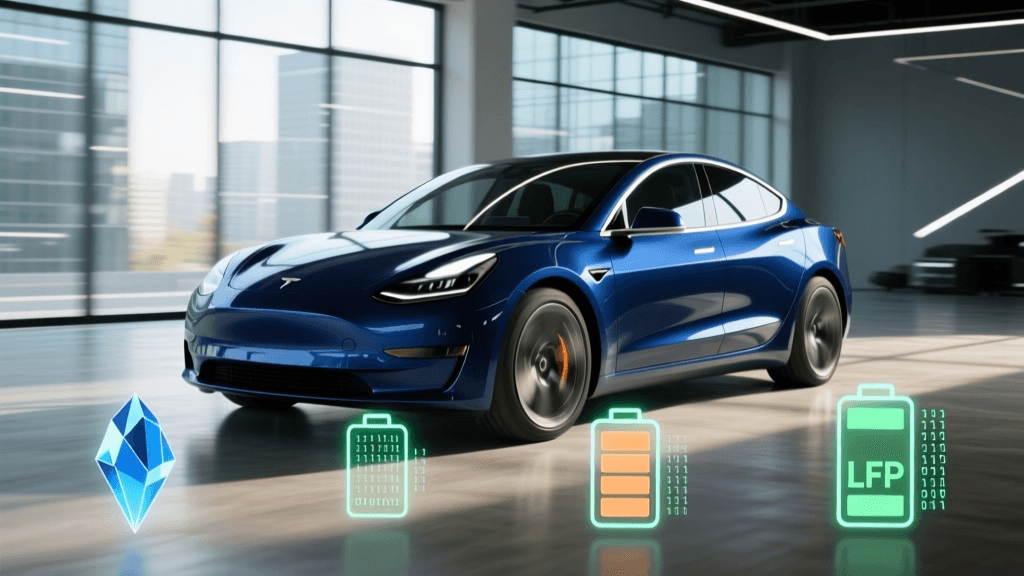
LFP batteries swap out nickel and cobalt for iron and phosphate. While historically heavier and less energy-dense, recent innovations in cell-to-pack structural design—such as BYD’s Blade Battery and CATL’s Cell-to-Pack technology—have drastically narrowed the range gap. LFP is inherently more thermally stable, significantly cheaper to produce, and boasts a vastly superior cycle life. Vehicles like the base Tesla Model 3 Rear-Wheel Drive and the standard-range Ford Mustang Mach-E have popularized this chemistry in the West.
Future Trends & Industry Outlook
The industry outlook is shifting dramatically in favor of LFP for standard-range vehicles. According to the International Energy Agency's Global EV Outlook 2024, the market share of LFP batteries has surged globally, driven by massive scaling in China and rapid adoption by Western automakers for their entry-level models. The future trend points toward a bifurcated market: LFP will dominate the high-volume, affordable, and standard-range segments, while NMC (and eventually solid-state batteries) will be reserved for high-performance, heavy-duty, and ultra-long-range applications.
Furthermore, the push for battery recycling and circular supply chains heavily favors LFP's abundant, non-toxic materials. Innovations like CATL’s Shenxing ultra-fast-charging LFP battery—which promises 400 kilometers of range from a 10-minute charge—are actively debunking the outdated myth that LFP cannot handle rapid DC charging speeds, securing its place in the next generation of EVs.
Head-to-Head Comparison: Which Fits Your Drive?
| Feature | NMC (Nickel Manganese Cobalt) | LFP (Lithium Iron Phosphate) |
|---|---|---|
| Energy Density | High (Ideal for 300+ mile range) | Moderate (Ideal for 200-270 mile range) |
| Cycle Life (Degradation) | 1,000 - 2,000 cycles | 3,000 - 5,000+ cycles |
| Daily Charging Limit | 80% (to preserve health) | 100% (required for BMS calibration) |
| Cold Weather Performance | Superior (Better range retention) | Inferior (Requires more preconditioning) |
| Cost & Replacement | Higher initial and replacement cost | Lower initial cost, rarely needs replacement |
| Safety (Thermal Runaway) | Moderate (Requires strict cooling) | Excellent (Highly resistant to fires) |
Actionable Advice: Choosing Your EV Battery
1. The Daily Commuter and Urban Driver (Choose LFP)
If your daily drive is under 60 miles and you have access to home charging, LFP is the undisputed champion. You can charge it to 100% every night without battery anxiety. The lower upfront cost of LFP-equipped vehicles means immediate savings, and the battery's robust chemistry means it will likely outlast the car's physical chassis. You also benefit from the convenience of always waking up to a 'full tank' without worrying about degrading the cells by sitting at a 100% state of charge.
2. The Road Tripper and Cold-Climate Driver (Choose NMC)
If you live in freezing northern latitudes or frequently take 500-mile road trips, NMC remains the better choice. LFP batteries suffer more pronounced range loss in sub-freezing temperatures due to higher internal resistance and a more rigid olivine crystal structure that impedes ion flow in the cold. NMC's superior energy density and cold-weather resilience mean fewer charging stops and less range anxiety when the mercury drops below freezing.
3. The Long-Term Owner and Fleet Operator (Choose LFP)
If you plan to keep your EV for 10+ years, or you are buying for a high-mileage rideshare fleet, LFP's massive cycle life is a financial lifesaver. NMC batteries will show noticeable degradation after 150,000 miles, potentially requiring a costly $10,000+ out-of-warranty replacement. LFP batteries are proven to retain over 80% of their original capacity even after 300,000 miles, effectively eliminating battery replacement costs from your total cost of ownership (TCO) calculations.
Charging Habits for Maximum Longevity
Understanding how to treat your specific chemistry is vital for preserving resale value and range. The US Department of Energy's Alternative Fuels Data Center notes that thermal management and specific charging habits dictate overall battery lifespan.
- For NMC Owners: The golden rule is the 20-80% window. Charging to 100% and letting the car sit for days causes micro-fractures in the cathode and accelerates capacity loss. Only charge to 100% immediately before a long road trip.
- For LFP Owners: LFP's flat voltage discharge curve makes it difficult for the Battery Management System (BMS) to guess the exact state of charge. Therefore, automakers mandate charging LFP to 100% at least once a week to calibrate the BMS. Failing to do so can result in sudden range drop-offs and inaccurate dashboard estimates.
The Verdict: Looking Ahead to Solid-State
While LFP and NMC battle for market dominance today, the distant horizon belongs to solid-state batteries. Research from facilities like Argonne National Laboratory indicates that solid-state technology will eventually replace the flammable liquid electrolyte with a solid material, offering NMC-level energy density combined with LFP-level safety and rapid charging. However, commercial viability at scale is still years away, with supply chain hurdles yet to be overcome.
Until solid-state batteries reach price parity, the LFP vs. NMC dichotomy will define the EV market. There is no inherently 'bad' battery chemistry—only the wrong chemistry for your specific lifestyle. By evaluating your local climate, daily mileage, and long-term ownership goals, you can select the battery that will deliver the most value and reliability over the life of your vehicle.