The single most consequential decision on an EV spec sheet isn't horsepower or 0-60 time — it's the battery chemistry hiding under the floor. In 2026, nearly every mainstream EV uses one of two lithium-ion chemistries: Lithium Iron Phosphate (LFP) or Nickel Manganese Cobalt / Nickel Cobalt Aluminum (NMC/NCA). Both store electrons, but they behave very differently over a decade of ownership. This guide breaks down the battery vs battery matchup with real degradation data, warranty terms, replacement costs, and daily-use implications so you can choose the chemistry that fits your driving life.
LFP vs NMC/NCA: The Chemistry Showdown
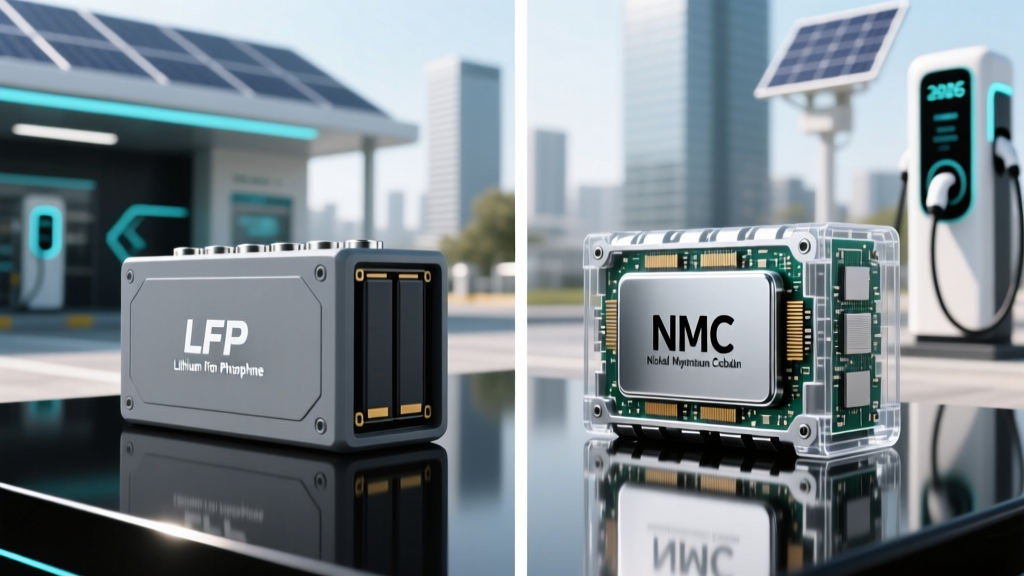
At the cell level, the cathode material defines the battery's personality. NMC (nickel-manganese-cobalt) and NCA (nickel-cobalt-aluminum) chemistries prioritize energy density — packing more kilowatt-hours (kWh) into a lighter, smaller pack. That's why long-range sedans and performance SUVs overwhelmingly use nickel-based cells. LFP (lithium iron phosphate) sacrifices some energy density for dramatically longer cycle life, superior thermal stability, and lower raw-material cost. Tesla's Standard Range Model 3 and Model Y, the base Ford Mustang Mach-E Select, and most BYD models sold globally use LFP.
| Attribute | LFP (Lithium Iron Phosphate) | NMC / NCA (Nickel-Based) |
|---|---|---|
| Energy Density (cell-level) | 160–180 Wh/kg | 220–300 Wh/kg |
| Typical Cycle Life | 3,000–6,000+ cycles | 1,000–2,500 cycles |
| Calendar Lifespan | 15–20+ years (projected) | 10–15 years (projected) |
| Cold-Weather Performance | Weaker — slower charge & greater range loss below 32°F | Better — retains charge speed & range more effectively |
| Thermal Runaway Risk | Very low (inherently stable cathode) | Higher — requires more robust BMS & cooling |
| Recommended Daily SoC | Can charge to 100% daily without accelerated degradation | Best kept 20–80% for daily use; 100% only for trips |
| Cost (per kWh, pack-level, 2026) | ~$80–$100 | ~$110–$140 |
| Cobalt / Ethical Sourcing | Cobalt-free | Contains cobalt (varies by supplier) |
| Common 2026 Vehicles | Tesla Model 3/Y RWD, Ford Mach-E Select (base), BYD Seal/Atto 3, Rivian Standard pack (LFP variant) | Tesla Long Range/Performance, Hyundai Ioniq 5/6, Kia EV6/EV9, Ford F-150 Lightning Extended, Chevy Equinox EV, BMW iX |
The bottom line: If you want maximum range per charge and don't mind managing state-of-charge habits, NMC/NCA delivers. If you prioritize longevity, lower cost, and the simplicity of charging to 100% every night, LFP is the pragmatic pick — especially for commuters and high-mileage drivers.
How Long Do EV Batteries Actually Last?
Most 2026 EV batteries will outlast the car they're installed in. The fear of a sudden $20,000 replacement at 80,000 miles is not supported by fleet data. According to analysis from Recurrent Auto, which tracks over 15,000 EVs in real-world conditions, the average EV battery retains roughly 90–95% of its original capacity after 5 years and 80,000–100,000 miles. Degradation follows a curve: a steeper initial drop (2–5% in the first year or two) followed by a long, slow linear decline.
Typical Degradation Trajectory (NMC, liquid-cooled, moderate climate):
- Year 1 / 15,000 mi: ~3–5% loss (initial formation & SEI layer stabilization)
- Year 3 / 45,000 mi: ~7–9% total loss
- Year 5 / 75,000 mi: ~9–12% total loss
- Year 8 / 120,000 mi: ~12–17% total loss
- Year 10 / 150,000 mi: ~15–22% total loss
LFP cells typically show 1–3% less degradation at equivalent milestones due to their higher cycle-life tolerance, though real-world pack-level results depend heavily on the battery management system (BMS) and thermal management.
A 2025 study published by the National Renewable Energy Laboratory (NREL) found that modern liquid-cooled EV batteries, when operated in moderate climates and charged primarily on Level 2, can expect to retain 80% or more of original capacity at 200,000 miles. Air-cooled packs (now rare but still found in some older Nissan Leaf models on the used market) degrade significantly faster — up to twice the rate in hot climates.
What the Battery Warranty Actually Covers
Federal law mandates that EV batteries carry a minimum warranty of 8 years or 100,000 miles (whichever comes first). In California and states that follow CARB emissions rules, that extends to 10 years / 150,000 miles. Most automakers exceed these minimums and guarantee a specific capacity-retention threshold — typically 70% of original capacity.
| Vehicle | Warranty Period | Capacity Threshold | Chemistry |
|---|---|---|---|
| Tesla Model 3/Y RWD (LFP) | 8 yr / 100,000 mi | 70% | LFP |
| Tesla Model 3/Y Long Range | 8 yr / 120,000 mi | 70% | NMC |
| Hyundai Ioniq 5 | 10 yr / 100,000 mi | 70% | NMC |
| Ford Mustang Mach-E | 8 yr / 100,000 mi | 70% | NMC (LFP on Select) |
| Chevrolet Equinox EV | 8 yr / 100,000 mi | 60% (Ultium) | NMC |
| BMW iX xDrive50 | 8 yr / 100,000 mi | 70% | NMC |
| Rivian R1S / R1T (Standard) | 8 yr / 120,000 mi | 70% | LFP |
What's covered: Capacity loss below the stated threshold, manufacturing defects, and cell/module failures under normal use. What's not covered: Damage from accidents, improper charging equipment, modifications, or abuse (e.g., repeated 100% charges on NMC without need). Read your warranty booklet — the exclusions section matters.
EV Battery Replacement Cost: What to Budget For
Here's the reality that calms most replacement anxiety: the vast majority of EV batteries never need a full replacement during original ownership. When they do, it's usually at 12–15+ years, often after the car has changed hands. That said, if you're buying a used EV or planning to keep yours past 200,000 miles, here's what replacement looks like in 2026:
| Vehicle / Pack Size | Battery kWh | Replacement Cost Range | Notes |
|---|---|---|---|
| Tesla Model 3 RWD | ~57 kWh (LFP) | $7,000–$10,000 | LFP cells cheaper; CATL-supplied |
| Tesla Model Y Long Range | ~75 kWh (NMC) | $10,000–$14,000 | Panasonic 4680 cells |
| Hyundai Ioniq 5 | 77.4 kWh (NMC) | $11,000–$16,000 | SK On cells |
| Ford F-150 Lightning Ext. Range | 131 kWh (NMC) | $18,000–$28,000 | Largest consumer pack; labor-intensive |
| Chevrolet Equinox EV | ~85 kWh (NMC) | $12,000–$16,000 | Ultium modular — individual module replacement possible |
| BMW iX xDrive50 | 105.2 kWh (NMC) | $16,000–$22,000 | BMW offers module-level repair |
One encouraging trend: modular pack architectures (GM's Ultium, BMW's Gen5) allow technicians to replace individual modules rather than the entire pack, reducing costs to $2,000–$5,000 per module when only a few cells have failed. Always ask whether module-level repair is an option before authorizing a full pack swap.
Five Factors That Accelerate (or Slow) Battery Degradation
Chemistry sets the baseline, but your habits determine where your battery lands on the degradation curve. Here are the five biggest variables, ranked by impact:
- 1. Extreme temperatures (especially heat): Sustained ambient temperatures above 95°F accelerate electrolyte decomposition. Liquid-cooled packs mitigate this, but parking in shade or a garage in Phoenix or Houston measurably extends pack life. Cold weather temporarily reduces range but causes less permanent damage than heat.
- 2. Sustained high state of charge (NMC/NCA only): Storing an NMC battery at 100% SoC for days or weeks stresses the cathode. For daily driving, charge to 80% and only go to 100% when you need the full range for a trip. LFP owners can ignore this — charge to 100% freely, and in fact should do so periodically for BMS cell-balancing calibration.
- 3. DC fast-charging frequency: Occasional DC fast charging (1–2 sessions per week) has minimal impact. Daily reliance on 150+ kW DC fast charging can add 1–3% extra degradation per year versus exclusive Level 2 home charging, according to Idaho National Laboratory testing. Preconditioning the battery before fast charging (a feature built into most modern EVs) significantly reduces this effect.
- 4. Deep discharges (below 10% SoC): Regularly running the battery to near-zero stresses both chemistries. Try to keep the floor around 10–15%. The buffer built into the pack (typically 3–5 kWh below "0%" displayed) protects against true zero, but habitual deep cycling still accelerates wear.
- 5. High-performance driving & heavy towing: Sustained high-current draws generate internal heat. Track days, frequent hard launches, and heavy towing in hot weather push cell temperatures higher. Most EVs will throttle power to protect the pack, but the cumulative thermal stress adds up over years.
How to Monitor Your Battery's State of Health (SoH)
State of Health (SoH) is the percentage of original capacity your battery can still hold. A new battery is 100% SoH; a battery that held 75 kWh when new but now holds 67.5 kWh is at 90% SoH. Here's how to check it:
Native in-car tools: Tesla's app shows estimated range at 100% — by tracking this over time and comparing to the original EPA figure, you can infer SoH. Hyundai/Kia's infotainment system includes an EV battery diagnostics screen. BMW's iDrive displays battery health percentage directly. Ford's MyFordPass app shows battery health status.
OBD-II diagnostic apps: Devices like the OBDLink SX paired with apps such as Car Scanner or EVbatMon can read the BMS-reported SoH value directly. This is the most accurate consumer-accessible method and takes about 2 minutes.
Third-party services: Recurrent offers free battery health reports by connecting to your vehicle's telematics data. Some used-EV marketplaces (Carvana, CarMax) now include SoH reports on listings.
The manual method: Charge to a known SoC (e.g., 100% for LFP, 90% for NMC), drive a measured distance, note the energy consumed (kWh), and calculate: (kWh consumed ÷ % SoC used) × 100 = estimated total capacity in kWh. Compare this to the original rated capacity.
Beyond LFP and NMC: Solid-State and Silicon-Anode Batteries
The next frontier in EV battery technology is solid-state batteries, which replace the liquid electrolyte with a solid material — promising higher energy density (potentially 400+ Wh/kg at the cell level), faster charging, and reduced fire risk. Toyota, Samsung SDI, and QuantumScape have all demonstrated prototype solid-state cells in laboratory settings.
Realistic timeline: Limited-production solid-state EVs are expected from Toyota around 2027–2028, initially in low-volume, premium models priced well above $70,000. Broad market adoption at mainstream price points is unlikely before 2030–2032. These are announced targets and subject to manufacturing-scale delays.
Silicon-anode batteries are closer to market. Companies like Sila Nanotechnologies and Group14 are supplying silicon-dominant anode materials that boost energy density by 15–25% over conventional graphite anodes. Expect silicon-anode cells to appear in production EVs starting in 2026–2027, initially in performance-oriented models. These use conventional liquid electrolytes, so they integrate into existing manufacturing lines more easily than solid-state.
For today's buyer, these emerging technologies are worth watching but should not delay a purchase. Current LFP and NMC chemistries, paired with modern thermal management, already deliver lifespans that exceed typical vehicle ownership periods.
LFP vs NMC: Which Should You Choose?
Choose LFP if:
- You're a daily commuter covering 30–80 miles round-trip and can charge at home nightly
- You want to charge to 100% every night without worrying about degradation
- You plan to keep the vehicle 10+ years or put on very high mileage (150,000+ mi)
- You prioritize lower purchase price and cobalt-free sourcing
- You live in a moderate or warm climate (cold-weather range penalty is the main LFP drawback)
Choose NMC/NCA if:
- You need maximum EPA range for frequent road trips (300+ mi per charge)
- You live in a cold climate where NMC's superior low-temperature performance matters
- You want the lightest possible pack (relevant for performance handling and efficiency)
- You're buying a larger vehicle (SUV, truck) where battery weight and packaging space are at a premium
- You're comfortable managing SoC habits (20–80% daily, 100% only for trips)
Frequently Asked Questions
Is the EV battery the same as the 12V battery?
No. The high-voltage traction battery (typically 50–130+ kWh) powers the electric motor and determines your range. The 12V auxiliary battery is a small lead-acid or lithium unit that runs the vehicle's electronics, lights, and infotainment — just like in a gas car. The 12V battery may need replacement every 3–5 years at a cost of $150–$400, but this is completely separate from the traction battery discussed in this guide.
Does fast charging ruin my EV battery?
Not in moderation. Occasional DC fast charging (1–2 times per week) has a negligible effect on modern liquid-cooled packs. Daily reliance on 150+ kW charging can add roughly 1–3% extra annual degradation versus Level 2 charging, per Idaho National Laboratory data. Always precondition the battery before a fast-charge session — most EVs do this automatically when you navigate to a charger.
Should I charge my EV to 100% every night?
It depends on chemistry. LFP batteries should be charged to 100% regularly — Tesla and BYD both recommend it for cell balancing. NMC/NCA batteries last longer when daily charges are limited to 80%, with 100% reserved for days when you need the full range.
What happens when an EV battery degrades to 70%?
A battery at 70% SoH still functions — it just holds 30% less energy than when new. An EV with a 300-mile EPA range when new would have roughly 210 miles of range at 70% SoH. Many owners find this perfectly usable for daily driving. The battery doesn't "die" at a specific threshold; it continues to slowly lose capacity.
Can I replace just one bad module instead of the whole pack?
On modular architectures like GM's Ultium and BMW's Gen5 eDrive, yes — individual modules can be replaced for $2,000–$5,000 each. On older or non-modular packs (some early Tesla designs), full pack replacement may be required. Ask your service center about module-level diagnostics before authorizing a full replacement.
Do EV batteries qualify for any warranty beyond the manufacturer's?
The federal minimum is 8 years / 100,000 miles. In CARB states (California, New York, Massachusetts, and others adopting California emissions standards), the requirement extends to 10 years / 150,000 miles. Some manufacturers voluntarily exceed these minimums. The IRS does not offer a separate tax credit for battery replacement, though the cost may qualify as a deductible repair if the vehicle is used for business — consult a tax professional.