The Chemistry Behind Your EV: LFP Explained
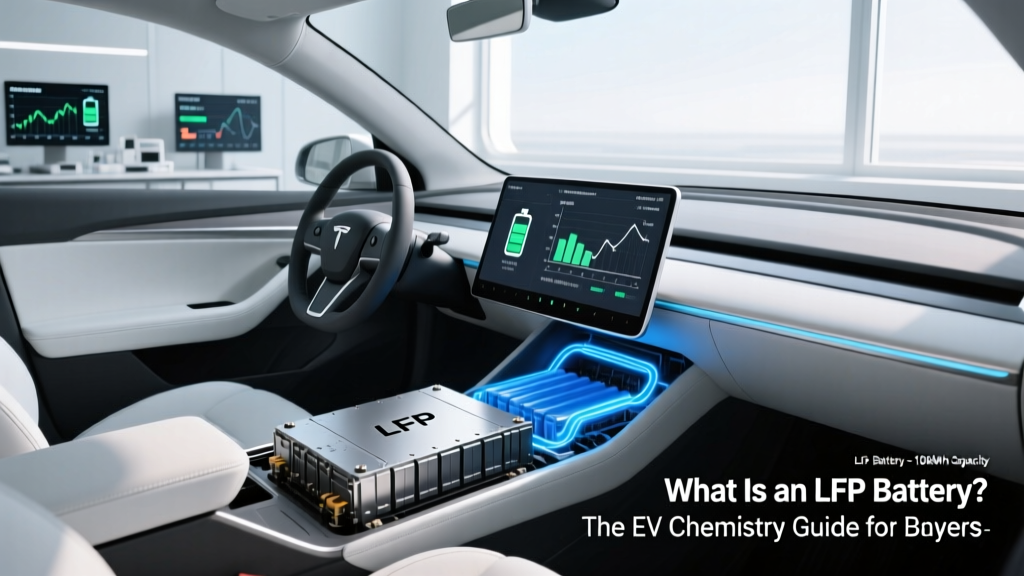
If you have shopped for a Tesla Model 3, a base Ford Mustang Mach-E, or a BYD Atto 3 in recent years, you have likely encountered the term "LFP battery" on the spec sheet. LFP stands for lithium iron phosphate (LiFePO₄), a specific cathode chemistry that has reshaped the entry-level and mid-range electric vehicle market since 2021. Unlike the nickel-rich chemistries found in long-range and performance EVs, LFP trades some energy density for dramatically longer cycle life, lower cost, and improved thermal stability.
Understanding what is an LFP battery — and how it compares to the NMC (nickel manganese cobalt) and NCA (nickel cobalt aluminum) packs in higher-trim EVs — is one of the most consequential decisions you will make as an EV buyer. The chemistry in your pack affects real-world range, charging habits, long-term degradation, and even how often you should charge to 100%. This guide gives you the exact data points to decide.
LFP vs NMC vs NCA: Chemistry Trade-Offs at a Glance
Every lithium-ion EV battery uses a specific cathode material that determines its fundamental characteristics. Here is how the three dominant chemistries compare across the metrics that matter to owners:
| Characteristic | LFP (Lithium Iron Phosphate) | NMC (Nickel Manganese Cobalt) | NCA (Nickel Cobalt Aluminum) |
|---|---|---|---|
| Energy Density (cell-level) | 160–180 Wh/kg | 220–260 Wh/kg | 250–280 Wh/kg |
| Cycle Life (to 80% capacity) | 3,000–6,000 cycles | 1,000–2,000 cycles | 800–1,500 cycles |
| Cost per kWh (cell-level, 2025–2026) | ~$55–$70/kWh | ~$95–$120/kWh | ~$100–$130/kWh |
| Thermal Stability | Excellent (onset ~270°C) | Moderate (onset ~210°C) | Lower (onset ~180°C) |
| Cold-Weather Performance | Weaker below 0°C / 32°F | Better low-temp discharge | Better low-temp discharge |
| Recommended Daily SoC | 100% charging is fine | 80% daily, 100% for trips | 80% daily, 100% for trips |
| Cobalt Content | None | Yes (supply-chain concern) | Yes (supply-chain concern) |
| Typical EV Applications | Standard-range / base trims | Long-range / mid trims | Performance / premium trims |
The single biggest practical difference for daily ownership: LFP batteries can and should be charged to 100% regularly, while NMC/NCA packs last longer when held at 80% for daily driving and only charged to full for road trips. Tesla, Ford, and Rivian all recommend 100% for their LFP-equipped vehicles. This means a 57.5 kWh LFP pack charged to 100% every morning gives you the full usable capacity daily, whereas a 75 kWh NMC pack at an 80% daily limit effectively gives you ~60 kWh of daily range.
How Long Do EV Batteries Last? Degradation Data
The fear of a dead battery is the single largest barrier to EV adoption — and it is largely overstated by data. Modern EV batteries, both LFP and NMC, are engineered with thermal management systems, buffer zones (typically 3–5 kWh of unusable capacity at the top and bottom of the pack), and chemistry formulations designed to outlast the vehicle itself in most cases.
LFP Degradation: The Slow Curve
LFP cells degrade remarkably slowly. Industry testing by organizations like Recurrent and independent lab data show LFP packs retaining 90%+ of original capacity after 100,000 miles in moderate climates. A typical degradation profile:
- Year 1 / 15,000 miles: 2–3% capacity loss (initial formation loss)
- Year 3 / 45,000 miles: 4–6% total loss
- Year 5 / 75,000 miles: 5–8% total loss
- Year 8 / 120,000 miles: 8–12% total loss
- Year 10+ / 150,000+ miles: 10–15% total loss
NMC Degradation: Steeper but Still Manageable
NMC packs degrade faster in early life but still deliver strong longevity. A typical NMC degradation curve from real-world fleet data:
- Year 1 / 15,000 miles: 3–5% capacity loss
- Year 3 / 45,000 miles: 6–10% total loss
- Year 5 / 75,000 miles: 8–13% total loss
- Year 8 / 120,000 miles: 12–18% total loss
- Year 10+ / 150,000+ miles: 15–22% total loss
For context, a 2024 Tesla Model Y Long Range (NMC, ~75 kWh usable, EPA 330 miles) showing 15% degradation at 120,000 miles would still deliver roughly 280 EPA-equivalent miles — still more range than most new gas cars can travel between fill-ups.
EV Battery Warranty Terms: What Is Actually Covered
Federal law in the United States mandates a minimum battery warranty of 8 years or 100,000 miles (whichever comes first) for all EVs. In California Air Resources Board (CARB) states — which include California, Colorado, Connecticut, Maine, Maryland, Massachusetts, New Jersey, New York, Oregon, Rhode Island, Vermont, Virginia, and Washington — that mandate extends to 10 years or 150,000 miles. Most manufacturers meet or exceed these minimums.
| Manufacturer | Warranty Period | Mileage Limit | Capacity Retention Threshold |
|---|---|---|---|
| Tesla (Model 3 RWD / LFP) | 8 years | 100,000 miles | 70% |
| Tesla (Model Y LR / NMC) | 8 years | 120,000 miles | 70% |
| Ford (Mach-E / F-150 Lightning) | 8 years | 100,000 miles | 70% |
| Hyundai / Kia (EVs) | 10 years | 100,000 miles | 70% |
| Rivian (R1T / R1S) | 8 years | 175,000 miles | 70% |
| GM (Ultium-based EVs) | 8 years | 100,000 miles | 70% |
| BMW (i4 / iX) | 8 years | 100,000 miles | 70% |
The critical detail: the warranty triggers only when capacity drops below the stated threshold (typically 70%). A battery at 72% State of Health (SoH) at 95,000 miles would not qualify for a replacement, even though you have lost over a quarter of your original range. In practice, very few modern EV batteries fall below 70% within the warranty period unless there is a manufacturing defect.
EV Battery Replacement Costs: When and How Much
Battery replacement is the scenario every EV skeptic raises — and it is the one area where honest numbers matter more than reassurance. The reality: full pack replacement is rare, expensive when it happens, and usually unnecessary within the typical ownership period of a single owner.
| Vehicle | Battery Size (usable kWh) | Chemistry | Estimated Pack Replacement Cost |
|---|---|---|---|
| Tesla Model 3 RWD | 57.5 kWh | LFP | $7,000–$10,000 |
| Tesla Model Y Long Range | 75 kWh | NMC | $12,000–$16,000 |
| Ford Mustang Mach-E (ER) | 91 kWh | NMC | $15,000–$22,000 |
| Hyundai Ioniq 5 (Long Range) | 77.4 kWh | NMC | $11,000–$16,000 |
| Chevrolet Bolt EV | 65 kWh | NMC | $9,000–$14,000 |
| Ford F-150 Lightning (ER) | 131 kWh | NMC | $22,000–$32,000 |
| Rivian R1T (Large Pack) | 128 kWh | NMC | $20,000–$28,000 |
| BMW iX xDrive50 | 105.2 kWh | NMC | $18,000–$25,000 |
Important context: LFP packs cost less to replace because the raw materials (iron, phosphate) are cheaper and more abundant than nickel and cobalt. Cell-level pricing for LFP has dropped below $60/kWh at scale, meaning a 57.5 kWh replacement pack in raw cells costs under $3,500 — the remainder of the replacement cost is module assembly, labor, diagnostics, and dealer markup.
When is replacement typically needed? Based on current fleet data, the vast majority of EV batteries never require full replacement under normal ownership. Out-of-warranty replacements typically occur after 200,000+ miles or 15+ years, and even then, partial module replacement (replacing only the degraded modules within the pack) is increasingly available at 30–50% of the full-pack cost. Companies like NHTSA-monitored repair networks and independent EV shops are expanding module-level repair capabilities.
What Kills an EV Battery? Factors That Accelerate Degradation
Not all miles are created equal when it comes to battery wear. The following factors have the most significant measurable impact on long-term capacity retention:
1. Sustained High State of Charge (NMC/NCA Only)
Holding an NMC or NCA battery at 100% SoC for extended periods — especially in hot weather — accelerates electrolyte decomposition and cathode microcracking. This is why Tesla, BMW, and Hyundai all recommend an 80% daily charge limit for NMC/NCA vehicles. LFP batteries are largely immune to this issue; their flat voltage curve and stable olivine crystal structure tolerate 100% SoC without meaningful additional wear.
2. Frequent DC Fast Charging
Repeated high-power DC fast charging (150+ kW) generates internal heat that stresses cell chemistry over time. Data from Recurrent and Idaho National Laboratory shows that vehicles DC fast-charging more than 3 times per week exhibit 2–4% additional degradation over 100,000 miles compared to vehicles primarily charging on Level 2. This effect is more pronounced in NMC packs; LFP cells handle high C-rates somewhat better due to their thermal stability.
3. Extreme Temperatures
Both hot and cold extremes affect batteries, but in different ways:
- Heat (above 95°F / 35°C sustained): Accelerates chemical degradation permanently. Vehicles in Arizona, Texas, and the Middle East show 2–5% higher degradation rates over 5 years compared to temperate-climate vehicles. Thermal management systems mitigate this but cannot eliminate it.
- Cold (below 32°F / 0°C): Reduces range temporarily (15–30% loss is normal) and slows charging speeds due to lithium plating risk. Cold does not cause permanent degradation unless the battery is charged at high power while below freezing — which is why modern EVs precondition the battery before fast charging in cold weather.
4. Deep Discharge Cycles
Regularly driving the battery down to 0% (or near 0%) stresses cells more than shallow cycles. While the buffer zone protects against catastrophic damage, habitual deep discharges accumulate wear faster than keeping SoC between 20% and 80% (for NMC) or 10% and 100% (for LFP).
- LFP owners: Charge to 100% at least once per week (Tesla recommends daily). Avoid prolonged storage below 20% SoC.
- NMC/NCA owners: Set daily charge limit to 80%. Charge to 100% only when departing for a road trip. Avoid leaving the car at 100% for more than a few hours.
- All EV owners: Use Level 2 home charging as your primary method. Limit DC fast charging to road trips when possible. Enable battery preconditioning before fast charging (automatic in most 2024+ EVs when navigating to a charger). Avoid leaving the vehicle at very low SoC (below 10%) for extended periods, especially in heat.
- Cold-climate owners: Plug in whenever possible to allow the thermal management system to maintain battery temperature. Use scheduled departure times to precondition the pack while still on grid power.
How to Check Your EV Battery Health (State of Health)
State of Health (SoH) is the percentage of original capacity your battery retains. A new EV has 100% SoH; a battery at 85% SoH holds 85% of its original kWh. Monitoring SoH helps you track degradation, plan for resale value, and identify abnormal wear that might qualify for a warranty claim.
Methods for Checking SoH
- In-vehicle display: Some EVs (notably the Hyundai Ioniq 5/6, Kia EV6/EV9, and newer BMW iX) display SoH percentage directly in the vehicle settings or infotainment system. Tesla does not natively show SoH in the car but provides it through service diagnostics.
- OBD-II apps: Third-party apps like Leaf Spy (Nissan Leaf), Tessie (Tesla), or Car Scanner (various brands) can read SoH data from the battery management system via an OBD-II Bluetooth dongle. Accuracy varies by vehicle but is generally within 1–2% of dealer diagnostic readings.
- Dealer diagnostic check: Most manufacturers can perform a full battery health report during a service visit. This is the most accurate method and is typically required for warranty claims. Expect to pay $0–$150 for this service if out of warranty.
- Charging math method: Charge from a known low SoC (e.g., 10%) to 100% on a metered Level 2 charger. Compare the kWh delivered (adjusted for ~90% charging efficiency) to the pack's original usable capacity. This gives a rough SoH estimate within 3–5%.
For used-EV buyers, a pre-purchase battery health check is essential. Request the SoH reading from the seller or budget for a dealer diagnostic before finalizing the purchase. A used Tesla Model 3 with 60,000 miles showing 93% SoH is a healthy pack; one showing 82% at the same mileage warrants investigation.
Beyond LFP and NMC: What Is Coming Next
Battery chemistry is advancing rapidly, but buyers should distinguish between technologies in production today and those still in development:
LFP Improvements (Available Now)
Second-generation LFP cells from CATL and BYD have pushed energy density to 170–180 Wh/kg (up from ~140 Wh/kg in 2020), making LFP viable in vehicles like the Tesla Model 3 RWD (272 miles EPA) and the Ford Mustang Mach-E Select (250 miles EPA). CATL's "Shenxing" LFP cells also support 4C charging rates (10–80% in approximately 10 minutes), closing the charging-speed gap with NMC.
Sodium-Ion Batteries (Early Production, 2025–2026)
CATL and BYD have begun limited production of sodium-ion batteries for small, affordable EVs in China. Sodium-ion offers lower energy density (~120–140 Wh/kg) but dramatically lower cost and better cold-weather performance than LFP. Expect these to appear in US-market budget EVs by 2027–2028, primarily in city cars and light commercial vehicles.
Silicon-Anode Enhancements (Limited Production)
Adding silicon to the graphite anode increases energy density by 10–20%. Tesla, GM (with partner Sila Nanotechnologies), and Mercedes-Benz have announced silicon-anode adoption in select models. The Mercedes EQG and upcoming GM Ultium-based vehicles are expected to incorporate silicon-anode cells. This technology is available now in limited applications and expanding through 2027.
Solid-State Batteries (Announced — Not Yet Available)
Solid-state batteries replace the liquid electrolyte with a solid material, promising 30–50% higher energy density, faster charging, and improved safety. Toyota, Samsung SDI, and QuantumScape have announced production timelines targeting 2027–2030 for initial vehicle integration. However, as of early 2026, no solid-state EV battery is available in a production vehicle. Expect first-generation solid-state packs to appear in limited, premium models (likely Toyota and Nissan) around 2028–2029, with mainstream adoption not arriving until the early 2030s. Cost per kWh will initially be significantly higher than current liquid-cell technology.
LFP vs NMC: Which Battery Should You Choose?
The answer depends entirely on your driving patterns, climate, and budget. Here is a practical decision framework:
Choose LFP if:
- You want the lowest long-term degradation and plan to keep the vehicle 8+ years
- You primarily charge at home on Level 2 and want the simplicity of charging to 100% daily
- You live in a moderate to warm climate (LFP's cold-weather weakness matters less when you can precondition while plugged in)
- You are buying a standard-range or base trim and want the best value per dollar
- You care about cobalt-free supply chains and lower environmental impact from mining
Choose NMC/NCA if:
- You need maximum range for frequent long-distance travel (300+ mile EPA)
- You live in a cold climate and need better low-temperature discharge performance
- You want a performance trim with higher power output (NCA cells handle higher discharge C-rates)
- You need the lightest possible pack for towing or payload-sensitive applications
- You are comfortable managing an 80% daily charge limit and reserving 100% for trips
Frequently Asked Questions
Is an LFP battery safe?
Yes. LFP is widely considered the safest lithium-ion chemistry in mass production. Its olivine crystal structure is thermally stable up to approximately 270°C before oxygen release begins, compared to ~210°C for NMC and ~180°C for NCA. This makes thermal runaway events (battery fires) far less likely in LFP packs. No EV battery is immune to damage from severe impacts, but LFP provides the widest safety margin of current chemistries.
Can I charge my LFP battery to 100% every day?
Yes — and you should. Tesla, Ford, and other manufacturers explicitly recommend charging LFP-equipped vehicles to 100% at least weekly (Tesla recommends daily). This is because LFP's flat voltage curve makes it difficult for the battery management system to accurately estimate SoC without periodic full charges. Charging to 100% regularly actually improves the accuracy of your range estimate and does not meaningfully accelerate degradation.
Does cold weather damage an LFP battery?
Cold weather reduces LFP range more noticeably than NMC — expect 20–35% range loss below freezing versus 15–25% for NMC. However, cold alone does not cause permanent damage as long as the battery management system prevents high-power charging while the cells are below freezing. Modern EVs handle this automatically through preconditioning. The range loss is temporary and fully recovers when temperatures rise.
Will my EV battery need to be replaced?
Statistically, probably not during your ownership. Current fleet data shows the vast majority of EV batteries retaining above 80% capacity at 150,000 miles. Full replacement is most commonly needed after 200,000+ miles or due to physical damage (collision, flood). For most first and second owners, the battery will outlast the rest of the vehicle's useful life.
How does the federal tax credit interact with battery chemistry?
The IRS §30D clean vehicle credit of up to $7,500 has specific battery-sourcing and critical-mineral requirements that change annually. LFP batteries using iron and phosphate may have different sourcing profiles than NMC batteries using nickel and cobalt, which can affect credit eligibility depending on the model year and where materials are processed. Always verify current-year eligibility on the IRS website or with a tax professional before purchasing — the rules are complex and change frequently. MSRP caps ($55,000 for sedans, $80,000 for SUVs/trucks) and buyer income limits also apply.
Can I upgrade from an NMC battery to LFP (or vice versa)?
No. Battery packs are engineered for specific vehicle platforms with particular voltage architectures, physical dimensions, and thermal management requirements. You cannot swap an NMC pack for an LFP pack (or a larger pack for a smaller one) outside of manufacturer-approved configurations. The chemistry is determined at purchase.