Bigger Isn't Always Better: What "Largest Battery" Really Means
When shoppers search for the EV with the largest battery, they're usually chasing one thing: maximum range. But raw kilowatt-hours (kWh) — the unit measuring a battery's total energy capacity — only tells part of the story. A 131 kWh pack in a heavy, boxy truck may deliver fewer real-world miles than a 100 kWh pack in a slippery sedan. Chemistry, thermal management, vehicle weight, and aerodynamics all shape what that battery actually does on the road.
This guide breaks down the EVs with the largest battery packs available in the U.S. market for the 2026 model year, then goes deeper into what matters for long-term ownership: cell chemistry trade-offs, degradation data, warranty coverage, replacement costs, and how to monitor and maximize your battery's State of Health (SoH) over a decade or more of driving.
EVs With the Largest Battery Packs in 2026
Here's how the current heavyweight battery packs stack up. Note that usable kWh is what matters — manufacturers include a buffer (typically 3-5%) above and below the stated capacity to protect cells from overcharge and deep-discharge damage.
| Vehicle | Usable Battery (kWh) | Chemistry | EPA Range (mi) | Efficiency (kWh/100mi) | Base MSRP |
|---|---|---|---|---|---|
| Ford F-150 Lightning (Extended Range) | ~131 | NMC | 320 | 41 | $72,990 |
| GMC Hummer EV Pickup | ~212 (estimated) | NMC | 329 | ~64 | $98,845 |
| Rivian R1T (Max Pack) | ~149 | NMC (2170 cells) | 352 | ~42 | $89,900 |
| Lucid Air Grand Touring | ~112 | NMC | 516 | 22 | $110,900 |
| Tesla Model S (Long Range) | ~100 | NMC/NCA | 402 | 25 | $79,990 |
| Cadillac Escalade IQ | ~200 (estimated) | NMC (Ultium) | 450 (est.) | ~44 | $129,990 |
The GMC Hummer EV technically carries the largest battery by raw kWh, but its extreme weight and poor aerodynamics mean it uses roughly three times the energy per mile that a Lucid Air requires. The Lucid's 112 kWh pack delivers more real-world range than packs nearly twice its size. Efficiency, not just capacity, determines how far you actually go.
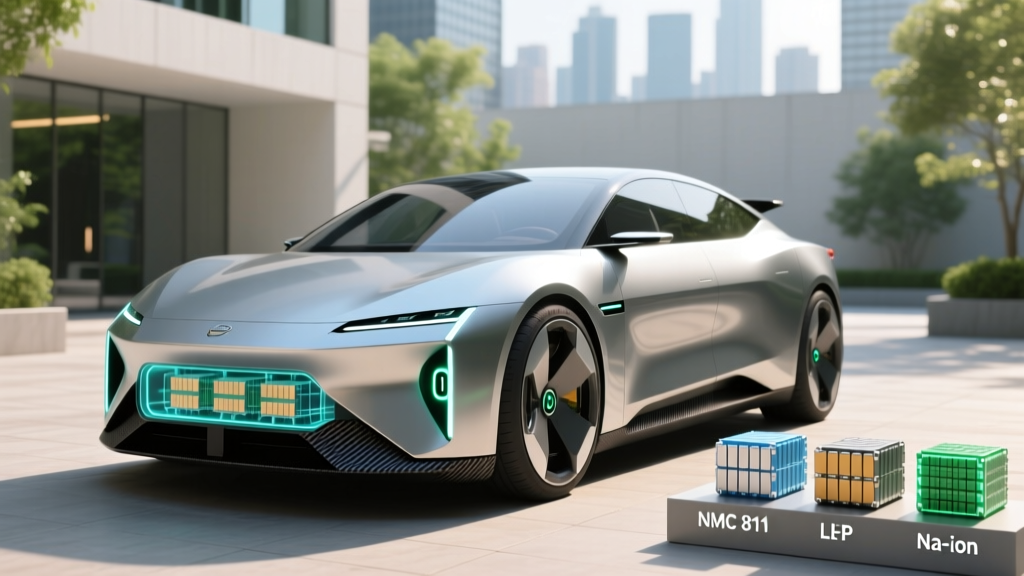
LFP vs. NMC vs. NCA: Which Chemistry Is Right for You?
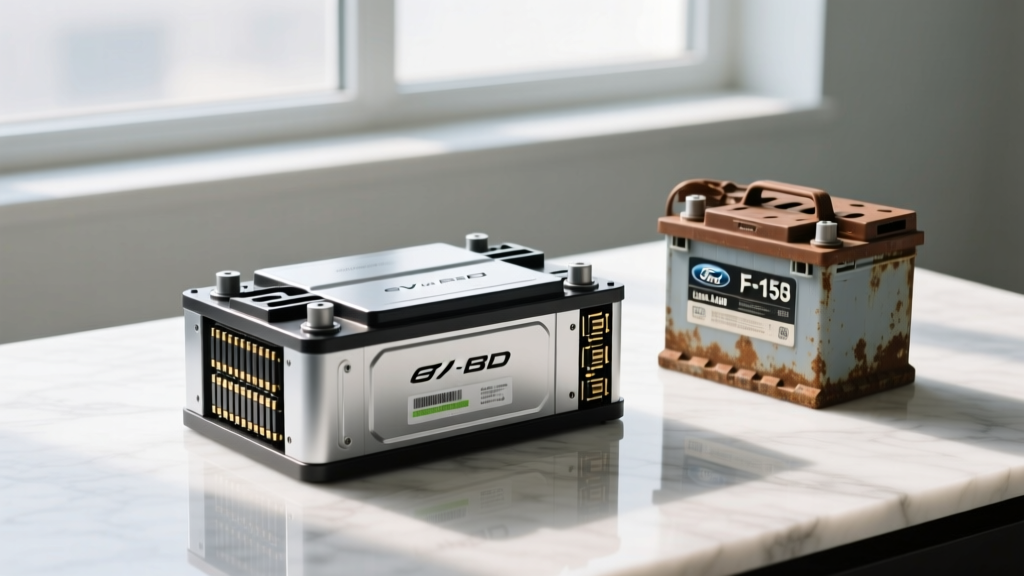
The cells inside your EV's battery pack aren't all the same. Three dominant lithium-ion chemistries power today's EVs, each with distinct trade-offs. Understanding these helps explain why a Tesla Model 3 RWD with a smaller battery can outlast a larger NMC pack in calendar years, or why the largest battery packs almost exclusively use NMC chemistry.
| Attribute | LFP (Lithium Iron Phosphate) | NMC (Nickel Manganese Cobalt) | NCA (Nickel Cobalt Aluminum) |
|---|---|---|---|
| Energy Density | Lower (~160 Wh/kg cell-level) | Higher (~250 Wh/kg cell-level) | Highest (~260+ Wh/kg cell-level) |
| Cycle Life | 3,000-5,000+ cycles | 1,000-2,000 cycles | 1,000-1,500 cycles |
| Cold-Weather Performance | Moderate — greater range loss below freezing | Better low-temp discharge capability | Good low-temp performance |
| Cost (per kWh) | Lowest — no cobalt or nickel | Higher — cobalt/nickel commodity exposure | Higher — similar to NMC |
| Recommended Daily SoC | Can charge to 100% daily | Best kept at 80% for daily use | Best kept at 80% for daily use |
| Typical Applications | Tesla Model 3/Y RWD, Ford Mustang Mach-E Select (2025+), Rivian Standard | Most long-range/AWD models, trucks, SUVs | Tesla Long Range/Performance models |
| Thermal Stability | Excellent — lowest runaway risk | Good — requires active thermal management | Good — requires active thermal management |
The takeaway: If you see an EV with the largest battery pack, it almost certainly uses NMC chemistry. The energy density advantage is essential for fitting 130+ kWh into a vehicle without excessive weight. LFP dominates in standard-range, lower-cost models where longevity and daily 100% charging convenience matter more than squeezing out every mile. NCA is largely a Tesla specialty, offering a middle ground in energy density.
LFP's cycle-life advantage is significant: 3,000-5,000 full charge cycles at 100% depth of discharge means an LFP pack could theoretically deliver 750,000+ miles of cumulative energy throughput before reaching end-of-life. Most NMC packs reach similar degradation thresholds at roughly 300,000-500,000 cumulative miles. In practice, most vehicles are retired or totaled before either chemistry reaches its cycle limit.
How Long Do EV Batteries Actually Last? Degradation Data
Battery degradation — the gradual loss of capacity over time and use — is one of the most misunderstood aspects of EV ownership. The fear of a sudden, catastrophic battery failure is largely unfounded. Modern lithium-ion packs degrade slowly and predictably, losing a small percentage of capacity each year.
- Year 1: ~2-3% loss (initial formation loss, steepest part of the curve)
- Years 2-5: ~1-2% loss per year (linear slow-degradation phase)
- Years 6-10: ~0.5-1.5% loss per year (plateau phase)
- At 150,000 miles / 10 years: Expect ~85-92% of original capacity retained
Source: Data compiled from Recurrent Auto fleet telemetry across 15,000+ EVs and Geotab fleet analysis of 6,300 vehicles.
Real-world data from Recurrent Auto's monitoring of over 15,000 EVs shows that the median Tesla Model 3 retains approximately 90% of its original range at 100,000 miles. The Chevrolet Bolt EV, which uses NMC chemistry, shows roughly 8-10% degradation at the same mileage. These figures align with laboratory accelerated-life testing from battery manufacturers.
LFP packs show a different pattern: degradation is more linear with less initial drop-off, and the chemistry tolerates sustained high SoC without the same acceleration in capacity loss that NMC experiences. Tesla's LFP-equipped Model 3 RWD units have shown roughly 93-95% capacity retention at 60,000 miles in early fleet data.
Factors That Accelerate Degradation
- Frequent DC fast charging above 150 kW — Sustained high-current sessions generate heat; occasional use is fine, but daily 350 kW sessions accelerate wear. Research from the U.S. Department of Energy's Idaho National Lab found that exclusive DCFC use showed modestly higher degradation (~1-2% additional over 50,000 miles) compared to Level 2 charging.
- Sustained 100% State of Charge — For NMC/NCA packs, sitting at 100% SoC for days stresses cells. Charge to 80% for daily use; reserve 100% for road trips.
- Deep discharge below 10% — Repeatedly draining the pack to near-zero increases mechanical stress on electrode materials.
- Extreme heat exposure — Parking in 100°F+ ambient temperatures for extended periods without thermal management active. Most modern EVs run cooling even when parked, but this draws energy.
- Cold charging without preconditioning — Plugging into a DC fast charger with a cold-soaked battery (below 40°F) can cause lithium plating on the anode, permanently reducing capacity.
What the Battery Warranty Actually Covers
Federal law mandates that EV battery warranties cover at minimum 8 years or 100,000 miles (whichever comes first). In California Air Resources Board (CARB) states, that extends to 10 years / 150,000 miles. Most manufacturers exceed these minimums in capacity-retention guarantees.
| Manufacturer | Warranty Period | Mileage Cap | Capacity Retention Threshold | Notes |
|---|---|---|---|---|
| Tesla (Model 3/Y NMC) | 8 years | 120,000 mi | 70% | Covers defects + capacity below threshold |
| Tesla (Model 3/Y LFP) | 8 years | 100,000 mi | 70% | Same threshold, lower mileage cap |
| Hyundai / Kia (E-GMP) | 10 years | 100,000 mi | 70% | Among the longest coverage periods |
| Ford (F-150 Lightning) | 8 years | 100,000 mi | 70% | Standard across Ford EVs |
| GM (Ultium platform) | 8 years | 100,000 mi | 70% | Covers Bolt, Blazer EV, Silverado EV, Escalade IQ |
| Rivian (R1T/R1S) | 8 years | 175,000 mi | 70% | Highest mileage threshold in the segment |
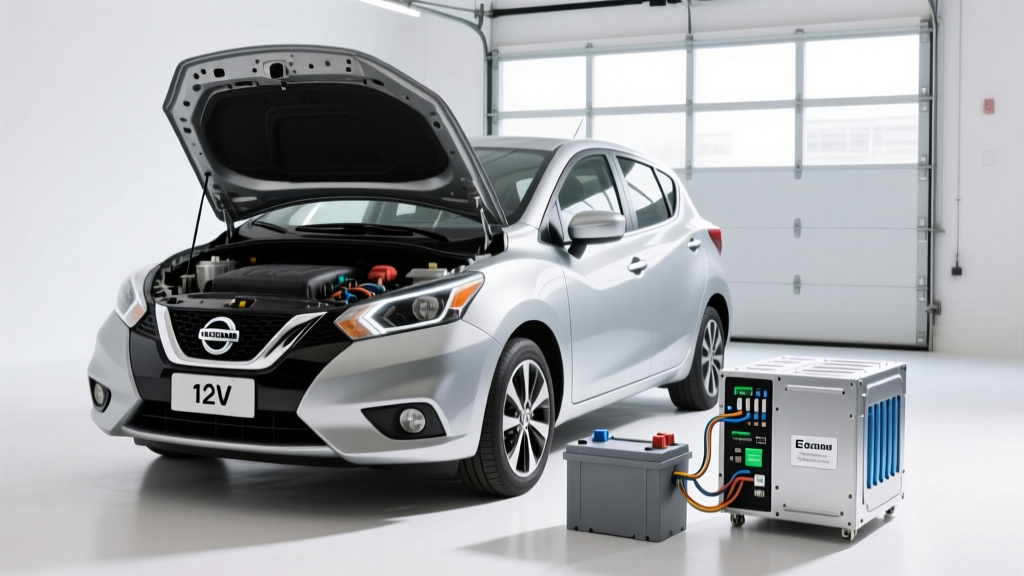
| BMW (iX / i4) | 8 years | 100,000 mi | 70% | Includes 12V battery coverage |
The critical number is the capacity retention threshold — typically 70%. If your battery drops below 70% of its original capacity within the warranty period, the manufacturer must repair or replace it at no cost. In practice, very few EVs hit this threshold under normal use. The degradation data above shows most packs retain 85%+ at 100,000 miles, well above the warranty floor.
Important caveat: warranties typically exclude damage from accidents, flooding, modifications, or improper charging equipment. They also don't cover gradual degradation that stays above the threshold — a pack at 72% capacity at year 7 won't trigger a warranty claim, even though you've lost nearly a third of your range.
How Much Does an EV Battery Cost to Replace?
This is the question that generates the most anxiety — and the most misleading headlines. The sticker price of a replacement pack is real, but context matters enormously.
| Vehicle | Battery Size (kWh) | Estimated Replacement Cost | Cost per kWh |
|---|---|---|---|
| Tesla Model 3 (Standard / LFP) | ~60 | $12,000 - $15,000 | ~$200-$250 |
| Tesla Model Y (Long Range / NMC) | ~82 | $16,000 - $22,000 | ~$195-$270 |
| Chevrolet Equinox EV | ~85 | $15,000 - $20,000 | ~$175-$235 |
| Ford F-150 Lightning (Extended) | ~131 | $25,000 - $35,000 | ~$190-$265 |
| Hyundai Ioniq 5 (Long Range) | ~77.4 | $14,000 - $19,000 | ~$180-$245 |
| Rivian R1T (Max Pack) | ~149 | $30,000 - $40,000 | ~$200-$270 |
| GMC Hummer EV | ~212 | $40,000 - $55,000 | ~$190-$260 |
These figures represent full pack replacements through OEM channels. Independent EV repair shops and refurbished pack options can reduce costs by 30-50%, and module-level repair (replacing individual degraded modules rather than the entire pack) is increasingly available for common models like the Tesla Model 3 and Chevrolet Bolt.
The crucial context: According to data from Consumer Reports and Recurrent Auto, fewer than 2% of EVs have required a battery replacement outside of warranty coverage as of 2025. Most EV batteries outlast the vehicles they're installed in. The average age of a scrapped vehicle in the U.S. is roughly 12-15 years, and current data shows EV packs routinely reaching 200,000+ miles with 80%+ capacity retention. The odds of needing an out-of-pocket replacement remain low for most owners.
Battery pack costs have also declined from roughly $1,000/kWh in 2010 to approximately $130-$150/kWh at the cell level in 2025, with pack-level costs around $180-$220/kWh. This trend continues downward, meaning a replacement in 2035 will almost certainly cost less in real dollars than one today.
Monitoring and Maximizing Battery Health
Modern EVs provide multiple ways to track your battery's State of Health (SoH) — the percentage of original capacity remaining. Here's how to stay informed and what you can actively control.
How to Check Your Battery's State of Health
- In-vehicle displays: Tesla's service menu (accessible via the software screen) shows estimated range at 100% charge, which you can compare to the original EPA figure. Hyundai/Kia's infotainment includes an EV battery status screen. Rivian provides SoH data through its mobile app.
- OBD-II diagnostic tools: Third-party apps like Battery Health (for Tesla via BLE) or OBDLink with EV-specific software can read detailed cell-level voltage data, internal resistance, and estimated capacity.
- Third-party telemetry services: Recurrent Auto offers free battery health reports by connecting to your vehicle's telematics data. Geotab provides fleet-level SoH analytics.
- Dealer diagnostics: Any authorized service center can run a full battery health check, typically providing a detailed report with individual module voltages and capacity estimates. Request this during routine service visits.
Practical Battery Care Habits
- NMC/NCA packs: Set daily charge limit to 80%. Charge to 100% only before a road trip, and try to depart shortly after reaching full charge rather than letting it sit.
- LFP packs: Charge to 100% at least once per week. LFP cells need periodic full charges for the battery management system (BMS) to accurately calibrate SoC estimation. Tesla explicitly recommends this.
- Use Level 2 home charging as your primary method. Slow, steady charging generates less heat and places less stress on cells than daily DC fast charging.
- Precondition before DC fast charging. Most EVs automatically precondition the battery when you navigate to a charger. This warms cells to the optimal 85-95°F range, improving charge speed and reducing lithium-plating risk. If your car doesn't auto-precondition, manually initiate it 15-20 minutes before arrival.
- Avoid prolonged storage at extreme SoC. If leaving your EV for more than a week, aim for 50-60% SoC. Don't leave it at 100% or below 10% for extended periods.
- Use scheduled charging. Set your car to finish charging just before you leave in the morning. This minimizes time spent at high SoC and ensures the battery is at a moderate temperature from the charging process.
What's Next: Solid-State, Silicon Anodes, and Beyond
Next-generation battery technologies promise step-changes in energy density, charging speed, and longevity. Here's where they stand as of early 2026 — with realistic timelines, not concept-car hype.
Solid-State Batteries
Solid-state cells replace the liquid electrolyte in conventional lithium-ion batteries with a solid material (ceramic, sulfide, or polymer). The theoretical benefits are significant: 2-3x energy density, faster charging (potentially 10-80% in under 10 minutes), improved safety (no flammable electrolyte), and longer cycle life.
Reality check: Toyota has announced solid-state battery production for a limited-run vehicle in 2027-2028, with broader availability not expected before 2030. Samsung SDI and QuantumScape are in pilot production phases. Manufacturing yield, cost, and scaling challenges remain substantial. No solid-state EV is currently available for purchase in the U.S. market, and any vehicle announced with this technology should be treated as preliminary until production units are independently tested.
Silicon Anode Technology
Replacing graphite anodes with silicon (or silicon-carbon composites) can increase energy density by 20-40%. Companies like Sila Nanotechnologies and Group14 Technologies are supplying silicon anode materials to battery manufacturers.
Timeline: Partial silicon anode adoption is already underway — the 2026 Mercedes-Benz G-Class EV uses cells with silicon-dominant anodes from Sila. Expect incremental adoption across premium models through 2027-2029, with mainstream vehicles likely seeing silicon-blend anodes by 2030.
Sodium-Ion Batteries
Sodium-ion chemistry eliminates lithium entirely, using abundant sodium instead. Energy density is lower (~120-140 Wh/kg), making it unsuitable for long-range vehicles, but cost advantages are compelling for urban EVs and energy storage. CATL has begun mass production in China, with U.S. market entry expected in budget-oriented models by 2028-2030.
Frequently Asked Questions
How long do EV batteries last in years and miles?
Based on fleet data from Recurrent Auto and Geotab, modern EV batteries retain 85-92% of original capacity at 150,000 miles or 10 years under normal use. Many packs reach 200,000+ miles with 80%+ retention. Catastrophic failure is rare — fewer than 2% of EVs have required out-of-warranty battery replacement as of 2025. Most EV batteries will outlast the useful life of the vehicle itself.
How much does an EV battery cost to replace?
Full OEM replacement costs range from approximately $12,000 for a Tesla Model 3 LFP pack to $40,000-$55,000 for the GMC Hummer EV's ~212 kWh pack. Per-kWh costs are roughly $180-$270 at the pack level including labor. Independent shops and refurbished options can reduce costs by 30-50%. However, most owners never need a replacement — warranty coverage and slow degradation curves mean the vast majority of packs last the life of the car.
What does the EV battery warranty actually cover?
Federal minimum is 8 years / 100,000 miles (10 years / 150,000 miles in CARB states). Coverage includes manufacturing defects and capacity loss below a specified threshold — typically 70% of original capacity. If your battery falls below that threshold within the warranty period, the manufacturer repairs or replaces it at no cost. Warranties do not cover accident damage, improper modifications, or normal degradation that remains above the threshold.
How do I check and maximize my battery's health?
Check SoH through your vehicle's built-in battery status screens, OBD-II diagnostic tools, or third-party services like Recurrent Auto. To maximize longevity: charge NMC/NCA packs to 80% daily (100% only for trips), charge LFP packs to 100% weekly for BMS calibration, rely primarily on Level 2 home charging, precondition before DC fast charging, and avoid prolonged storage at extreme charge levels.
LFP vs. NMC — which battery chemistry is better?
Neither is universally better; they serve different priorities. Choose LFP if you want maximum cycle life (3,000-5,000+ cycles), the convenience of daily 100% charging, lower cost, and superior thermal safety — and you can accept slightly lower energy density and greater cold-weather range loss. Choose NMC if you need maximum range per kWh (essential for the largest battery packs and long-range vehicles), better cold-weather performance, and don't mind managing daily charge limits to 80%. For most daily commuters, LFP offers the better ownership experience. For road-trippers and truck buyers, NMC's energy density is essential.
Does DC fast charging damage my battery?
Occasional DC fast charging causes negligible additional wear. Research from Idaho National Lab showed only 1-2% additional degradation over 50,000 miles for vehicles that exclusively used DCFC versus Level 2. The key mitigations are battery preconditioning (which most EVs do automatically when navigating to a charger) and avoiding unnecessary sessions at peak charge rates above 250 kW when a slower charger would suffice. Daily DCFC use is acceptable if your routine requires it, but Level 2 home charging remains the gentler option.
Will solid-state batteries make my current EV obsolete?
Not for at least 5-8 years. Solid-state production is in pilot phases as of 2026, with Toyota targeting limited production in 2027-2028 and broad availability not expected before 2030+. Even when available, solid-state EVs will initially command premium pricing. Your current EV's battery will remain functional, supported, and economically viable well into the 2030s. The transition will be gradual, similar to how LED TVs didn't immediately make LCD sets worthless.