When EV shoppers ask about "the largest battery in the world," they are usually thinking about grid-scale storage — like the 150 MWh lithium-ion installations that stabilize electrical grids. But for drivers, the more relevant question is: which production electric vehicle packs the biggest traction battery? In 2026, the answer pushes past 200 kWh, and the engineering trade-offs behind those massive packs reveal a lot about battery chemistry, degradation, longevity, and total cost of ownership.
This guide breaks down the largest EV batteries on the road, explains the LFP vs. NMC chemistry choices that determine how long they last, and provides hard data on degradation, warranty coverage, and replacement costs. Whether you are evaluating a 98 kWh midsize SUV or a 212 kWh electric pickup, the physics and economics of lithium-ion cells follow predictable patterns.
The Largest EV Batteries in Production (2026)
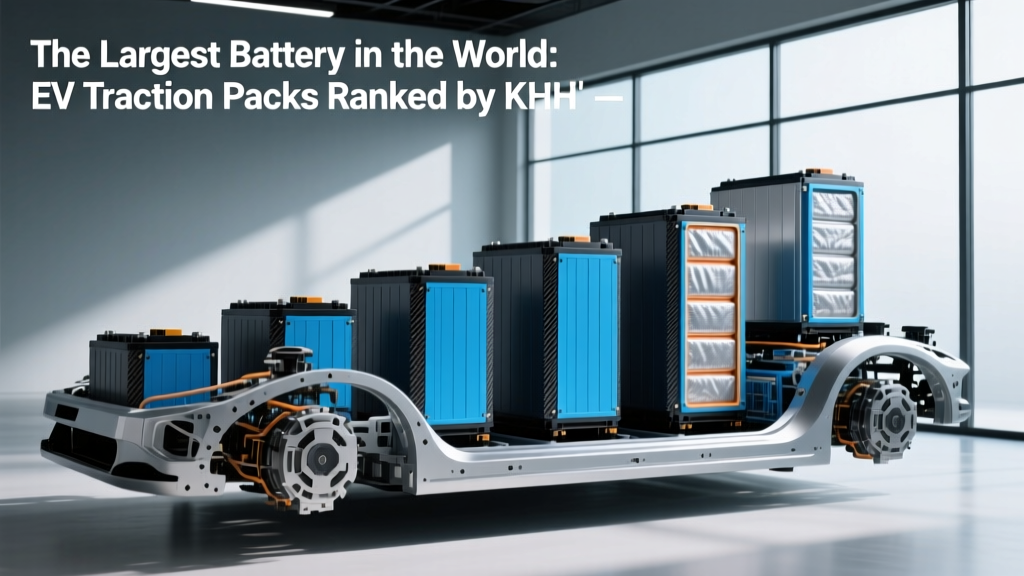
The title of "largest battery in a production vehicle" currently belongs to the GMC Hummer EV, which carries a 212.7 kWh (gross) Ultium lithium-ion pack — roughly double the capacity of a Tesla Model 3 Long Range. The Hummer EV's pack weighs approximately 2,923 pounds, which is heavier than some entire compact cars. Here is how the biggest packs in the U.S. market stack up:
| Vehicle | Battery (kWh usable) | Chemistry | EPA Range | Est. Pack Weight |
|---|---|---|---|---|
| GMC Hummer EV Pickup | ~212.7 | NMC (Ultium) | 329 mi | ~2,923 lbs |
| Cadillac Escalade IQ | ~200 | NMC (Ultium) | ~450 mi (est.) | ~2,800 lbs |
| Silverado EV RST | ~200 | NMC (Ultium) | 440 mi | ~2,700 lbs |
| Rivian R1T (Max Pack) | ~141 | NMC | 410 mi | ~1,900 lbs |
| Tesla Model S | ~100 | NCA | 402 mi | ~1,200 lbs |
| Hyundai Ioniq 5 (Long Range) | 84.0 | NMC | 305 mi | ~1,050 lbs |
| Tesla Model 3 (Standard) | ~60 | LFP | 272 mi | ~790 lbs |
A larger battery does not automatically mean better ownership. The Hummer EV achieves roughly 1.5–1.6 miles per kWh — an efficiency penalty imposed by its 9,000+ lb curb weight — while the Model 3 on LFP chemistry delivers over 4 mi/kWh. More kWh buys range, but it also buys weight, cost, and longer charge times.
Battery Chemistry: LFP vs. NMC/NCA Trade-Offs
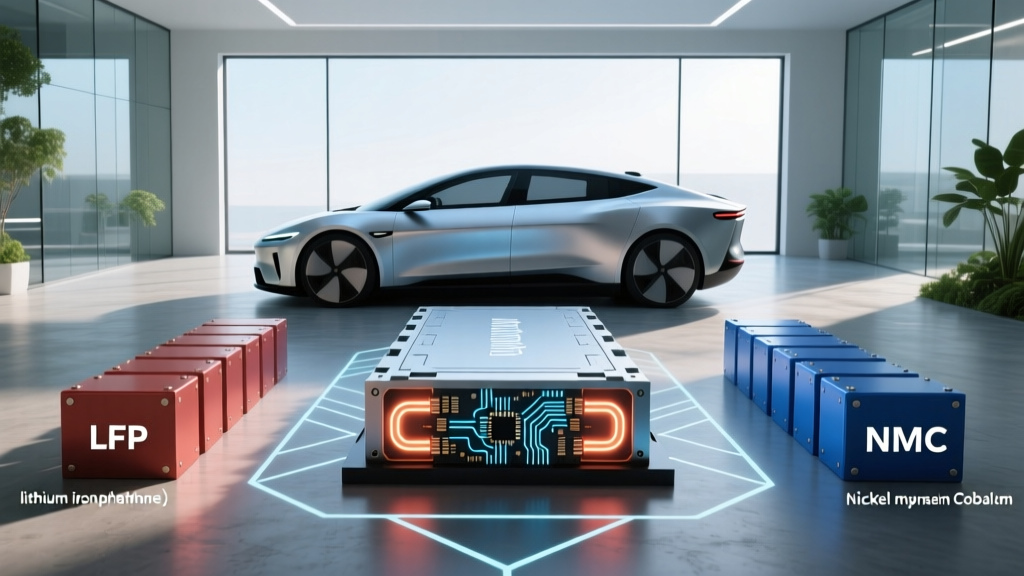
The two dominant lithium-ion chemistries in 2026 EVs are NMC (nickel-manganese-cobalt) and LFP (lithium iron phosphate). NCA (nickel-cobalt-aluminum), used by Tesla in some Long Range models, shares similar characteristics with NMC. The chemistry choice determines energy density, cycle life, thermal behavior, and cost.
| Attribute | LFP (Lithium Iron Phosphate) | NMC / NCA |
|---|---|---|
| Energy Density | Lower (~160–180 Wh/kg cell-level) | Higher (~220–280 Wh/kg cell-level) |
| Cycle Life | 3,000–5,000+ cycles to 80% SoH | 1,000–2,000 cycles to 80% SoH |
| Cold-Weather Performance | Weaker; more range loss below freezing | Better low-temp discharge capability |
| Thermal Stability | Superior; less prone to thermal runaway | Good but requires more active cooling |
| Cost per kWh | Lower (~$70–90/kWh cell-level in 2026) | Higher (~$95–120/kWh cell-level) |
| State-of-Charge Behavior | Can be charged to 100% daily without penalty | Best kept 20–80% for daily use |
| Common Applications | Tesla Model 3 RWD, Ford Mustang Mach-E Select, BYD models | Long-range and performance trims, trucks, SUVs |
Which is better? It depends on your use case. LFP wins for daily commuters who charge at home, want maximum cycle life, and do not need 350+ miles of range. NMC/NCA wins for road-trippers, cold-climate drivers, and anyone who needs the largest possible battery in a given vehicle footprint — which is why the biggest packs on the list above are all NMC.
How Long Do EV Batteries Last? Degradation Data
The most common fear among prospective EV buyers is premature battery failure. Real-world data tells a reassuring story: modern lithium-ion traction batteries are lasting significantly longer than early-generation packs from 2011–2015.
Typical Degradation Curve (NMC, liquid-cooled):
- Year 1 / 15,000 mi: ~2–4% capacity loss (initial formation)
- Year 3 / 45,000 mi: ~6–9% total loss
- Year 5 / 75,000 mi: ~8–12% total loss
- Year 8 / 120,000 mi: ~10–15% total loss
- Year 10+ / 150,000+ mi: ~12–20% total loss
LFP Degradation: Typically slower, with many packs retaining 90%+ capacity at 100,000 miles, thanks to the chemistry's inherent cycle-life advantage.
According to data aggregated by Recurrent Auto from over 15,000 vehicles, the average EV battery retains approximately 90–95% of original capacity after three years. Outlier failures do occur, but they are overwhelmingly covered under warranty and represent a small fraction of the fleet.
Real-world context: a Tesla Model 3 Long Range (82 kWh NMC) starting at 321 miles EPA range will likely deliver 280–295 miles of real-world range at the 8-year mark — still entirely usable for daily driving and road trips with brief DC fast-charging stops.
Battery Warranty Terms: What Is Actually Covered
Federal regulations mandate a minimum 8-year / 100,000-mile warranty on EV battery packs (with some states requiring 10 years / 150,000 miles under CARB rules). Most manufacturers exceed this baseline. Here is how major brands structure coverage:
| Manufacturer | Duration | Mileage | Capacity Retention Threshold |
|---|---|---|---|
| Tesla (Model 3/Y LFP) | 8 years | 120,000 mi | 70% |
| Tesla (Model S/X) | 8 years | 150,000 mi | 70% |
| Hyundai / Kia | 10 years | 100,000 mi | 70% |
| GM (Ultium) | 8 years | 100,000 mi | 60% (70% on select models) |
| Ford (Mach-E / F-150 Lightning) | 8 years | 100,000 mi | 70% |
| Rivian | 8 years | 175,000 mi | 70% |
| BMW / Mercedes-Benz | 8 years | 100,000 mi | 70% |
What the warranty covers: If your battery falls below the stated retention threshold (typically 70% of original capacity) within the warranty period, the manufacturer will repair or replace the pack — or specific modules — at no cost. Some manufacturers replace only the degraded modules rather than the entire pack, which is faster and less resource-intensive.
What it does not cover: Damage from accidents, improper charging equipment, flooding, or modifications. Normal gradual degradation above the threshold is also not a warranty claim — a battery at 73% capacity at year 7 is functioning within spec.
EV Battery Replacement Cost: What to Expect
Out-of-warranty battery replacement is the nightmare scenario EV skeptics cite. The costs are real, but context matters: the vast majority of EV batteries outlast the vehicle's useful life or are replaced under warranty. According to IRS §30D rules and industry data, most drivers will sell or retire their EV before needing a paid replacement. When replacement is needed, here is the current pricing landscape:
| Battery Size | Example Vehicles | Replacement Cost Range | When Typically Needed |
|---|---|---|---|
| ~60 kWh (LFP) | Tesla Model 3 RWD | $8,000 – $12,000 | Rarely; 200,000+ mi if at all |
| ~80–85 kWh (NMC) | Model 3 LR, Ioniq 5, Mach-E ER | $12,000 – $18,000 | 150,000–200,000+ mi |
| ~100 kWh (NMC/NCA) | Model S, EQS, iX | $15,000 – $22,000 | 150,000+ mi |
| ~140+ kWh (NMC) | Rivian R1T Max, Silverado EV | $20,000 – $30,000 | 150,000+ mi |
| ~200+ kWh (NMC) | Hummer EV, Escalade IQ | $25,000 – $40,000 | Unlikely within vehicle lifespan |
Two important trends are reducing these costs over time. First, cell prices have dropped from over $1,100/kWh in 2010 to approximately $80–110/kWh in 2026, per BloombergNEF tracking. Second, module-level repair is increasingly common — replacing a few degraded modules rather than the full pack can cost $2,000–$6,000 instead of the full-pack price.
Factors That Accelerate (or Slow) Battery Degradation
Battery longevity is not purely a function of age and mileage. How you charge, store, and drive your EV has a measurable impact on State of Health (SoH) over time. Here are the primary factors, ranked by impact:
Highest Impact:
- Extreme heat exposure: Sustained ambient temperatures above 95°F, especially combined with high SoC, accelerates electrolyte decomposition. Garage parking and preconditioning help.
- Persistent DC fast charging: Daily use of 150+ kW DC chargers increases cell stress. Reserve DCFC for road trips; use Level 2 for daily needs.
- Storing at 100% SoC for extended periods: Leaving an NMC vehicle plugged in at 100% for weeks causes calendar degradation. LFP is more tolerant of high-SoC storage.
Moderate Impact:
- Deep discharges to 0%: Regularly draining below 10% stresses cells. Keep a 20% buffer when possible.
- Extreme cold charging without preconditioning: Charging an ice-cold battery forces lithium plating. Always precondition in sub-freezing weather.
- Aggressive driving and frequent hard regen: High C-rates (rapid charge/discharge) generate heat. Moderate driving extends pack life.
Lower Impact:
- Total mileage alone: Modern liquid-cooled packs handle 1,000–2,000+ cycles. A 60 kWh LFP pack rated for 4,000 cycles could theoretically deliver 240,000 miles before reaching 80% SoH.
- Level 2 charging speed (7.2 vs. 11.5 kW): The difference in degradation impact is negligible for liquid-cooled packs.
How to Check and Monitor Battery Health (SoH)
State of Health (SoH) is expressed as a percentage of the battery's original capacity. A new EV starts at 100% SoH; a 5-year-old EV at 88% SoH has experienced 12% degradation. Here is how owners can monitor this critical metric:
In-vehicle displays: Tesla provides a "Battery Health" percentage in the service menu (Settings → Service → Battery Health). Hyundai/Kia's Bluelink and FordPass apps display estimated range that reflects degradation. Rivian shows battery health data in the owner app.
OBD-II diagnostic tools: Third-party apps like OBDeleven, Car Scanner, and LeafSpy (for Nissan Leaf) can read the battery management system (BMS) directly and report SoH with reasonable accuracy. A Bluetooth OBD-II adapter costs $20–$50.
Third-party services: Companies like Recurrent Auto offer free battery health reports by connecting to your vehicle's telematics data. These reports compare your pack's degradation to a fleet average, giving you context for whether your battery is aging normally.
Manual calculation: Fully charge your vehicle to 100%, note the displayed range, and compare it to the original EPA range. While the displayed range is affected by driving habits and temperature, tracking it over time at consistent conditions reveals the degradation trend.
Emerging Battery Technology: What Comes Next
The next generation of EV batteries promises step-changes in energy density, charge speed, and longevity. However, timelines matter — and the gap between lab announcements and production vehicles is typically 3–5 years.
Solid-state batteries: These replace the liquid electrolyte with a solid ceramic or polymer, enabling lithium-metal anodes and energy densities of 400–500 Wh/kg (roughly double current NMC). Toyota has announced limited solid-state production for 2027–2028, initially in low volumes and likely in premium models first. Expect broad market availability no earlier than 2030. QuantumScape and Samsung SDI are also advancing solid-state cells, with pilot programs underway.
Silicon-dominant anodes: Companies like Sila Nanotechnologies and Group14 are replacing graphite anodes with silicon composites, boosting energy density by 20–40%. These cells are expected in production EVs by 2027–2028, likely starting with performance and luxury segments.
Sodium-ion batteries: CATL and BYD are producing sodium-ion cells that eliminate lithium entirely. These are cheaper and perform well in cold weather, but have lower energy density (~140–160 Wh/kg). Expect them in budget city cars and stationary storage before they appear in U.S.-market long-range EVs.
LMFP (lithium manganese iron phosphate): An evolution of LFP that adds manganese for ~15–20% higher energy density while retaining LFP's cost and safety advantages. Tesla and other OEMs are expected to adopt LMFP cells in standard-range models within the next 2–3 years.
None of these technologies are available in production vehicles you can buy today. If you are shopping for an EV now, current-generation LFP and NMC packs are proven, well-warranted, and supported by extensive real-world degradation data.
Frequently Asked Questions
What is the largest battery in a production EV?
The GMC Hummer EV carries the largest traction battery in a production vehicle at approximately 212.7 kWh (gross). The Cadillac Escalade IQ and Chevrolet Silverado EV follow with ~200 kWh packs on GM's Ultium platform. These massive packs enable 329–450 miles of EPA range but add significant weight, reducing efficiency to around 1.5 mi/kWh.
How long do EV batteries last in years and miles?
Modern liquid-cooled EV batteries typically last 150,000–200,000+ miles before reaching 80% State of Health, which translates to 12–15+ years of average use. LFP chemistry packs may exceed 200,000 miles with slower degradation. Most batteries outlast the vehicle they are installed in.
How much does it cost to replace an EV battery?
Full pack replacement costs range from $8,000 for a 60 kWh LFP pack to $25,000–$40,000 for a 200+ kWh pack in large trucks and SUVs. However, most replacements are covered under the 8-year/100,000-mile federal warranty mandate, and module-level repairs ($2,000–$6,000) are increasingly available as an alternative to full-pack swaps.
Is LFP better than NMC for battery longevity?
Yes, for pure cycle life. LFP cells can endure 3,000–5,000+ charge cycles before reaching 80% capacity, compared to 1,000–2,000 cycles for NMC. LFP also tolerates daily 100% charging and is more thermally stable. However, NMC offers higher energy density (more range per pound), better cold-weather performance, and faster DC charge acceptance — making it the choice for long-range and performance vehicles.
Does frequent DC fast charging damage the battery?
Exclusive reliance on DC fast charging (150+ kW) does accelerate degradation compared to Level 2 home charging, but the effect is moderate for liquid-cooled packs. Studies show a difference of approximately 2–4% additional capacity loss over 100,000 miles for vehicles that DC fast-charge daily versus those that primarily use Level 2. For road trips, DC fast charging is perfectly fine — just avoid using it as your only charging method.
How do I maximize my EV battery's lifespan?
For NMC batteries: set your daily charge limit to 80%, avoid leaving the car at 100% SoC for extended periods, precondition in cold weather, and use Level 2 charging for daily needs. For LFP batteries: charge to 100% at least once per week to keep the BMS calibrated, but otherwise the same moderate-temperature and moderate-SoC principles apply. For both chemistries: avoid deep discharges below 10%, minimize exposure to extreme heat, and drive moderately when possible.