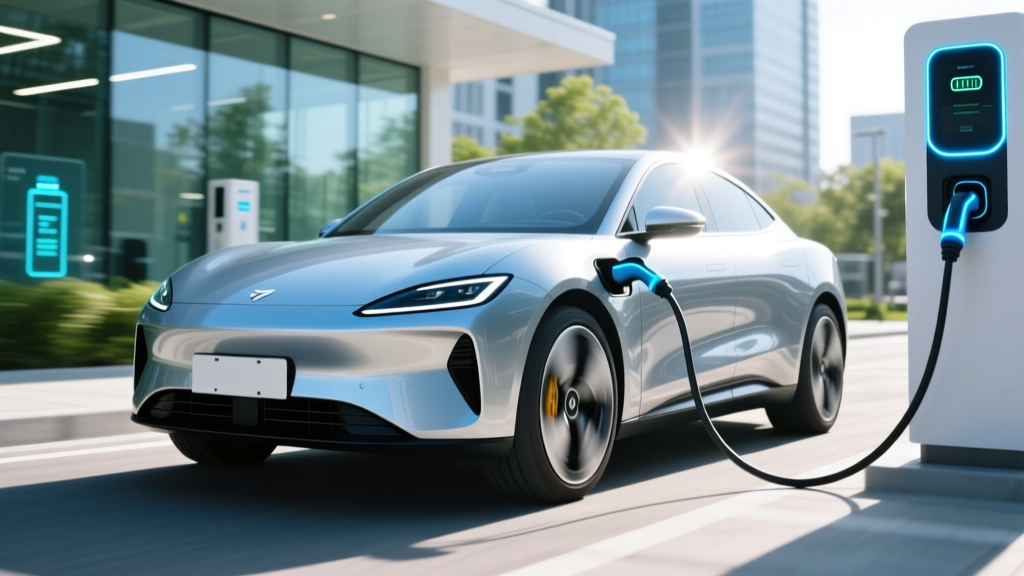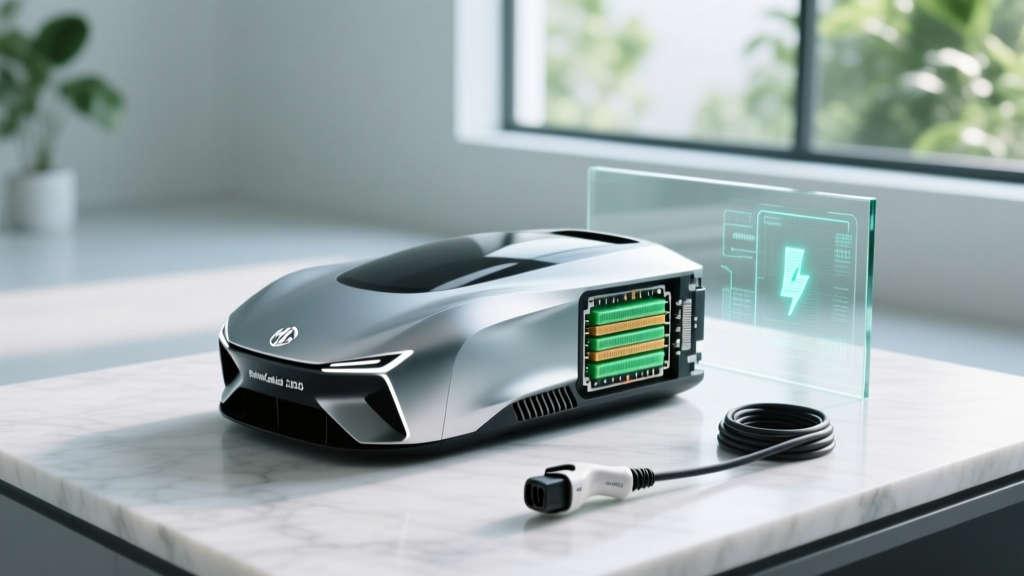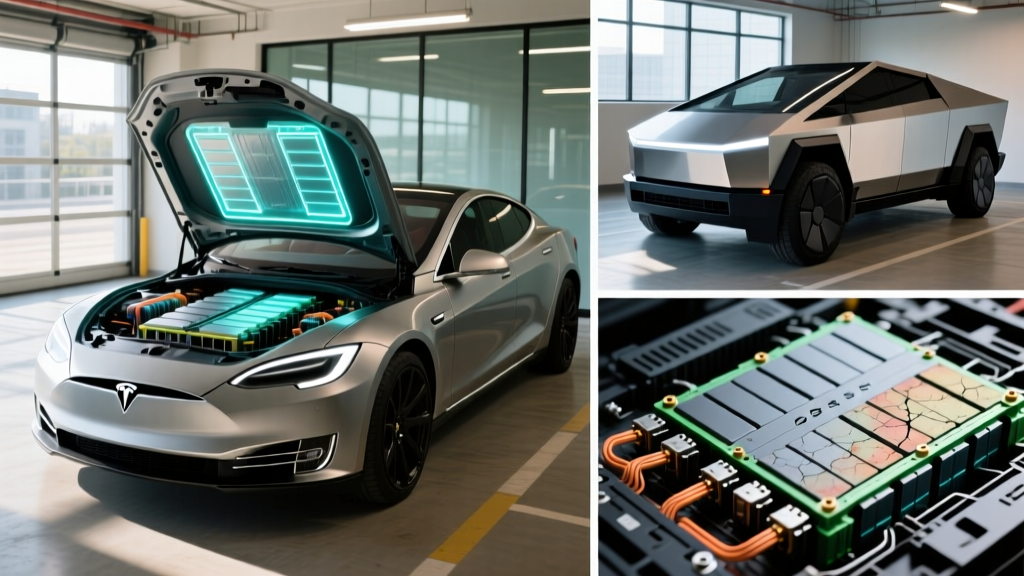
If your electric vehicle won't start, your first instinct might be the same as it would be with a gas car: grab a set of jumper cables. But EVs carry two batteries — a familiar 12-volt auxiliary battery and a massive high-voltage traction battery (typically 400V or 800V) — and the rules for each are very different. Understanding which one has failed, and what "jumping a battery" actually means in an EV context, is essential before you connect anything to your vehicle's electrical system.
This guide covers exactly what happens when an EV battery system fails, how to safely address a dead 12V auxiliary battery, and why the high-voltage traction pack is not something you jump, replace at home, or treat like a conventional car battery. We'll also dig into battery chemistry, degradation data, warranty coverage, replacement costs, and how to monitor and maximize your traction battery's lifespan.
The Two Batteries in Every EV: 12V Auxiliary vs. High-Voltage Traction
Every production EV sold in the US — from the Nissan LEAF to the Tesla Model Y to the Ford F-150 Lightning — contains two separate battery systems:
- 12V Auxiliary Battery: Powers the vehicle's computers, lighting, infotainment, door locks, and safety systems. It's a conventional lead-acid or increasingly a lithium-ion 12V battery, similar to what you'd find in a gas car.
- High-Voltage Traction Battery: The large lithium-ion pack (typically 50–130+ kWh of usable capacity) that powers the electric drive motors. This operates at 400V or 800V and is sealed, liquid-cooled, and managed by a sophisticated Battery Management System (BMS).
When an EV "won't start" or the screens stay dark, the culprit is almost always the 12V auxiliary battery — not the traction pack. The traction battery may be at 80% State of Charge (SoC) and perfectly healthy, but if the 12V battery is dead, the vehicle's contactors won't close and the high-voltage system won't energize.
Jumping the 12V Battery in an EV: What You Need to Know
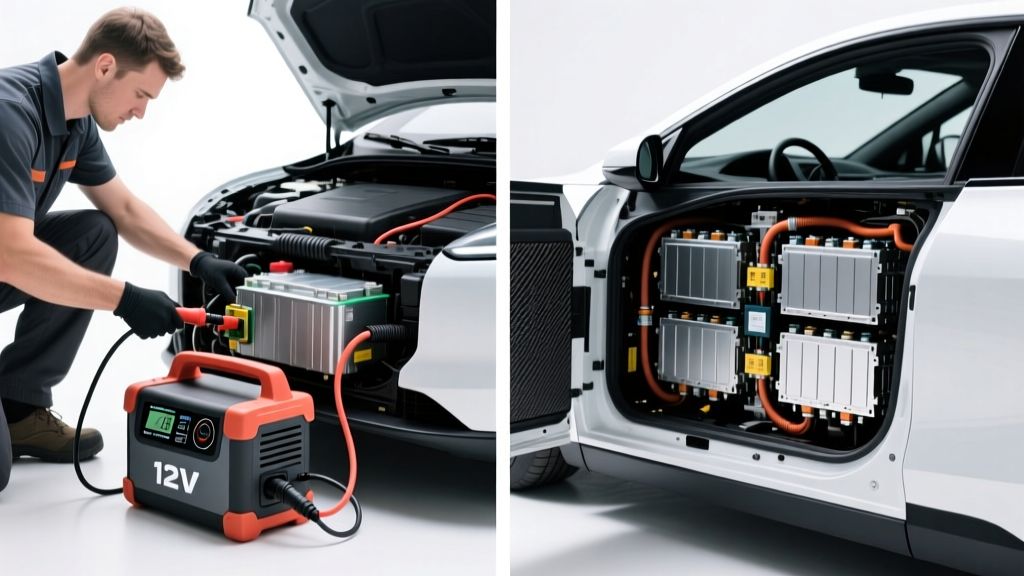
Yes, you can jump-start the 12V auxiliary battery in most EVs using a portable lithium jump-starter pack or jumper cables connected to a donor vehicle — but there are important caveats:
- Locate the correct terminals: Many EVs have designated 12V jump-start points under the hood (frunk area) rather than direct battery access. Consult your owner's manual for the exact location. For example, Tesla vehicles have specific jump-start terminal posts in the front trunk area.
- Use a low-amperage jump pack: Avoid high-amperage commercial jump starters designed for diesel trucks. A standard 400–600 amp lithium jump pack is sufficient for a 12V auxiliary battery.
- Never connect to the high-voltage system: The orange cabling in an EV is high-voltage. Do not touch, probe, or connect anything to orange cables or components.
- Let the DC-DC converter take over: Once the 12V battery has enough charge to boot the vehicle's computers and close the high-voltage contactors, the vehicle's DC-DC converter will begin charging the 12V battery from the traction pack — just like an alternator in a gas car.
Some newer EVs, including certain 2025–2026 models from Hyundai, Kia, and Tesla, are moving to lithium-ion 12V auxiliary batteries that are lighter, longer-lasting, and less prone to sudden failure than traditional lead-acid units. However, the jump-start procedure remains similar.
EV Traction Battery Chemistry: LFP vs. NMC vs. NCA
The high-voltage traction battery is the most expensive component in your EV, and its chemistry determines its energy density, longevity, cold-weather performance, and cost. Two dominant chemistries are used in 2026 production vehicles:
| Attribute | LFP (Lithium Iron Phosphate) | NMC / NCA (Nickel Manganese Cobalt / Nickel Cobalt Aluminum) |
|---|---|---|
| Energy Density | Lower (~160–180 Wh/kg cell-level) | Higher (~220–260 Wh/kg cell-level) |
| Cycle Life | 3,000–5,000+ cycles to 80% SoH | 1,000–2,000 cycles to 80% SoH |
| Cold-Weather Performance | More range loss in extreme cold (~35–40% at 20°F) | Better cold retention (~25–30% loss at 20°F) |
| Charging to 100% | Recommended regularly for BMS calibration | Best kept 20–80% for daily use; 100% for trips only |
| Cost | Lower per kWh (no cobalt or nickel) | Higher per kWh (commodity-sensitive) |
| Thermal Stability | Superior — lower risk of thermal runaway | Good but requires more active thermal management |
| Common Applications (2026) | Tesla Model 3/Y RWD, base Ford Mustang Mach-E, standard-range models | Long-range and performance trims, Hyundai Ioniq 5/6, BMW iX, Rivian |
Which is better? It depends on your use case. LFP is the pragmatic choice for daily commuters and high-mileage drivers who want maximum cycle life and don't need the last 30 miles of range. NMC/NCA is better for drivers who need maximum range per charge, frequently drive in cold climates, or tow. Neither chemistry is universally superior — the right choice aligns with your driving patterns and climate.
How Long Do EV Traction Batteries Actually Last?
The short answer: far longer than most buyers assume. The traction battery in a modern EV is designed to outlast the vehicle's economic life in most cases.
Real-world degradation data from multiple sources paints a clear picture:
- Tesla 2025 Impact Report: Model 3/Y batteries retain approximately 85% of original capacity after 200,000 miles. Vehicles in the fleet show an average degradation of roughly 12–15% at this mileage milestone.
- Geotab fleet data (2024–2025 aggregated): Across 10,000+ EVs monitored, average annual degradation was approximately 1.8% per year, meaning a typical EV retains ~82% SoH after 10 years.
- Recurrent Auto data: Vehicles with active liquid cooling (Tesla, Hyundai E-GMP, GM Ultium) show measurably slower degradation than passively cooled packs (older Nissan LEAF).
- LFP-specific data: Tesla Model 3 RWD (LFP) fleets show minimal degradation curves, with many vehicles above 100,000 miles still retaining 90%+ capacity.
Most traction batteries are not replaced during the vehicle's typical 12–15 year ownership life. Catastrophic failure (sudden, total loss) is rare. The more common scenario is gradual capacity loss that reduces range but doesn't render the vehicle undrivable.
Battery Warranty Coverage: What's Protected and for How Long
Federal law mandates that EV battery warranties cover a minimum of 8 years or 100,000 miles (whichever comes first) in most states, and 10 years or 150,000 miles in California Air Resources Board (CARB) states. Most manufacturers exceed these minimums.
| Vehicle | Warranty Period | Capacity Threshold | Notes |
|---|---|---|---|
| Tesla Model 3 RWD (LFP) | 8 yr / 100,000 mi | 70% retention | Long Range/Performance: 8 yr / 120,000 mi |
| Hyundai Ioniq 5 | 10 yr / 100,000 mi | 70% retention | Lifetime coverage for original owner (10yr/100k transferable) |
| Ford F-150 Lightning | 8 yr / 100,000 mi | 70% retention | Extended range pack same terms |
| Chevrolet Equinox EV | 8 yr / 100,000 mi | 60% retention | GM Ultium platform standard |
| BMW iX xDrive50 | 8 yr / 80,000 mi | 70% retention | BMW's mileage cap slightly lower |
| Rivian R1T / R1S | 8 yr / 175,000 mi | 70% retention | Industry-leading mileage cap |
What triggers a warranty claim? If your battery's State of Health (SoH) drops below the stated threshold (typically 70% of original capacity) within the warranty period, the manufacturer must repair or replace the pack at no cost. This is measured via the BMS and confirmed at a dealership or service center. Note that the warranty covers defects and abnormal degradation — not damage from accidents, flooding, or unauthorized modifications.
EV Battery Replacement Cost: What You'll Actually Pay
This is the question that causes the most anxiety among prospective EV buyers. Here's the reality with current 2026 pricing:
| Vehicle | Battery Capacity (usable) | Replacement Cost Range | Typical Need Timeline |
|---|---|---|---|
| Tesla Model 3 RWD (LFP) | ~57 kWh | $8,000 – $12,000 | Rarely needed; 300,000+ mi projected life |
| Hyundai Ioniq 5 (Long Range) | ~77.4 kWh | $12,000 – $18,000 | Rarely needed; 200,000+ mi projected |
| Ford F-150 Lightning (Extended) | ~131 kWh | $20,000 – $30,000 | Very rare; large pack = slower degradation |
| Chevrolet Bolt EV/EUV (older gen) | ~65 kWh | $9,000 – $14,000 | Recall replacements covered; out-of-warranty rare |
| BMW iX xDrive50 | ~105.2 kWh | $20,000 – $28,000 | Rarely needed within vehicle life |
| Rivian R1T (Large Pack) | ~128.9 kWh | $18,000 – $25,000 | Module-level repair may reduce cost |
Several important context points on replacement cost:
- Module-level repair: Many modern packs (GM Ultium, Hyundai E-GMP, Rivian) are designed with modular architectures. A service center can often replace individual modules rather than the entire pack, reducing cost to $2,000–$6,000 per module.
- Costs are declining: Battery pack prices have fallen from ~$1,200/kWh in 2010 to approximately $115–$130/kWh in 2025–2026, according to BloombergNEF. Replacement costs will continue to trend downward.
- Most packs outlive the car: The average age of a scrapped US vehicle is approximately 15 years. Given degradation rates of ~1.8%/year, a 15-year-old EV battery would retain roughly 73% of its original capacity — still well within usable territory.
- Third-party rebuilders are emerging: Independent EV shops are beginning to offer pack refurbishment at 40–60% of OEM replacement cost, though availability varies by region.
Factors That Accelerate Battery Degradation (and How to Avoid Them)
While modern BMS systems actively protect the pack, certain habits and conditions accelerate wear:
- ✅ Daily SoC limit: Set charge limit to 80% for NMC/NCA vehicles. LFP vehicles can (and should) charge to 100% regularly per manufacturer guidance.
- ✅ Minimize DC fast charging: Occasional road-trip fast charging is fine, but daily use of 150+ kW DC chargers accelerates degradation. Use Level 2 home charging as your primary method.
- ✅ Avoid extreme SoC storage: Don't leave the vehicle parked at 100% or below 10% SoC for extended periods (weeks). If storing, set to ~50% SoC.
- ✅ Precondition before fast charging: Use your vehicle's navigation-based preconditioning to warm the battery before arriving at a DC fast charger. This reduces stress and improves charge speed.
- ✅ Park in shade/garage in extreme heat: Sustained battery temperatures above 95°F (35°C) accelerate chemical aging. A garage or shaded spot matters in Arizona, Texas, and similar climates.
- ✅ Use scheduled charging: Set your vehicle to charge during cooler overnight hours rather than immediately after a hot day.
- ❌ Don't obsess over 1–2% degradation: BMS recalibration events can make SoH readings fluctuate. Look at trends over months, not individual readings.
The single most impactful factor? Heat combined with high State of Charge. A battery held at 100% SoC in 100°F ambient heat degrades measurably faster than one held at 60% SoC in moderate temperatures. Liquid-cooled packs (standard on virtually all 2026 EVs) mitigate this substantially, but physics still applies.
How to Monitor Your EV Battery's State of Health (SoH)
State of Health (SoH) is expressed as a percentage of the battery's current maximum capacity relative to its original capacity when new. A brand-new battery is at 100% SoH; a battery that can now hold only 77 kWh of its original 84 kWh is at approximately 91.7% SoH.
Methods for checking SoH:
- In-vehicle displays: Some manufacturers (BMW, Mercedes, Hyundai) provide a battery health indicator in the vehicle settings menu. Others (Tesla) do not expose SoH directly but display estimated range at full charge, which you can compare to the original EPA rating.
- OBD-II diagnostic tools: Third-party tools like OBDLink SX/MX+ paired with apps such as EV BATT or Car Scanner ELM OBD2 can read BMS data including SoH, cell voltages, and pack temperature. This is the most accurate owner-accessible method.
- Dealership diagnostic check: Service centers can pull a full battery health report. Request this during routine service visits, especially as the vehicle approaches the warranty mileage threshold.
- Third-party services: Companies like Recurrent offer battery health reports based on connected vehicle data, sometimes used in used-EV transactions to verify remaining capacity.
For used-EV buyers, checking SoH should be as routine as a compression test was for used gas cars. A vehicle at 60,000 miles showing 94% SoH has degraded normally and is a sound purchase; one showing 82% SoH at the same mileage may have a defective module or a history of abusive charging.
Emerging Battery Technology: Solid-State and Silicon Anodes
Next-generation battery technologies promise higher energy density, faster charging, and improved safety — but realistic timelines matter:
- Solid-state batteries: Companies including Toyota, Samsung SDI, and QuantumScape are developing solid-state cells that replace the liquid electrolyte with a solid material. Toyota has announced limited production in select models by 2027–2028, but broad commercial availability across multiple models is not expected before 2030. Promised benefits include 2–3x energy density improvement and 10-minute 10–80% charging. These are announced targets, not current production reality.
- Silicon anode batteries: Companies like Sila Nanotechnologies and Group14 are producing silicon-dominant anode materials that increase energy density by 20–40% compared to graphite anodes. These are beginning to appear in limited production applications (2025–2026) and are expected to scale through the late 2020s.
- Sodium-ion batteries: CATL and other manufacturers are producing sodium-ion cells for lower-cost, lower-energy-density applications. These may appear in entry-level EVs and urban commuter vehicles, offering reduced cost but shorter range.
For buyers shopping today, current LFP and NMC chemistries are mature, well-understood, and backed by extensive real-world data. Waiting for solid-state means waiting at least 3–5 years for meaningful availability, and initial pricing will be at a premium.
Frequently Asked Questions
Can I jump-start an EV the same way I jump a gas car?
You can jump-start the 12V auxiliary battery using similar methods (jumper cables or a portable jump pack), but you are only jump-starting the 12V system — not the high-voltage traction battery. Once the 12V system boots and the contactors close, the traction battery takes over propulsion and the DC-DC converter recharges the 12V battery. Never connect jumper cables to any high-voltage (orange) cabling.
How long do EV batteries last in years and miles?
Based on 2024–2026 fleet data, modern liquid-cooled EV batteries typically retain 80–85% of original capacity after 200,000 miles or 10–12 years. LFP chemistries often exceed this. Complete failure is rare; most packs remain functional well beyond 250,000 miles with reduced but usable range.
How much does it cost to replace an EV battery?
Full pack replacement costs range from approximately $8,000 for smaller packs (Tesla Model 3 RWD, ~57 kWh) to $25,000–$30,000 for large packs (F-150 Lightning Extended Range, ~131 kWh). However, most packs never need replacement during the vehicle's life. Module-level repairs, where available, cost $2,000–$6,000.
What does the EV battery warranty actually cover?
Federal minimum is 8 years / 100,000 miles (10/150,000 in CARB states). The warranty covers capacity loss below a stated threshold (typically 70% SoH) and manufacturing defects. It does not cover damage from accidents, improper modifications, or environmental events. Check your specific manufacturer's warranty terms, as coverage varies — Rivian offers 8yr/175,000mi, while Hyundai offers 10yr/100,000mi.
LFP or NMC — which battery chemistry should I choose?
Choose LFP if you want maximum cycle life (3,000–5,000+ cycles), lower cost, and primarily drive in moderate climates. Choose NMC/NCA if you need maximum range per charge, frequently drive in cold weather, or tow heavy loads. LFP vehicles should be charged to 100% regularly; NMC vehicles benefit from an 80% daily charge limit.
Sources: EPA Fuel Economy, IRS Clean Vehicle Credits, manufacturer warranty documentation.