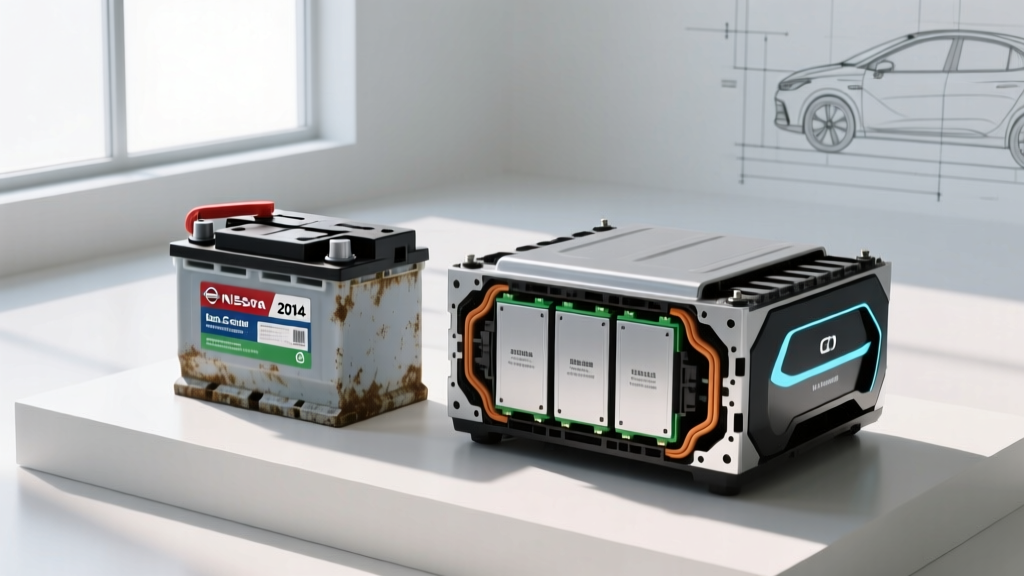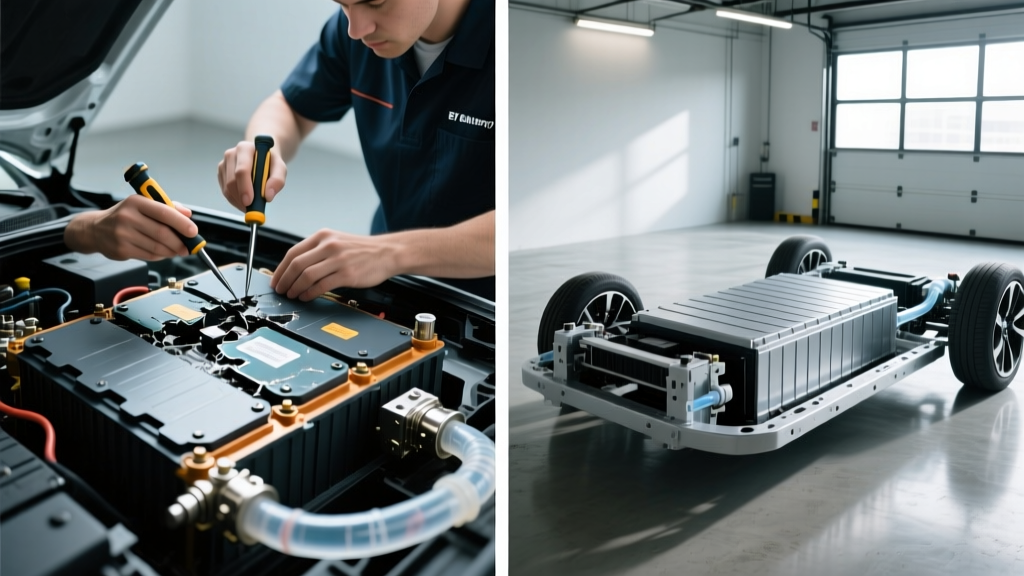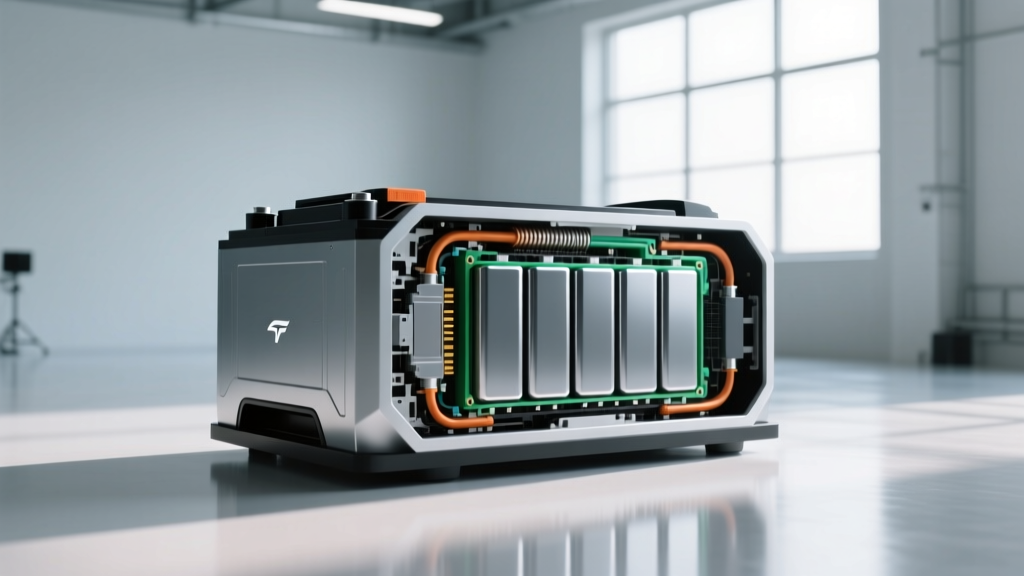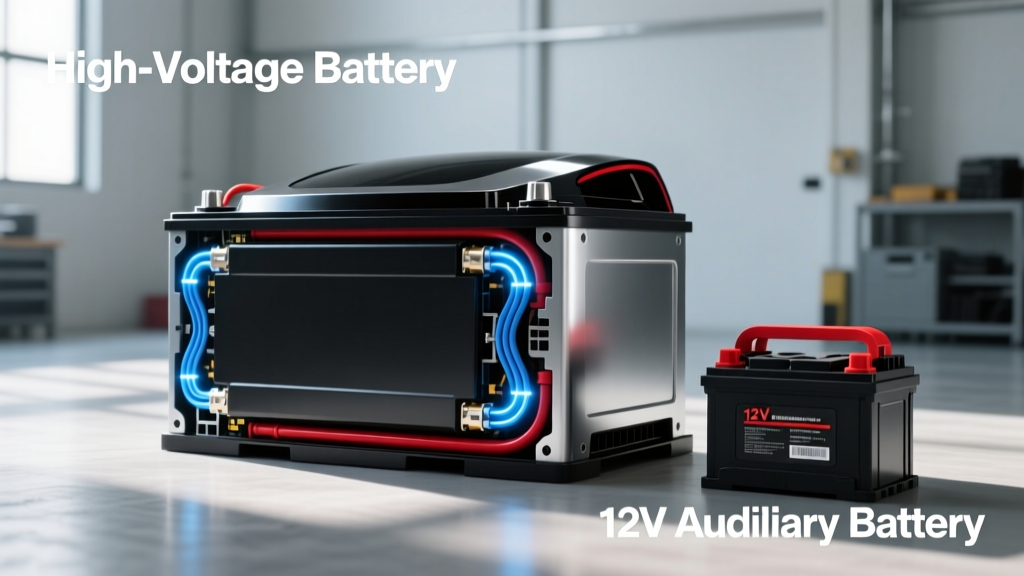
If you've ever searched for "jumper cables for battery" while standing next to your electric vehicle, you're not alone — but you may be about to make a very expensive mistake. EVs actually have two batteries: a conventional 12-volt auxiliary battery (often lead-acid or lithium-ion) that powers the computers, lights, and door locks, and a massive high-voltage traction battery (400V or 800V) that actually drives the wheels. Jumper cables are only relevant to the 12V side. Connecting them to the high-voltage pack is dangerous and potentially lethal.
This guide untangles the confusion and gives you a complete picture of EV battery technology in 2026 — from chemistry and degradation to warranty coverage, replacement costs, and the emerging solid-state horizon.
Why Jumper Cables Only Apply to the 12V Auxiliary Battery
Every EV sold in the U.S. — from the Tesla Model 3 to the Ford F-150 Lightning — carries a small 12V battery that wakes up the vehicle's computers, runs the infotainment system, and powers safety electronics. If this battery dies (usually from parasitic drain during long parking sessions or extreme cold), the car won't "start," even though the main traction pack may be 80% full.
Standard jumper cables or a portable lithium jump-starter can revive the 12V battery, just like on a gas car. However, you must never attempt to jump or externally charge the high-voltage traction battery. Those packs are sealed, liquid-cooled systems managed by the vehicle's Battery Management System (BMS). The proper way to recharge a depleted traction battery is through a Level 2 home charger or DC fast charger — period.
LFP vs. NMC/NCA: The Two Battery Chemistries Dominating 2026
The high-voltage traction battery is the most expensive component in any EV, and its chemistry dictates range, longevity, charging behavior, and cost. In 2026, two lithium-ion chemistries dominate the market:
- LFP (Lithium Iron Phosphate): Used in standard-range Tesla Model 3/Y, Ford Mustang Mach-E Select, BYD vehicles, and many entry-level EVs.
- NMC/NCA (Nickel Manganese Cobalt / Nickel Cobalt Aluminum): Found in long-range and performance variants from Hyundai, Kia, BMW, Rivian, and others.
| Attribute | LFP | NMC/NCA |
|---|---|---|
| Energy Density | ~160 Wh/kg (lower) | ~250–300 Wh/kg (higher) |
| Typical Cycle Life | 3,000–5,000 cycles | 1,500–2,500 cycles |
| Cold-Weather Performance | Moderate; greater range loss below 32°F | Better low-temp conductivity |
| Charging to 100% | Recommended periodically for BMS calibration | Best kept at 80–90% daily; 100% for trips only |
| Cobalt Content | Zero | Contains cobalt/nickel |
| Cost per kWh (pack-level) | ~$95–$110 | ~$120–$145 |
| Best For | Daily commuters, high-mileage fleets | Long-range road trippers, performance models |
Neither chemistry is universally "better." LFP wins on longevity and cost; NMC wins on energy density and cold-weather range. Your choice should match your driving pattern, not marketing hype.
How Long Do EV Batteries Actually Last?
The short answer: longer than most owners expect. According to data aggregated by fueleconomy.gov and long-term fleet studies, the average EV traction battery loses approximately 5–10% of its original capacity over the first 100,000 miles. Degradation is non-linear — steepest in the first 20,000–30,000 miles, then flattening into a slow, predictable decline.
- Year 1 / 15,000 mi: ~3–4% loss
- Year 3 / 45,000 mi: ~7–8% loss
- Year 5 / 75,000 mi: ~9–11% loss
- Year 8 / 120,000 mi: ~12–15% loss
- Year 10 / 150,000 mi: ~15–18% loss
Real-world data from Recurrent Auto's 2025 fleet report (covering over 15,000 EVs) found that only 1.5% of vehicles required battery replacement before 150,000 miles — and most of those were covered under warranty. The vast majority of EV batteries will outlast the vehicle's body and interior.
Battery Warranty: What's Actually Covered?
Federal law mandates that EV batteries carry a minimum warranty of 8 years / 100,000 miles. In California Air Resources Board (CARB) states, that extends to 10 years / 150,000 miles. Most manufacturers exceed these minimums.
| Manufacturer | Warranty Term | Capacity Retention Threshold |
|---|---|---|
| Tesla (Model 3/Y RWD – LFP) | 8 yr / 100,000 mi | 70% |
| Tesla (Long Range/Performance) | 8 yr / 120,000 mi | 70% |
| Hyundai / Kia | 10 yr / 100,000 mi | 70% |
| Ford (Mustang Mach-E, F-150 Lightning) | 8 yr / 100,000 mi | 70% |
| BMW (i4, iX) | 8 yr / 100,000 mi | 70% |
| Rivian (R1T, R1S) | 8 yr / 175,000 mi | 70% |
| Chevrolet (Equinox EV, Blazer EV) | 8 yr / 100,000 mi | 60% |
The capacity threshold matters: if your 80 kWh pack drops below 56 kWh (70% of original) within the warranty period, the manufacturer must repair or replace it at no cost. Normal degradation above that threshold is considered "within spec."
EV Battery Replacement Cost: The Honest Numbers
Battery replacement is rare but not free. Costs depend on pack size, chemistry, and labor. Here's what owners and insurers are seeing in 2026:
| Vehicle / Pack Size | Chemistry | Replacement Cost (Parts + Labor) | Typical Replacement Trigger |
|---|---|---|---|
| Tesla Model 3 RWD (57.5 kWh) | LFP | $10,000–$13,000 | Physical damage; rare degradation |
| Tesla Model Y LR (82 kWh) | NMC | $14,000–$18,000 | Collision damage; out-of-warranty failure |
| Hyundai Ioniq 5 (77.4 kWh) | NMC | $13,000–$16,500 | Module imbalance; coolant intrusion |
| Ford F-150 Lightning Ext. Range (131 kWh) | NMC | $22,000–$28,000 | Collision; extreme degradation (rare) |
| Chevrolet Bolt EV (65 kWh) | NMC | $9,000–$12,000 | Recall-related replacement (largely resolved) |
| Rivian R1T Large Pack (149 kWh) | NMC | $24,000–$30,000 | Physical damage; out-of-warranty |
Context matters: the average age of a vehicle scrapped in the U.S. is 15.6 years (per IHS Markit/S&P Global Mobility). Most EV batteries will never need replacement during original ownership. When they do, it's almost always due to collision damage (covered by insurance) or a manufacturing defect (covered by warranty).
Factors That Accelerate (or Preserve) Battery Life
Battery degradation is influenced by how you charge, drive, and store your EV. Here's what the data shows:
- Daily charge limit: Set to 80% for NMC; 100% is fine for LFP (and recommended monthly for calibration).
- DC fast charging: Occasional use is fine; daily 350 kW sessions accelerate degradation by ~2–4% over 5 years vs. Level 2 charging.
- Temperature: Store and charge in moderate temps when possible. Precondition the battery before fast charging in cold weather.
- Avoid deep discharge: Don't routinely drain below 10%. If storing for weeks, leave at ~50% SoC.
- Use scheduled charging: Charge during off-peak hours and let the BMS manage thermal conditioning.
- Keep firmware updated: OTA updates often refine BMS algorithms for better longevity.
How to Check Your Battery's State of Health (SoH)
State of Health (SoH) is the percentage of your battery's original capacity that remains usable. Monitoring it is easier than most owners realize:
- In-vehicle displays: Tesla, Hyundai, Kia, and BMW now show SoH or estimated range vs. original in the service menu or app.
- OBD-II dongles + apps: Tools like LeafSpy (Nissan), Scan My Tesla, or OBDeleven can read BMS data on most EVs.
- Third-party services: Recurrent Auto offers free battery health reports using telematics data, comparing your pack against thousands of identical vehicles.
- Dealership diagnostics: Any authorized service center can pull a full SoH report — useful before buying a used EV.
If your SoH drops below 80% while still under warranty, schedule a diagnostic visit. Most manufacturers will address module-level imbalances before a full pack replacement is necessary.
What's Next: Solid-State and Silicon-Anode Batteries
Two emerging technologies promise to reshape EV batteries — but neither is commercially available in production vehicles as of 2026:
- Solid-state batteries: Replace the liquid electrolyte with a solid ceramic or polymer, potentially doubling energy density and enabling 10-minute fast charges. Toyota has announced limited production in select 2027–2028 models (preliminary). QuantumScape and Samsung SDI are in advanced testing. Realistic mass-market availability: 2029–2031.
- Silicon-anode batteries: Replace graphite anodes with silicon, boosting capacity by 20–40%. Sila Nanotechnologies and Group14 are supplying early production cells for 2026–2027 luxury models (announced). Broader adoption expected by 2028.
These technologies will eventually trickle down to mainstream EVs, but current LFP and NMC chemistries remain the practical choice for buyers today.
FAQ: EV Battery Questions Answered
Can I use jumper cables on an EV's main battery?
No. Jumper cables are only for the 12V auxiliary battery. The high-voltage traction battery (400–800V) must only be charged via a proper EV charger (Level 1, Level 2, or DC fast). Attempting to jump the traction battery is extremely dangerous.
How long do EV batteries last in years and miles?
Most EV traction batteries retain 80–85% of original capacity at 150,000 miles / 10 years. LFP chemistries often outperform this. Full failure before 200,000 miles is statistically rare (under 2% per fleet data).
How much does it cost to replace an EV battery?
Replacement costs range from ~$9,000 (small packs like the Bolt EV) to $28,000+ (large packs like the F-150 Lightning or Rivian R1T). However, most replacements are covered by warranty or insurance, and the majority of EV batteries never need replacement during original ownership.
What does the EV battery warranty cover?
Federal minimum is 8 years / 100,000 miles (10 yr / 150,000 mi in CARB states). The warranty guarantees the battery will retain at least 60–70% of original capacity (varies by manufacturer). Defects, module failures, and excessive degradation are covered; damage from accidents or abuse is not.
LFP vs. NMC — which battery chemistry should I choose?
Choose LFP if you prioritize longevity, lower cost, and don't need maximum range (ideal for daily commuting under 250 miles). Choose NMC if you need 300+ miles of range, better cold-weather performance, or faster charging on road trips. Both chemistries will reliably last the life of the vehicle with proper care.
Does frequent DC fast charging damage the battery?
Occasional DC fast charging has minimal impact. Daily use of 350 kW chargers can accelerate degradation by 2–4% over 5 years compared to Level 2 home charging. Modern BMS systems actively manage heat and taper charge rates to protect the pack.
How do I check my EV battery health before buying used?
Request a State of Health (SoH) report from the seller or dealership. Use an OBD-II reader with EV-compatible software, or use a service like Recurrent Auto. Compare the current estimated range against the original EPA rating — a drop of more than 15% at under 80,000 miles warrants a professional inspection.
For official battery warranty details and federal EV tax credit eligibility (IRS §30D), always consult irs.gov and your manufacturer's spec sheet. Battery technology evolves rapidly, but the fundamentals of chemistry, care, and cost remain remarkably consistent across today's EV lineup.