Johnson Controls Batteries and the EV Landscape
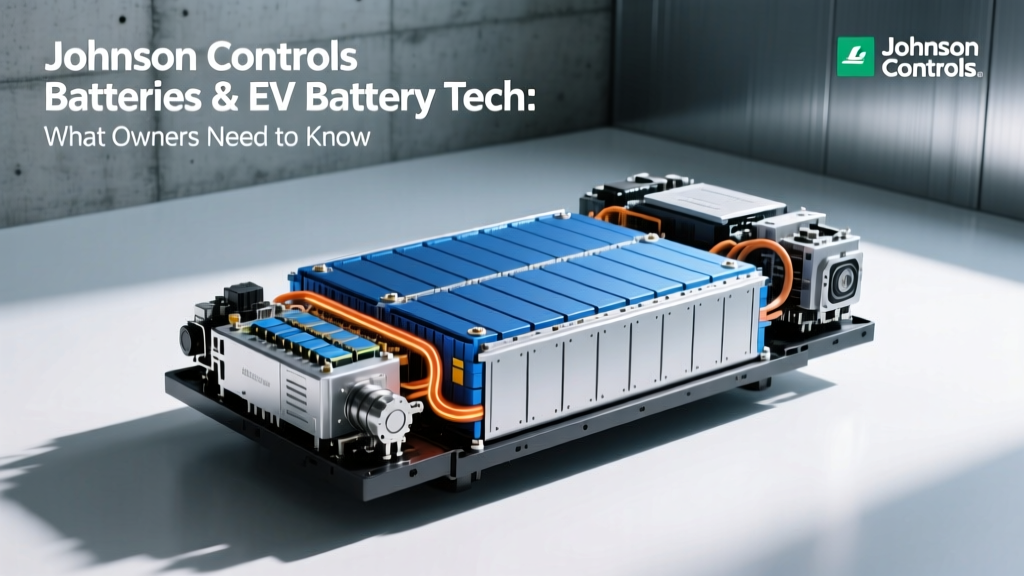
When EV shoppers search for "Johnson Controls batteries," they are usually thinking about one of two things: the company's long history supplying 12V auxiliary batteries for vehicles (including many EVs), or the broader question of who actually makes the high-voltage traction batteries that power electric cars. Johnson Controls — now operating its battery division under the Clarios brand since 2019 — remains a major player in 12V automotive batteries and low-voltage energy storage. But the high-voltage lithium-ion packs in today's EVs come from a different set of manufacturers: CATL, LG Energy Solution, Panasonic, SK On, Samsung SDI, and BYD, among others.
This guide untangles the Johnson Controls name from EV traction battery technology, then delivers the data EV owners and buyers actually need — chemistry trade-offs, real degradation numbers, warranty coverage, replacement costs, and how to maximize the life of a pack that will likely outlast the car itself.
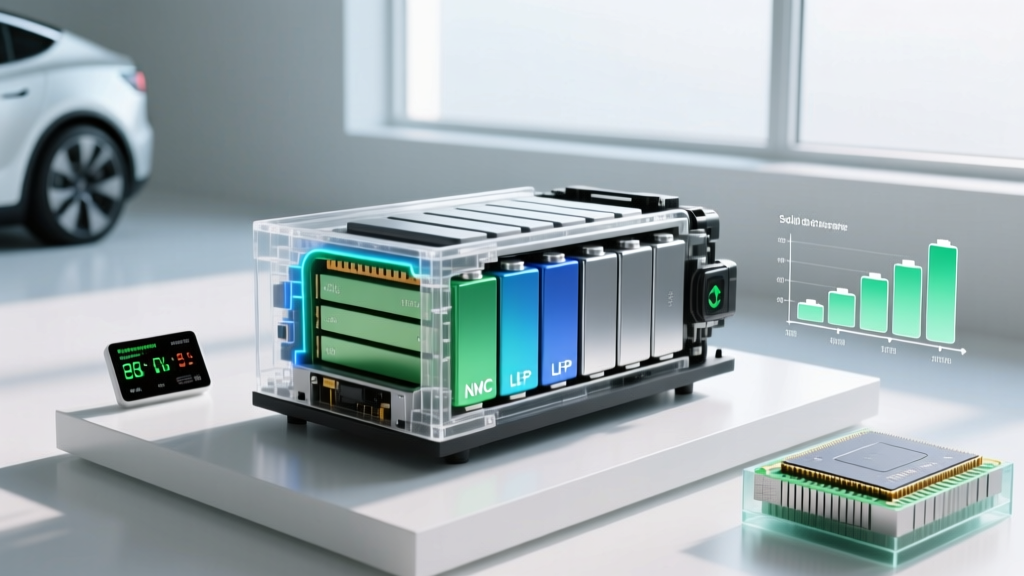
LFP vs NMC vs NCA: EV Battery Chemistry Explained
The two dominant lithium-ion chemistries in 2026 EVs are LFP (lithium iron phosphate) and NMC/NCA (nickel manganese cobalt / nickel cobalt aluminum). Each has distinct trade-offs that affect range, longevity, cost, and cold-weather behavior.
| Attribute | LFP (Lithium Iron Phosphate) | NMC / NCA (Nickel-Based) |
|---|---|---|
| Energy Density | ~160–180 Wh/kg (lower) | ~220–300 Wh/kg (higher) |
| Cycle Life | 3,000–5,000+ cycles to 80% SoH | 1,000–2,000 cycles to 80% SoH |
| Cold Performance | Weaker below 32°F; ~25–35% range loss in deep cold | Better cold tolerance; ~15–25% range loss |
| Cost per kWh | ~$80–100/kWh (cell level, 2026) | ~$110–140/kWh (cell level, 2026) |
| Thermal Stability | Excellent — inherently more stable | Good — requires more active thermal management |
| Typical SoC Recommendation | Can charge to 100% regularly | Best kept 20–80% for daily use |
| Notable 2026 Vehicles | Tesla Model 3/Y RWD, Ford Mustang Mach-E Select (LFP option), BYD models | Hyundai Ioniq 5/6, Kia EV6/EV9, Tesla Long Range, Rivian R1T/R1S |
Which is better? For urban commuters with home charging who rarely face sub-freezing winters, LFP offers longer cycle life and lower cost — a compelling match. For drivers who need maximum range per charge, tow frequently, or live in cold climates, NMC/NCA's higher energy density and better cold performance justify the premium. Neither chemistry is universally superior; the right choice depends on driving patterns and climate.
How Long Do EV Batteries Last? Degradation Data
The most persistent EV fear is premature battery failure. The data tells a different story. Modern lithium-ion traction batteries are engineered to last the usable life of the vehicle — typically 150,000 to 200,000+ miles before capacity drops below 70–80% of original.
- Tesla Model 3/Y (NMC, 2020–2024): Fleet data aggregated by Recurrent Auto shows median ~12% capacity loss at 100,000 miles, with most packs retaining 85–90% State of Health (SoH).
- Chevrolet Bolt EV/EUV (NMC, 2017–2023): After early recall-replacement campaigns for manufacturing defects, remaining packs show ~8–10% loss at 80,000 miles.
- Hyundai Ioniq 5 (NMC, 2022–2025): Early fleet data indicates ~5–7% loss at 50,000 miles with typical Level 2 home charging.
- Tesla Model 3 RWD (LFP, 2022–2025): LFP packs show slower degradation curves — approximately 5–8% loss at 80,000 miles, with the curve flattening significantly after initial break-in.
Sources: Recurrent Auto, owner forums, manufacturer service bulletins.
Capacity loss is non-linear. Most packs lose 2–5% in the first year or 10,000–20,000 miles (the "break-in" drop), then degradation slows to roughly 1–2% per year under normal conditions. A 2026 EV with an 80 kWh pack and 2% annual loss will still hold ~72 kWh after five years — enough to deliver 85–90% of its original EPA-rated range.
What Does the EV Battery Warranty Cover?
Federal regulation mandates a minimum 8-year / 100,000-mile warranty on EV traction batteries for vehicles sold in the United States. California Air Resources Board (CARB) states extend this to 10 years / 150,000 miles. Most manufacturers meet or exceed these minimums.
| Manufacturer | Warranty Period | Capacity Retention Threshold | Notes |
|---|---|---|---|
| Tesla | 8 yr / 120,000 mi (Model 3/Y LR); 8 yr / 100,000 mi (RWD) | 70% minimum | Transferable to subsequent owners |
| Hyundai / Kia | 10 yr / 100,000 mi | 70% minimum | Among the longest coverage periods |
| Ford | 8 yr / 100,000 mi | 70% minimum | Covers battery and electric drive components |
| GM (Chevrolet, Cadillac) | 8 yr / 100,000 mi | 70% minimum (60% for Bolt-era packs under specific conditions) | Ultium platform packs included |
| Rivian | 8 yr / 175,000 mi (Max pack) | 70% minimum | Higher mileage threshold for larger packs |
The warranty threshold matters: a pack that degrades from 100% to 72% over eight years is functioning within warranty spec. Manufacturers will replace or repair the battery only if measured capacity falls below the stated threshold (typically 70%) during the warranty period. This is a defect-and-excessive-degradation warranty, not a guarantee of zero loss.
EV Battery Replacement Cost: What to Expect
Full traction battery replacement remains rare for vehicles under 150,000 miles, but it is the single largest potential repair cost in EV ownership. Prices have declined steadily as cell costs fall, but a full pack swap is still a major expense.
| Vehicle / Pack Size | Estimated Replacement Cost (2026) | When Typically Needed |
|---|---|---|
| Tesla Model 3 RWD (60 kWh, LFP) | $8,000–$12,000 | Rarely before 200,000+ mi |
| Hyundai Ioniq 5 (77.4 kWh, NMC) | $10,000–$15,000 | Rarely before 180,000+ mi |
| Ford F-150 Lightning Ext. Range (131 kWh, NMC) | $18,000–$25,000 | Rarely before 150,000+ mi |
| Chevrolet Equinox EV (85 kWh, NMC) | $10,000–$14,000 | Rarely before 180,000+ mi |
| Rivian R1T Max Pack (149 kWh, NMC) | $20,000–$28,000 | Rarely before 175,000+ mi |
Two important nuances: First, module-level repair is increasingly possible. Many packs are composed of 8–16 individual modules; a single degraded or faulty module can sometimes be replaced for $1,500–$4,000 rather than swapping the entire pack. Second, by the time a 2026 EV actually needs a full replacement (likely 2035+), refurbished packs and third-party options will probably be available at significantly lower cost.
Factors That Affect EV Battery Lifespan
Battery degradation is driven by chemistry, temperature, and usage patterns. Understanding these factors lets owners slow the clock considerably.
- Limit DC fast charging to road trips. Frequent use of 150+ kW DC fast charging accelerates degradation. Research from the Idaho National Laboratory found that packs charged primarily via DCFC showed ~2–4% additional capacity loss over 50,000 miles compared to Level 2-only charging. Use Level 2 (7–11 kW) at home for daily needs.
- Avoid extreme State of Charge. For NMC/NCA packs, keep daily charging between 20–80%. LFP packs tolerate 100% better and Tesla recommends periodic 100% charges for LFP calibration. Never leave any pack at 100% SoC for extended periods (days) in hot weather.
- Precondition before fast charging. Most 2026 EVs automatically precondition the battery when you navigate to a DC fast charger. This warms the cells to the optimal ~95–104°F (35–40°C) temperature window, improving charge speed and reducing lithium plating risk. If your vehicle doesn't auto-precondition, allow 10–15 minutes of driving before plugging into a fast charger in cold weather.
- Minimize deep discharges. Regularly running the battery below 10% stresses cells. Charge when you reach 15–20% rather than waiting for the low-battery warning.
- Park in shade or a garage when possible. Sustained high battery temperatures (above 95°F ambient, which can mean 120°F+ inside a parked car) accelerate calendar degradation. In hot climates, a garage or shaded spot measurably extends pack life.
- Use scheduled charging. Set your vehicle to finish charging just before you leave, rather than sitting at full charge for hours. Most 2026 EVs offer this feature in the app or infotainment system.
How to Monitor Your EV Battery Health (SoH)
State of Health (SoH) is the percentage of original capacity your battery currently holds. A new pack is 100% SoH; a pack that held 80 kWh and now holds 72 kWh is at 90% SoH. Here is how to check it:
- In-vehicle displays: Some 2026 models (notably Tesla, Hyundai/Kia, and BMW) include a battery health percentage in the settings or service menu. Tesla's "Battery Health" test in the service menu runs a brief diagnostic and reports estimated SoH.
- OBD-II dongles and apps: Third-party tools like OBDeleven, Leaf Spy (Nissan), or Scan My Tesla can read the Battery Management System (BMS) directly and report SoH, cell voltage variance, and pack temperature. These cost $20–$60 for the hardware.
- Dealer diagnostic: Any authorized service center can run a full battery health report. Request this during routine service or before purchasing a used EV.
- Manual calculation: Charge to 100%, note the displayed range, and compare to the original EPA-rated range. A Model 3 Long Range that originally showed 330 miles at 100% and now shows 297 miles is at approximately 90% SoH. This method is approximate (the BMS estimate can drift) but gives a useful ballpark.
For used-EV buyers, a battery health report should be as standard as a vehicle history report. Request one before purchase, and factor SoH into the price negotiation — a pack at 85% SoH on a 5-year-old vehicle is normal and healthy, not a red flag.
Emerging Battery Tech: Solid-State and Silicon Anodes
Next-generation battery technologies are advancing, but realistic timelines matter for purchase decisions today.
Solid-state batteries replace the liquid electrolyte with a solid material, promising higher energy density (potentially 400–500 Wh/kg at the cell level), faster charging, and improved safety. Toyota has announced a solid-state EV prototype targeting 2027–2028 production, and Samsung SDI has begun sample production. However, manufacturing scale-up remains the major hurdle. Industry consensus places meaningful solid-state EV availability in the 2029–2032 window for premium models, with mainstream adoption likely post-2032.
Silicon-dominant anodes are closer to market. Companies like Sila Nanotechnologies and Group14 Technologies are supplying silicon-carbon anode materials that boost energy density by 15–25% compared to graphite. The 2026 Mercedes-Benz G-Class EV (announced) uses a silicon-anode battery from Sila. Expect this technology to proliferate through 2027–2028 model-year vehicles as an incremental improvement rather than a revolution.
Sodium-ion batteries are entering the market at the budget end. CATL began shipping sodium-ion packs in Chinese-market EVs in 2024–2025, with energy density around 140–160 Wh/kg. These offer lower cost and excellent cold performance but less range per kilogram, making them suited for affordable city EVs rather than long-range vehicles. US-market availability remains uncertain for 2026.
The practical takeaway: today's lithium-ion chemistries (LFP and NMC) are mature, well-understood, and backed by robust warranties. Waiting for solid-state means waiting at least 3–5 years for limited availability at premium prices. Current EVs are not a dead-end purchase.
Frequently Asked Questions
Are Johnson Controls batteries used in electric vehicles?
Johnson Controls (now Clarios) primarily supplies 12V auxiliary batteries for vehicles, including many EVs. The high-voltage traction battery that propels an EV is made by dedicated lithium-ion cell manufacturers such as CATL, LG Energy Solution, Panasonic, SK On, or BYD — not by Johnson Controls. If your EV's 12V battery needs replacement, a Clarios/Johnson Controls unit may be the correct part, but this is a separate system from the main EV battery.
How long do EV batteries last in years and miles?
Most modern EV traction batteries are designed to last 150,000–200,000+ miles or 12–15 years before degrading below 70–80% of original capacity. Fleet data from Recurrent Auto shows median degradation of 10–12% at 100,000 miles for NMC packs and 5–8% for LFP packs. Many packs will outlast the vehicle's body, interior, and suspension components.
How much does it cost to replace an EV battery in 2026?
Full pack replacement costs range from approximately $8,000 for a smaller LFP pack (e.g., Tesla Model 3 RWD, ~60 kWh) to $25,000+ for a large NMC pack (e.g., Ford F-150 Lightning Extended Range, 131 kWh). However, full replacement before 150,000 miles is uncommon, and module-level repair ($1,500–$4,000) is increasingly an option. Most owners will sell or trade the vehicle before needing a replacement.
Does the EV battery warranty cover normal degradation?
EV battery warranties cover excessive degradation — specifically, capacity loss below a stated threshold (typically 70% of original capacity) within the warranty period (usually 8 years / 100,000 miles). Normal degradation of 10–15% over that period is expected and not warrantable. The warranty protects against defects and premature failure, not the natural aging of lithium-ion cells.
LFP or NMC — which battery should I choose?
Choose LFP if: you charge at home daily, drive mostly in moderate climates, want maximum cycle life, and don't need the absolute longest single-charge range. Choose NMC/NCA if: you need 300+ miles of EPA range, regularly drive in sub-freezing temperatures, tow heavy loads, or take frequent road trips where maximum range between charges matters. Both chemistries are proven and reliable — the right choice depends on your driving profile.
Can I check my EV battery health myself?
Yes. Many 2026 EVs include a battery health readout in the vehicle settings. Alternatively, an OBD-II adapter ($20–$60) paired with apps like Scan My Tesla or Leaf Spy can read State of Health directly from the Battery Management System. You can also approximate SoH by comparing your 100% charge range display to the original EPA-rated range. For a definitive report, request a battery diagnostic from your dealer during service.
Sources: EPA fueleconomy.gov for vehicle range data; Recurrent Auto for fleet degradation studies; manufacturer warranty documentation (Tesla, Hyundai, Ford, GM, Rivian). Battery cost estimates based on BloombergNEF cell-price surveys and industry service-bulletin data. Tax credit and incentive rules per IRS §30D — consult a tax professional for eligibility.