Johnson Controls Battery Brands: Where They Fit in the EV Landscape
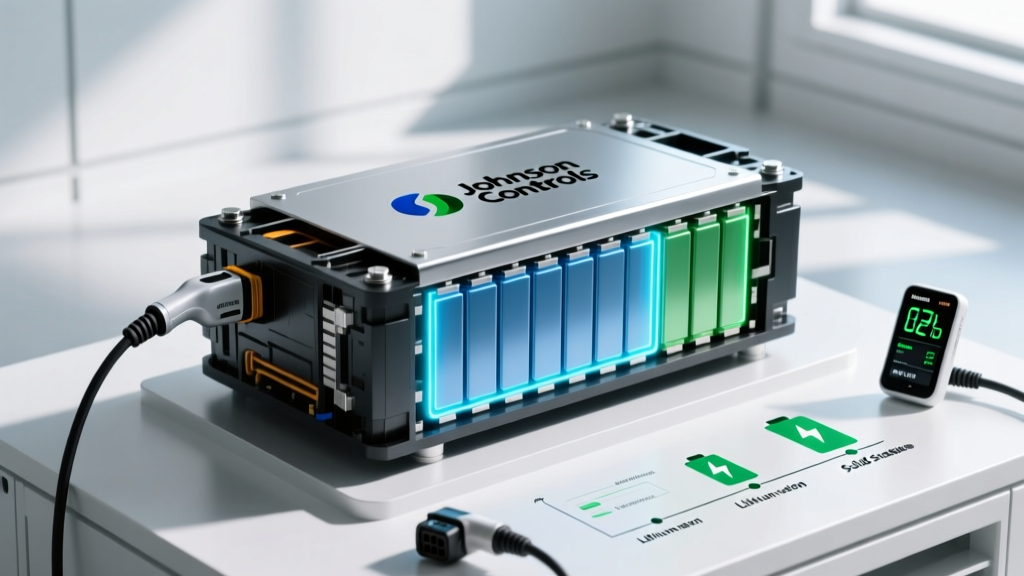
Johnson Controls has long been a household name in automotive batteries, primarily through its Optima and Continental brand lines, as well as its role as an OEM supplier for 12V lead-acid and AGM starter batteries. However, when EV shoppers search for "Johnson Controls battery brands," they're often conflating two very different products: the 12V auxiliary battery that powers electronics and the high-voltage traction battery that actually propels the vehicle. This guide clarifies that distinction and delivers a comprehensive look at EV traction battery technology — the chemistry, degradation, cost, and care practices that determine your real-world ownership experience.
Johnson Controls' core expertise remains in 12V auxiliary batteries (including AGM and lithium-ion 12V replacements for EVs), not the large lithium-ion traction packs made by companies like CATL, LG Energy Solution, Panasonic, SK On, and BYD. Understanding this distinction matters because the two battery systems have entirely different lifespans, costs, and maintenance requirements.
LFP vs NMC: The Chemistry Decision That Shapes Your EV
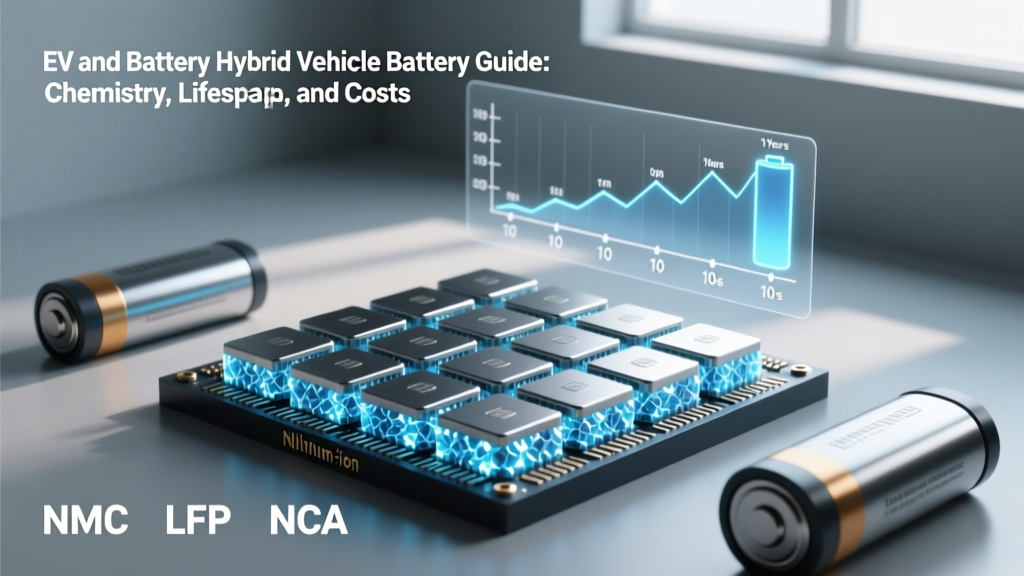
Modern EV traction batteries predominantly use one of two lithium-ion chemistries: Lithium Iron Phosphate (LFP) or Nickel Manganese Cobalt (NMC/NCA). Each carries distinct trade-offs that affect range, longevity, charging behavior, and cost.
| Attribute | LFP (Lithium Iron Phosphate) | NMC/NCA (Nickel-based) |
|---|---|---|
| Energy Density | Lower (~160 Wh/kg cell-level) | Higher (~250-300 Wh/kg cell-level) |
| Cycle Life | 3,000-5,000+ cycles | 1,000-2,000 cycles typical |
| Cost per kWh | Lower (no cobalt/nickel) | Higher (commodity-sensitive) |
| Cold-Weather Performance | Weaker below 32°F; slower charging | Better low-temp conductivity |
| Thermal Stability | Excellent; lower runaway risk | Good but requires more thermal management |
| Recommended SoC Range | Can charge to 100% regularly | Best kept 20-80% for daily use |
| Common Applications | Tesla Model 3/Y RWD, BYD, Ford Mustang Mach-E Select (LFP trims) | Long-range/performance trims, Hyundai Ioniq 5/6, VW ID.4, Rivian |
Which is better? There's no universal winner. LFP excels in cycle life and cost — ideal for daily commuting and fleet use. NMC/NCA delivers more range per pound, making it better for long-range models and cold climates. Tesla offers both chemistries across its lineup, and BYD's Blade Battery (LFP) has demonstrated exceptional puncture safety in independent testing.
How Long Do EV Batteries Actually Last?
The most common EV anxiety centers on battery lifespan. Real-world data from millions of vehicles on the road tells a reassuring story: most EV traction batteries outlast the cars they power.
Typical Degradation Curve (Real-World Data)
- Year 1-2: ~2-5% capacity loss (initial "break-in" degradation)
- Year 3-5: ~1-2% per year (linear slow-degradation phase)
- Year 5-8: ~1-2% per year continued
- 100,000 miles: Most packs retain 88-94% of original capacity
- 200,000 miles: Typically 80-88% retention
- 150,000+ miles: Tesla's 2024 Impact Report showed fleet data indicating ~88% retention at 200,000 miles for Model 3/Y packs
Sources: fueleconomy.gov, Geotab fleet studies, Tesla Impact Reports, Recurrent Auto battery health data.
Degradation is not linear. You'll see the steepest drop in the first year or two, then the curve flattens significantly. A 2026-model Hyundai Ioniq 5 with its 77.4 kWh NMC pack, for instance, is projected to retain roughly 90% capacity at 100,000 miles under normal use. LFP packs from Tesla and BYD show even slower fade due to their superior cycle-life characteristics.
What Does the EV Battery Warranty Cover?
Federal regulations in the United States mandate a minimum battery warranty of 8 years or 100,000 miles (whichever comes first) for emissions-related components, and most manufacturers align their EV battery warranties to this standard or exceed it. California Air Resources Board (CARB) states require 10 years/150,000 miles.
| Manufacturer | Warranty Period | Capacity Retention Threshold |
|---|---|---|
| Tesla (Model 3/Y RWD — LFP) | 8 yr / 100,000 mi | 70% minimum |
| Tesla (Model 3/Y LR/Perf — NMC) | 8 yr / 120,000 mi | 70% minimum |
| Hyundai/Kia | 10 yr / 100,000 mi | 70% minimum |
| Ford (Mustang Mach-E, F-150 Lightning) | 8 yr / 100,000 mi | 70% minimum |
| General Motors (Ultium platform) | 8 yr / 100,000 mi | 70% minimum (some models 60%) |
| Volkswagen (ID.4) | 8 yr / 100,000 mi | 70% minimum |
| BMW | 8 yr / 100,000 mi | 70% minimum |
| Rivian | 8 yr / 175,000 mi | 70% minimum |
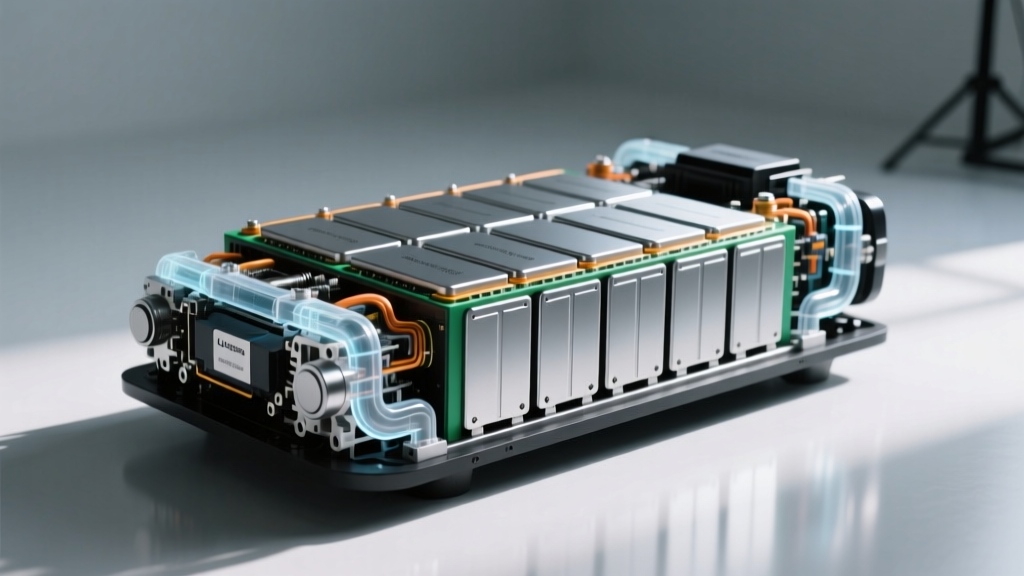
What triggers a warranty claim? If your battery's State of Health (SoH) drops below the threshold — typically 70% of original capacity — within the warranty window, the manufacturer will repair or replace modules to restore capacity above that level. This doesn't mean a full new pack in every case; most repairs involve replacing degraded modules (a pack contains 4-20+ modules depending on design).
The warranty covers defects and abnormal degradation. It does not cover damage from collisions, flooding, improper modifications, or use outside manufacturer specifications.
EV Battery Replacement Cost: What to Expect
Out-of-warranty battery replacement is the scenario that generates the most fear — often fueled by $20,000+ headlines. Here's the grounded reality for 2026:
| Vehicle / Battery Size | Approximate Replacement Cost (Parts + Labor) | Notes |
|---|---|---|
| Tesla Model 3 RWD (60 kWh LFP) | $12,000 - $16,000 | LFP packs declining in cost; module repair often $3,000-$6,000 |
| Tesla Model Y LR (82 kWh NMC) | $14,000 - $20,000 | Full pack replacement rare; module service more common |
| Hyundai Ioniq 5 (77.4 kWh NMC) | $14,000 - $18,000 | Modular design allows partial replacement |
| Ford F-150 Lightning Ext. Range (131 kWh) | $20,000 - $28,000 | Largest consumer pack; highest replacement cost |
| Chevrolet Bolt EV (65 kWh NMC) | $10,000 - $14,000 | Smaller pack; older models post-recall |
| Nissan LEAF (40-60 kWh) | $8,000 - $12,000 | Air-cooled; higher degradation risk historically |
When is replacement actually needed? For most owners: never. The vast majority of EVs will be retired, traded, or sold before the traction battery requires full replacement. Module-level repairs are increasingly common and cost significantly less — typically $3,000-$7,000 for a single module swap. Out-of-warranty full-pack replacements become relevant mostly for high-mileage fleet vehicles, second or third owners of older EVs, or vehicles exposed to extreme conditions.
Used and refurbished EV battery packs are also emerging as a cost-saving option, typically 40-60% less than new OEM packs. Independent EV shops are increasingly capable of module-level diagnostics and repair.
Factors That Accelerate (or Protect) Battery Life
Battery degradation isn't purely a function of time — your habits matter significantly. Here's what the data shows:
Practices That Protect Battery Health
- Daily SoC between 20-80%: For NMC/NCA packs, avoid routinely charging to 100%. LFP packs can be charged to 100% regularly without accelerated degradation.
- Minimize DC fast charging: Occasional fast charging is fine; daily use of 150+ kW chargers accelerates degradation by ~1-2% over 5 years compared to Level 2 home charging (per Geotab fleet data).
- Precondition before charging: Most modern EVs do this automatically when navigating to a charger. A warm battery (68-86°F / 20-30°C) charges faster and with less stress.
- Avoid prolonged storage at 0% or 100%: If storing for weeks, leave the pack at ~50% SoC.
- Use scheduled charging: Set your EV to finish charging just before departure rather than sitting at high SoC overnight.
- Park in shade or garages during extreme heat: Sustained ambient temps above 95°F (35°C) accelerate calendar degradation.
Practices That Accelerate Degradation
- Daily DC fast charging without need
- Routinely draining to 0% or below 5%
- Leaving the vehicle at 100% SoC for days in hot weather
- Towing at max capacity frequently in high temperatures
- Aftermarket modifications that bypass thermal management
One nuance worth noting: kW (power, or the rate of energy flow during charging) is different from kWh (energy, or total battery capacity). Charging at a higher kW rate generates more heat, which is why DC fast charging — often 150-350 kW — stresses the battery more than Level 2 home charging at 7-19 kW. The charge curve also matters: peak kW is only sustained at low SoC. Most packs taper significantly above 80%, which is why 10-80% charging times are the industry standard metric.
Monitoring Battery Health: How to Check SoH
State of Health (SoH) is a percentage representing your battery's current maximum capacity relative to its original capacity. A new pack is 100% SoH; at 85% SoH, your 80 kWh pack effectively holds ~68 kWh.
How to check SoH:
- In-vehicle displays: Tesla, Hyundai, Kia, and BMW offer battery health indicators in the infotainment or service menus, though granularity varies.
- OBD-II diagnostic tools: Apps like LeafSpy (Nissan), Scan My Tesla, or ABRP-compatible OBD dongles read real SoH data from the battery management system (BMS).
- Manufacturer service visits: Dealers can pull detailed SoH reports, including per-module voltage balance data.
- Third-party services: Recurrent Auto and Geotab offer fleet and consumer battery health tracking that aggregates data over time.
- Charging data analysis: Comparing kWh added during a full charge cycle (from low SoC to full) against the pack's rated capacity gives a reasonable SoH estimate.
For buyers evaluating a used EV, requesting a battery health report from the seller or running an independent OBD-II diagnostic is as essential as checking a Carfax. A 2023 Tesla Model 3 at 45,000 miles showing 94% SoH is in excellent shape; the same car at 87% SoH warrants investigation.
Emerging Battery Technologies: What's Next and When
Several next-generation battery technologies are in development, each with realistic timelines that buyers should understand before delaying a purchase:
- Silicon-dominant anode batteries: Companies like Sila Nanotechnologies and Group14 are replacing graphite anodes with silicon composites, boosting energy density by 20-40%. Limited production vehicles are expected by 2027-2028. Mercedes-Benz and Panasonic are among early partners.
- Solid-state batteries: These replace liquid electrolyte with a solid conductor, promising higher energy density, faster charging, and improved safety. Toyota, Samsung SDI, and QuantumScape are targeting limited production in 2027-2029, but mass-market availability at competitive pricing remains 2030+. Solid-state batteries are not available in any consumer EV as of 2026.
- Sodium-ion batteries: CATL and BYD are producing sodium-ion packs for lower-cost, shorter-range applications (city cars, energy storage). These avoid lithium entirely and perform well in cold weather but offer ~30% less energy density than LFP. First appearing in Chinese-market vehicles in 2024-2025, US availability remains limited.
- LMFP (Lithium Manganese Iron Phosphate): An evolution of LFP that adds manganese for ~15% higher energy density while retaining cost and safety advantages. Tesla and CATL are expected to deploy LMFP cells in select models by 2027.
These technologies are real but remain announced or in pilot production. None should factor into a 2026 purchase decision — today's LFP and NMC packs, properly maintained, are proven to last 15+ years and 200,000+ miles.
Johnson Controls Battery Brands: The 12V Connection
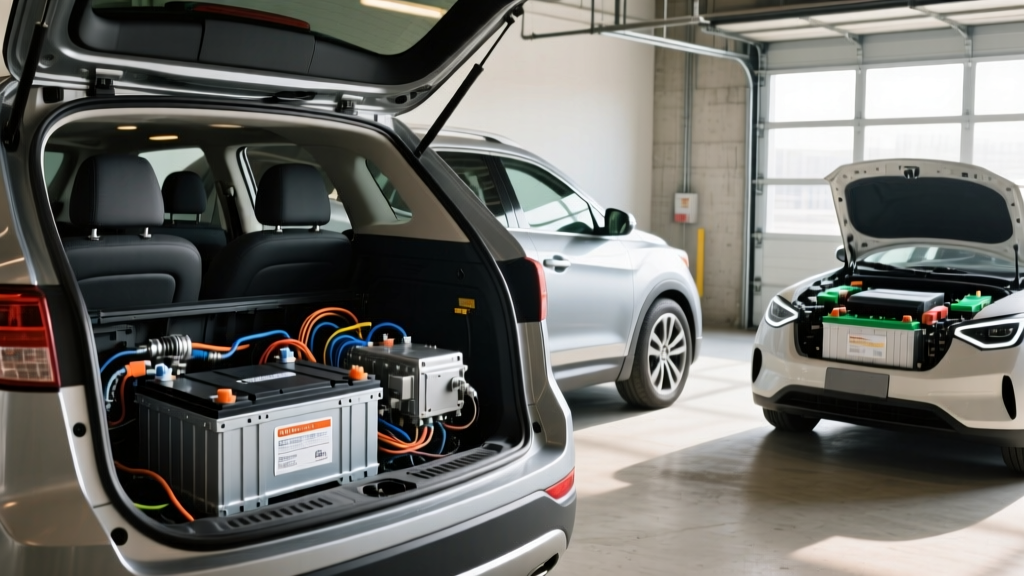
Returning to the original search intent: Johnson Controls remains relevant to EV owners through the 12V auxiliary battery. Every EV has a small 12V battery that powers the onboard computers, lighting, door locks, and safety systems — even though the main traction battery (typically 400V-800V) drives the wheels.
Johnson Controls' Optima brand produces AGM (Absorbed Glass Mat) 12V batteries used in many EVs, and the company supplies OEM 12V lithium-ion batteries for select manufacturers. If your EV's 12V battery fails — a common issue around years 3-5 — you may encounter a Johnson Controls-branded replacement. This is entirely separate from the high-voltage traction battery and typically costs $200-$400 to replace.
Some newer EVs (2024+ Tesla models, Hyundai Ioniq 6) have moved to lithium-ion 12V batteries that last longer and weigh less than traditional lead-acid units, reducing this maintenance item.
Frequently Asked Questions
How long do EV batteries last in years and miles?
Most EV traction batteries are designed to last 15-20 years and 200,000+ miles before reaching 70-80% of original capacity. Real-world fleet data from Tesla, Geotab, and Recurrent Auto consistently shows packs retaining 85-92% capacity at 100,000 miles. LFP chemistries tend to outlast NMC/NCA due to higher cycle-life ratings.
How much does an EV battery cost to replace?
Full out-of-warranty replacement ranges from ~$8,000 for smaller packs (Nissan LEAF, Chevrolet Bolt) to $20,000-$28,000 for large packs (Ford F-150 Lightning, GMC Hummer EV). Module-level repairs are far more common and typically cost $3,000-$7,000. Most EVs never need a full pack replacement during their useful life.
What does the EV battery warranty cover?
Standard warranties cover 8 years/100,000 miles (10 yr/150,000 mi in CARB states) against capacity loss below 70% of original. This includes defective cells, module imbalance, and BMS failures. Warranties do not cover collision damage, flood damage, or modifications. Check your specific manufacturer's terms, as Hyundai/Kia offers 10 years and Rivian covers 175,000 miles.
How do I check and maximize my EV battery health?
Monitor SoH through your vehicle's service menu, OBD-II diagnostic apps, or dealer service visits. Maximize longevity by keeping NMC packs between 20-80% SoC for daily use, minimizing DC fast charging frequency, preconditioning before charging, avoiding extreme SoC storage, and parking in moderate temperatures when possible. LFP owners can charge to 100% without concern.
LFP vs NMC — which battery chemistry is better?
LFP wins on cycle life (3,000-5,000 cycles vs 1,000-2,000), cost, thermal safety, and daily charging convenience (100% SoC is fine). NMC wins on energy density (more range per pound), cold-weather performance, and fast-charging capability. For daily commuters and fleet operators, LFP is increasingly the pragmatic choice. For long-range needs and cold climates, NMC remains superior. Neither is universally "better" — the right choice depends on your driving pattern and climate.
Are Johnson Controls batteries used in EVs?
Johnson Controls (through its Optima and OEM brands) supplies 12V auxiliary batteries for many EVs, not the high-voltage traction batteries. The traction packs are manufactured by companies like CATL, LG Energy Solution, Panasonic, SK On, Samsung SDI, and BYD. If your EV needs a 12V battery replacement, a Johnson Controls product is a common and reliable option.