From Lead-Acid to Lithium: Understanding the Johnson Controls Battery Legacy in EVs
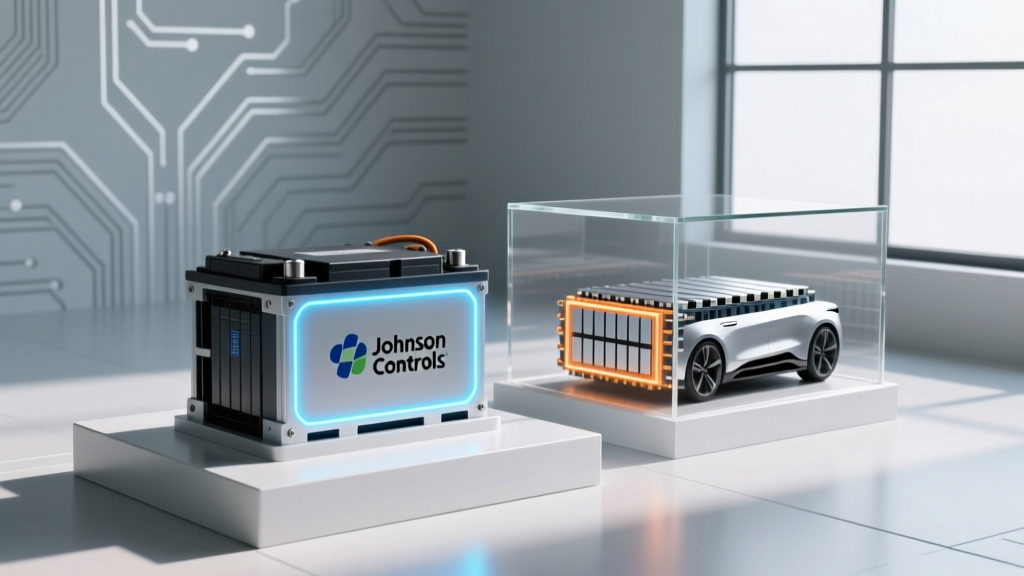
When EV owners hear "Johnson Controls battery," most think of the 12V lead-acid or AGM auxiliary batteries that power lights, infotainment, and vehicle computers. Johnson Controls (now operating its battery division under Clarios) has been a dominant supplier of conventional automotive batteries for decades. But as electric vehicles have gone mainstream, the battery conversation has shifted entirely — from a $200 lead-acid unit under the hood to a $10,000–$20,000 lithium-ion traction pack bolted to the vehicle floor.
This guide bridges both worlds. We'll clarify what Johnson Controls batteries do in an EV (spoiler: they still handle the 12V auxiliary system), then focus on what actually matters to EV buyers and owners — the high-voltage traction battery that determines your range, charging speed, and long-term ownership cost.
LFP vs NMC vs NCA: EV Battery Chemistry Explained
The two dominant lithium-ion chemistries in 2026 EVs are Lithium Iron Phosphate (LFP) and Nickel Manganese Cobalt (NMC), with Nickel Cobalt Aluminum (NCA) used primarily by Tesla and a few others. Each has distinct trade-offs that affect your real-world driving experience.
| Attribute | LFP (Lithium Iron Phosphate) | NMC/NCA (Nickel-based) |
|---|---|---|
| Energy Density | ~160–180 Wh/kg (lower — heavier pack for same range) | ~220–300 Wh/kg (higher — lighter, more compact) |
| Cycle Life | 3,000–6,000+ cycles to 80% capacity | 1,000–2,000 cycles to 80% capacity |
| Cold-Weather Performance | Weaker — more range loss below freezing, slower cold charging | Better — retains more capacity in cold, charges faster when cold |
| Thermal Stability / Safety | Excellent — very resistant to thermal runaway | Good — requires more active thermal management |
| Cost | Lower — no cobalt or nickel, cheaper raw materials | Higher — cobalt/nickel price volatility |
| SoC Recommendation | Can charge to 100% regularly (no degradation penalty) | Best kept 20–80% daily; 100% only for trips |
| Common In (2026) | Tesla Model 3/Y RWD, Ford Mustang Mach-E Select, BYD, Rivian Standard | Tesla Long Range, Hyundai Ioniq 5/6, Chevy Equinox EV, BMW iX, most luxury EVs |
Which is better? It depends on your use case. LFP wins for daily commuters who charge at home every night and want maximum longevity — the ability to charge to 100% without degradation guilt is a genuine daily-life advantage. NMC wins for drivers who prioritize maximum range in a lighter package, frequently drive in cold climates, or need the fastest possible DC charging speeds. Neither is universally superior; the chemistry choice should match your driving pattern.
How Long Do EV Batteries Actually Last?
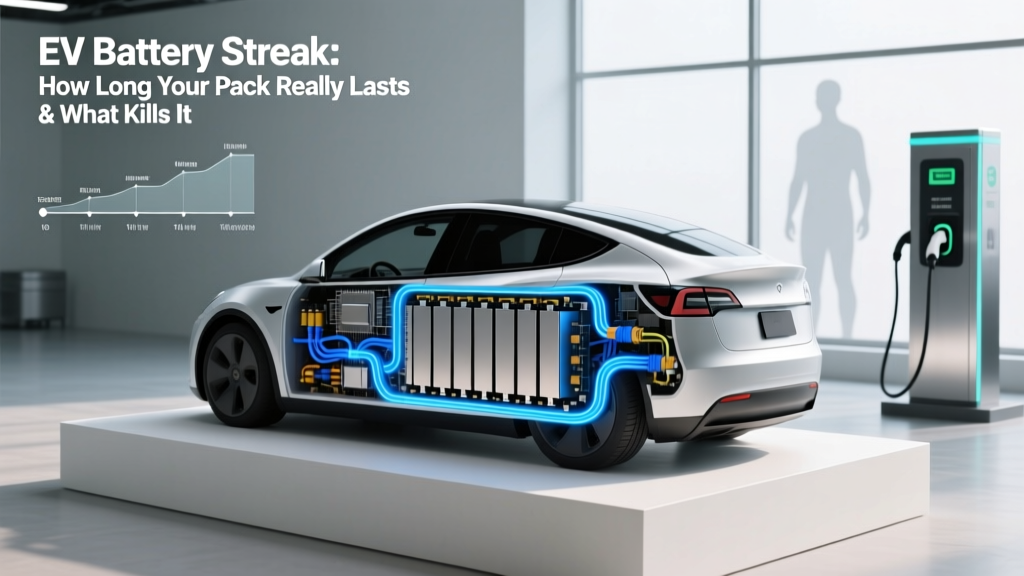
The short answer: longer than most buyers expect. Modern EV traction batteries are engineered to outlast the vehicle's economic life. But "last" needs defining — a battery doesn't suddenly die; it gradually loses capacity.
- Tesla Model 3/Y (NMC): ~5% capacity loss at 100,000 miles, ~8–10% at 200,000 miles (per Tesla's 2025 Impact Report fleet data)
- Chevrolet Bolt EV/EUV (NMC): ~6–8% loss at 80,000 miles; some early 2017 models recalled for battery defects, but post-recall units hold well
- Hyundai Ioniq 5 (NMC): ~4–6% loss at 60,000 miles in owner-reported fleet data
- LFP packs (Tesla RWD, BYD): ~2–4% loss at 100,000 miles; slower degradation curve due to chemistry
- Industry average (all chemistries): ~1.5–2.5% loss per year for typical use, tapering after year 3–4
Most degradation occurs in the first 1–2 years (an initial "break-in" drop of 2–4%), then the curve flattens significantly. A well-maintained 2026 EV battery should retain 85–92% of original capacity at 150,000 miles. Full replacement before 200,000 miles remains uncommon outside of manufacturing defects covered under warranty.
What Does the EV Battery Warranty Cover?
Federal law mandates a minimum 8-year/100,000-mile warranty on EV batteries (10 years/150,000 miles in California and states that follow CARB standards). Most manufacturers meet or exceed this baseline. The key detail is the capacity retention threshold — the point at which the manufacturer will repair or replace the battery.
| Manufacturer | Duration | Mileage | Min. Capacity Retention |
|---|---|---|---|
| Tesla | 8 years | 100,000–120,000 mi (varies by model) | 70% |
| Hyundai / Kia | 10 years | 100,000 mi | 70% |
| General Motors (Chevy/Cadillac) | 8 years | 100,000 mi | 60–70% (varies) |
| Ford | 8 years | 100,000 mi | 70% |
| Rivian | 8 years | 175,000 mi | 70% |
| BMW | 8 years | 100,000 mi | 70% |
The warranty covers defects and excessive capacity loss — meaning if your battery drops below the stated threshold within the warranty period, the manufacturer must repair or replace it at no cost. It does not cover damage from accidents, improper charging equipment, or modifications. Some warranties also cover the battery management system (BMS) and associated power electronics.
EV Battery Replacement Cost: What to Expect
Out-of-warranty battery replacement is the single largest fear among prospective EV buyers. Here's the reality: it's expensive, but rarely needed within a vehicle's practical lifespan.
| Vehicle / Pack Size | Battery (Parts) | Labor | Total Estimated |
|---|---|---|---|
| Chevy Bolt EV (65 kWh) | $10,000–$14,000 | $2,000–$3,500 | $12,000–$17,500 |
| Tesla Model 3/Y (75–82 kWh) | $12,000–$16,000 | $2,500–$4,000 | $14,500–$20,000 |
| Hyundai Ioniq 5 (77.4 kWh) | $11,000–$15,000 | $2,000–$3,500 | $13,000–$18,500 |
| Ford F-150 Lightning (131 kWh Extended) | $18,000–$25,000 | $3,000–$5,000 | $21,000–$30,000 |
| BMW iX (111.5 kWh) | $20,000–$28,000 | $3,500–$5,000 | $23,500–$33,000 |
When is replacement typically needed? Based on current degradation data, most EV batteries will not require full replacement before 200,000–250,000 miles. At that mileage, many vehicles are at or past their economic life regardless of powertrain. Module-level repair (replacing individual cell groups rather than the entire pack) is increasingly available and costs $2,000–$6,000, offering a more affordable alternative for out-of-warranty vehicles.
Factors That Accelerate Battery Degradation
Not all miles are equal. How you charge and drive has a measurable impact on long-term battery health. Here are the primary degradation accelerators, ranked by impact:
- Avoid sustained 100% SoC (NMC/NCA only): Store and daily-charge at 80% maximum. LFP owners can ignore this — charge to 100% freely.
- Minimize DC fast charging when possible: Frequent 150+ kW sessions generate sustained heat. Use Level 2 for daily charging; reserve DCFC for road trips.
- Precondition before fast charging: Most EVs do this automatically when you navigate to a charger. Cold batteries charge slower and experience more stress.
- Avoid prolonged storage at low SoC: If parking for weeks, leave the vehicle at ~50% SoC. Below 10% for extended periods risks cell damage.
- Extreme heat is worse than extreme cold: Sustained ambient temps above 100°F accelerate chemical degradation. Garage parking helps significantly in hot climates.
- Don't obsess over perfection: Modern BMS systems actively protect the battery. Occasional 100% charges, fast-charging sessions, and cold-weather driving won't destroy your pack. The chemistry is more resilient than internet forums suggest.
Monitoring Your Battery's State of Health (SoH)
State of Health (SoH) measures your battery's current maximum capacity as a percentage of its original capacity when new. A 77.4 kWh battery at 93% SoH can store approximately 72 kWh. Here's how to check it:
- In-vehicle displays: Tesla shows estimated range vs. original; Hyundai/Kia provides a battery health percentage in the EV menu. BMW and Mercedes include SoH in their connected services apps.
- OBD-II diagnostic apps: Tools like OBDeleven, Leaf Spy (for Nissan), or Scan My Tesla can read BMS data including SoH, cell voltage variance, and cycle count.
- Dealership diagnostic reports: Request a battery health report during service visits. This documents SoH for warranty claims and resale value.
- Third-party services: Companies like Recurrent Auto provide fleet-based degradation benchmarking, letting you compare your pack against thousands of identical vehicles.
A healthy SoH reading shows consistent cell voltages (variance under 0.05V across modules) and capacity within expected degradation curves. If your SoH drops below the warranty threshold before the time/mileage limit, document it and contact the manufacturer for a warranty claim.
What's Next: Solid-State and Silicon-Anode Batteries
Next-generation battery technologies promise higher energy density, faster charging, and improved safety. Here's where they stand as of 2026:
- Silicon-anode batteries: Companies like Sila Nanotechnologies and Group14 are replacing graphite anodes with silicon, boosting energy density by 20–40%. Limited production vehicles (Mercedes G-Class EV, select startups) are beginning to use silicon-dominant anodes. Expect broader adoption by 2027–2028.
- Solid-state batteries: Toyota, Samsung SDI, and QuantumScape have demonstrated prototype cells with 2–3× the energy density of current NMC and the potential for 10-minute charging. Toyota has announced a 2027–2028 production timeline for limited models. However, manufacturing scale-up and cost remain significant barriers — widespread availability in mainstream vehicles is realistically 2029–2031.
- Sodium-ion batteries: CATL and BYD are producing sodium-ion packs for budget EVs in China. Lower energy density but dramatically lower cost and no lithium/cobalt dependency. US availability is not yet announced.
These technologies are promising but not yet available in production vehicles you can buy today. Current LFP and NMC chemistries will remain the standard through at least 2029 for most buyers.
Connecting the Dots: Johnson Controls, Clarios, and the EV Supply Chain
While Johnson Controls no longer manufactures EV traction batteries, its successor company Clarios remains a major supplier of 12V lithium-ion and AGM auxiliary batteries used in EVs. Every EV still needs a 12V system to power computers, door handles, lighting, and safety systems — and when that small battery dies (typically every 3–5 years), it can brick the vehicle just as effectively as a dead traction battery. Clarios/Johnson Controls products are OEM equipment in many EVs including select Ford, GM, and Stellantis models.
The broader lesson: battery technology spans from the $200 auxiliary unit to the $15,000 traction pack, and understanding both matters for complete EV ownership.
Frequently Asked Questions
How long do EV batteries last in years and miles?
Based on fleet data from Tesla, Hyundai, and independent trackers like Recurrent, modern EV batteries typically retain 85–92% capacity at 150,000 miles. In calendar years, expect 12–20 years of practical service life before capacity drops to a point where range becomes inconvenient. Most EV batteries will outlast the vehicle's economic life.
How much does an EV battery cost to replace?
Full traction battery replacement costs $12,000–$30,000+ depending on pack size and vehicle. A Chevy Bolt pack runs $12,000–$17,500; a Ford F-150 Lightning extended-range pack runs $21,000–$30,000. However, replacement is rarely needed before 200,000+ miles. Module-level repairs ($2,000–$6,000) are increasingly available as a lower-cost alternative.
What does the battery warranty actually cover?
Federal law requires at least 8 years/100,000 miles of coverage (10/150,000 in CARB states). The warranty covers defects and capacity loss below a stated threshold — typically 70% of original capacity. If your battery drops below that threshold within the warranty period, the manufacturer replaces or repairs it free of charge. Damage from accidents, flooding, or unauthorized modifications is excluded.
How do I check and maximize my EV battery health?
Check SoH through your vehicle's infotainment system, an OBD-II diagnostic app, or a dealership service report. Maximize longevity by: charging to 80% daily (NMC/NCA), using Level 2 for routine charging, preconditioning before DC fast charging, avoiding prolonged storage below 10% SoC, and parking in shade/garage in extreme heat. LFP owners can charge to 100% without degradation concern.
LFP vs NMC — which chemistry should I choose?
Choose LFP if you charge at home nightly, want maximum cycle life, live in a moderate climate, and prefer the simplicity of charging to 100%. Choose NMC/NCA if you need maximum range, frequently drive in cold weather, take regular road trips requiring fast DC charging, or prioritize a lighter vehicle. Neither is universally better — match the chemistry to your driving pattern.
Is a Johnson Controls battery used in EVs?
Johnson Controls' battery division (now Clarios) supplies 12V auxiliary batteries to several EV manufacturers. These are not the high-voltage traction batteries that power the drivetrain — they handle vehicle electronics, computers, and accessories. The traction battery comes from suppliers like CATL, LG Energy Solution, Panasonic, SK On, or Samsung SDI.
Sources: fueleconomy.gov (EPA range and efficiency data), IRS.gov (§30D tax credit rules), manufacturer warranty documentation from Tesla, Hyundai, Ford, and GM press sites.