2021 Jeep Wrangler 4xe Battery: The 17.3 kWh Question Explained
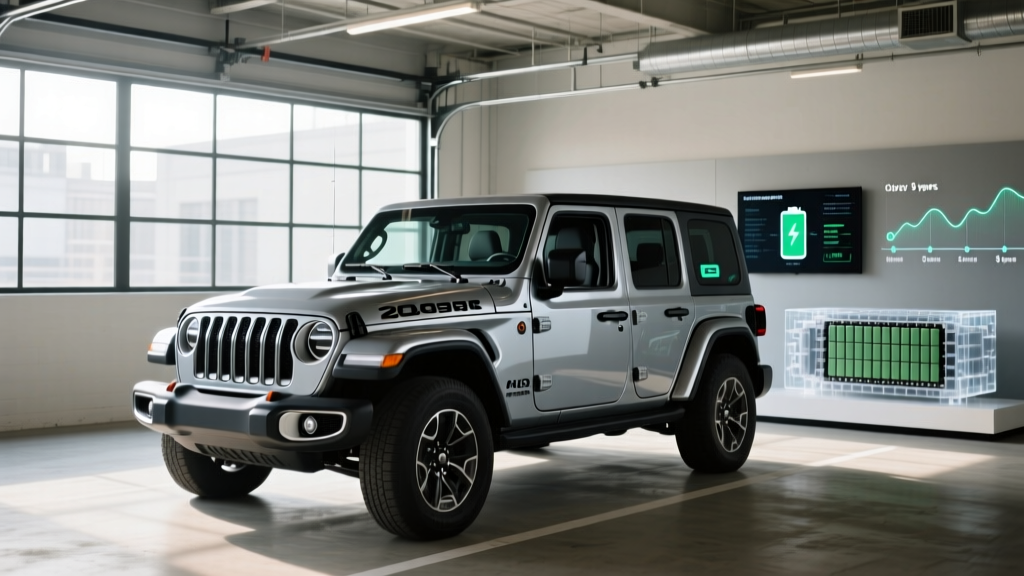
If you've been searching for the 2021 Jeep Wrangler 4xe usable battery capacity kWh figure, here's the exact number: 17.3 kWh usable out of a gross pack capacity of approximately 17.3 kWh (the 4xe's battery management system keeps a small buffer top and bottom to protect cell longevity). This lithium-ion pack uses NMC (nickel manganese cobalt) chemistry, mounted beneath the rear seats, and delivers an EPA-rated 21 miles of electric-only range and 49 MPGe combined when blending electric and gas operation, per fueleconomy.gov.
But usable capacity is just the starting point for understanding Wrangler 4xe ownership. The real questions PHEV buyers and owners ask are: How quickly does that 17.3 kWh shrink over time? What does the warranty actually cover if degradation accelerates? And what does a replacement cost if the pack fails out of warranty? This guide answers those questions with hard data — and puts the 4xe's battery in context against the broader EV and PHEV landscape.
| Specification | Value |
|---|---|
| Gross Battery Capacity | ~17.3 kWh |
| Usable Battery Capacity | 17.3 kWh |
| Battery Chemistry | NMC (Nickel Manganese Cobalt) |
| EPA Electric-Only Range | 21 miles |
| EPA Combined MPGe | 49 MPGe |
| Gas-Only Combined MPG | 20 MPG |
| Total System Horsepower | 375 hp |
| Total System Torque | 470 lb-ft |
| Level 2 AC Charge Rate | ~7.2 kW (est. ~2 hrs 0–100%) |
| DC Fast Charging | Not supported |
| 0–60 mph | ~6.0 seconds |
| Battery Warranty | 8 years / 100,000 miles |
NMC vs LFP: Understanding the Chemistry Inside Your PHEV or EV
The 2021 Wrangler 4xe uses NMC cells, which was the dominant chemistry for plug-in vehicles through the early 2020s. But the battery landscape has shifted significantly, and understanding the trade-offs between NMC and LFP (lithium iron phosphate) matters whether you're evaluating a 4xe or shopping for a new EV in 2026.
| Attribute | NMC / NCA | LFP |
|---|---|---|
| Energy Density | Higher (250–300 Wh/kg cell-level) | Lower (160–200 Wh/kg cell-level) |
| Typical Cycle Life | 1,000–2,000 full cycles | 3,000–6,000+ full cycles |
| Cold-Weather Performance | Better low-temp discharge | Reduced performance below 32°F; needs preconditioning |
| Cost per kWh (2026) | $110–$140/kWh pack-level | $75–$100/kWh pack-level |
| Thermal Stability | Lower; more prone to thermal runaway | Higher; inherently more stable |
| State-of-Charge Recommendation | Best at 20–80% daily | Can charge to 100% regularly; periodic 100% recommended for cell balancing |
| Common Applications | Long-range EVs, PHEVs, performance models | Standard-range EVs, fleet vehicles, stationary storage |
Which is better? It depends on your use case. NMC wins when you need maximum range in a compact package — which is why the Wrangler 4xe, with limited underbody space, uses it. LFP wins on longevity, cost, and safety, which is why Tesla's Standard Range models, the base Ford Mustang Mach-E, and many 2025–2026 Chinese-market EVs have shifted to LFP. For a PHEV like the 4xe, the smaller pack size means NMC's energy density advantage is critical to fitting 17+ kWh into a vehicle designed around a solid rear axle.
How Long Do EV and PHEV Batteries Actually Last?
The fear of a dead battery pack is the single biggest psychological barrier to EV and PHEV ownership. Real-world data tells a less alarming story.
According to long-term fleet data published by Geotab (analyzing over 10,000 electric vehicles), the average EV battery loses approximately 2.3% of its capacity per year under normal use. That means after 8 years, an average pack retains roughly 82% of its original capacity — well above most warranty thresholds.
Typical Battery Degradation Curve (NMC Chemistry, Average Use):
- Year 1: ~2–3% loss (initial formation loss)
- Year 2–3: ~1.5–2% per year (linear phase)
- Year 4–8: ~1–1.5% per year (gradual plateau)
- Year 8 average retention: ~80–85% of original capacity
- Year 10 average retention: ~75–80% of original capacity
Note: Degradation is not linear. Most loss occurs in the first 12–18 months, then the curve flattens. Individual results vary based on climate, charging habits, and thermal management system quality.
For the 2021 Wrangler 4xe specifically, that 2.3%/year average would mean losing roughly 4 kWh of usable capacity over a decade — dropping from 21 miles of electric range to approximately 16–17 miles. Noticeable, but not catastrophic for a PHEV that always has its 2.0L turbo engine as backup.
PHEV batteries face a unique stress: they cycle more frequently than large BEV packs because the usable window is smaller. A 4xe owner who charges daily and depletes the pack every commute puts roughly 300–365 partial cycles per year on a 17.3 kWh pack. Over 8 years, that's ~2,500+ cycles — approaching the upper end of NMC cycle life ratings. However, PHEV battery management systems are typically conservative with charge/discharge limits to compensate.
What the Jeep Wrangler 4xe Battery Warranty Actually Covers
Stellantis provides an 8-year / 100,000-mile high-voltage battery warranty on the Wrangler 4xe (extended to 10 years / 150,000 miles in California Air Resources Board states and those that have adopted CARB emissions standards). Here's what that warranty covers — and what it doesn't.
| Coverage Item | Detail |
|---|---|
| Duration | 8 years / 100,000 miles (10 yr / 150k mi in CARB states) |
| Capacity Retention Threshold | Stellantis typically warrants against failure to retain ~70% of original capacity (confirm with dealer for exact 4xe threshold) |
| Defect Coverage | Manufacturing defects, cell failures, BMS malfunctions |
| Gradual Degradation | Covered ONLY if capacity drops below the retention threshold |
| Physical Damage | NOT covered — off-road impacts, flooding, collision damage |
| Improper Charging | NOT covered if damage traced to non-approved equipment |
| Transferability | Yes — warranty transfers to subsequent owners |
The critical detail most owners miss: the warranty covers failure below a threshold, not gradual range loss you simply don't like. If your 4xe still delivers 15 miles of electric range (roughly 70% of 21), Stellantis considers the battery performing within spec. This is consistent across nearly every OEM — Tesla, Hyundai, Ford, and GM all use similar 70% retention thresholds over 8 years.
EV Battery Replacement Cost: What You'd Actually Pay
If your battery fails out of warranty — or you're buying a used 4xe with high miles — replacement cost matters. Here's the current landscape for 2026:
| Vehicle Category | Pack Size | Replacement Cost Range | Typical Replacement Timeline |
|---|---|---|---|
| PHEV (e.g., Wrangler 4xe) | 15–20 kWh | $6,000–$12,000 | Rarely needed; most PHEVs retired before pack replacement |
| Compact BEV (e.g., Chevy Bolt) | 60–66 kWh | $12,000–$18,000 | 10–15+ years under normal use |
| Mid-size BEV (e.g., Model Y, Ioniq 5) | 75–84 kWh | $14,000–$22,000 | 10–15+ years under normal use |
| Large BEV (e.g., F-150 Lightning, Hummer EV) | 100–215 kWh | $20,000–$35,000+ | 10–15+ years under normal use |
For the Wrangler 4xe specifically, a high-voltage battery replacement would likely fall in the $8,000–$12,000 range (parts and labor) at a dealership, though aftermarket and refurbished options are increasingly available for 40–60% less. The important context: the vast majority of PHEV and EV batteries are never replaced. Data from Consumer Reports and warranty claim rates suggest fewer than 5% of EV/PHEV packs require replacement during the warranty period, and most packs outlast the vehicle itself.
5 Factors That Accelerate (or Preserve) Battery Life
Battery degradation isn't random — it's driven by specific, controllable factors. Here's what the data shows:
Battery Care Best Practices for Wrangler 4xe and All PHEVs/EVs:
- Avoid sustained 100% SoC: For NMC packs, storing the battery at 100% for days accelerates calendar degradation. Charge to 100% when you'll drive soon; for daily use, 80–90% is the sweet spot. (LFP owners: charge to 100% at least weekly for cell balancing.)
- Minimize DC fast charging: Repeated high-rate DC charging (above 1C) generates heat that stresses NMC cells. The 4xe doesn't support DC fast charging, so this is a non-issue — Level 2 at 7.2 kW is gentle on the pack.
- Extreme heat is worse than extreme cold: Sustained ambient temperatures above 95°F cause more permanent capacity loss than cold. If you live in Phoenix or Las Vegas, park in shade or a garage whenever possible.
- Don't let the pack sit at 0%: Deep discharge can cause copper dissolution in the cells. If storing the 4xe for weeks, leave it at ~50% SoC.
- Use preconditioning when available: Warming the battery before driving in cold weather reduces stress and improves regen effectiveness. The 4xe's thermal management system handles this, but plugging in during cold nights helps.
How to Monitor Your Wrangler 4xe Battery Health (SoH)
State of Health (SoH) is the percentage of original battery capacity remaining. Unlike State of Charge (which fluctuates daily), SoH declines slowly over years. Here's how 4xe owners can track it:
Dealership diagnostic scan: A Stellantis dealer can run a high-voltage battery health report using the wiTECH diagnostic tool. This gives a precise SoH percentage. Request this during routine service visits — it's typically included at no charge.
Real-world range tracking: The simplest DIY method. Track your electric-only miles over several full charges. If your 4xe consistently delivered 20 miles of electric range when new and now delivers 16, that's approximately 80% SoH. Use the trip computer's EV range readout and average across 5–10 charge cycles for accuracy.
OBD-II tools: Third-party OBD-II scanners with PHEV/EV support (such as OBDLink devices paired with apps like ABRP or EV-specific diagnostic apps) can read battery module voltage delta, internal resistance, and estimated SoH from the BMS. Accuracy varies by tool, but voltage delta between the highest and lowest cell modules is a strong degradation indicator — a delta exceeding 200mV under load suggests cell imbalance worth investigating.
Charging time changes: If your Level 2 charge from empty to full used to take 2 hours and now takes only 1 hour 40 minutes, the pack's usable capacity has shrunk. This is a rough but practical indicator.
Emerging Battery Technology: What's Coming (and When)
Current lithium-ion technology (both NMC and LFP) will dominate through at least 2030. But several next-generation technologies are in development:
Solid-state batteries: These replace the liquid electrolyte with a solid conductor, promising 2–3x energy density, faster charging, and improved safety. Toyota, Samsung SDI, and QuantumScape have all announced pilot production lines, but mass-market vehicle availability remains estimated at 2028–2032. Cost per kWh remains 3–5x current lithium-ion. No current production vehicle uses a full solid-state pack.
Silicon-dominant anodes: Replacing graphite anodes with silicon can boost energy density by 20–40%. Companies like Sila Nanotechnologies and Group14 are supplying early production cells (the Mercedes G-Class electric uses Sila silicon anodes as of 2025). Expect broader adoption in 2026–2028 model-year vehicles.
Sodium-ion batteries: CATL and other Chinese manufacturers have begun shipping sodium-ion packs for low-cost, short-range EVs. These offer lower energy density than LFP but use abundant, inexpensive materials. US-market availability is uncertain due to trade and tariff dynamics, but sodium-ion could appear in budget PHEVs and urban EVs by 2027–2029.
None of these technologies will retrofit into an existing Wrangler 4xe. But if you're planning your next vehicle purchase in the 2028+ timeframe, the battery landscape will look meaningfully different — with better longevity, faster charging, and lower cost per kWh across the board.
Frequently Asked Questions: Wrangler 4xe Battery & EV Battery Longevity
How long do EV batteries last in years and miles?
Most modern EV and PHEV batteries last 10–20 years and 150,000–300,000+ miles before degrading below 70% capacity. Fleet data shows average degradation of ~2.3% per year. Many early Nissan LEAFs and Chevy Volts from 2011–2014 are still on their original packs with 75–85% capacity retention after 10+ years.
How much does it cost to replace a Jeep Wrangler 4xe battery?
A dealership replacement for the 4xe's 17.3 kWh high-voltage pack is estimated at $8,000–$12,000 (parts and labor) in 2026. Refurbished or aftermarket packs may cost 40–60% less. However, the vast majority of 4xe batteries will never need replacement — the pack is designed to outlast the vehicle's typical service life.
What does the Wrangler 4xe battery warranty cover?
Stellantis covers the high-voltage battery for 8 years/100,000 miles (10 years/150,000 miles in CARB states) against manufacturing defects and capacity loss below approximately 70% of original capacity. Physical damage from off-roading, collisions, or flooding is excluded. The warranty transfers to subsequent owners.
How do I check my 4xe battery's State of Health?
The most accurate method is a dealership diagnostic scan using Stellantis' wiTECH tool. DIY options include tracking electric-only range over multiple charge cycles (reduced range = reduced SoH) or using an OBD-II scanner that reads BMS data. Request a battery health report at every service visit.
Is LFP better than NMC for a PHEV like the Wrangler 4xe?
LFP offers longer cycle life, lower cost, and better thermal stability — but lower energy density. For the Wrangler 4xe, where battery packaging space is severely limited by the solid rear axle and body-on-frame design, NMC's higher energy density is the practical choice. An LFP pack of equivalent capacity would be physically larger and heavier. For a dedicated BEV with flexible packaging, LFP is increasingly the preferred option.
Does off-roading damage the Wrangler 4xe battery?
The 4xe's battery pack is mounted under the rear seats with skid plate protection. Normal off-roading within the vehicle's rated capability (10.9 inches of ground clearance, 30 inches of water fording) should not impact the battery. However, severe underbody impacts that damage the battery casing are not covered under warranty and could compromise the pack's waterproofing. Inspect the underbody after aggressive trail runs.
Can I upgrade to a larger battery in my 2021 Wrangler 4xe?
No. The 4xe's battery pack, power electronics, and BMS are integrated and calibrated for the 17.3 kWh pack. There is no OEM or aftermarket larger-capacity upgrade path. The 2024+ Wrangler 4xe did not receive a larger battery either — it remains at approximately 17.3 kWh usable.