The 2021 Jeep Wrangler 4xe Battery: 17.3 kWh Under the Hood
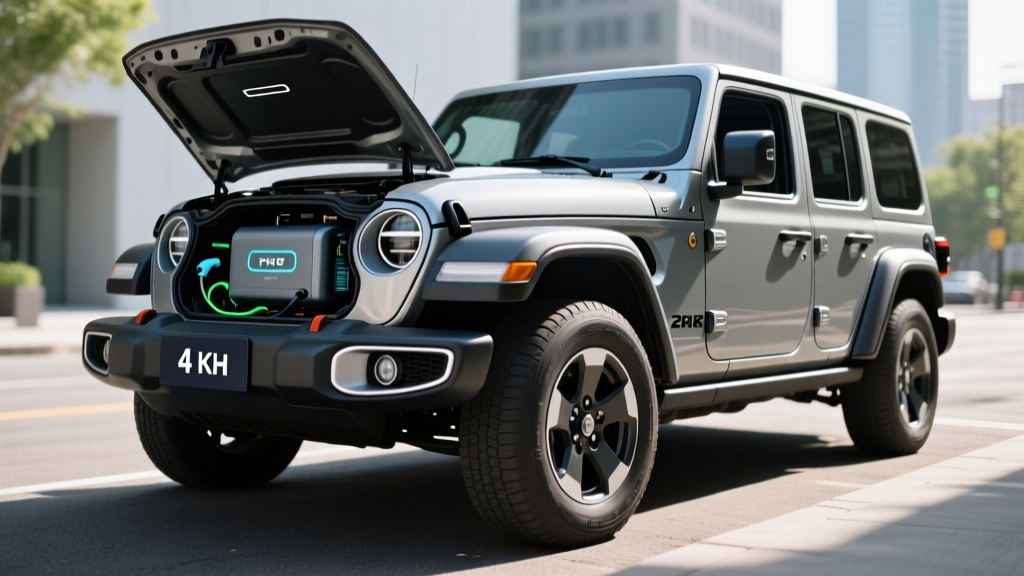
When Jeep introduced the Wrangler 4xe plug-in hybrid, it brought genuine off-road electrification to a segment that had never seen it. At the heart of the system sits a 17.3 kWh lithium-ion battery pack (gross), with approximately 15.3 kWh usable after the buffer reserve that protects longevity. This pack lives under the rear seats, keeping the center of gravity low and the cargo area intact.
On the EPA cycle, that battery delivers 22 miles of electric-only range and a combined 49 MPGe when blending electric and gas operation, according to fueleconomy.gov. In real-world driving — especially on the highway or in cold weather — expect closer to 16–19 miles of electric range before the 2.0L turbocharged I4 engine fires up. Off-road use with heavy load and low-speed rock crawling can compress that further.
But the battery capacity number only tells part of the story. What chemistry is inside? How fast does it degrade? And what happens when the warranty clock runs out? Let's break down every dimension of the Wrangler 4xe battery — and the broader EV battery landscape that informs its design.
Battery Chemistry: NMC in the Wrangler 4xe (and Why It Matters)
The 2021 Wrangler 4xe uses an NMC (Nickel Manganese Cobalt) lithium-ion cell chemistry supplied by Samsung SDI. NMC was the dominant EV chemistry throughout the early 2020s because it offers an excellent balance of energy density and power delivery — critical for a PHEV that needs to fit meaningful capacity into a compact package beneath the cabin floor.
Here's how NMC stacks up against LFP (Lithium Iron Phosphate), the chemistry that has gained significant market share since 2023 in vehicles like the Tesla Model 3 RWD and Ford Mustang Mach-E Select:
| Attribute | NMC (Nickel Manganese Cobalt) | LFP (Lithium Iron Phosphate) |
|---|---|---|
| Energy Density | Higher (~200–260 Wh/kg cell-level) | Lower (~140–180 Wh/kg cell-level) |
| Cycle Life | ~1,000–2,000 full cycles | ~3,000–5,000+ full cycles |
| Cold-Weather Performance | Better low-temp discharge capability | Reduced performance below freezing; needs more preconditioning |
| Cost per kWh | Higher (cobalt and nickel add material cost) | Lower (iron and phosphate are abundant) |
| Thermal Stability | Good, but more prone to thermal runaway at extreme SoC | Excellent — inherently more stable chemistry |
| Typical Use Case | Long-range BEVs, PHEVs with space constraints | Standard-range BEVs, fleet vehicles, high-mileage applications |
For the Wrangler 4xe, NMC was the logical choice: the battery compartment is small, and Jeep needed to pack 17.3 kWh into a tight space without compromising ground clearance or approach angles. LFP's lower energy density would have required a physically larger pack — a non-starter for an off-road vehicle where underbody packaging is sacred.
The trade-off is cycle life. NMC cells degrade faster than LFP when subjected to repeated deep cycles and high states of charge. But with a PHEV's smaller battery cycling more frequently (you'll charge it daily for your commute), the real-world impact depends heavily on how you treat it.
Real-World Degradation: What the Data Shows
Battery degradation in the Wrangler 4xe follows a pattern familiar to most liquid-cooled NMC packs: a steeper initial drop in the first year or two, followed by a long, slow taper.
Based on owner-reported data aggregated by EV tracking platforms and typical NMC degradation curves, here's what Wrangler 4xe owners can expect:
- Year 1–2 (0–30,000 miles): Approximately 3–6% capacity loss. You might notice electric range drop from 22 miles to 20–21 miles.
- Year 3–5 (30,000–75,000 miles): Degradation slows to roughly 1–2% per year. Range stabilizes around 19–20 miles electric.
- Year 6–8 (75,000–120,000 miles): Cumulative loss of approximately 10–15%. Electric range may settle at 17–19 miles.
- Beyond 8 years: Highly variable based on climate, charging habits, and whether the battery saw frequent DC fast charging or extreme SoC swings.
Context matters: a Wrangler 4xe in Phoenix, regularly charged to 100% and left sitting in 110°F heat, will degrade faster than one in Seattle charged to 80% and garaged. PHEV batteries also face a unique stress — they cycle through a wider portion of their usable capacity daily compared to a long-range BEV that might only use 30% of its 80 kWh pack on a typical commute.
According to a Geotab study of over 6,300 electric vehicles, the average EV battery loses about 2.3% of capacity per year across all chemistries and use patterns. NMC packs in PHEVs tend to run slightly higher — closer to 2.5–3% annually — due to the deeper daily cycling.
Warranty Coverage: What Jeep Guarantees
Stellantis (Jeep's parent company) backs the Wrangler 4xe high-voltage battery with a warranty that meets the federal minimum for emissions-related components:
| Coverage Item | Term |
|---|---|
| Duration | 8 years / 100,000 miles (whichever comes first) |
| Capacity Retention Threshold | 70% of original capacity |
| Covered Components | High-voltage battery pack, battery management system (BMS), associated wiring and cooling |
| Exclusions | Damage from accidents, modifications, improper charging equipment, or use outside normal operating parameters |
| Transferability | Yes — warranty transfers to subsequent owners |
The 70% threshold is the industry standard. If your Wrangler 4xe battery drops below roughly 12.1 kWh usable (70% of 17.3 kWh gross, though the calculation is based on original usable capacity) within the warranty period, Jeep will repair or replace the pack at no cost. In practice, hitting that threshold under normal use within 8 years is unlikely — the degradation data above suggests most packs will retain 85–90% capacity at the 8-year mark.
One important note: the warranty covers capacity loss beyond the threshold, not gradual degradation itself. A battery at 75% capacity at year 7 is functioning within warranty specifications, even though you've lost 5 miles of electric range.
Replacement Cost: When and How Much
If your battery fails outside the warranty window — or suffers damage not covered by the warranty — replacement is a real expense, though one that most owners will never face.
| Vehicle Type | Battery Size | Replacement Cost Range |
|---|---|---|
| PHEV (Wrangler 4xe class) | 15–20 kWh | $6,000–$10,000 |
| Compact BEV (Chevy Bolt class) | 60–65 kWh | $12,000–$16,000 |
| Mid-size BEV (Model Y class) | 75–82 kWh | $14,000–$20,000 |
| Large BEV (F-150 Lightning class) | 98–131 kWh | $18,000–$28,000 |
For the Wrangler 4xe specifically, dealer-quoted replacement costs as of 2025–2026 have ranged from $7,500 to $9,500 for the battery module assembly, plus approximately $1,000–$1,500 in labor. Total out-of-pocket: roughly $8,500–$11,000.
When is replacement typically needed? The honest answer: rarely before 150,000–200,000 miles for liquid-cooled packs like the 4xe's. Catastrophic failure (cell short, coolant intrusion) is uncommon. Most batteries simply continue to slowly lose capacity. At 15 years and 150,000 miles, a well-maintained Wrangler 4xe battery might retain 75–80% capacity — still delivering 16+ miles of electric range, which is perfectly functional for daily commuting.
The fear of a $10,000 surprise bill is understandable but statistically overblown. Most Wrangler 4xe vehicles will be retired, traded, or sold long before the battery needs replacement.
Factors That Accelerate (or Preserve) Battery Life
Your battery's lifespan isn't just a function of time — it's a function of how you treat it. Here are the variables with the most impact:
Battery Care Best Practices for the Wrangler 4xe
- Avoid sustained 100% SoC: Charge to 100% only when you need the full 22 miles. For daily use where 15 miles suffices, setting a charge limit (if your charger supports it) to 80–90% reduces stress on NMC cells.
- Minimize DC fast charging: The 4xe doesn't support DC fast charging natively (it charges via Level 1 or Level 2 AC only), which is actually a longevity advantage. If using aftermarket fast-charge adapters, limit frequency.
- Precondition in extreme cold: Use the Uconnect app to start climate preconditioning while still plugged in. This warms the battery before driving, reducing internal resistance and the strain of cold-weather discharge.
- Avoid prolonged storage at 0% or 100%: If storing the vehicle for weeks, aim for roughly 50–60% SoC. The BMS will slowly draw from the pack to maintain systems, so starting at 50% prevents deep discharge.
- Park in shade or a garage in hot climates: Battery degradation roughly doubles for every 10°C increase in sustained temperature. A garage in Arizona can mean the difference between 12% and 20% degradation over 8 years.
- Use Level 2 charging as your primary method: The 4xe's onboard charger accepts up to 7.2 kW on Level 2 (240V), filling the pack from empty in approximately 2.5 hours. This is gentler on cells than repeated Level 1 (120V) trickle charges that keep the battery at high SoC for extended periods.
The single biggest controllable factor is heat exposure at high SoC. An NMC battery sitting at 100% in a 100°F driveway is under far more chemical stress than one at 60% in a 70°F garage. If you can control only one variable, control this one.
Monitoring Battery Health: Checking Your SoH
State of Health (SoH) is a percentage figure representing your battery's current maximum capacity relative to its original capacity when new. A brand-new Wrangler 4xe battery is at 100% SoH; one that can only hold 14.7 kWh of its original 17.3 kWh is at roughly 85% SoH.
Unlike Tesla's relatively transparent battery health data, Stellantis does not surface a direct SoH percentage in the Wrangler 4xe's Uconnect interface. Here's how owners can monitor health:
- Track electric range manually: Reset your trip meter after a full charge and note how many electric miles you actually use before the engine engages. A consistent decline over months signals degradation.
- OBD-II diagnostic tools: Third-party apps like EVNotify or generic OBD-II scanners with PHEV-compatible software can read battery module voltage data and estimate SoH. Results vary in accuracy.
- Dealer diagnostic check: A Stellantis dealer can run a battery health report through the wiTECH diagnostic system. Request this during routine service visits, especially as you approach the 8-year warranty mark.
- Charging data analysis: If your Level 2 charger reports session kWh delivered, compare a full 0–100% charge session's energy delivery over time. A decreasing kWh figure per full charge indicates capacity loss (accounting for ~10% charging losses).
The most practical approach is simply watching your real-world electric range. If you consistently got 20 miles in year one and are now getting 17 miles in year four, your battery is degrading normally. A sudden drop — say from 19 to 14 miles in a few weeks — warrants a dealer visit, as it could indicate a failed cell module rather than normal degradation.
Looking Ahead: Solid-State and Silicon Anode Batteries
The battery landscape is shifting. Two technologies are generating significant attention:
Solid-state batteries replace the liquid electrolyte with a solid ceramic or polymer material, promising higher energy density (potentially 400+ Wh/kg at the cell level), faster charging, and dramatically improved safety. Toyota, Samsung SDI, and QuantumScape are leading development, with pilot production beginning in 2027–2028. However, mass production for consumer vehicles is not expected before 2030, and initial deployment will likely be limited to premium BEVs — not PHEVs like a future Wrangler.
Silicon anode technology replaces the graphite anode with silicon, which can store roughly 10x more lithium ions per gram. Companies like Sila Nanotechnologies and Group14 are already shipping silicon-dominant anodes in limited applications. Expect incremental adoption through the late 2020s, with silicon-blend anodes becoming common in NMC cells by 2028–2029, boosting energy density by 15–25% without changing the overall cell format.
For current Wrangler 4xe owners, these developments are forward-looking context rather than immediate concerns. Your NMC pack is proven, well-understood technology with a predictable degradation curve. The next-generation Wrangler PHEV (whenever it arrives) may benefit from these advances, potentially offering 30+ miles of electric range in the same physical package.
Frequently Asked Questions
How long do EV batteries last in years and miles?
Liquid-cooled EV and PHEV batteries like the Wrangler 4xe's typically last 15–20 years or 150,000–200,000+ miles before degrading to 70–80% of original capacity. Catastrophic failure is rare. The 8-year/100,000-mile warranty covers the early life of the battery, but most packs outlive their warranty by a significant margin. Many first-generation Nissan Leafs (which used air-cooled batteries far more prone to heat degradation) are still running on original packs at 10+ years, though with notable range loss.
How much does a Wrangler 4xe battery cost to replace?
As of 2026, expect $8,500–$11,000 total (parts and labor) for an out-of-warranty replacement. This is on the lower end of EV battery replacements because the PHEV pack is relatively small at 17.3 kWh. For comparison, a full-size BEV battery replacement can exceed $20,000. Most Wrangler 4xe owners will never need a replacement — the vehicle's mechanical life or resale value will end before the battery reaches end-of-life.
What does the battery warranty actually cover?
Jeep's warranty covers the battery pack against capacity loss below 70% of original capacity within 8 years or 100,000 miles, as well as defects in materials and workmanship. It does not cover gradual degradation that stays above the 70% threshold, damage from accidents or improper use, or the 12V auxiliary battery (which has its own separate warranty). The warranty is fully transferable to second owners, which supports resale value.
How do I maximize my Wrangler 4xe battery health?
The most impactful practices: avoid leaving the vehicle at 100% charge for extended periods, precondition in extreme temperatures, park in a garage or shade when possible, and use Level 2 charging as your primary method. The 4xe's lack of DC fast charging capability is actually a longevity advantage — you're never subjecting the cells to the thermal stress of 50+ kW charging rates. Follow the care checklist above, and your battery should retain 85%+ capacity through the full warranty period.
LFP vs. NMC — which chemistry is better for my needs?
Neither is universally better; it depends on your priorities. NMC (like the Wrangler 4xe) wins on energy density and cold-weather performance — essential for a PHEV with limited physical space and owners who drive in winter conditions. LFP wins on cycle life, cost, and thermal stability — ideal for standard-range BEVs where the pack is large enough that lower energy density isn't a constraint. If you're choosing between two BEVs and one offers LFP at a lower price with slightly less range, LFP is often the smarter long-term ownership play. For PHEVs, NMC remains the practical choice given space constraints.