Why a 2014 Wrangler Battery Search Leads to the EV Battery Conversation
If you're shopping for a battery for Jeep Wrangler 2014, you're almost certainly looking at a 12-volt lead-acid or AGM starting battery — a $150–$280 part that cranks a 3.6L Pentastar V6. But that search query has become a surprisingly useful entry point into a much larger question: how do modern electric-vehicle traction batteries compare in cost, longevity, and replacement economics?
The 2014 Wrangler's 12V battery (Group 34 or H7, roughly 70–80 Ah) typically lasts 3–5 years before it needs replacement. An EV's high-voltage traction battery, by contrast, is engineered to outlast the vehicle itself — often running 150,000–200,000+ miles with manageable degradation. Understanding the difference matters whether you're maintaining a gas Wrangler today or evaluating a plug-in Jeep Wrangler 4xe for your next purchase.
This guide breaks down EV battery chemistry, real degradation data, warranty coverage, replacement costs, and care practices — all the information that separates informed EV buyers from anxious ones.
LFP vs NMC vs NCA: EV Battery Chemistry Explained
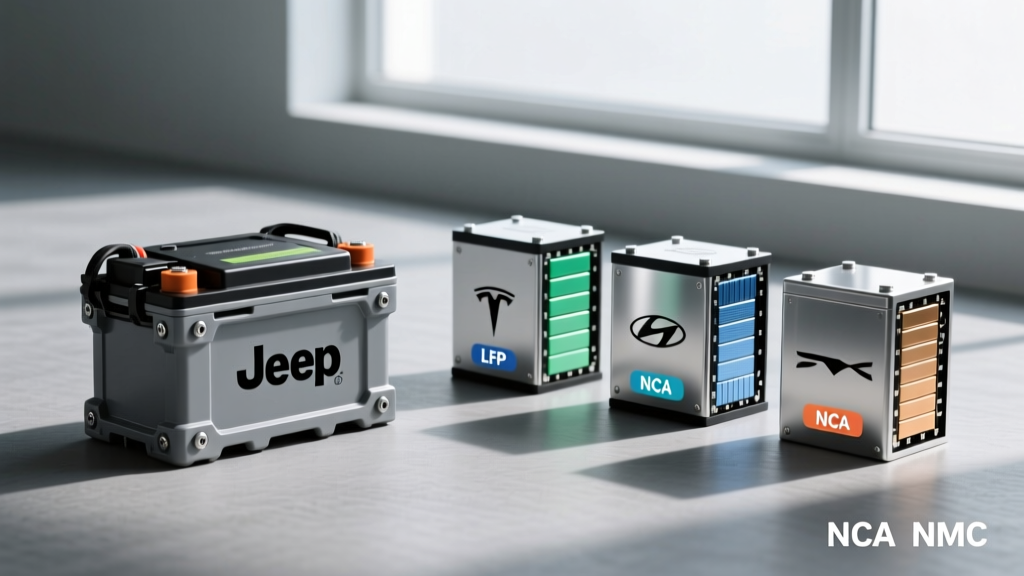
Every EV on the road today uses a lithium-ion traction battery, but not all lithium-ion cells are the same. The cathode chemistry determines energy density, cycle life, cold-weather performance, safety, and cost. The two dominant families in 2026 are LFP (lithium iron phosphate) and NMC/NCA (nickel manganese cobalt / nickel cobalt aluminum).
| Attribute | LFP (LiFePO₄) | NMC / NCA |
|---|---|---|
| Energy Density | Lower (~160 Wh/kg cell-level) | Higher (~220–260 Wh/kg cell-level) |
| Typical Range Impact | Slightly shorter range for same pack weight | Longer range or lighter pack |
| Cycle Life | 3,000–5,000+ cycles to 80% SoH | 1,000–2,000 cycles to 80% SoH |
| Cold Performance | Weaker below 32°F; needs preconditioning | Better low-temp charge/discharge |
| Thermal Stability | Excellent — very low thermal-runaway risk | Good, but requires more active management |
| Cobalt / Nickel | None (cobalt-free) | Contains cobalt and/or nickel |
| Cost (per kWh) | ~$80–$100 (2026 cell pricing) | ~$110–$140 (2026 cell pricing) |
| Common in 2026 | Tesla Model 3/Y RWD, Ford Mustang Mach-E Select, Rivian Standard, BYD | Hyundai Ioniq 5/6, Tesla Long Range, BMW iX, Mercedes EQS, Porsche Taycan |
Which is better? There's no universal winner. LFP is ideal for standard-range models, daily commuters who charge to 100% regularly (LFP actually benefits from periodic full charges), and buyers prioritizing longevity and lower cost. NMC/NCA suits long-range applications, cold-climate drivers, and performance-oriented models where energy density matters.
For context, a Jeep Wrangler 4xe uses an NMC pack (17.3 kWh usable) to deliver 21 miles of EPA electric range. Tesla's standard-range Model 3 switched to LFP in late 2021 and has seen outstanding longevity data since.
How Long Do EV Batteries Actually Last? Real Degradation Data
The most persistent EV myth is that batteries need replacing every few years like a 12V starter battery. The data tells a different story.
Observed Degradation Benchmarks (sourced from fleet data, owner surveys, and OEM reports):
- Tesla Model 3/Y (NMC and LFP): ~5–7% capacity loss at 100,000 miles, based on Tesla's 2024 Impact Report and independent fleet analysis. Many units retain 90%+ SoH at 150,000 miles.
- Nissan Leaf (early 24/30 kWh NMC, no active cooling): 15–25% loss by 80,000–100,000 miles — the cautionary tale that drove the industry toward liquid thermal management.
- Hyundai/Kia E-GMP platform (Ioniq 5, EV6): ~4–6% loss at 60,000 miles per owner-reported data on EV forums and Recurrent Auto fleet studies.
- Chevrolet Bolt EV/EUV (65 kWh NMC): ~5–8% degradation at 80,000 miles, per Recurrent Auto aggregated data across thousands of vehicles.
- BMW i3 (early 22 kWh): ~10–15% loss at 80,000 miles, with active thermal management helping despite small pack size.
Most liquid-cooled EV batteries from 2020 onward lose roughly 1–2% capacity per year or 5–8% per 100,000 miles under normal use. The degradation curve is non-linear: expect a steeper drop in the first 10,000–20,000 miles (initial formation loss), then a long, gradual plateau.
At this rate, a modern EV battery will typically retain 75–85% of its original capacity at 150,000 miles — still providing usable daily range and rarely requiring full replacement during the vehicle's first-owner lifecycle.
What Does the EV Battery Warranty Actually Cover?
Federal regulation mandates a minimum 8-year / 100,000-mile battery warranty for EVs sold in the US (extended to 10 years / 150,000 miles in California Air Resources Board states and those adopting CARB rules). Most manufacturers exceed these minimums.
| Manufacturer | Warranty Period | Capacity Retention Threshold |
|---|---|---|
| Tesla (Model 3/Y RWD — LFP) | 8 yr / 100,000 mi | 70% |
| Tesla (Long Range / Performance) | 8 yr / 120,000 mi | 70% |
| Hyundai / Kia (E-GMP) | 10 yr / 100,000 mi | 70% |
| Ford (Mach-E, F-150 Lightning) | 8 yr / 100,000 mi | 70% |
| GM (Ultium platform) | 8 yr / 100,000 mi | 70% |
| BMW | 8 yr / 100,000 mi | 70% |
| Volkswagen (ID.4) | 8 yr / 100,000 mi | 70% |
| Jeep Wrangler 4xe (PHEV) | 8 yr / 100,000 mi | 70% (hybrid battery) |
What's covered: If your battery falls below the stated retention threshold (typically 70% of original capacity) within the warranty period, the manufacturer will repair, replace, or recondition the pack at no cost. This covers manufacturing defects and abnormal degradation.
What's NOT covered: Gradual capacity loss above the threshold, damage from accidents, improper charging (extremely rare claims), or modifications. Normal degradation of, say, 15% over 8 years is considered expected behavior and falls outside warranty if you're still above 70%.
For comparison, that 12V battery for a Jeep Wrangler 2014 typically carries a 2–3 year free-replacement warranty from retailers like AutoZone or Advance Auto Parts — a fraction of the coverage an EV traction battery receives.
EV Battery Replacement Cost: What to Expect and When
Full traction battery replacement is rare during a vehicle's first 10–15 years, but it does happen — usually after collisions, manufacturing defects discovered outside warranty, or on early-generation EVs with passive thermal management.
| Vehicle / Pack Size | Battery Capacity | Replacement Cost Range (Parts + Labor) |
|---|---|---|
| Nissan Leaf (40 kWh) | 40 kWh NMC | $6,500–$9,000 |
| Chevrolet Bolt EV | 65 kWh NMC | $9,000–$14,000 |
| Tesla Model 3 (Standard Range) | ~60 kWh LFP | $10,000–$13,000 |
| Tesla Model Y / 3 Long Range | ~75–82 kWh NMC | $12,000–$16,000 |
| Hyundai Ioniq 5 / Kia EV6 | 77.4 kWh NMC | $12,000–$18,000 |
| Ford F-150 Lightning (Extended) | ~131 kWh NMC | $18,000–$28,000 |
| Porsche Taycan | 83.7 kWh NMC (net) | $20,000–$30,000 |
| Jeep Wrangler 4xe (PHEV) | 17.3 kWh NMC | $6,000–$9,000 |
Important context: These are worst-case out-of-warranty figures. Most replacements occur under warranty at zero cost to the owner. Cell-level repair is increasingly common — technicians can replace individual modules or cell groups rather than the entire pack, reducing costs to $2,000–$6,000 in many cases.
Battery pack prices have fallen from over $1,000/kWh in 2010 to roughly $115–$130/kWh at the pack level in 2026, per BloombergNEF tracking. That trend continues to push replacement costs down year over year.
For perspective: replacing the 12V battery for a Jeep Wrangler 2014 costs $150–$280 and takes 15 minutes. An EV traction battery is a fundamentally different component — more analogous to an engine than a starter battery — and the cost reflects that.
Factors That Accelerate (or Preserve) Battery Life
Battery degradation is driven by heat, high state-of-charge stress, and charge rate. Here's what actually moves the needle:
Habits That Preserve Battery Health
- Daily charge limit of 80% (NMC/NCA): Reduces cathode stress. Most EVs let you set a charge limit in the app. LFP batteries are an exception — Tesla and Ford recommend periodic 100% charges for LFP to maintain cell balancing.
- Precondition before DC fast charging: Warming the battery to its optimal temperature window (typically 77–95°F / 25–35°C) enables faster charging and reduces lithium plating risk. Most EVs precondition automatically when you navigate to a charger.
- Garage parking in extreme climates: Keeping the pack out of sustained 100°F+ heat or prolonged sub-zero cold reduces calendar degradation.
- Moderate DC fast charging frequency: Daily 250 kW sessions will accelerate wear vs. primarily Level 2 home charging. Weekly DCFC is fine; daily DCFC adds measurable degradation over years.
- Avoid prolonged storage at 100% or 0%: If leaving the car for weeks, set charge to 50–60% and leave it plugged in so the BMS can manage.
Habits That Accelerate Degradation
- Exclusive DC fast charging with no Level 2 use
- Regularly parking at 100% SoC in hot climates
- Repeated deep discharges to 0% (below the buffer)
- Ignoring thermal preconditioning in cold weather
- Aftermarket modifications to the battery management system
How to Check Your EV Battery's State of Health (SoH)
State of Health (SoH) is the percentage of original capacity your battery currently holds. A new battery is 100% SoH; at 70%, you'd hit the typical warranty replacement threshold.
Built-in tools:
- Tesla: Service menu (hold the model badge on the About screen for ~3 seconds) displays nominal vs. typical range, from which you can calculate SoH. The Tesla app also shows range at 100%.
- Hyundai/Kia: Some models display SoH in the EV settings menu; dealers can pull detailed BMS logs.
- GM (Ultium): OnStar diagnostics include battery health reports on request.
- Nissan Leaf: The dashboard "health bars" (12 bars = 100%, each bar ≈ 8.3%) provide a quick visual.
Third-party tools:
- OBD-II dongles + apps: Tools like OBDLink MX+ paired with apps such as EVNotify or LeafSpy (Nissan-specific) can read BMS data including SoH, cell voltage variance, and temperature.
- Recurrent Auto: A free service that connects to your EV's telematics and provides ongoing degradation tracking benchmarked against a fleet of identical vehicles.
- Dealer diagnostic reports: Any authorized service center can pull a full battery health report — request one before buying a used EV.
For a used-EV buyer, pulling SoH data is as critical as checking a Carfax. A 2022 Model 3 with 45,000 miles showing 94% SoH is a healthier buy than one at 88%, even if the price is similar.
What's Next: Solid-State and Silicon-Anode Batteries
Two technologies dominate the "next generation" battery conversation:
Solid-state batteries replace the liquid electrolyte with a solid conductor, promising higher energy density (potentially 400+ Wh/kg at the cell level), faster charging, and improved safety. Toyota has announced a production target for solid-state EVs around 2027–2028, while Samsung SDI and QuantumScape are in pilot-production phases. However, manufacturing scale-up and cost remain significant hurdles. Expect initial deployment in premium/low-volume models first, with mainstream adoption not arriving until the early 2030s.
Silicon-anode batteries (silicon-dominant or silicon-carbon composite anodes) offer 20–40% energy density improvement over graphite anodes. Companies like Sila Nanotechnologies and Group14 are already supplying silicon-anode materials to manufacturers. The Mercedes-AMG EQG (G-Wagen electric) is expected to use a silicon-anode pack. This technology is closer to market than solid-state and will likely appear in production vehicles from 2026–2028.
Neither technology is currently available in a production EV you can buy today. Treat any "solid-state EV" announcement with a timeline skepticism until vehicles are actually in customer hands.
From a 2014 Wrangler to a 2026 EV: The Battery Ownership Shift
The contrast is stark. Maintaining a battery for Jeep Wrangler 2014 means swapping a $200 lead-acid unit every 3–5 years, dealing with corrosion on terminals, and hoping it doesn't die on a cold morning. It's a simple, inexpensive, but recurring maintenance item.
An EV traction battery is a different paradigm entirely: a sealed, liquid-cooled, software-managed system designed to last 15+ years and 150,000+ miles with no scheduled maintenance. The upfront cost is embedded in the vehicle price, the warranty coverage is robust (8 years minimum), and the degradation is gradual and predictable.
If you're cross-shopping between keeping a reliable older gas vehicle and switching to an EV, battery longevity shouldn't be the factor holding you back. The data consistently shows that modern EV batteries outlast the period most owners keep their cars — and when they do eventually need service, module-level repair and declining pack costs make the economics manageable.
How long do EV batteries last in years and miles?
Most liquid-cooled EV batteries from 2020 onward retain 75–85% of original capacity at 150,000 miles or 10–15 years. Real-world fleet data from Tesla, Hyundai, and GM platforms shows roughly 1–2% annual degradation under normal use. Full replacement before 200,000 miles is uncommon.
How much does an EV battery cost to replace?
Out-of-warranty replacement ranges from ~$6,500 (small packs like the Nissan Leaf) to $28,000+ (large packs like the F-150 Lightning Extended Range). However, most replacements occur under the 8-year/100,000-mile warranty at no cost. Module-level repairs can cost $2,000–$6,000.
What does the EV battery warranty cover?
Federal minimum is 8 years / 100,000 miles (10 years / 150,000 miles in CARB states). If your battery drops below 70% capacity within that period, the manufacturer repairs or replaces it. Normal gradual degradation above the threshold is not covered.
How do I check and maximize my EV battery health?
Check SoH via the vehicle's built-in diagnostics, an OBD-II reader with EV-compatible software, or a service like Recurrent Auto. Maximize longevity by setting an 80% daily charge limit (NMC/NCA), preconditioning before DC fast charging, avoiding extreme-SoC storage, and primarily using Level 2 home charging.
LFP vs NMC — which battery chemistry is better?
LFP offers longer cycle life (3,000–5,000+ cycles), lower cost, and better thermal stability, but with lower energy density and weaker cold-weather performance. NMC/NCA provides higher energy density and better cold performance but at higher cost and shorter cycle life. LFP is better for daily commuters and standard-range models; NMC suits long-range and cold-climate applications.
Is the battery for Jeep Wrangler 2014 the same as an EV battery?
No. The 2014 Wrangler uses a conventional 12V lead-acid or AGM starting battery (Group 34/H7, ~$150–$280) that cranks the engine and powers accessories. An EV traction battery is a high-voltage lithium-ion pack (typically 400V–800V, 50–130+ kWh) that propels the vehicle. Even the Jeep Wrangler 4xe plug-in hybrid uses both: a 12V starter battery plus a 17.3 kWh NMC traction battery.