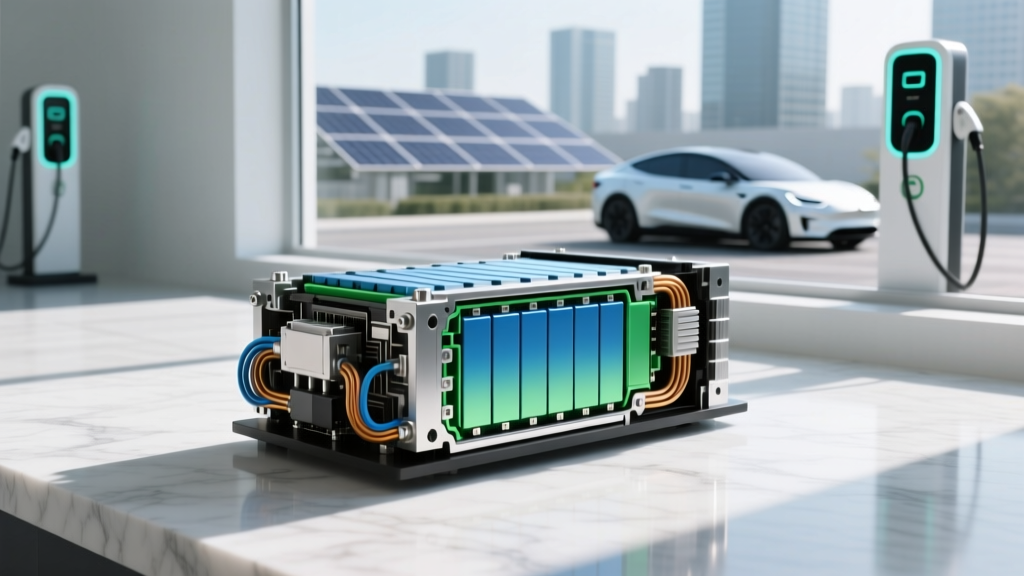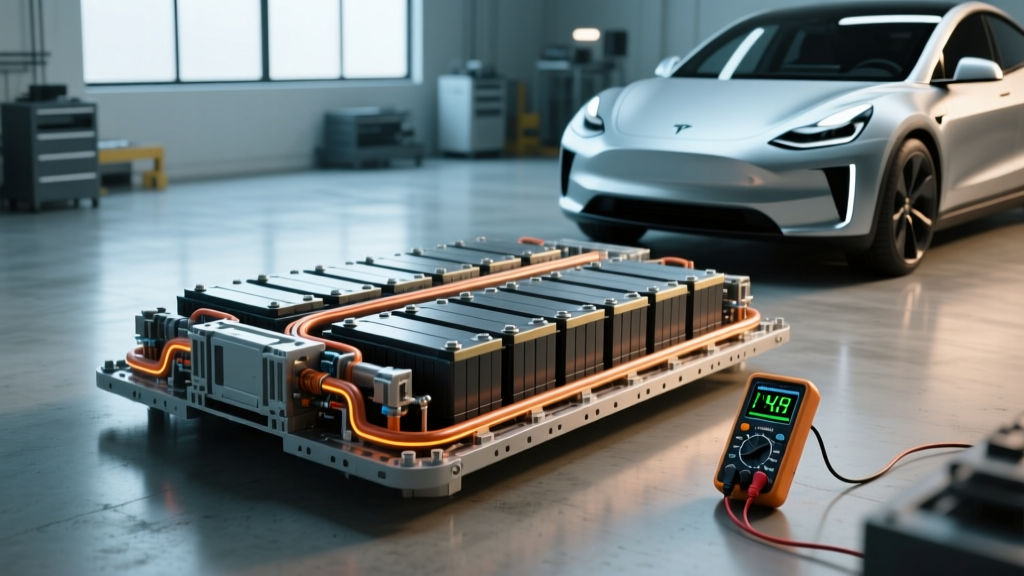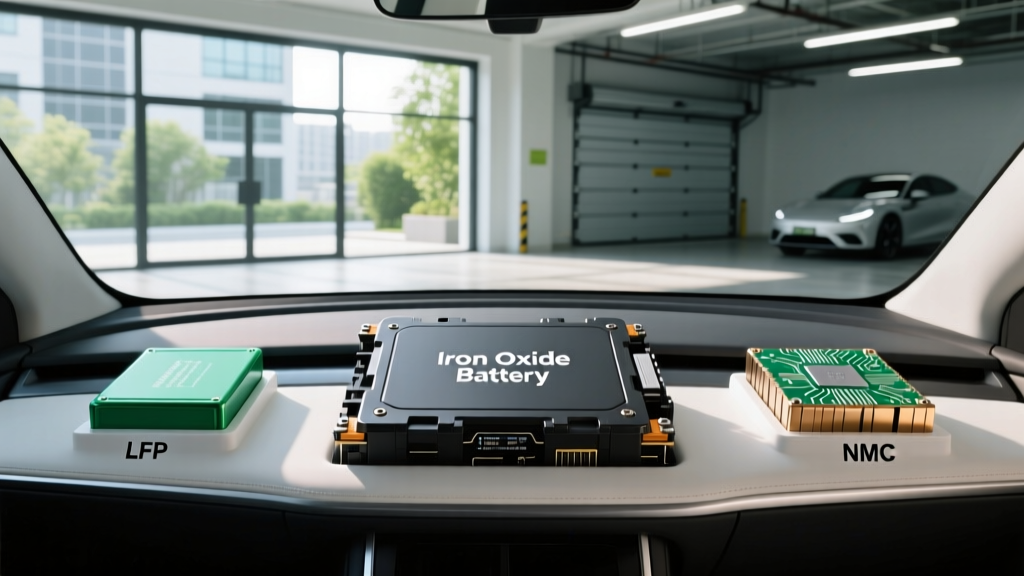
Search for the next big leap in EV battery technology and you will eventually encounter the term iron oxide battery. It sounds like a breakthrough — abundant materials, ultra-low cost, potentially massive cycle life. But what exactly is it, how does it stack up against the lithium iron phosphate (LFP) and nickel manganese cobalt (NMC) cells powering today's EVs, and is it something you can actually put in your driveway? This guide separates the lab-bench promises from the drivetrain reality, while giving you the exact degradation figures, warranty terms, and replacement costs you need to evaluate any EV battery in 2026.
What Is an Iron Oxide Battery — and Is It Available?
An iron oxide battery uses iron oxide (rust, essentially) as a primary active material in the anode or cathode. Several research groups — including teams at UC Riverside and various Chinese universities — have demonstrated iron oxide anodes in lithium-ion configurations that offer high theoretical capacity (around 1,000 mAh/g for Fe₂O₃, compared to roughly 372 mAh/g for conventional graphite). Some prototypes also explore iron oxide in iron-air or conversion-type chemistries aimed at grid-scale storage.
The catch: no production electric vehicle sold in the U.S. as of the 2026 model year uses an iron oxide battery. The technology remains in the research and early-prototype stage. The challenges are significant:
- Volume expansion: Iron oxide anodes can swell by 100%+ during lithiation, cracking the electrode and killing cycle life within a few hundred cycles in most lab configurations.
- Low initial Coulombic efficiency: First-cycle losses of 30-40% are common, meaning a large portion of the lithium inventory is consumed before the battery is even usable.
- Poor rate capability: Iron oxide's low electrical conductivity limits fast-charging performance — a critical drawback for EVs.
- Manufacturing scale: No established supply chain exists for iron oxide electrodes at automotive volumes.
If you see a startup or headline touting iron oxide batteries, treat the timeline with skepticism. Realistic commercialization for passenger EVs is at least 7-10 years away, and more likely a grid-storage application first. For buyers shopping today, the relevant chemistries are LFP and NMC/NCA.
LFP vs NMC/NCA: The Chemistry Comparison That Matters Now
Every EV sold in the U.S. in 2026 uses one of two dominant lithium-ion chemistries. Here is how they compare on the metrics that affect your ownership experience:
| Attribute | LFP (Lithium Iron Phosphate) | NMC/NCA (Nickel-Based) |
|---|---|---|
| Energy density (cell-level) | 160-180 Wh/kg | 250-300 Wh/kg |
| Typical cycle life | 3,000-6,000+ cycles | 1,000-2,000 cycles |
| Cold-weather performance | Moderate (slower charge below 32°F) | Better low-temp discharge, still reduced |
| Cost per kWh (pack-level) | ~$90-$110 | ~$120-$150 |
| Thermal stability / safety | Excellent (high thermal runaway threshold ~270°C) | Good but lower threshold (~210°C) |
| Recommended daily SoC | 100% OK (no degradation penalty) | 80% for daily, 100% only for trips |
| Common 2026 vehicles | Tesla Model 3/Y RWD, Ford Mustang Mach-E Select (LFP option), BYD models | Tesla Long Range, Hyundai Ioniq 5, BMW iX, Rivian R1T/R1S |
| Key trade-off | Lower range per kg; heavier pack for same range | Higher range; degrades faster if held at 100% |
Which is better? It depends on your use case. If you commute daily, charge at home, and want maximum longevity with minimal babysitting, LFP is the stronger pick — you can charge to 100% every night without penalty, and the cycle life is exceptional. If you need maximum range for road trips or live in an apartment without regular charging access, NMC/NCA gives you more miles per kilogram, which translates to a lighter, longer-range vehicle at a given price point.
How Long Do EV Batteries Actually Last?
The fear that EV batteries need replacing every few years is not supported by fleet data. Here is what real-world degradation looks like, drawn from aggregated owner reports and manufacturer testing:
| Vehicle / Chemistry | Mileage | Average Capacity Retention | Source |
|---|---|---|---|
| Tesla Model 3/Y (NMC) | 100,000 mi | ~88-92% | Tesla Impact Report 2024 |
| Tesla Model 3 RWD (LFP) | 100,000 mi | ~93-96% | Fleet owner data (Recurrent, 2025) |
| Hyundai Ioniq 5 (NMC) | 80,000 mi | ~90-93% | Owner surveys, Hyundai forums |
| Chevrolet Bolt EV (NMC) | 100,000 mi | ~85-90% | Recurrent Auto 2025 study |
| Nissan Leaf (LMO/NMC) | 80,000 mi | ~80-87% (air-cooled) | Owner data; Leaf lacks active thermal mgmt |
Several takeaways emerge from this data:
- Most modern EV batteries retain 85-95% of capacity at 100,000 miles. This means a vehicle with a 300-mile EPA range when new will still deliver roughly 255-285 miles at that mileage.
- LFP degrades more slowly than NMC in typical daily-use patterns, particularly when charged to 100% regularly.
- Thermal management matters enormously. The Nissan Leaf's passive (air) cooling leads to noticeably faster degradation compared to liquid-cooled packs from Tesla, Hyundai, or GM.
- Most batteries will outlast the vehicle. The average age of a scrapped passenger car in the U.S. is roughly 15 years. At 12,000 miles/year, that is 180,000 miles — well within the lifespan of a modern liquid-cooled pack.
Battery Warranty Terms: What Is Actually Covered?
Federal law mandates that EV batteries carry a minimum warranty of 8 years / 100,000 miles (in California Air Resources Board states, the powertrain warranty extends to 10 years / 150,000 miles). But the details matter. Here is what major manufacturers offer for 2026 models:
| Manufacturer | Warranty Term | Capacity Retention Threshold | Notes |
|---|---|---|---|
| Tesla (Model 3/Y) | 8 yr / 120,000 mi (LR); 8 yr / 100,000 mi (RWD) | 70% | Covers defect + excessive degradation below threshold |
| Hyundai / Kia | 10 yr / 100,000 mi | 70% | Among the longest coverage in the industry |
| GM (Ultium platform) | 8 yr / 100,000 mi | 70% (some models 60%) | Verify exact threshold per model year |
| Ford (Mach-E, F-150 Lightning) | 8 yr / 100,000 mi | 70% | Applies to traction battery only |
| Rivian | 8 yr / 175,000 mi (Max pack); 8 yr / 120,000 mi (Standard) | 70% | Higher mileage threshold on larger packs |
| BMW (iX, i4) | 8 yr / 100,000 mi | 70% | BMW also offers Battery Health Report via app |
Critical nuance: The warranty triggers when capacity drops below the stated threshold (typically 70%). A battery at 72% capacity at 95,000 miles is functioning within warranty spec, even though you have lost 28% of your original range. Also, warranties generally exclude damage from accidents, flooding, improper charging equipment, or unauthorized modifications. Always read the specific warranty booklet for your model year — terms change.
EV Battery Replacement Cost: The Real Numbers
If your battery does degrade below the warranty threshold — or if it is damaged out of warranty — replacement is expensive. However, most owners will never face this cost. Here is what out-of-pocket replacement looks like across popular 2026 models:
| Vehicle | Battery Size (usable kWh) | Chemistry | Estimated Replacement Cost | Labor / Notes |
|---|---|---|---|---|
| Tesla Model 3 RWD | ~57 kWh | LFP | $10,000-$14,000 | Single-pack design; Tesla refurb program may reduce cost |
| Tesla Model Y Long Range | ~75 kWh | NMC | $14,000-$18,000 | Structural pack; higher labor for removal |
| Hyundai Ioniq 5 | ~77.4 kWh | NMC | $13,000-$17,000 | E-GMP platform; module-level repair possible |
| Ford F-150 Lightning (Extended) | ~131 kWh | NMC | $22,000-$30,000 | Largest consumer pack; high parts cost |
| Chevrolet Equinox EV | ~85 kWh | NMC (Ultium) | $14,000-$18,000 | Ultium modular design allows partial replacement |
| Nissan Leaf (if still in service) | ~40-62 kWh | NMC/LMO | $6,500-$9,000 | Simpler pack; aftermarket options exist |
Key context: Pack-level prices have fallen from over $1,000/kWh in 2010 to roughly $130-$150/kWh at the cell level in 2026, per BloombergNEF. However, dealer-installed replacement pricing includes labor ($1,500-$4,000), shop supplies, and markup. Some manufacturers — notably Tesla and GM — offer refurbished or remanufactured packs at a discount. Also, module-level replacement (swapping only the degraded modules rather than the entire pack) is increasingly possible on Ultium and E-GMP platforms, reducing cost to $3,000-$8,000 for a partial fix.
Factors That Accelerate Battery Degradation
Not all miles age a battery equally. The following factors have the most measurable impact on long-term capacity retention:
1. State of Charge (SoC) Habits
For NMC/NCA batteries, sitting at 100% SoC for extended periods accelerates electrolyte decomposition and cathode stress. Best practice: Charge to 80% for daily driving; reserve 100% for road trips where you will begin driving immediately. LFP batteries tolerate 100% SoC much better — in fact, Tesla recommends periodic 100% charges for LFP packs to maintain accurate state-of-charge estimation.
2. DC Fast-Charging Frequency
High-power DC fast charging (150-350 kW) generates significant heat. Occasional fast charging on road trips has negligible impact, but daily reliance on DCFC — especially without preconditioning — measurably accelerates degradation. A 2024 study by Recurrent Auto found that vehicles fast-charging more than 3 times per week showed roughly 2-4% additional capacity loss over 100,000 miles compared to primarily Level 2-charged vehicles.
3. Extreme Temperatures
Battery chemistry degrades faster above 95°F ambient (especially when combined with high SoC) and below 20°F (where lithium plating can occur during charging without proper preconditioning). Modern liquid-cooled packs mitigate this substantially, but vehicles parked outdoors in Phoenix or Minneapolis will see slightly faster degradation than those in temperate climates. Always precondition your battery before fast charging in cold weather — most EVs do this automatically when a charger is set as the navigation destination.
4. Depth of Discharge
Regularly draining a battery to 5-10% and then charging to 100% (a full 0-100 cycle) stresses cells more than partial cycles. Shallow cycles — say, 30% to 80% — are gentler. This is another reason LFP excels for daily commuting: you can plug in nightly and keep the battery in a narrow, comfortable SoC band.
Battery Care Checklist for Maximum Longevity
- ✅ NMC/NCA: Set daily charge limit to 80%; charge to 100% only before trips
- ✅ LFP: Charge to 100% at least weekly for SoC calibration
- ✅ Prioritize Level 2 home charging; use DCFC for road trips, not daily routine
- ✅ Precondition battery before fast charging in cold weather (set charger as nav destination)
- ✅ Avoid leaving the vehicle at 100% SoC for more than 24 hours
- ✅ Park in shade or a garage during sustained high-heat periods when possible
- ✅ Do not let the battery sit below 10% SoC for extended periods (days/weeks)
- ✅ Keep tire pressure optimized — higher rolling resistance means more energy drawn per mile, increasing battery cycling
How to Check and Monitor Battery Health (SoH)
State of Health (SoH) is the percentage of your battery's original capacity that remains usable. A new battery is 100% SoH; at 70% SoH, your 300-mile vehicle now has roughly 210 miles of range. Here is how to check it:
- In-vehicle displays: Tesla provides a battery health percentage in the Service menu (Software 2025.26+). BMW offers a Battery Health Report in the iDrive system and companion app. Hyundai/Kia displays are less granular but show estimated range trends.
- OBD-II diagnostic tools: Devices like the OBDLink MX+ paired with apps such as LeafSpy (Nissan), Scan My Tesla, or ABRP's battery health feature can read real-time SoH, cell voltages, and pack temperature from the BMS (Battery Management System).
- Third-party services: Companies like Recurrent and Recurrent's partner dealerships offer battery health reports that compare your pack's degradation to a fleet average of the same model and mileage.
- Manual calculation: Charge to 100%, record the displayed range, and compare it to the original EPA range. This is approximate (displayed range varies with recent driving patterns) but gives a reasonable estimate over time.
For used-EV buyers, a battery health report should be a non-negotiable part of the pre-purchase inspection. A 3-year-old Model 3 Long Range showing 94% SoH is in excellent shape; one at 82% warrants negotiation or walking away.
Emerging Battery Technologies: Beyond Iron Oxide
While iron oxide remains a research curiosity, several other next-generation technologies are closer to production — though still not available in 2026 model-year vehicles:
- Solid-state batteries: Toyota, Samsung SDI, and QuantumScape have announced solid-state prototypes with energy densities exceeding 400 Wh/kg and 10-minute fast-charge capability. Toyota has stated a 2027-2028 production target for limited models, but no solid-state EV is currently on sale. Expect initial availability in luxury or low-volume vehicles, with mainstream adoption likely post-2030.
- Silicon-dominant anodes: Companies like Sila Nanotechnologies and Group14 are supplying silicon-carbon composite anodes to manufacturers including Mercedes-Benz (for the upcoming G-Class electric). Silicon anodes offer 20-40% higher energy density than graphite. Limited production vehicles with silicon-anode cells are expected in 2027-2028.
- Sodium-ion batteries: CATL and BYD have begun producing sodium-ion cells for low-cost, short-range EVs in China. Energy density is roughly 140-160 Wh/kg — lower than LFP — but raw materials are dramatically cheaper. U.S. availability is uncertain and likely post-2028.
- LMFP (Lithium Manganese Iron Phosphate): An evolution of LFP that adds manganese for ~15-20% higher energy density while retaining LFP's safety and cycle-life advantages. Tesla and other manufacturers are expected to adopt LMFP cells in standard-range models by 2027-2028.
All of these technologies are announced or in pilot production. None are available in a vehicle you can purchase today. Treat any marketing claim suggesting otherwise with extreme skepticism, and verify against the manufacturer's official U.S. spec sheet.
Frequently Asked Questions
Is an iron oxide battery available in any 2026 EV?
No. Iron oxide battery technology is in the research and prototype stage. No production passenger vehicle sold in the United States uses iron oxide cells. The dominant chemistries remain LFP and NMC/NCA, both of which offer proven longevity and established supply chains.
How long do EV batteries last in years and miles?
Modern liquid-cooled EV batteries typically retain 85-95% of their original capacity at 100,000 miles. At an average of 12,000 miles per year, that translates to roughly 8+ years before meaningful range loss. Most batteries will outlast the vehicle's body and interior. LFP chemistry tends to degrade more slowly than NMC in daily-use scenarios.
How much does it cost to replace an EV battery?
Out-of-warranty replacement costs range from roughly $6,500 (smaller packs like the Nissan Leaf) to $30,000 (large packs like the F-150 Lightning Extended Range). Most popular mid-size EVs fall in the $12,000-$18,000 range including labor. Module-level repair on platforms like GM Ultium or Hyundai E-GMP can reduce costs to $3,000-$8,000. However, the vast majority of owners never need a replacement — the battery is covered under warranty for 8-10 years, and most packs outlast the car.
What does the EV battery warranty cover?
Federal law requires a minimum 8-year/100,000-mile warranty on EV traction batteries (10 years/150,000 miles in CARB states). Coverage includes manufacturing defects and capacity loss below a stated threshold — typically 70% of original capacity. Some manufacturers, like Rivian, offer higher mileage thresholds on larger packs. Warranties do not cover damage from accidents, flooding, or unauthorized modifications. Always review your specific model-year warranty booklet.
How do I check my EV's battery health?
Many modern EVs display battery health in the vehicle's settings menu or companion app (Tesla, BMW, and others). You can also use an OBD-II adapter with apps like Scan My Tesla or LeafSpy to read State of Health (SoH) directly from the battery management system. Third-party services like Recurrent offer fleet-comparison reports. For used-EV purchases, insist on a battery health report as part of the pre-purchase inspection.
LFP or NMC — which battery chemistry should I choose?
Choose LFP if: you charge at home daily, want maximum cycle life, prefer charging to 100% without worry, and do not need the absolute longest single-charge range. Choose NMC/NCA if: you need maximum range for road trips, want the lightest possible pack for a given capacity, or regularly drive in very cold climates where NMC's low-temperature discharge characteristics are marginally better. Both chemistries are proven and reliable in 2026 vehicles.
Does frequent DC fast charging damage the battery?
Occasional DC fast charging on road trips has minimal long-term impact. However, relying on DCFC as your primary charging method — especially without preconditioning — adds measurable degradation over time (roughly 2-4% additional loss over 100,000 miles per Recurrent Auto data). Level 2 home charging at 7-11 kW is the gentlest and most cost-effective method for daily use.
Will solid-state batteries make current EVs obsolete?
Not in the near term. Solid-state batteries remain in limited prototype and pilot production as of 2026, with Toyota targeting 2027-2028 for initial low-volume deployment. Mainstream, affordable solid-state EVs are unlikely before 2030+. Current LFP and NMC batteries offer excellent longevity, and today's EVs will remain practical and supported for years. Do not delay a purchase waiting for solid-state — the timeline is uncertain and initial offerings will carry a significant price premium.