If you have been following energy-storage headlines, you have likely seen the term iron-air battery surface alongside promises of ultra-cheap, long-duration storage. Form Energy's iron-air cells have demonstrated multi-day energy storage at a fraction of lithium-ion cost, prompting a natural question from EV shoppers: will this chemistry end up under the hood of your next electric car?
The short answer: not anytime soon, and probably not ever for passenger vehicles. Iron-air batteries are engineered for grid-scale, multi-day duration storage where weight and volume are secondary concerns. But understanding why iron-air occupies a different lane than the lithium-ion cells powering today's EVs requires a solid grasp of battery chemistry trade-offs — and that knowledge directly impacts which EV you should buy today.
This guide breaks down the chemistries that actually matter for EV buyers in 2026, explains degradation with real data, covers warranty terms and replacement costs, and puts emerging technologies like iron-air and solid-state into realistic context.
What Is an Iron-Air Battery, and Why It Is Not Coming to Your EV
An iron-air battery uses the reversible oxidation of iron (essentially, controlled rusting and un-rusting) to store and release energy. The concept is elegantly simple: expose iron to air and water during discharge, then reverse the process during charging. Companies like Form Energy have scaled this chemistry to grid installations, targeting 100+ hour storage durations at costs potentially below $20/kWh at the cell level.
That cost figure sounds extraordinary compared to lithium-ion packs that still run roughly $100–$140/kWh at the cell level in 2026. But the trade-offs are disqualifying for automotive use:
- Extremely low power density: Iron-air cells cannot discharge quickly enough to accelerate a 4,500-lb vehicle. They are designed for slow, steady output over days.
- Massive weight per kWh: The energy density by weight is a small fraction of lithium-ion. A 75 kWh iron-air pack would weigh several thousand pounds.
- Slow charge acceptance: Reversing the oxidation process takes many hours — incompatible with any DC fast-charging expectation.
- Form factor: Current iron-air modules are built for stationary racks in shipping-container-sized installations, not vehicle skateboard platforms.
Iron-air is a legitimate breakthrough for grid storage, where it can backstop renewable generation across multi-day weather lulls. For EV traction batteries, lithium-ion chemistries — specifically LFP and NMC/NCA — remain the only viable options, and that will not change within any foreseeable vehicle development cycle.
LFP vs. NMC/NCA: The Chemistry Decision That Shapes Your EV
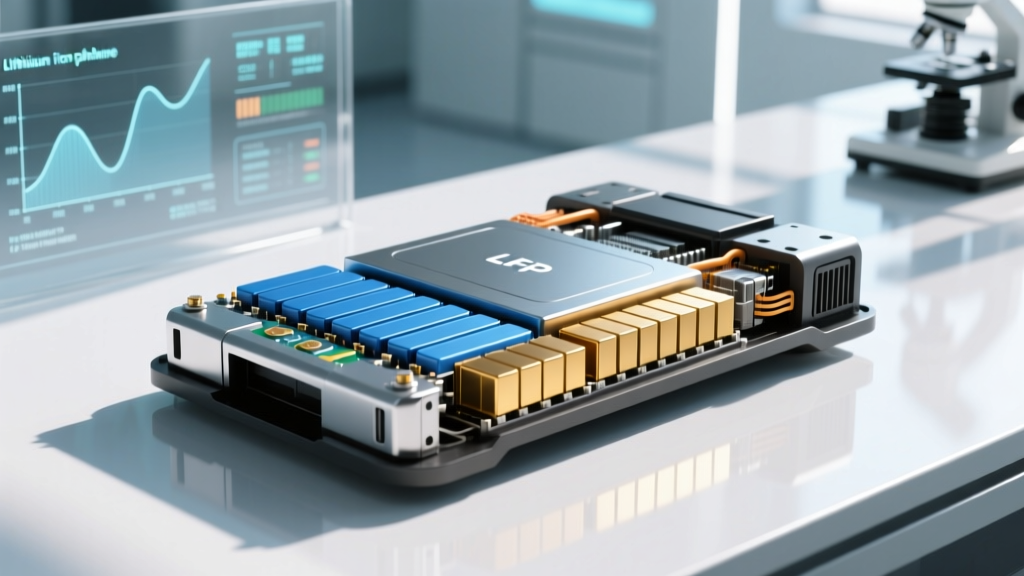
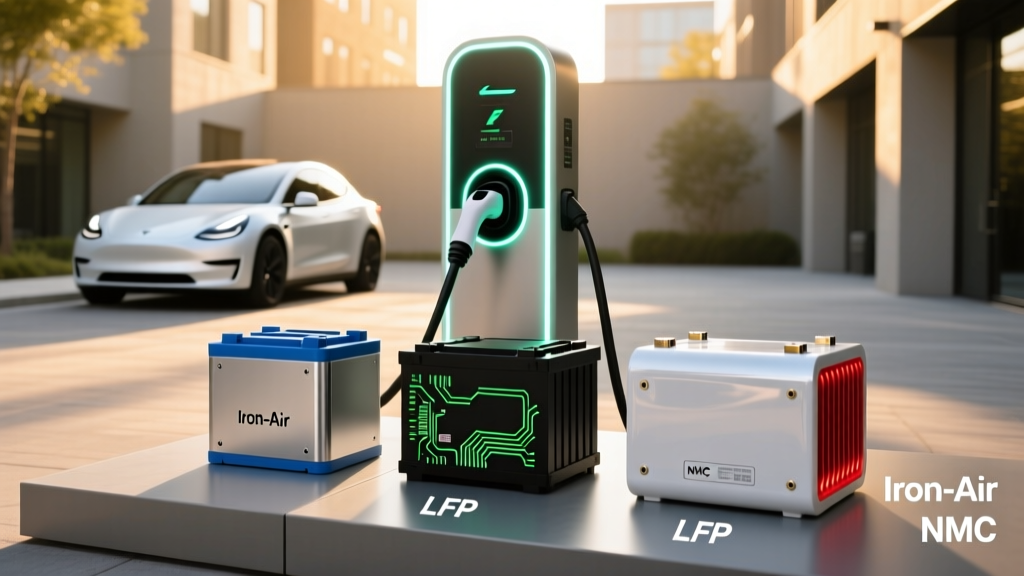
Every EV sold in the US in 2026 uses one of two dominant cathode chemistries: LFP (lithium iron phosphate, LiFePO₄) or NMC/NCA (nickel manganese cobalt / nickel cobalt aluminum). The choice affects your range, charging behavior, longevity, and even how you should manage daily state of charge.
| Attribute | LFP (Lithium Iron Phosphate) | NMC / NCA (Nickel-based) |
|---|---|---|
| Energy Density (cell-level) | ~160–180 Wh/kg | ~220–300 Wh/kg |
| Cycle Life | 3,000–6,000+ cycles to 80% SoH | 1,000–2,500 cycles to 80% SoH |
| Daily Charge Recommendation | 100% SoC is fine daily | 80% SoC recommended daily; 100% for trips only |
| Cold-Weather Performance | Weaker below 32°F; slower charge acceptance | Better low-temp performance with thermal management |
| Cost (cell-level, 2026) | ~$70–$90/kWh | ~$100–$140/kWh |
| Cobalt Content | None | Varies; trending lower but still present |
| Typical EV Applications | Tesla Model 3/Y RWD, Ford Mustang Mach-E Select (LFP trims), BYD models, base-trim standard-range packs | Long-range and performance trims across most OEMs |
| Thermal Stability | Excellent; very resistant to thermal runaway | Good with active thermal management; more sensitive at high SoC |
What this means practically: If you buy a standard-range Tesla Model 3 with an LFP pack, you can (and should) charge to 100% regularly — the BMS actually needs periodic full charges for accurate state-of-charge calibration. If you opt for a long-range NMC pack, daily charging to 80% extends calendar life significantly, and you save 100% for road trips.
Neither chemistry is universally "better." LFP wins on longevity and cost; NMC wins on energy density and cold-weather capability. Your commute pattern, climate, and ownership horizon should drive the choice.
How Long Do EV Batteries Actually Last? Degradation Data
The most persistent EV myth is that batteries need replacement every few years like smartphone batteries. Real-world fleet data tells a different story. Most modern EV battery packs will outlast the vehicle's useful economic life.
Typical degradation trajectory for liquid-cooled NMC and LFP packs (fleet-averaged data):
- Year 1 / 15,000 miles: 2–4% capacity loss (initial formation settling)
- Year 3 / 45,000 miles: 5–8% total loss
- Year 5 / 75,000 miles: 7–12% total loss
- Year 8 / 120,000 miles: 10–18% total loss (LFP typically at the lower end)
- Year 10 / 150,000 miles: 12–22% total loss
Sources: Geotab fleet battery health studies, Recurrent Auto battery degradation reports, OEM warranty data.
A few critical nuances behind these numbers:
- The degradation curve is not linear. Most packs lose capacity faster in the first year or two, then the curve flattens considerably. A pack that has lost 8% by year 3 is not on track to lose 24% by year 9 — it will likely lose far less.
- Calendar aging matters as much as cycle aging. A garage-kept EV driven 5,000 miles/year still degrades from time and temperature exposure. High SoC + high ambient temperature is the worst combination for calendar aging.
- LFP packs show less degradation at high cycle counts but can exhibit larger apparent capacity swings due to their flat voltage curve, which makes BMS estimation harder. Periodic 100% charges help recalibrate.
Battery Warranty Terms: What OEMs Actually Cover
Federal regulation mandates a minimum 8-year/100,000-mile warranty on EV battery packs for emissions-related compliance, and most manufacturers meet or exceed this baseline. Here is what the major warranties look like in 2026:
| Manufacturer | Battery Warranty | Capacity Retention Threshold |
|---|---|---|
| Tesla (Model 3/Y LFP) | 8 years / 100,000 miles | 70% minimum |
| Tesla (Model 3/Y LR/Perf) | 8 years / 120,000 miles | 70% minimum |
| Hyundai / Kia (E-GMP) | 10 years / 100,000 miles | 70% minimum |
| Ford (Mustang Mach-E, F-150 Lightning) | 8 years / 100,000 miles | 70% minimum |
| GM (Ultium platform) | 8 years / 100,000 miles | 70% minimum (some trims 60% for commercial) |
| Rivian | 8 years / 175,000 miles | 70% minimum |
| BMW (Neue Klasse / iX) | 8 years / 100,000 miles | 70% minimum |
Key details buyers miss:
- The 70% threshold means the manufacturer will repair or replace modules (not necessarily the entire pack) only if measured capacity drops below 70% of original within the warranty period. Most packs never reach this threshold under normal use.
- Warranty coverage typically excludes damage from collisions, flooding, improper charging equipment, or unauthorized modifications.
- Some warranties transfer to second owners, which supports EV resale values. Verify transferability before buying used.
EV Battery Replacement Cost: Numbers and Context
Out-of-warranty battery replacement is the scenario that generates the most anxiety — and the most misleading headlines. Here are realistic 2026 replacement costs based on pack size and chemistry:
| Vehicle Category | Pack Size (usable kWh) | Chemistry | Estimated Replacement Cost |
|---|---|---|---|
| Compact sedan (e.g., Tesla Model 3 RWD) | 57–60 kWh | LFP | $7,000–$10,000 |
| Mid-size crossover LR (e.g., Model Y LR, Ioniq 5) | 75–84 kWh | NMC | $10,000–$16,000 |
| Full-size truck (e.g., F-150 Lightning Ext. Range) | 131 kWh | NMC | $18,000–$28,000 |
| Luxury sedan (e.g., Lucid Air, Mercedes EQS) | 100–118 kWh | NMC/NCA | $15,000–$25,000 |
Context that matters:
- Most EVs never need a full pack replacement. Module-level repairs (replacing a handful of degraded or failed modules) are increasingly possible and cost $2,000–$5,000 depending on the pack architecture.
- Cell prices continue declining. A pack that costs $15,000 to replace in 2026 will likely cost significantly less by the time a 2026 model year vehicle is 12–15 years old.
- The vehicle is often totaled before the battery fails. Average US vehicle age is ~12.6 years. At typical degradation rates, a 12-year-old EV pack retains 78–88% capacity — still functional, just with reduced range.
Factors That Accelerate or Slow Battery Degradation
Not all miles are equal when it comes to battery wear. These factors have the largest measurable impact on long-term State of Health (SoH):
Highest-impact degradation accelerators:
- Sustained high SoC in heat: Parking at 100% SoC in 95°F+ ambient temperatures causes the most calendar-aging damage. If you must charge to 100%, drive away soon after reaching full charge.
- Frequent DC fast charging above 150 kW without preconditioning: High-current charging stresses cells thermally. Always use the vehicle's navigation-based preconditioning (routing to a charger triggers this automatically in most 2026 models).
- Regular discharge below 10% SoC: Deep discharges stress the anode. Try not to routinely run the pack below 15–20%.
- Extreme cold charging without preconditioning: Charging a cold NMC pack at high kW can cause lithium plating on the anode, permanently reducing capacity.
Practices that maximize longevity:
- Charge to 80% daily for NMC/NCA; 100% is fine for LFP
- Use Level 2 home charging as your primary method (gentler than daily DCFC)
- Enable scheduled departure charging so the pack reaches target SoC just before you drive, not hours before
- Keep the vehicle plugged in during extreme heat or cold so the thermal management system can maintain pack temperature
- For long-term storage (2+ weeks), leave the pack at ~50% SoC in a cool environment
Monitoring Battery Health: How to Check Your SoH
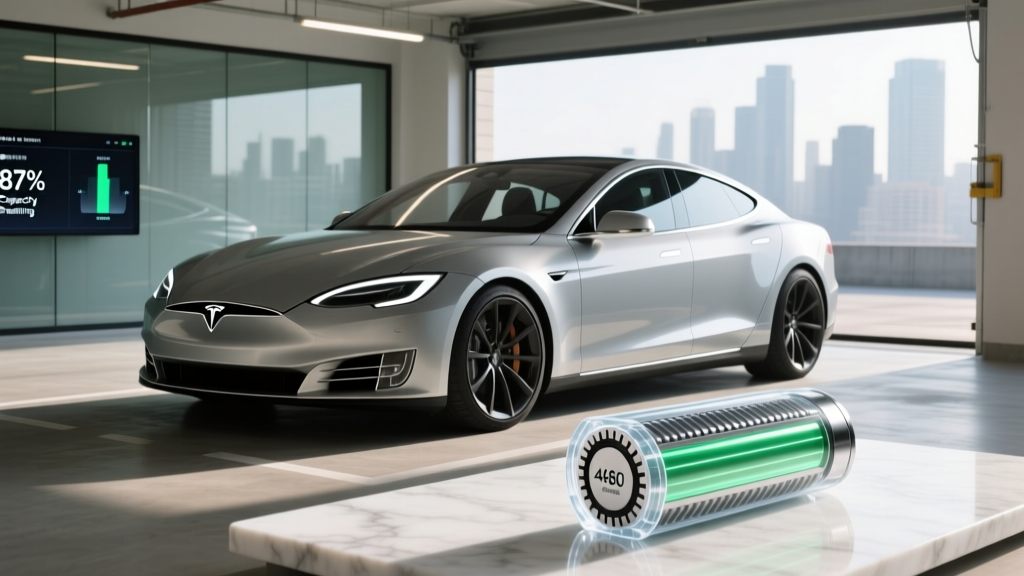
State of Health (SoH) is the percentage of your battery's original capacity that remains available. A new pack is 100% SoH; a pack with 90% SoH holds 90% of its original kWh.
OEM-integrated tools:
- Tesla: The mobile app does not display SoH directly, but you can estimate it by comparing the displayed range at 100% SoC to the original EPA range. Third-party apps like Tessie or Stats for Tesla pull more granular BMS data.
- Hyundai/Kia: The EV Settings menu in newer models includes a battery health indicator. The BlueLink/Kia Connect app provides additional data.
- GM (Ultium): The myChevrolet/myCadillac app includes a battery health section showing estimated SoH percentage.
- Ford: The FordPass app displays battery health status, and dealerships can pull detailed BMS logs.
Third-party and OBD-II tools: Devices like the OBDLink SX combined with apps such as ABRP (A Better Routeplanner) or Car Scanner can read BMS-reported SoH directly from the CAN bus. This is the most reliable method for used-EV buyers who want independent verification before purchase.
Dealership SoH certification: Some manufacturers (notably Nissan with the Leaf's battery health certificate) offer official SoH documentation. Request this when buying a certified pre-owned EV.
Beyond Iron-Air: Solid-State, Silicon Anodes, and Realistic Timelines
While iron-air is grid-bound, other next-generation chemistries are genuinely headed for EVs — just not as quickly as headlines suggest.
Solid-state batteries: These replace the liquid electrolyte with a solid conductor, promising higher energy density (potentially 400+ Wh/kg at the cell level), faster charging, and improved safety. Toyota has announced limited solid-state production for 2027–2028, initially in low volumes for premium models. Samsung SDI and QuantumScape are targeting similar timelines. Realistically, broad solid-state availability in mainstream EVs is a 2029–2032 prospect, and initial packs will carry significant cost premiums.
Silicon-dominant anodes: Replacing graphite anodes with silicon can boost energy density 20–40%. Companies like Sila Nanotechnologies and Group14 are already supplying silicon-composite anode materials to battery manufacturers. Expect incremental silicon-anode adoption across 2026–2028 model-year vehicles, particularly in performance and long-range trims. This is the nearest-term improvement most buyers will actually see.
Sodium-ion batteries: CATL and other manufacturers have begun sodium-ion cell production for lower-cost, lower-range applications. These may appear in budget EVs or as range-extender auxiliary packs, but energy density (~140–160 Wh/kg) limits their use in long-range vehicles.
None of these technologies change the buying calculus for 2026. Today's LFP and NMC packs, paired with modern thermal management, already deliver 200,000+ mile service life with manageable degradation. The chemistries coming next will improve cost and energy density, but they are not worth delaying a purchase to wait for.
Frequently Asked Questions
Will iron-air batteries ever be used in electric cars?
Almost certainly not. Iron-air batteries are designed for stationary, multi-day grid storage where weight, volume, and power density are irrelevant. Their extremely low power output and massive weight per kWh make them fundamentally incompatible with vehicle propulsion. They solve a real and important problem — long-duration renewable energy storage — but that problem is on the grid, not in your driveway.
How long do EV batteries last in years and miles?
Modern liquid-cooled EV battery packs routinely last 15–20 years and 200,000+ miles before reaching 70–80% of original capacity. Fleet data from Geotab and Recurrent Auto shows that average annual degradation for well-managed packs is roughly 1.5–2.3% per year after the initial break-in period. Many packs outlive the vehicle they were installed in.
How much does it cost to replace an EV battery in 2026?
Full pack replacement costs range from roughly $7,000 for a compact LFP pack (e.g., Tesla Model 3 RWD) to $28,000 for a large truck pack (e.g., F-150 Lightning Extended Range). However, most replacements are module-level repairs at $2,000–$5,000, and most packs never need replacement at all during the vehicle's life. Cell prices are also declining, so future replacement costs will be lower than today's figures.
What does the EV battery warranty actually cover?
Federal minimum is 8 years / 100,000 miles with a 70% capacity retention threshold. Some OEMs offer 10 years (Hyundai/Kia) or higher mileage limits (Rivian at 175,000 miles). Coverage applies to capacity loss below the threshold and manufacturing defects, but excludes collision damage, improper charging, and unauthorized modifications. Module-level repairs are common and covered under warranty.
LFP vs. NMC — which battery chemistry should I choose?
Choose LFP if you want maximum cycle life, plan to own the vehicle 8+ years, live in a moderate climate, and prefer the simplicity of charging to 100% daily. Choose NMC/NCA if you need maximum range per charge, regularly drive in cold weather, or prioritize performance. Both chemistries are proven and reliable — the right choice depends on your driving patterns and ownership timeline, not on one being objectively superior.
Does frequent DC fast charging damage the battery?
Occasional DC fast charging is fine and expected. The risk comes from exclusive DCFC use without preconditioning, particularly at high power levels (250+ kW) on a cold pack. Modern BMS systems actively manage charge rates and temperatures to limit damage, but fleet data shows vehicles that DCFC more than 3–4 times per week exhibit slightly higher degradation (~1–2% additional over 5 years) compared to predominantly Level 2-charged vehicles. Use Level 2 at home as your baseline and DCFC for road trips.
How can I check my EV battery's State of Health before buying used?
The most reliable method is an OBD-II scan using a tool like OBDLink SX with Car Scanner or a brand-specific app to read BMS-reported SoH directly. You can also compare the displayed range at 100% charge to the original EPA rating — if a 310-mile EPA vehicle shows 265 miles at 100%, that suggests roughly 85% SoH. Request a dealership battery health certificate if available, and check whether the OEM warranty is still active and transferable.