If you're researching a hybrid or plug-in hybrid purchase, the high-voltage traction battery is likely your biggest long-cost concern. Unlike the small 12V auxiliary battery that powers accessories, the hybrid vehicle battery is the large lithium-ion (or nickel-metal hydride) pack that actually drives the electric motor and stores energy from regenerative braking. It's also the single most expensive component in the car.
The good news: modern hybrid batteries routinely outlast 150,000 miles with minimal degradation, and federal warranty mandates protect you for at least 8 years or 100,000 miles. But chemistry choice, driving habits, and climate all influence how quickly capacity fades — and what you'll pay if a replacement is eventually needed.
How Long Do Hybrid Vehicle Batteries Actually Last?
Based on fleet data and manufacturer warranty thresholds, most hybrid and PHEV batteries retain 70–85% of their original capacity after 100,000 miles or 8–10 years of typical use. Toyota's hybrid synergy drive system — used in the Prius, RAV4 Hybrid, and Camry Hybrid — has a particularly strong track record: many first-generation Prius packs (NiMH chemistry) exceeded 200,000 miles before needing service.
For modern lithium-ion packs in vehicles like the Toyota RAV4 Prime (18.1 kWh usable), Hyundai Tucson PHEV (13.8 kWh), and Jeep Wrangler 4xe (17.3 kWh), degradation tends to follow a curve: steeper loss in the first 1–2 years (roughly 3–5%), then a long, slow plateau of about 1–2% per year.
Typical Hybrid/PHEV Battery Degradation Curve (Li-ion NMC):
- Year 1–2: 95–97% State of Health (SoH) — initial formation loss
- Year 3–5: 90–94% SoH — gradual linear decline
- Year 6–8: 85–90% SoH — still well within warranty threshold
- Year 10+: 78–85% SoH — noticeable electric-range reduction on PHEVs
Sources: Recurrent Auto battery health data (2025 fleet study), fueleconomy.gov for baseline EPA range figures.
For a PHEV with an EPA-rated 35-mile electric range, 85% SoH at year 8 means roughly 30 miles of real-world electric driving — still highly usable for daily commutes. Standard hybrids (HEVs) with smaller 1–2 kWh packs are even less affected because the battery is cycled within a narrow state-of-charge window, reducing stress.
LFP vs NMC: Which Hybrid Battery Chemistry Is Better?
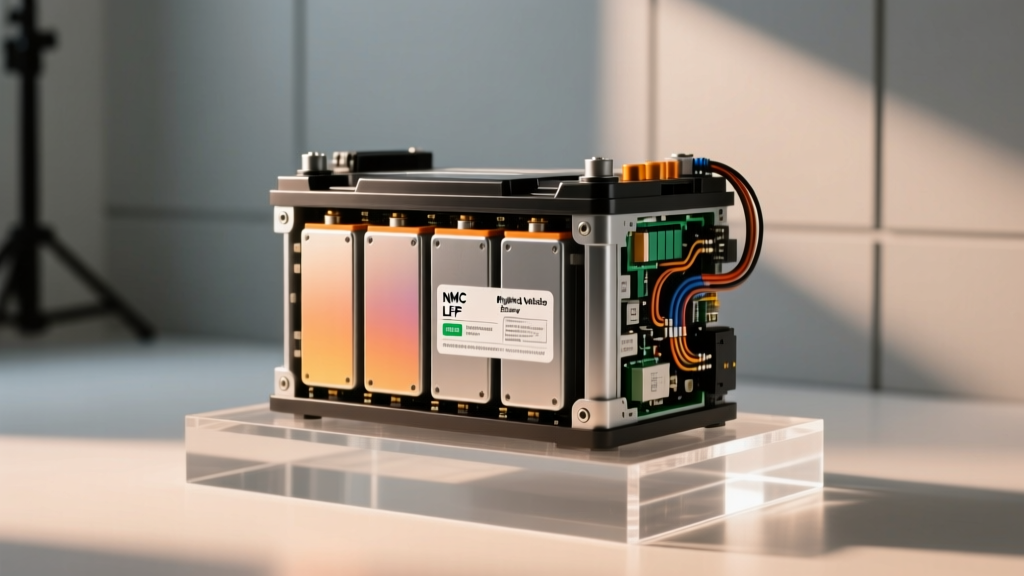
Most hybrid and PHEV batteries sold in the US through 2026 use NMC (nickel manganese cobalt) or NCA (nickel cobalt aluminum) lithium-ion chemistry. A growing number — particularly from Chinese-market models and some newer Toyota hybrids — use LFP (lithium iron phosphate). Each has distinct trade-offs.
| Attribute | LFP (Lithium Iron Phosphate) | NMC / NCA (Nickel-based) |
|---|---|---|
| Energy Density | Lower (~160 Wh/kg cell-level) | Higher (~230–260 Wh/kg cell-level) |
| Cycle Life | 3,000–5,000+ cycles to 80% SoH | 1,000–2,000 cycles to 80% SoH |
| Cold-Weather Performance | Weaker below 32°F; slower charge acceptance | Better low-temp discharge; preconditioning helps |
| Thermal Stability | Excellent; less prone to thermal runaway | Good with active thermal management |
| Cost (cell-level) | ~$60–75/kWh (2025 pricing) | ~$90–110/kWh (2025 pricing) |
| Typical Use in Hybrids | HEV small packs, some newer PHEVs | Most current PHEVs (RAV4 Prime, Wrangler 4xe, Tucson PHEV) |
The bottom line: NMC wins on energy density, which matters for PHEVs trying to maximize electric-only range in a compact package. LFP wins on longevity and cost — ideal for standard hybrids where the battery is small and cycled frequently in a narrow band. If you plan to keep your hybrid for 12+ years, an LFP-equipped model has a meaningful cycle-life advantage.
What Does the Hybrid Battery Warranty Actually Cover?
Under US federal law (EPA emissions-related warranty provisions), hybrid battery packs on PZEV and partial-zero-emission vehicles carry a minimum warranty of 8 years / 100,000 miles. In California Air Resources Board (CARB) states — which include CA, NY, MA, WA, CO, and others — that extends to 10 years / 150,000 miles for many models.
| Manufacturer | Warranty Term | Capacity Threshold | Notes |
|---|---|---|---|
| Toyota (Hybrid/PHEV) | 10 yr / 150,000 mi | Not explicitly published; case-by-case | Covers HV battery and hybrid components |
| Hyundai / Kia (PHEV) | 10 yr / 100,000 mi | ~70% capacity retention | Original owner; transfers at reduced term |
| Stellantis (Jeep 4xe) | 8 yr / 100,000 mi | 70% capacity retention | Federal minimum; CARB states may differ |
| Ford (PHEV) | 8 yr / 100,000 mi | 70% capacity retention | Escape PHEV, others |
The capacity-retention threshold matters: most manufacturers define a "defective" battery as one that drops below 70% of its original usable capacity within the warranty period. If your PHEV's EPA-rated 32-mile electric range drops to 22 miles or less (roughly 70%), that typically qualifies for a warranty replacement or repair. Always document your range with the vehicle's trip computer or an OBD-II reader to establish a baseline.
How Much Does a Hybrid Vehicle Battery Cost to Replace?
Out-of-warranty replacement is the scenario most buyers fear — but it's rarer than headlines suggest. Most hybrid batteries outlive the vehicle's useful economic life. When replacement is needed, costs vary dramatically by pack size and vehicle.
| Vehicle | Battery Size (usable kWh) | New OEM Pack | Refurbished / Reman | Typical Replacement Mileage |
|---|---|---|---|---|
| Toyota Prius (HEV) | ~0.75 kWh (NiMH) / ~4.0 kWh (Li-ion, 2023+) | $2,200–$3,500 | $1,000–$1,800 | 180,000–250,000+ mi |
| Toyota RAV4 Prime (PHEV) | 14.9 kWh usable | $7,000–$9,500 | $4,000–$6,000 | 150,000–200,000+ mi |
| Jeep Wrangler 4xe (PHEV) | 14.3 kWh usable | $6,500–$8,500 | $3,500–$5,500 | 120,000–180,000+ mi |
| Hyundai Tucson PHEV | 11.3 kWh usable | $5,500–$7,500 | $3,000–$4,500 | 130,000–180,000+ mi |
| Ford Escape PHEV | 11.2 kWh usable | $5,000–$7,000 | $3,000–$4,500 | 140,000–190,000+ mi |
Refurbished or remanufactured packs — where failed cells or modules are replaced within the original casing — are a cost-effective option for older hybrids no longer under warranty. Independent hybrid specialists (not just dealerships) increasingly offer these services. Labor adds $500–$1,200 depending on pack location and vehicle complexity.
Context: at $7,500 for a RAV4 Prime pack replacement at 180,000 miles, that's roughly $0.04 per mile in battery cost over the vehicle's life — far less than the transmission or engine repairs common on high-mileage ICE vehicles.
Factors That Accelerate (or Preserve) Hybrid Battery Life
Not all miles are equal when it comes to battery wear. These factors have the largest measurable impact on long-term State of Health:
What Hurts Your Hybrid Battery
- Frequent DC fast charging (PHEVs): Repeatedly using Level 3 DC fast charging above 50 kW stresses NMC cells. For daily use, Level 2 (3.3–7.2 kW) is gentler.
- Sustained high SoC: Leaving a PHEV plugged in at 100% for days in hot weather accelerates calendar degradation. Most hybrids manage this with a software buffer, but it's still best practice.
- Deep discharges: Running the battery to near-zero regularly. HEV systems avoid this by design (narrow SoC window); PHEV owners should avoid routinely depleting to 0%.
- Extreme heat: Ambient temperatures above 95°F, especially with a parked car at full charge, cause the most calendar-aging damage. Garage parking helps significantly.
- Towing at high SoC: Heavy loads combined with high battery charge generate excess heat in cells.
What Preserves Your Hybrid Battery
- Moderate SoC range (20–80%): For PHEVs, this is the sweet spot for daily use. Some models (Hyundai, BMW) offer a user-set charge limit.
- Level 2 charging over DCFC: Slower charging = less heat = longer cycle life.
- Thermal preconditioning: If your PHEV offers it, preconditioning the battery before fast charging reduces stress.
- Regular driving: Batteries degrade faster sitting idle at high SoC. Regular use with moderate cycling is actually beneficial.
- Climate-controlled parking: Even shade in summer makes a measurable difference in calendar aging.
How to Check Your Hybrid Battery's State of Health
Unlike full EVs, which often display SoH in the infotainment system or app, most hybrids and PHEVs don't surface battery health data directly to the driver. Here's how to monitor it:
OBD-II diagnostic tools: Devices like the OBDLink MX+ or Carista adapter, paired with apps such as Dr. Prius (Toyota-specific) or Hybrid Assistant, can read the HV battery's internal resistance, individual cell voltages, and estimated SoH percentage. These tools cost $40–$120 and work with most OBD-II-compliant hybrids.
Dealer diagnostic scan: During routine service, ask for a "hybrid battery health check." Toyota, Hyundai, and Ford dealers can pull a detailed SoH report from the vehicle's battery management system (BMS). This is often free under warranty.
Range tracking (PHEVs): The simplest method — track your electric-only range over time. If your PHEV consistently delivered 33 EPA-rated miles when new but now delivers 24 after three years, that's roughly 73% SoH and may warrant a warranty claim if you're within the coverage period.
Fuel economy drift (HEVs): Standard hybrids don't have an electric range to measure, but a noticeable drop in combined MPG (e.g., a Prius falling from 52 to 44 MPG over 80,000 miles) can indicate the battery is losing its ability to support the engine efficiently.
Emerging Battery Tech: Solid-State and Silicon Anodes
Two technologies are frequently cited as next-generation breakthroughs for hybrid batteries:
Solid-state batteries replace the liquid electrolyte with a solid ceramic or polymer, promising higher energy density (~400+ Wh/kg projected), faster charging, and improved safety. Toyota has announced solid-state packs for limited production by 2027–2028, initially in BEVs. For hybrids, the smaller pack sizes make solid-state potentially cost-effective sooner, but no hybrid on sale in 2026 uses solid-state chemistry. Realistic availability for hybrid applications: 2028–2030 at earliest, likely premium models first.
Silicon-anode lithium-ion replaces graphite anodes with silicon-dominant composites, boosting energy density by 20–40%. Companies like Sila Nanotechnologies and Group14 are supplying early production cells. This tech is closer to market — expect it in PHEV packs by 2027–2028, enabling 50+ mile electric ranges without increasing pack size. Several announced 2027 PHEV models reference silicon-anode cells in preliminary specs.
Both technologies remain forward-looking. If you're buying a hybrid in 2026, current NMC and LFP packs are mature, well-understood, and backed by extensive warranty coverage. Waiting for solid-state means delaying a purchase by 3–5 years with no guarantee of affordable pricing at launch.
Hybrid Battery FAQ
How long do hybrid vehicle batteries last in years and miles?
Most modern hybrid and PHEV batteries last 10–15 years or 150,000–200,000+ miles before capacity drops below 70%. Toyota's NiMH packs in the Prius have documented cases exceeding 250,000 miles. Lithium-ion packs in newer PHEVs are tracking similarly based on fleet data from Recurrent Auto.
How much does it cost to replace a hybrid vehicle battery?
Replacement costs range from $2,200–$3,500 for a standard Prius HEV pack to $6,500–$9,500 for larger PHEV packs (RAV4 Prime, Wrangler 4xe). Refurbished options cut costs by 40–50%. Most owners never need a replacement — the battery outlasts the car's economic life.
What does the hybrid battery warranty cover?
Federal minimum is 8 years / 100,000 miles. In CARB states, many manufacturers extend to 10 years / 150,000 miles. Coverage applies if capacity drops below a defined threshold (typically 70%). The warranty covers the battery pack, not damage from accidents, flooding, or unauthorized modifications.
How do I check my hybrid battery's State of Health?
Use an OBD-II scanner with hybrid-compatible software (Dr. Prius, Hybrid Assistant) to read SoH percentage and cell voltages. For PHEVs, track electric-only range over time. Ask your dealer for a BMS diagnostic report during service visits.
LFP vs NMC — which hybrid battery chemistry is better?
NMC offers higher energy density, giving PHEVs more electric range per pound. LFP offers 2–3× longer cycle life and lower cost, making it ideal for standard HEVs and buyers who prioritize longevity. Neither is universally "better" — it depends on whether you value range (NMC) or lifespan (LFP).
Does fast charging damage a PHEV battery?
Occasional DC fast charging (50 kW+) is fine, but making it your daily routine accelerates NMC degradation due to heat. Level 2 home charging at 3.3–7.2 kW is the optimal daily method. Most PHEVs limit DCFC to 50–80 kW anyway due to smaller pack sizes.
Should I worry about hybrid battery replacement when buying used?
Check remaining warranty (it transfers to second owners in most cases, though sometimes at reduced terms). Get a pre-purchase BMS scan. A 6-year-old RAV4 Hybrid with 90,000 miles still has 4 years / 60,000 miles of federal warranty remaining. The risk is low — but verify before purchasing.