If you have searched "how to charge battery" in the context of your electric vehicle, you are asking the right question at the right time. Unlike a smartphone you replace every three years, an EV traction battery is a $10,000–$25,000 component designed to outlast the car itself — but only if you treat it correctly. The answer to how you should charge depends almost entirely on one variable: your battery's chemistry.
This guide breaks down the two dominant lithium-ion chemistries on the road in 2026 — lithium iron phosphate (LFP) and nickel manganese cobalt (NMC/NCA) — and gives you exact, data-backed protocols for charging, storing, and monitoring each one. We will also cover degradation curves, warranty fine print, and what a replacement actually costs if the worst happens.
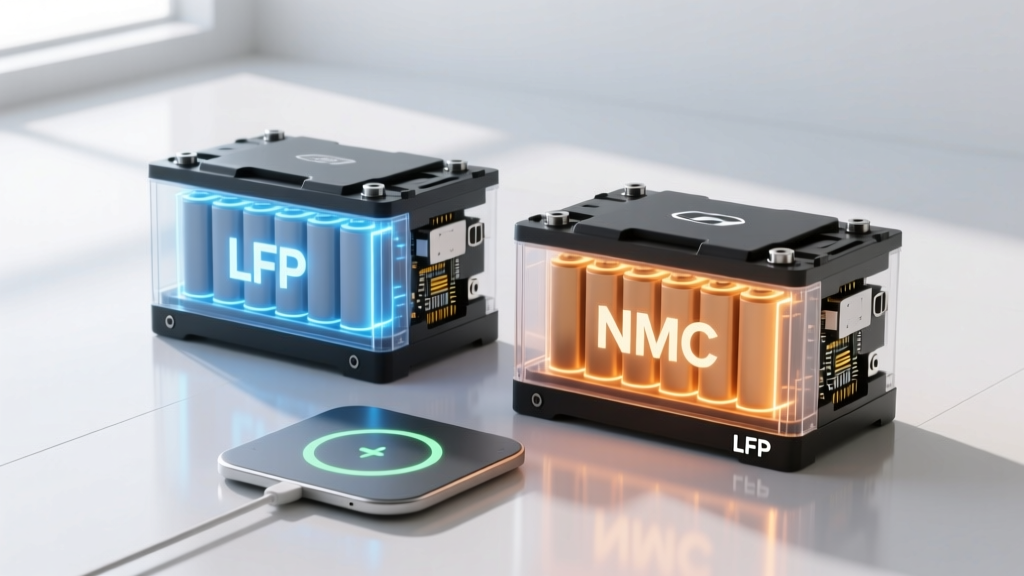
LFP vs NMC: The Chemistry That Dictates How You Charge
Before you plug in, you need to know what is inside your pack. In 2026, virtually every EV sold in the US uses one of two cathode chemistries, and they behave differently at the electrochemical level.
| Attribute | LFP (Lithium Iron Phosphate) | NMC / NCA (Nickel-based) |
|---|---|---|
| Energy Density | ~160–180 Wh/kg (lower) | ~230–280 Wh/kg (higher) |
| Cycle Life | 3,000–5,000+ cycles to 80% SoH | 1,500–2,500 cycles to 80% SoH |
| Cold-Weather Performance | Moderate — greater range loss below 32°F | Better low-temp discharge, but still loses 20–30% range |
| Recommended Daily Charge Limit | 100% (charge to full regularly) | 80% for daily, 100% only before trips |
| Cost per kWh (pack level) | ~$90–$110 | ~$120–$150 |
| Typical 2026 Vehicles | Tesla Model 3/Y RWD, Ford Mustang Mach-E Select, base Chevy Equinox EV | Tesla Long Range/Performance, Hyundai Ioniq 5/6, Rivian R1T/R1S, BMW iX |
| Thermal Stability | Excellent — less prone to thermal runaway | Good but requires more active thermal management |
The single biggest takeaway: LFP batteries want to be charged to 100% regularly, while NMC batteries prefer to sit at 80% or below for daily use. Tesla, Ford, and Hyundai all state this explicitly in their owner's manuals. Getting this wrong over five years can cost you 5–10% additional capacity loss.
How Long Do EV Batteries Last? Real Degradation Data
EV batteries do not "die" the way a 12V lead-acid battery does. They gradually lose capacity — a process called degradation — measured as a percentage of original State of Health (SoH). A battery at 85% SoH holds 85% of its original kWh capacity.
Typical Degradation Curve (Fleet & Owner-Reported Data):
- Year 1 / 15,000 miles: 2–4% loss (initial formation drop)
- Year 3 / 45,000 miles: 6–9% total loss
- Year 5 / 75,000 miles: 8–12% total loss
- Year 8 / 120,000 miles: 10–16% total loss
- Year 10 / 150,000 miles: 12–20% total loss (varies heavily by chemistry and habit)
Source: Aggregated fleet data from Recurrent Auto's 2025 EV battery longevity report and owner-reported data on TeslaFi and ABetterRoutePlanner.
LFP packs generally degrade slower than NMC, especially when the NMC pack is routinely charged to 100% or exposed to sustained high temperatures. A 2024 study by Geotab analyzing 10,000+ EVs found that vehicles DC fast-charging more than three times per week showed an average of 2–3% additional degradation over four years compared to those primarily using Level 2 home charging.
For context: a 2026 Hyundai Ioniq 5 with a 77.4 kWh (usable) NMC pack rated at 305 miles EPA would still deliver roughly 260–275 miles EPA-equivalent at year eight — well within usable daily range for most drivers.
What Does the Battery Warranty Actually Cover?
Federal law mandates a minimum 8-year/100,000-mile warranty on EV battery packs for emissions-related compliance, and most manufacturers meet or exceed this. But the fine print matters.
| Manufacturer | Warranty Term | Capacity Retention Threshold | Notes |
|---|---|---|---|
| Tesla (Model 3/Y RWD — LFP) | 8 yr / 100,000 mi | 70% | Standard Range models |
| Tesla (Model 3/Y Long Range — NMC) | 8 yr / 120,000 mi | 70% | Higher mileage threshold |
| Hyundai / Kia | 10 yr / 100,000 mi | 70% | Among the longest terms |
| Ford (Mach-E, F-150 Lightning) | 8 yr / 100,000 mi | 70% | Transferable to second owner |
| GM (Ultium-based: Equinox, Blazer, Silverado EV) | 8 yr / 100,000 mi | 70% | Ultium packs modular — partial replacement possible |
| Rivian | 8 yr / 175,000 mi | 70% | Highest mileage cap in the market |
| BMW (iX, i4) | 8 yr / 100,000 mi | 70% | Battery preconditioning standard |
What "70% capacity retention" means in practice: If your 77.4 kWh Ioniq 5 pack drops below 54.2 kWh usable capacity within 10 years or 100,000 miles, Hyundai will repair or replace it at no cost. In reality, very few packs hit this threshold under normal use — Recurrent's fleet data shows less than 1.5% of EVs have needed a warranty battery replacement.
What is NOT covered: Cosmetic issues, minor capacity loss above the threshold, damage from accidents, flooding, improper modifications, or using non-approved charging equipment. Always keep records of your charging setup.
How Much Does an EV Battery Replacement Cost?
This is the number that generates the most anxiety — and the most misinformation. Here are actual out-of-warranty replacement costs based on 2025–2026 dealer and independent-shop data:
| Vehicle | Pack Size (Usable) | Chemistry | Replacement Cost (Parts + Labor) | Typical Need Timeline |
|---|---|---|---|---|
| Tesla Model 3 RWD | 57.5 kWh | LFP | $12,000–$14,000 | 15+ years / 200k+ mi (if ever) |
| Tesla Model Y Long Range | 75 kWh | NMC | $14,000–$18,000 | 15+ years / 200k+ mi (if ever) |
| Hyundai Ioniq 5 | 77.4 kWh | NMC | $15,000–$20,000 | 15+ years / 200k+ mi (if ever) |
| Ford F-150 Lightning Extended | 131 kWh | NMC | $22,000–$30,000 | 15+ years / 200k+ mi (if ever) |
| Chevy Bolt EV (2023 final year) | 65 kWh | NMC | $14,000–$16,000 | Post-recall packs show improved longevity |
| Rivian R1T Large Pack | 128.9 kWh | NMC | $20,000–$28,000 | 15+ years / 200k+ mi (if ever) |
Two critical context points. First, most EV batteries never need replacement. Current data shows the vast majority of packs retain above 80% SoH at 150,000 miles, and the vehicle is typically retired or traded in before the pack reaches end-of-life. Second, pack costs continue to fall — BloombergNEF's 2025 battery price survey reported average pack prices at $115/kWh, down from $140/kWh in 2023. By the time a 2026 EV actually needs a new pack in the 2040s, replacement costs will likely be substantially lower.
Modular pack designs (GM Ultium, some BMW architectures) also allow replacing individual modules rather than the entire pack, potentially cutting costs by 40–60%.
How to Charge Your Battery for Maximum Longevity
Here is where the chemistry distinction becomes actionable. Follow the protocol for your specific pack type.
For LFP Battery Owners (Tesla Model 3/Y RWD, Mach-E Select, base Equinox EV):
- Set your charge limit to 100% and charge to full at least once per week. LFP cells need full charges for the Battery Management System (BMS) to accurately calibrate cell balancing.
- Daily charging to 100% is fine — LFP chemistry is stable at full SoC.
- Avoid leaving the car at 0% (or near-zero) for extended periods. Below 10% SoC for days can cause copper dissolution in the anode.
- Use DC fast charging as needed; LFP tolerates it well, but prefer Level 2 for routine overnight charging.
- In cold weather, use preconditioning (scheduled departure) to warm the pack before charging — LFP charges very slowly below 40°F without it.
For NMC/NCA Battery Owners (Long Range/Performance models, Ioniq 5/6, Rivian, BMW iX):
- Set your daily charge limit to 80%. Charging to 100% should be reserved for road trips when you need the full range.
- Avoid leaving the car at 100% SoC for more than a few hours. If you charge to full, drive shortly after.
- Keep the pack between 20–80% SoC for the "sweet spot" — this minimizes stress on the cathode structure.
- Minimize DC fast charging to 1–2 sessions per week when possible. Repeated 150+ kW charging accelerates lithium plating on the anode.
- Use preconditioning before DC fast charging — a cold NMC pack that accepts a fast charge without warming first experiences increased degradation.
- For long-term storage (2+ weeks), leave the pack at approximately 50% SoC.
Universal best practices for both chemistries:
- Level 2 home charging (7–11.5 kW / 240V) is the gold standard for daily use. It is gentler on the pack than DC fast charging and vastly more convenient.
- Enable scheduled charging to finish just before you leave — this avoids the battery sitting at high SoC for hours.
- In extreme heat (100°F+), park in shade or a garage when possible. Sustained pack temperatures above 95°F accelerate calendar aging.
- Keep your vehicle's OTA software updated — manufacturers regularly refine BMS algorithms for better longevity.
How to Check and Monitor Your Battery Health (SoH)
State of Health (SoH) is the percentage of your battery's original capacity that remains usable. Here is how to track it in 2026:
Built-in vehicle tools:
- Tesla: The service menu (hold the model badge on the screen for 3 seconds, enter "service") displays a battery health test. You can also view estimated range at 100% as a proxy.
- Hyundai/Kia: The EV settings menu includes a battery health indicator on newer models (2025+). Dealers can run a full diagnostic.
- GM Ultium vehicles: The myChevrolet/myCadillac app shows battery health status, and OnStar diagnostics include SoH reporting.
- Ford: The FordPass app provides battery health status. Dealers can perform a full pack diagnostic via FDRS (Ford Diagnostic & Repair System).
Third-party tools:
- Recurrent Auto (free enrollment): Connects to your vehicle's telematics and provides monthly SoH reports benchmarked against similar vehicles.
- OBDeleven / OBD-II scanners with EV PIDs: Can read cell-level voltage data and pack SoH on many models (varies by manufacturer).
- TeslaFi / Tessie: For Tesla owners, these apps track estimated range at full charge over time, giving a clear degradation trendline.
Check your SoH quarterly. If you notice a sudden drop (more than 2–3% in a month), schedule a dealer diagnostic — this could indicate a failing module rather than normal degradation.
What's Next: Solid-State and Silicon-Anode Batteries
Looking forward, two technologies are in active development that could reshape EV batteries:
Solid-state batteries replace the liquid electrolyte with a solid material, promising higher energy density (potentially 400+ Wh/kg), faster charging, and improved safety. Toyota has announced a 2027–2028 production timeline for solid-state EVs, while Samsung SDI targets 2027. Nissan and Honda have also committed to late-2020s introductions. However, manufacturing scalability remains the primary bottleneck, and these timelines have shifted before. Treat any solid-state vehicle as announced/preliminary until it is on a dealer lot.
Silicon-dominant anodes (replacing graphite) can increase energy density by 20–40% within existing lithium-ion form factors. Companies like Sila Nanotechnologies and Group14 are already supplying silicon-anode materials for 2025–2026 model-year vehicles in limited applications. Expect gradual adoption across more models through 2028.
Neither technology changes the advice in this guide for current EV owners. Your LFP or NMC pack, charged correctly, will serve you well for a decade or more.
Frequently Asked Questions
Should I charge my EV to 100% every night?
It depends on your battery chemistry. If you have an LFP battery (check your owner's manual or vehicle specs — Tesla Model 3/Y RWD, base Mach-E, and base Equinox EV use LFP), yes: charge to 100% regularly. LFP cells require periodic full charges for the BMS to calibrate properly. If you have an NMC/NCA battery (most Long Range and Performance models), set your daily limit to 80% and only charge to 100% when you need the full range for a trip.
Does DC fast charging damage my battery?
DC fast charging does not "damage" your battery in normal use, but frequent reliance on it does accelerate degradation slightly. Geotab's fleet data shows vehicles that DC fast-charged 3+ times per week had roughly 2–3% more capacity loss over four years compared to those using primarily Level 2. For daily charging, a home Level 2 setup (240V, 32–48 amps / 7.7–11.5 kW) is ideal. Use DC fast charging for road trips and occasional top-ups without concern.
How does cold weather affect my battery?
Cold temperatures slow the electrochemical reactions inside lithium-ion cells. Expect 20–30% range reduction at 20°F compared to the EPA sticker, and 30–40% at 0°F. LFP batteries tend to lose slightly more range in cold than NMC. Charging speed is also affected — a cold pack may accept only 20–50 kW at a DC fast charger until it warms up. Always use your vehicle's preconditioning feature (often tied to scheduled departure or navigation to a charger) to warm the battery before fast charging in cold weather.
What is the difference between kW and kWh?
This is the most common point of confusion. kWh (kilowatt-hours) measures energy capacity — think of it as the size of your fuel tank. A 77.4 kWh battery holds 77.4 kilowatt-hours of energy. kW (kilowatts) measures power — the rate at which energy flows. A 250 kW DC fast charger can deliver energy at a rate of 250 kilowatts. Your battery capacity (kWh) determines your range; the charge rate (kW) determines how quickly you add range.
Will my EV battery need to be replaced?
Statistically, very unlikely during your ownership. Recurrent Auto's data shows fewer than 1.5% of EVs have required a battery replacement under warranty, and most packs retain 80%+ capacity at 150,000 miles. EV batteries are engineered for 200,000+ mile lifespans. The car's body, suspension, or interior will typically wear out before the traction battery reaches end-of-life. If a replacement is needed out of warranty, costs range from $12,000–$30,000 depending on pack size, but pack prices continue to decline year over year.
Does the federal tax credit affect battery replacement decisions?
The IRS §30D clean vehicle credit applies to new EV purchases, not battery replacements on existing vehicles. However, if you are considering replacing an older EV versus buying a new one, factor in the current credit rules: up to $7,500 for qualifying new EVs, subject to MSRP caps ($55,000 for sedans, $80,000 for SUVs/trucks), buyer income limits ($150,000 single / $300,000 joint AGI), and critical mineral/battery sourcing requirements. The credit can now be transferred to the dealer at point of sale. Consult a tax professional for your specific eligibility.