Inside the Tesla Battery: From Raw Materials to Finished Pack
When shoppers search "how Tesla battery is made," they're usually asking two things: what's actually inside the pack, and how long it will last. Tesla sources cells from multiple suppliers — CATL, Panasonic, LG Energy Solution — and assembles them into structural packs at its Gigafactories in Nevada, Texas, and Shanghai. The answer varies significantly by model and trim, because Tesla uses two fundamentally different chemistries depending on the vehicle.
As of the 2026 model year, the Model 3 Rear-Wheel Drive and Model Y Rear-Wheel Drive use lithium iron phosphate (LFP) prismatic cells supplied primarily by CATL. The Model 3 Long Range, Model Y Long Range, Model S, and Model X use nickel-based chemistry — either NMC (nickel manganese cobalt) from LG or NCA (nickel cobalt aluminum) from Panasonic — in cylindrical 2170 or 4680 cells. This chemistry split is the single most important factor in how your Tesla battery performs, charges, and ages.
| Attribute | LFP (LiFePO₄) | NMC / NCA (Nickel-Based) |
|---|---|---|
| Models Using | Model 3 RWD, Model Y RWD | Model 3 LR, Model Y LR, Model S, Model X |
| Cell Format | Prismatic | Cylindrical (2170 or 4680) |
| Typical Usable Capacity | ~57–60 kWh | ~75–100 kWh |
| Energy Density | Lower (~160 Wh/kg cell-level) | Higher (~260 Wh/kg cell-level) |
| Recommended Daily Charge | 100% (daily) | 80% (daily), 100% for trips |
| Cycle Life | 3,000–5,000+ cycles | 1,000–2,000 cycles |
| Cold-Weather Performance | More range loss in freezing temps | Better cold-weather retention |
| Cost per kWh | Lower | Higher |
| Cobalt Content | None | Some (NMC) / Trace (NCA) |
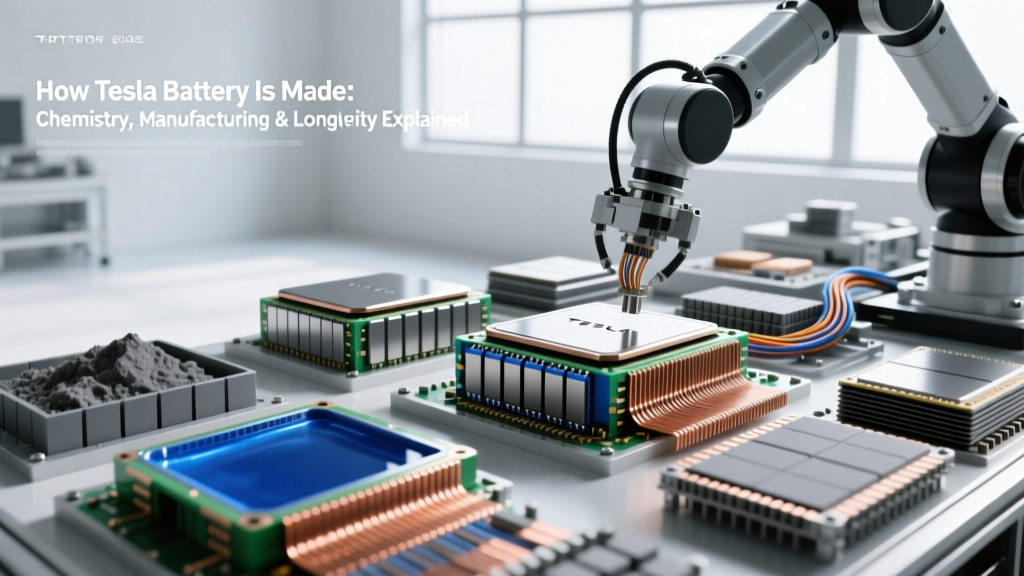
The manufacturing process itself follows a similar arc regardless of chemistry: electrode mixing and coating, cell winding or stacking, electrolyte filling, formation cycling, module integration, and final pack assembly with thermal management plumbing. Tesla's structural battery pack — introduced with the 4680 cell in the Model Y — eliminates module-level packaging, bonding cells directly to the pack enclosure to reduce weight and increase stiffness. This is a manufacturing innovation, not a chemistry change, but it affects repairability: structural packs are generally replaced as a unit rather than serviced at the module level.
LFP vs NMC: Which Tesla Battery Is Better for You?
Neither chemistry is universally superior — the right answer depends on how you drive, where you live, and how you charge.
Choose LFP if: You can charge at home daily, you mostly drive in moderate climates, you want maximum cycle life, and you prefer the simplicity of charging to 100% every day without worrying about accelerated degradation. LFP's lower energy density means shorter EPA range (the 2026 Model 3 RWD is rated at ~272 miles EPA), but the trade-off is exceptional longevity. CATL's LFP cells are rated for over 3,000 full charge cycles before reaching 80% capacity — that's roughly 800,000+ miles of theoretical use.
Choose NMC/NCA if: You need maximum range (the 2026 Model 3 Long Range achieves ~341 miles EPA), you frequently drive in cold climates where LFP suffers greater range loss, or you take regular road trips where energy density matters. The trade-off is more careful charging habits — Tesla recommends daily charging to 80% for nickel-based packs, reserving 100% for trip days.
The cold-weather difference is measurable. In testing below 20°F, LFP packs can lose 30–40% of rated range without preconditioning, while NMC/NCA packs typically lose 20–30% under similar conditions. Tesla's heat pump (standard on all current models) mitigates this, but the chemistry gap remains.
How Long Do Tesla Batteries Actually Last?
The short answer: longer than most owners keep the car. Tesla's own 2024 Impact Report (the most recent published dataset) reported that Model 3 and Model Y batteries retained approximately 85% of original capacity after 200,000 miles. Model S and Model X batteries showed roughly 88% retention at the same mileage — likely because those larger packs experience shallower average discharge cycles.
Tesla Battery Degradation Curve (Fleet Average Data):
- Year 1 / 15,000 mi: ~2–3% loss (initial formation settling)
- Year 3 / 45,000 mi: ~5–7% total loss
- Year 5 / 75,000 mi: ~8–10% total loss
- Year 8 / 120,000 mi: ~12–15% total loss
- 200,000 mi: ~15% loss (85% retained)
Note: Degradation is not linear. The steepest loss occurs in the first 10,000–20,000 miles, then the curve flattens significantly. A Tesla battery rarely "falls off a cliff" — it gradually loses capacity over hundreds of thousands of miles.
Real-world factors push these numbers in either direction. Owners who frequently DC fast-charge, regularly sit at 100% state of charge (for NMC/NCA), or operate in extreme heat without thermal management may see 15–20% loss by 120,000 miles. Owners who charge slowly at home, keep NMC/NCA packs between 20–80%, and live in moderate climates often see only 8–10% loss at 100,000 miles.
LFP packs complicate this picture in a good way: because Tesla recommends daily 100% charges for LFP, and because LFP chemistry is inherently more stable, these packs often show less measurable degradation over time — though the shorter total range means any loss is felt more acutely.
Tesla Battery Warranty: What's Covered and What Isn't
Tesla's battery warranty is one of the strongest in the industry, but the details matter. Coverage differs by model and pack type.
| Model | Battery Warranty | Capacity Retention Threshold | Drive Unit Warranty |
|---|---|---|---|
| Model 3 RWD (LFP) | 8 years / 100,000 mi | 70% minimum | 8 yr / 100,000 mi |
| Model 3 Long Range / Performance | 8 years / 120,000 mi | 70% minimum | 8 yr / 120,000 mi |
| Model Y (all trims) | 8 years / 120,000 mi | 70% minimum | 8 yr / 120,000 mi |
| Model S / Model X | 8 years / 150,000 mi | 70% minimum | 8 yr / 150,000 mi |
The 70% retention threshold means Tesla will replace or repair the battery if it falls below 70% of original capacity within the warranty period. In practice, very few Tesla batteries hit this threshold under normal use — the fleet data above shows most packs retain 85%+ at 200,000 miles, well beyond the warranty window.
What's not covered: damage from accidents, flooding, fire, or modifications; cosmetic issues that don't affect function; and capacity loss from consistently ignoring Tesla's charging recommendations (though this is rarely enforced as a denial). The warranty transfers to subsequent owners, which supports Tesla resale values.
EV Battery Replacement Cost: What Tesla Owners Actually Pay
This is where fear-mongering runs rampant, so let's ground this in real service data. A full Tesla battery pack replacement outside warranty typically costs between $12,000 and $22,000 depending on the model and pack size, including labor. Here's the breakdown by model:
| Model | Pack Size (Usable) | Chemistry | Estimated Replacement Cost |
|---|---|---|---|
| Model 3 RWD | ~57 kWh | LFP | $12,000–$14,000 |
| Model 3 Long Range | ~75 kWh | NMC | $14,000–$17,000 |
| Model Y Long Range | ~75 kWh | NMC/NCA | $14,000–$18,000 |
| Model S | ~95 kWh | NMC/NCA | $18,000–$22,000 |
| Model X | ~95 kWh | NMC/NCA | $18,000–$22,000 |
Context that matters: the vast majority of Tesla batteries never need replacement. Based on fleet degradation data, a Tesla battery will typically outlast the vehicle's economic life — meaning the car will be retired for other reasons (body damage, electronics failure, owner upgrade) before the battery degrades below usable levels. The scenario where you're writing a $20,000 check for a new battery at year 10 is statistically rare.
When replacements do occur, they're more often due to manufacturing defects (covered under warranty), physical damage, or coolant leaks than to simple end-of-life degradation. Tesla's remanufactured pack program also offers lower-cost replacements using refurbished packs, typically 20–30% below new-pack pricing.
Factors That Accelerate (or Preserve) Tesla Battery Health
Battery degradation is governed by electrochemistry, not luck. These are the factors you can control, ranked by impact:
High Impact:
- State of charge habits (NMC/NCA): Keep daily charging between 20–80%. Every hour spent at 100% SoC accelerates electrolyte decomposition. Set your charge limit to 80% and only raise it to 100% when you're about to leave on a trip.
- Extreme heat exposure: Sustained ambient temperatures above 95°F cause more degradation than any other single factor. Tesla's thermal management system mitigates this, but parking in shade and preconditioning while plugged in reduce thermal stress.
- DC fast-charging frequency: Occasional Supercharging is fine — Tesla's battery management system limits charge rate as the pack heats. But daily DC fast-charging, especially in hot climates, accelerates degradation by 1–3% over the pack's life compared to exclusive Level 2 home charging.
Moderate Impact:
- State of charge (LFP): Charge to 100% at least once per week. LFP cells need full charges for the BMS to accurately calibrate state of charge. Undercharging LFP leads to range estimation errors, not chemistry damage.
- Cold-weather preconditioning: Always precondition before driving in freezing temperatures. This warms the battery using grid power (if plugged in) rather than pack energy, reducing stress and improving regen effectiveness.
- Storage: If storing a Tesla for weeks, leave it plugged in with charge limit set to 50% (NMC/NCA) or 100% (LFP). Never store at very low SoC.
Low Impact:
- Regen braking intensity: Standard vs. low regen has negligible effect on battery health.
- Driving style: Aggressive acceleration draws high current, but Tesla's BMS limits peak discharge to protect cells. The impact on degradation is minor compared to SoC and temperature.
How to Check Your Tesla's Battery Health (State of Health)
Tesla does not expose a direct State of Health (SoH) percentage in the vehicle UI, which frustrates many owners. Here are the methods available:
1. The Range Calculation Method: Charge your Tesla to 100% (for LFP) or note the projected range at your typical charge limit. Divide the displayed range at 100% by the original EPA-rated range. A 2026 Model 3 Long Range rated at 341 miles EPA that shows 310 miles at 100% has roughly 91% SoH. This method is approximate — Tesla's range estimate algorithm factors in recent driving behavior and temperature, so it fluctuates.
2. Tesla Service Mode (Limited): Some Tesla service centers can pull detailed battery logs showing nominal full-pack energy (kWh) vs. original capacity. This is the most accurate method but requires a service appointment or mobile ranger visit.
3. Third-Party OBD-II Tools: Devices like the OBDeleven or apps like TeslaFi and Tessie can log battery data over time and estimate SoH by tracking how many kWh the pack accepts during full charges. This is reasonably accurate when tracked over months, not a single charge event.
4. Tesla's In-App Health Indicator: Beginning with software updates in late 2024, Tesla introduced a battery health section in the mobile app for some markets, showing a simplified health rating. Availability varies by region and model year — check your app's vehicle settings.
For prospective used-Tesla buyers, the most reliable approach is a pre-purchase inspection at a Tesla Service Center, which includes a battery health report. Alternatively, request that the seller perform a full charge and share the displayed range at 100% SoC.
What's Next: Solid-State and Silicon-Anode Batteries
The battery landscape is shifting, but timelines matter. Here's where emerging technologies stand as of 2026:
Silicon-anode cells: Companies like Sila Nanotechnologies and Group14 are shipping silicon-dominant anode materials that boost energy density by 15–25% over graphite anodes. These are beginning to appear in limited production EVs but have not been confirmed for any current Tesla model. Expect broader availability in 2027–2028 model-year vehicles.
Solid-state batteries: Toyota, Samsung SDI, and QuantumScape have all demonstrated solid-state prototype cells with energy densities exceeding 400 Wh/kg and faster charge acceptance. However, manufacturing scale-up remains the bottleneck. No automaker — Tesla included — has announced a production vehicle with solid-state cells available for consumer purchase. Realistic timeline for meaningful market penetration: 2029–2032.
Tesla's 4680 ramp: Tesla continues to scale its in-house 4680 cell production at Giga Texas. These cells use a tabless electrode design that improves thermal management and enables higher sustained charge rates. As of early 2026, 4680 packs are in production Model Y vehicles built at Giga Texas, but supply is still supplemented by Panasonic and LG 2170 cells. The 4680 is an evolution of existing NCA/NMC chemistry, not a new chemistry — expect incremental range and cost improvements rather than a step-change breakthrough.
Tesla has not announced a solid-state development program. Its strategy has consistently focused on manufacturing innovation (dry electrode coating, structural packs) and chemistry optimization (iron-based cathodes, high-nickel formulations) rather than waiting for next-generation chemistries to mature.
Frequently Asked Questions
How long do Tesla batteries last in years and miles?
Based on Tesla's fleet data, the average Tesla battery retains ~85% of original capacity at 200,000 miles. In years, most Tesla batteries will function well beyond 15 years of typical use (12,000–15,000 miles/year). Battery "end of life" is generally defined as 70–80% capacity retention — most packs won't reach this threshold during the vehicle's practical lifespan.
How much does it cost to replace a Tesla battery?
Out-of-warranty replacement costs range from ~$12,000 for a Model 3 RWD LFP pack to ~$22,000 for a Model S/X pack, including labor. Remanufactured packs are 20–30% less. However, full replacements are rare — most degradation-related concerns are covered under the 8-year warranty, and most packs outlive the vehicle.
What does Tesla's battery warranty cover?
Tesla warrants the battery against defects and capacity loss below 70% for 8 years / 100,000 miles (Model 3 RWD), 8 years / 120,000 miles (Model 3 LR, Model Y), or 8 years / 150,000 miles (Model S/X). The warranty covers replacement or repair if the pack falls below the 70% retention threshold under normal use. It does not cover physical damage, flooding, or aftermarket modifications.
Should I charge my Tesla to 100% every day?
It depends on your battery chemistry. LFP (Model 3 RWD, Model Y RWD): Yes — Tesla recommends charging to 100% at least weekly for accurate range estimation. NMC/NCA (Model 3 LR, Model Y LR, Model S, Model X): No — set your daily limit to 80% and charge to 100% only when departing on a trip. Sustained 100% SoC accelerates degradation in nickel-based cells.
Does frequent Supercharging damage the battery?
Occasional Supercharging has minimal impact. Tesla's BMS actively manages charge rate and temperature during DC fast charging to protect cells. However, exclusive reliance on DC fast charging (no home Level 2) can accelerate degradation by 1–3% over the pack's lifetime compared to predominantly slow charging. The effect is measurable but not dramatic.
LFP vs NMC — which is better for a Tesla?
LFP offers longer cycle life, lower cost, no cobalt, and simpler charging habits (100% daily OK) but delivers shorter range and worse cold-weather performance. NMC/NCA provides higher energy density, better cold-weather range, and longer EPA ratings but requires more careful charge management (80% daily). For most commuters with home charging, LFP is the pragmatic choice. For road-trippers and cold-climate drivers, NMC/NCA is preferable.
Can I check my Tesla battery health myself?
Yes, approximately. Charge to 100%, note the displayed range, and compare it to the original EPA rating. For more precise tracking, use a third-party app like TeslaFi or Tessie to log kWh accepted over full charges. For a definitive SoH report, request a battery health check at a Tesla Service Center.
Sources: fueleconomy.gov (EPA range ratings), Tesla Battery Warranty, Tesla Impact Report fleet degradation data.