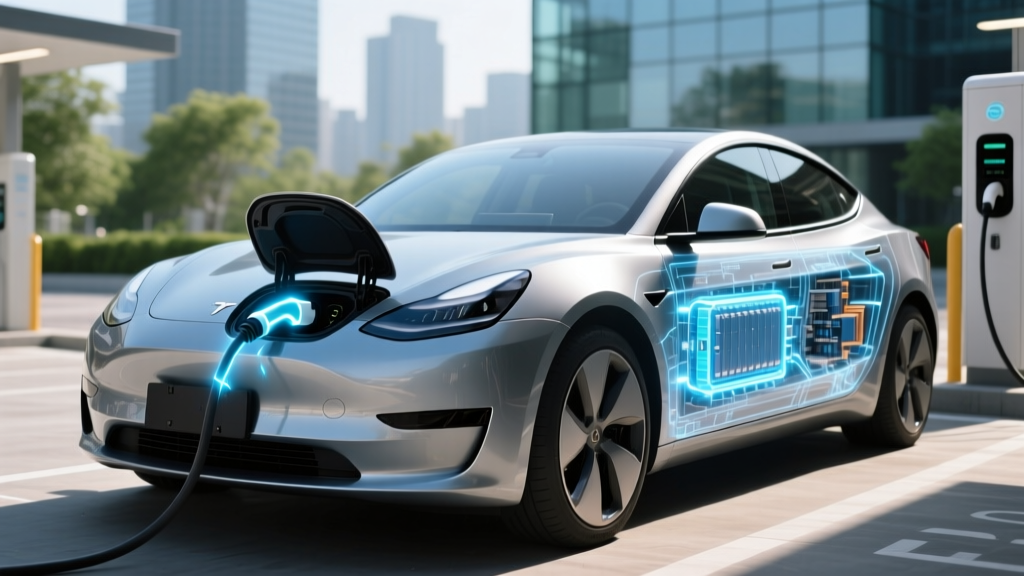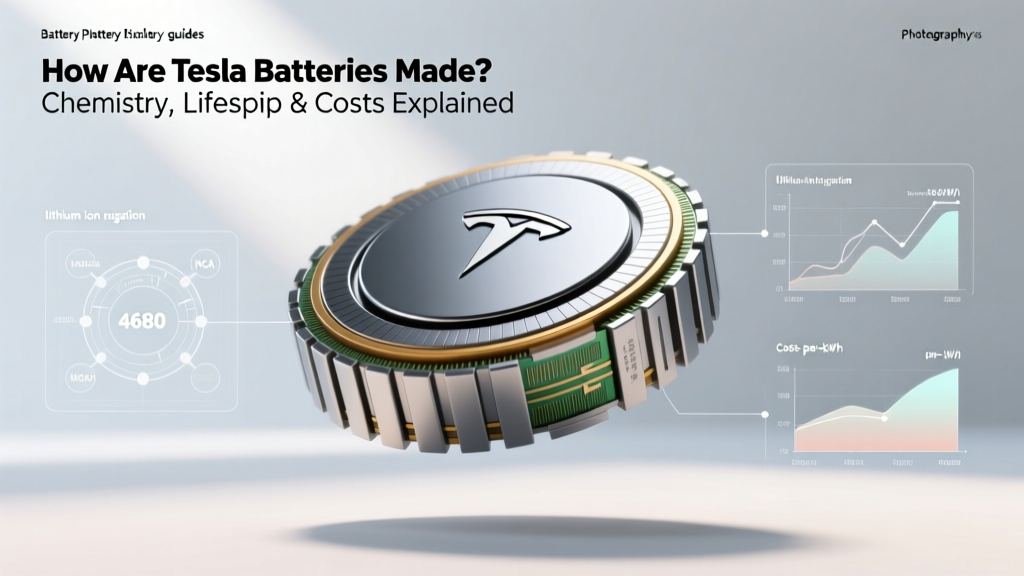
If you've ever wondered how are Tesla batteries made — and more importantly, how long they'll last and what happens when they degrade — you're asking the right questions. The high-voltage traction battery is the single most expensive component in any electric vehicle, and Tesla's approach to battery design, chemistry selection, and manufacturing has evolved significantly since the first Roadster. In 2026, Tesla sources cells from multiple suppliers (CATL, Panasonic, LG Energy Solution) and uses two primary chemistries across its lineup: lithium iron phosphate (LFP) and nickel-based (NMC/NCA). Understanding what's inside your battery, how it ages, and what ownership actually costs over a decade is essential before you sign a purchase agreement.
This guide breaks down Tesla's battery manufacturing approach, the real-world data on degradation, warranty coverage specifics, replacement costs if you ever need one, and the daily habits that meaningfully extend battery life. We'll also cover how to monitor your battery's State of Health (SoH) and what emerging technologies like solid-state cells could mean for the next generation of EVs.
Tesla Battery Chemistry: LFP vs NMC/NCA Explained
Tesla doesn't make a single "Tesla battery." The company designs battery packs — the enclosure, thermal management system, busbars, and battery management system (BMS) — but sources individual cells from partners. In 2026, the chemistry split across Tesla's lineup looks like this:
- LFP (Lithium Iron Phosphate): Used in the Model 3 Rear-Wheel Drive and Model Y Rear-Wheel Drive (Standard Range). These prismatic cells are primarily supplied by CATL and manufactured in China and, increasingly, at Tesla's own cell lines.
- NMC/NCA (Nickel Manganese Cobalt / Nickel Cobalt Aluminum): Used in Long Range and Performance variants of the Model 3 and Model Y, as well as the Model S, Model X, and Cybertruck. Panasonic supplies NCA cells from the Gigafactory in Nevada, while LG Energy Solution provides NMC cells.
Each chemistry has distinct engineering trade-offs that affect your ownership experience — from how far you can drive on a charge to how the battery handles winter cold.
| Attribute | LFP (LiFePO₄) | NMC/NCA (Nickel-based) |
|---|---|---|
| Energy Density | Lower (~160-180 Wh/kg cell-level) | Higher (~250-300 Wh/kg cell-level) |
| Typical Pack Size (Tesla) | ~57-60 kWh usable | ~75-82 kWh usable |
| Cycle Life | 3,000-5,000+ cycles to 80% SoH | 1,000-2,000 cycles to 80% SoH |
| Cold-Weather Performance | More range loss in freezing temps (~30-40% reduction) | Better cold performance (~20-30% reduction) |
| Recommended Daily SoC | 100% (Tesla recommends charging to full regularly) | 80% daily, 100% only for trips |
| Cost per kWh | Lower (~$90-110/kWh at cell level) | Higher (~$130-160/kWh at cell level) |
| Cobalt Content | None | Contains cobalt (NMC) or minimal (NCA) |
| Thermal Stability | Excellent — less prone to thermal runaway | Good — requires robust BMS and cooling |
The practical takeaway: If you buy a Model 3 RWD, you get an LFP battery with less total range (EPA 272 miles for 2026) but exceptional longevity and the convenience of charging to 100% daily without accelerated degradation. If you opt for a Long Range model, you gain range (EPA 341-363 miles depending on model/year) and better winter performance, but you should keep daily charges at 80% to preserve cell health. Neither chemistry is universally "better" — the right choice depends on your driving patterns and climate.
How Tesla Battery Packs Are Assembled
Understanding how are Tesla batteries made requires separating the cell from the pack. Tesla's cell suppliers manufacture individual cylindrical (2170 or 4680 format) or prismatic cells. Tesla then assembles these into modules and packs at its factories in Fremont, Austin, and Shanghai.
The key manufacturing steps at the pack level include:
- Cell sorting and matching: Cells are tested and grouped by capacity and internal resistance to ensure balanced performance across the pack.
- Module assembly: Cells are wired in series and parallel configurations within structural modules, with busbars connecting them.
- Thermal management integration: Tesla uses liquid cooling channels (glycol-based coolant) that snake between cell rows. This active thermal management is critical for both fast-charging speed and long-term degradation.
- BMS installation: The Battery Management System monitors voltage, temperature, and current at the cell-group level, managing charge/discharge limits, cell balancing, and thermal regulation.
- Structural pack integration: On newer vehicles (Model Y from Austin, Cybertruck), Tesla uses a structural battery pack where the pack itself serves as a stressed member of the vehicle chassis, reducing weight and increasing torsional rigidity.
The 4680 cell format (46mm diameter, 80mm height), introduced in limited production and scaling through 2025-2026, uses a tabless electrode design that reduces internal resistance. This allows faster charging and simpler thermal management, though real-world charge-speed gains have been incremental as Tesla refines manufacturing yield. The 4680 cells currently use a silicon-carbon anode and high-nickel NMC chemistry.
Real-World Tesla Battery Degradation: What the Data Shows
Battery degradation — the gradual, irreversible loss of usable capacity — is the number one concern for EV buyers. Here's what real-world data tells us about Tesla packs specifically:
Typical Tesla Battery Degradation Curve (Fleet Data)
- Year 1 / 15,000 miles: ~2-4% capacity loss (initial formation loss, steepest part of the curve)
- Year 3 / 45,000 miles: ~5-8% total loss
- Year 5 / 75,000 miles: ~7-10% total loss
- Year 8 / 120,000 miles: ~10-14% total loss (median fleet data)
- Year 10 / 150,000 miles: ~12-17% total loss (projected from fleet trends)
Sources: Tesla Impact Reports, fleet data aggregators like Teslanomics and Recurrent Auto. Individual results vary based on climate, charging habits, and chemistry.
Several important nuances shape these numbers:
- LFP packs degrade slower in calendar aging and cycle life, but may show slightly more apparent loss in cold weather due to chemistry characteristics.
- The degradation curve flattens. Most capacity loss occurs in the first 20,000-30,000 miles. After that, loss is roughly linear and slow — typically 1% or less per year.
- Tesla's BMS buffer helps. Tesla batteries have a top and bottom buffer (typically 2-5 kWh combined) that the BMS uses to protect cells. You never actually use 100.0% or 0.0% of the physical cell capacity. As cells degrade, the BMS may unlock a small amount of buffer to mask early degradation — which is why some owners see range "recover" after an OTA update.
- High-mileage taxis and fleet vehicles have demonstrated 200,000+ miles on original packs with 75-85% remaining capacity, particularly on NCA chemistry with consistent fast-charging.
Tesla Battery Warranty: What's Covered and What Isn't
Tesla's battery warranty is one of the strongest in the industry, but understanding the specifics matters — especially the capacity retention threshold that triggers a claim.
| Model / Variant | Warranty Period | Mileage Limit | Minimum Capacity Retention |
|---|---|---|---|
| Model 3 RWD (LFP) | 8 years | 100,000 miles | 70% |
| Model 3 Long Range / Performance | 8 years | 120,000 miles | 70% |
| Model Y RWD (LFP) | 8 years | 100,000 miles | 70% |
| Model Y Long Range / Performance | 8 years | 120,000 miles | 70% |
| Model S / Model X | 8 years | 150,000 miles | 70% |
| Cybertruck AWD / Cyberbeast | 8 years | 150,000 miles | 70% |
What the warranty covers: If your battery falls below 70% of its original usable capacity within the warranty period (whichever limit — time or miles — comes first), Tesla will repair or replace it at no cost. The replacement may be a new or remanufactured pack with at least 70% capacity.
What it does NOT cover:
- Normal degradation above the 70% threshold (even if you're unhappy with range loss)
- Damage from accidents, flooding, fire, or rodent damage
- Damage from using non-approved charging equipment or modifications
- Cosmetic issues that don't affect function
- The 12V auxiliary battery (covered under a separate, shorter warranty — typically 4 years/50,000 miles)
In practice, very few Tesla owners have needed to file a battery warranty claim. Fleet data from Recurrent Auto shows that fewer than 1.5% of Tesla batteries have been replaced under warranty — and the vast majority of those replacements were due to manufacturing defects early in the vehicle's life, not degradation.
EV Battery Replacement Cost: What Tesla Owners Actually Pay
If your battery fails outside of warranty — or if you're buying a used Tesla with high mileage — replacement cost is the elephant in the room. Here's the current landscape:
| Model | Battery Size (Usable) | Chemistry | Estimated Replacement Cost |
|---|---|---|---|
| Model 3 RWD | ~57 kWh | LFP | $10,000 - $13,000 |
| Model 3 Long Range | ~75 kWh | NMC/NCA | $13,000 - $17,000 |
| Model Y Long Range | ~75 kWh | NMC/NCA | $13,000 - $17,000 |
| Model S (2023+) | ~95 kWh | NMC/NCA | $18,000 - $22,000 |
| Model X (2023+) | ~95 kWh | NMC/NCA | $18,000 - $22,000 |
| Cybertruck | ~123 kWh | NMC (4680) | $20,000 - $28,000 |
Context that matters: These costs include the pack, labor, and diagnostics at a Tesla Service Center. Third-party EV repair shops are increasingly offering remanufactured pack swaps for 20-35% less. But here's the critical point: most Tesla batteries outlive the vehicle itself. The average age of a scrapped passenger car in the US is roughly 15 years. Given that fleet data shows Tesla packs retaining 80-88% capacity at 150,000 miles (roughly 10 years of average driving), the statistical likelihood of needing an out-of-warranty replacement is low for most owners.
The scenarios where replacement actually happens outside warranty:
- Collision or physical damage (typically covered by insurance)
- Manufacturing defect discovered late (Tesla has occasionally extended coverage via service campaigns)
- Very high-mileage fleet/taxi use exceeding 250,000+ miles
Factors That Affect Tesla Battery Lifespan
Not all miles are created equal when it comes to battery aging. The following factors have the most significant measurable impact on how quickly your Tesla's battery degrades:
Charging Habits
For NMC/NCA batteries (Long Range, Performance, Model S/X), the biggest longevity lever is your daily State of Charge (SoC). Keeping daily charges at 80% and only charging to 100% when you need the full range for a trip can reduce degradation by 30-50% over 8 years compared to daily 100% charges. For LFP batteries (Model 3/Y RWD), Tesla explicitly recommends charging to 100% regularly — this chemistry benefits from full-charge calibration and doesn't suffer the same high-SoC stress.
DC Fast Charging Frequency
Exclusive reliance on DC fast charging (Supercharging or third-party networks) accelerates degradation compared to Level 2 home charging. Fleet data suggests that vehicles fast-charging more than 80% of the time show roughly 2-3% additional capacity loss at 100,000 miles compared to primarily L2-charged vehicles. The heat generated during high-power charging (150-250 kW) stresses cells, even with Tesla's active thermal preconditioning. Occasional Supercharging for road trips is completely fine — it's the daily pattern that matters.
Extreme Temperatures
Batteries degrade faster when stored or operated frequently in extreme heat (above 95°F / 35°C). Phoenix and Las Vegas Teslas show slightly higher average degradation rates than those in temperate climates. Cold weather doesn't permanently damage batteries, but it temporarily reduces range (20-40% in sub-freezing conditions) and increases charging times because the BMS must warm the pack before accepting a charge. Tesla's heat pump (standard on all current models) and pack preconditioning mitigate this significantly.
Depth of Discharge
Regularly draining the battery to very low SoC (below 10%) stresses cells. The ideal operating window for NMC/NCA is roughly 20-80%. For LFP, the full 0-100% range is more tolerable, but repeatedly sitting at 0% for extended periods is still inadvisable.
Tesla Battery Care Checklist: Maximize Your Pack's Lifespan
- ☐ Set daily charge limit to 80% (NMC/NCA) or 100% (LFP) — adjust in the Tesla app
- ☐ Use Level 2 home charging as your primary charging method
- ☐ Enable "Scheduled Departure" with preconditioning to warm the battery before driving in cold weather
- ☐ Avoid leaving the car at 100% SoC for more than a few hours — time your full charges to depart shortly after
- ☐ Don't let the car sit below 10% SoC for extended periods (days or weeks)
- ☐ In extreme heat, plug in when parked so the thermal management system can cool the pack using grid power
- ☐ Use Tesla's built-in navigation for Supercharger stops — it automatically preconditions the battery for faster, gentler charging
- ☐ For long-term storage (2+ weeks), leave the car plugged in at ~50% SoC with "Scheduled Departure" disabled
How to Check Your Tesla Battery's State of Health
Tesla doesn't display a simple "battery health percentage" in the vehicle's UI the way some competitors do. But there are several ways to assess your pack's State of Health (SoH):
Method 1: Range Comparison at 100% SoC
Charge to 100% (or your known full charge) and note the displayed range. Compare this to the EPA-rated range when new. For example, if your 2023 Model 3 Long Range originally displayed 341 miles at 100% and now shows 310 miles, that's roughly 9% degradation. Note that displayed range is affected by recent driving efficiency, temperature, and BMS calibration — it's an estimate, not a direct capacity measurement.
Method 2: Tesla Service Mode (2024+ Vehicles)
On vehicles running recent firmware, Tesla's Service Mode (accessible via the software menu) includes a "Health Test" that runs a controlled discharge/charge cycle and reports a more accurate SoH percentage. This test takes several hours and requires the car to be parked and plugged in.
Method 3: Third-Party Apps
Apps like TeslaFi, Stats (iOS), and Tessie log detailed battery data via Tesla's API, tracking energy-in vs. energy-out over full charge cycles to calculate SoH. These tools provide trend lines over months and are popular among enthusiast owners. The EPA's EV technology resources also provide general guidance on battery health monitoring for all EV brands.
Method 4: Tesla Service Center Diagnostic
If you suspect a problem or are evaluating a used Tesla purchase, a Tesla Service Center can run a full pack diagnostic that reports individual module voltages, capacity, and overall SoH. This is typically free if done during a scheduled service visit.
Emerging Battery Technologies: What's Next After LFP and NMC
Tesla is actively investing in next-generation battery technology, but it's important to separate announced timelines from showroom reality:
Silicon Anode Cells (Near-term, 2026-2028): Tesla's 4680 cells already incorporate a silicon-carbon composite anode, replacing some graphite with silicon to increase energy density. Silicon can theoretically store 10x more lithium ions per gram than graphite, but it swells during charging — a problem Tesla has partially solved with nano-structured coatings. Expect incremental energy density improvements of 5-10% per cell generation rather than a step-change breakthrough.
Solid-State Batteries (Long-term, 2029+): Solid-state cells replace the liquid electrolyte with a solid ceramic or polymer, promising higher energy density (~400+ Wh/kg), faster charging, and near-zero fire risk. Multiple companies (Toyota, QuantumScape, Samsung SDI) have announced solid-state timelines, but none have reached mass production at automotive scale. Tesla has not announced a solid-state production timeline. Realistic availability in a Tesla vehicle: 2030 or later, likely debuting in a premium model.
Sodium-Ion Batteries (Emerging, 2027-2029): CATL has begun producing sodium-ion cells that use no lithium, nickel, or cobalt. These offer lower energy density than LFP but extremely low cost and excellent cold-weather performance. They could appear in a future Tesla entry-level model, but no specific vehicle has been announced.
For buyers making decisions today, current LFP and NMC/NCA chemistries are mature, well-proven, and backed by extensive warranty coverage. Waiting for solid-state is not a practical strategy if you need a vehicle in the next 1-3 years.
Frequently Asked Questions
How long do Tesla batteries last in years and miles?
Based on fleet data, Tesla batteries typically retain 85-90% of their original capacity at 150,000 miles (roughly 10 years of average US driving at 14,000 miles/year). LFP packs in Model 3/Y RWD may last longer in terms of cycle life (3,000-5,000 cycles to 80% SoH). Most Tesla batteries will outlast the vehicle's useful economic life. Complete failure before 200,000 miles is statistically rare — under 1.5% based on warranty claim data.
How much does it cost to replace a Tesla battery?
Out-of-warranty Tesla battery replacement costs range from approximately $10,000 for a Model 3 RWD (LFP, ~57 kWh) to $28,000 for a Cybertruck (~123 kWh, 4680 NMC). Most owners will never face this cost: the battery is covered for 8 years / 100,000-150,000 miles (depending on model), and fleet data shows degradation rarely drops below 70% within that window. If you do need a replacement, third-party shops offering remanufactured packs can reduce costs by 20-35%.
What does the Tesla battery warranty actually cover?
Tesla's battery warranty guarantees that the pack will retain at least 70% of its original usable capacity for 8 years or 100,000-150,000 miles (varies by model — see warranty table above). If capacity drops below 70% within that period, Tesla replaces or repairs the pack at no cost. The warranty does not cover normal degradation above 70%, accident damage, flood damage, or modifications. The 12V auxiliary battery is covered separately under the basic vehicle warranty.
LFP vs NMC — which Tesla battery is better for me?
Choose LFP (Model 3/Y RWD) if you prioritize longevity, want the convenience of daily 100% charging, live in a mild climate, and can accept ~270-280 miles of EPA range. Choose NMC/NCA (Long Range/Performance) if you need 340+ miles of range, regularly drive in freezing weather, take frequent road trips (better fast-charge performance in cold), or want maximum acceleration. LFP is the better "set it and forget it" battery; NMC/NCA gives you more range but requires more deliberate charging habits.
Does frequent Supercharging damage my Tesla battery?
Exclusive reliance on DC fast charging (Supercharging at 150-250 kW) causes slightly faster degradation — roughly 2-3% additional capacity loss at 100,000 miles compared to primarily Level 2 home charging. However, Tesla's thermal management system and battery preconditioning (which activates when you navigate to a Supercharger) significantly mitigate heat stress. Occasional Supercharging for road trips has negligible impact. The concern applies mainly to drivers who Supercharge daily and rarely use Level 2.
Can I check my Tesla battery health myself?
Yes. The simplest method is to charge to 100% and compare displayed range to the original EPA rating. For more precision, Tesla's Service Mode (on recent firmware) includes a Health Test, and third-party apps like TeslaFi or Tessie calculate SoH from energy flow data over full charge cycles. For a definitive assessment — especially when buying used — request a battery diagnostic at a Tesla Service Center.