The Raw Materials Behind Your Tesla's Range
When shoppers ask "how much lithium in Tesla battery packs," they're usually trying to answer one of three things: the environmental footprint of battery production, the geopolitical supply-chain risk, or the long-term cost implications of battery chemistry. The answer depends entirely on which Tesla model and which battery pack you're looking at, because Tesla uses two fundamentally different chemistries across its 2026 lineup — and the lithium content varies dramatically between them.
A Tesla Model Y Long Range with its ~75 kWh NMC (nickel manganese cobalt) battery pack contains roughly 8 to 10 kilograms (18–22 lbs) of lithium, primarily in the form of lithium hydroxide used in the cathode. A Tesla Model 3 Rear-Wheel Drive with its ~60 kWh LFP (lithium iron phosphate) pack contains approximately 6 to 8 kilograms (13–18 lbs) of lithium, using lithium carbonate instead. These figures encompass lithium in the cathode active material and the lithium salt in the electrolyte.
But lithium content is only part of the story. The chemistry choice — NMC vs LFP — dictates your real-world range, charging behavior, cold-weather performance, and how the battery degrades over a decade of ownership. Let's break down both chemistries with hard data.
LFP vs NMC/NCA: Tesla's Two Battery Chemistries
Tesla sources battery cells from multiple suppliers — primarily CATL (for LFP cells), Panasonic (for NCA/NMC cylindrical cells), and LG Energy Solution (for NMC pouch cells). Which chemistry ends up in your car depends on the trim level, and the trade-offs are significant.
| Attribute | LFP (Lithium Iron Phosphate) | NMC/NCA (Nickel Manganese Cobalt / Nickel Cobalt Aluminum) |
|---|---|---|
| Energy Density | ~160–180 Wh/kg (lower) | ~250–300 Wh/kg (higher) |
| Typical Tesla Application | Model 3 RWD, Model Y RWD | Model 3 Long Range, Model Y Long Range/Performance, Model S/X |
| Cycle Life | 3,000–5,000+ cycles to 80% SoH | 1,000–2,000 cycles to 80% SoH |
| Cold-Weather Performance | More range loss below freezing (~30–40%) | Better cold performance (~20–30% loss) |
| Recommended Charge Habit | Can (and should) charge to 100% regularly | Daily charge to 80%; 100% for trips only |
| Cobalt Content | Zero cobalt | Contains cobalt (supply-chain/ethical concern) |
| Cost per kWh (cell-level) | Lower (~$80–100/kWh) | Higher (~$110–140/kWh) |
| Lithium Form Used | Lithium carbonate (cheaper) | Lithium hydroxide (more expensive) |
The practical takeaway: If you buy a Model 3 RWD, you're getting an LFP pack that tolerates daily 100% charging and will likely outlast the car itself in cycle life, but you'll sacrifice some range and notice more winter range loss. If you buy a Long Range or Performance variant, you're getting NMC/NCA with higher energy density (more range in a lighter pack) and better cold performance, but you need to manage charge habits more carefully to minimize degradation.
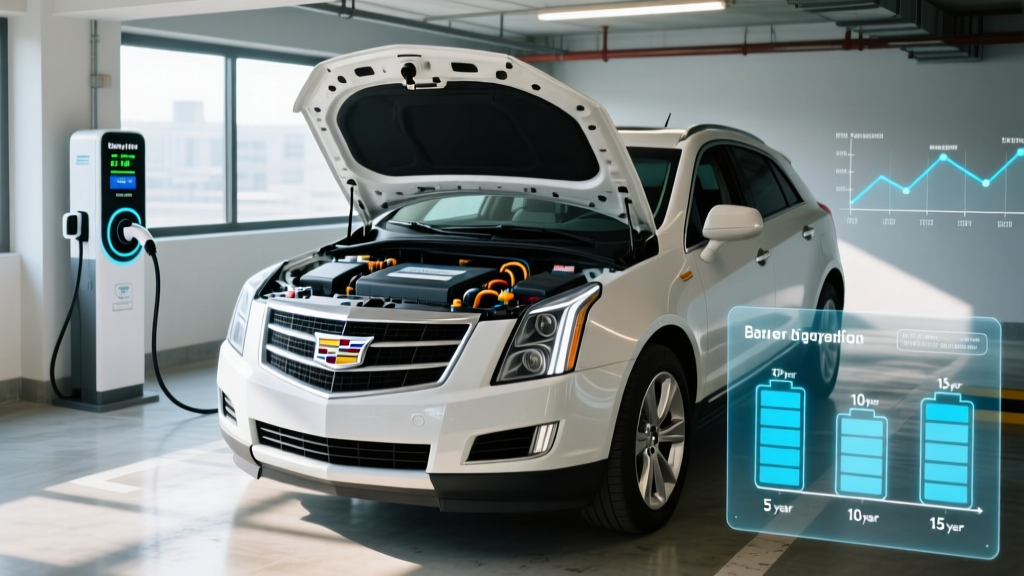
How Long Do Tesla Batteries Actually Last?
Tesla publishes fleet degradation data in its annual Impact Report, and independent researchers like Recurrent Auto have tracked thousands of Tesla vehicles over time. Here's what the data shows for real-world degradation:
- Year 1 / 15,000 miles: ~2–4% capacity loss (initial "formation" degradation)
- Year 3 / 45,000 miles: ~5–8% total loss
- Year 5 / 75,000 miles: ~8–12% total loss
- Year 8 / 120,000 miles: ~10–15% total loss for NMC; ~7–10% for LFP
- 200,000 miles: Tesla's fleet data suggests an average of ~12% degradation across NMC packs; LFP packs typically show less
These numbers represent average fleet data. Individual results vary based on charging habits, climate, and Supercharger frequency. The degradation curve is not linear — the steepest drop occurs in the first year or two, then it flattens significantly. Most Tesla owners will sell or trade the vehicle before battery degradation becomes a practical concern.
For context, a Model Y Long Range starting at an EPA-rated 330 miles with ~12% degradation after 200,000 miles would still offer roughly 290 miles of EPA-equivalent range. In real-world highway driving at 70 mph, expect about 10–15% less than the EPA sticker to begin with — so roughly 245–260 miles usable range after high mileage. Still very livable for daily driving.
What Does Tesla's Battery Warranty Actually Cover?
Tesla's battery and drive unit warranty is one of the stronger guarantees in the EV industry, but the details matter. Here's the breakdown for the 2026 model year:
| Model / Variant | Warranty Period | Mileage Limit | Minimum Capacity Retention |
|---|---|---|---|
| Model 3 RWD (LFP) | 8 years | 100,000 miles | 70% |
| Model 3 Long Range / Performance | 8 years | 120,000 miles | 70% |
| Model Y (all trims) | 8 years | 120,000 miles | 70% |
| Model S / Model X | 8 years | 150,000 miles | 70% |
What this means in practice: If your battery drops below 70% of its original usable capacity within the warranty period (whichever limit comes first — years or miles), Tesla will repair or replace it at no cost. The replacement may be a new or remanufactured pack that meets the 70% threshold. This warranty transfers to subsequent owners, which supports Tesla resale values.
Important exclusions: damage from accidents, flooding, fire, or unauthorized modifications is not covered. Using the vehicle as a stationary power source (V2H/V2G) in ways not approved by Tesla could also void coverage. Always check the full warranty document at Tesla's warranty page for your specific model year.
EV Battery Replacement Cost: What You'd Actually Pay
Out-of-warranty battery replacement is the number-one fear among prospective EV buyers. Here's the reality: full replacements are rare, and when they do happen, costs have been declining steadily. Based on service data and industry estimates for 2026:
| Model | Battery Size (usable kWh) | Estimated Pack Cost | Labor & Misc. | Total Estimated Range |
|---|---|---|---|---|
| Model 3 RWD (LFP) | ~60 kWh | $7,000–$9,000 | $1,500–$2,500 | $8,500–$11,500 |
| Model 3 Long Range (NMC) | ~75 kWh | $10,000–$13,000 | $1,500–$2,500 | $11,500–$15,500 |
| Model Y Long Range (NMC) | ~75 kWh | $10,000–$13,000 | $1,500–$2,500 | $11,500–$15,500 |
| Model S / X (NMC/NCA) | ~95–100 kWh | $14,000–$18,000 | $2,000–$3,000 | $16,000–$21,000 |
These are worst-case, full-pack-replacement figures. In practice, many out-of-warranty failures involve individual modules or the BMS (battery management system), which can be repaired for $2,000–$5,000. Independent EV repair shops are increasingly capable of module-level repairs, further reducing costs.
The critical context: based on degradation data above, the vast majority of Tesla batteries will retain 70%+ capacity well past 200,000 miles. Most will never need replacement during the vehicle's usable life. The fear of a $15,000 battery bill at 100,000 miles is not supported by fleet data.
Factors That Accelerate (or Preserve) Battery Life
Battery degradation is chemistry and physics, not luck. Here are the variables you control:
- State of Charge (SoC) habits: For NMC packs, keeping daily SoC between 20–80% significantly reduces calendar aging. LFP packs should be charged to 100% at least weekly to keep the BMS calibrated — this is a fundamental difference between the two chemistries.
- DC fast-charging frequency: Exclusive Supercharger use (high-power DC charging) adds thermal stress. Teslas that charge primarily at home on Level 2 (7–11 kW) and Supercharge occasionally show measurably less degradation than fleet vehicles that Supercharge daily. The difference is modest — perhaps 2–4% additional loss over 150,000 miles — but it's real.
- Temperature extremes: Sustained exposure to ambient heat above 95°F accelerates calendar degradation. Cold weather doesn't permanently damage the battery, but charging an LFP pack in sub-freezing temperatures without preconditioning can cause lithium plating — a permanent capacity loss mechanism. Always use the Tesla app to precondition before charging in cold weather.
- Storage SoC: Leaving any EV parked for weeks at 100% SoC (or below 10%) in hot weather is one of the fastest ways to degrade a battery. If storing, set the charge limit to ~50% and leave it plugged in so the thermal management system can operate.
How to Check and Monitor Your Tesla's Battery Health
Tesla doesn't expose a direct State of Health (SoH) percentage in the vehicle's UI the way some competitors do. Here are the methods available to owners:
- Tesla Service Mode: On newer software versions, you can access Service Mode (tap the "Software" label in the car settings multiple times) and navigate to the battery health screen, which shows a SoH percentage and usable capacity in kWh.
- Third-party apps: Tools like Tessie, Stats for Tesla, or TeslaFi log charging data and can estimate SoH by comparing energy added during a known SoC window against the original pack capacity.
- Manual calculation: Charge from a known low SoC (e.g., 10%) to a known high SoC (e.g., 90%), note the kWh added from the charger or app, and extrapolate total capacity. For example, if 52 kWh takes you from 10% to 90% (80% of the pack), your total usable capacity is ~65 kWh. Compare that to the original spec.
- Range-based estimate: Less precise, but if your car showed 330 miles at 100% when new and now shows 300 miles at 100% (accounting for software updates that may adjust the display), that's roughly 9% degradation.
For buyers of used Teslas, requesting a Service Mode screenshot showing SoH from the seller is the single most valuable piece of due diligence you can do. A healthy 3-year-old Model Y should show 92–96% SoH.
Beyond Lithium-Ion: Solid-State and Silicon Anode Timelines
Next-generation battery technologies are frequently hyped, but here's where they actually stand as of 2026:
Silicon-dominant anodes: Companies like Sila Nanotechnologies and Group14 are producing silicon-carbon composite anode materials that increase energy density by 15–25% over graphite anodes. These are entering production in limited applications (primarily consumer electronics and specialty vehicles) but are not yet in mass-market Tesla packs. Expect broader EV adoption by 2028–2030.
Solid-state batteries: Toyota, Samsung SDI, and QuantumScape have demonstrated solid-state cells with promising energy density and charge-speed characteristics. However, manufacturing at automotive scale and cost remains unsolved. Toyota has announced limited solid-state production for 2027–2028, but in low volumes for premium models. Mass-market solid-state EVs at price parity with current lithium-ion are realistically a 2030+ proposition.
Sodium-ion batteries: CATL has begun producing sodium-ion cells that use zero lithium. These have lower energy density (~120–140 Wh/kg) but are cheaper and better in cold weather. They're currently targeted at budget Chinese-market EVs and stationary storage, not Tesla vehicles. However, they represent a potential long-term alternative for entry-level models.
None of these technologies change the buying decision today. Current lithium-ion chemistries — both LFP and NMC — are mature, well-understood, and demonstrably long-lasting based on fleet data.
Frequently Asked Questions
How much lithium is in a Tesla Model Y battery?
A Tesla Model Y Long Range with a ~75 kWh NMC battery contains approximately 8–10 kg (18–22 lbs) of lithium. A Model Y Rear-Wheel Drive with a ~60 kWh LFP battery contains approximately 6–8 kg (13–18 lbs). The difference comes from the cathode chemistry — NMC uses lithium hydroxide, while LFP uses lithium carbonate — and the total pack energy capacity.
LFP vs NMC — which battery chemistry is better?
Neither is universally better; they serve different priorities. LFP wins on longevity (3,000–5,000+ cycles), cost, and cobalt-free sourcing, but has lower energy density and worse cold-weather range. NMC wins on energy density (more range per kg), cold performance, and charging speed, but has shorter cycle life and contains cobalt. For a daily commuter who charges at home, LFP is arguably the smarter choice. For road-trippers in cold climates, NMC's advantages are meaningful.
How long do EV batteries last in years and miles?
Based on Tesla fleet data and third-party tracking, most Tesla batteries retain 85–90% of original capacity at 150,000 miles and 80–88% at 200,000 miles. In years, that translates to 10–15 years of typical use before degradation reaches 20%. LFP packs tend to degrade less than NMC over the same mileage. Most batteries will outlast the vehicle's body, interior, and suspension components.
How much does a Tesla battery cost to replace?
Out-of-warranty full battery replacement ranges from roughly $8,500 for a Model 3 RWD (LFP) to $21,000 for a Model S/X. However, full replacements are rare — many issues are resolved through module-level repair ($2,000–$5,000) or BMS service. Under warranty (8 years / 100,000–150,000 miles depending on model), replacement is free if capacity drops below 70%.
Does frequent Supercharging damage the battery?
Exclusive DC fast-charging adds modest thermal stress that can accelerate degradation by an estimated 2–4% over 150,000 miles compared to primarily Level 2 home charging. Tesla's battery thermal management system actively cools the pack during Supercharging, which limits damage. The practical impact is small — not a reason to avoid road trips — but owners with home charging access will see slightly better long-term SoH by using Level 2 for daily charging and reserving Superchargers for trips.
How do I maximize my Tesla battery's lifespan?
For NMC packs: set the daily charge limit to 80%, avoid letting SoC drop below 10% regularly, use home Level 2 charging when possible, and precondition before Supercharging in cold weather. For LFP packs: charge to 100% at least once per week for BMS calibration, and follow the same temperature and preconditioning guidelines. For both: avoid leaving the car parked at very high or very low SoC in extreme heat for extended periods.