If you've ever searched "how long to drive car to charge battery," you're likely dealing with one of two very different problems: a dead 12-volt auxiliary battery in a gas car or EV, or a deeper question about how an electric vehicle's high-voltage traction battery charges, degrades, and lasts over time. These are fundamentally different systems, and conflating them leads to bad decisions — like thinking a 30-minute drive will fix a failing EV traction pack, or worrying that your EV's main battery needs "driving to charge" the way a gas car's alternator tops off a lead-acid 12V.
This guide untangles both questions, then goes deep on what actually matters for EV owners: traction battery chemistry, real-world degradation data, warranty coverage, replacement costs, and the habits that maximize battery lifespan over 100,000+ miles.
The 12V Battery Question: How Long Does a Drive Actually Take?
Let's address the literal keyword first, because it applies to every vehicle on the road — EVs included. Every modern electric vehicle still carries a 12V auxiliary battery (increasingly lithium-ion, but sometimes lead-acid) that powers the computers, lights, door handles, and contactors that close the circuit to the main high-voltage pack. If that 12V dies, the car won't start — even if the traction battery is at 100%.
In a conventional gas car, the alternator charges the 12V battery while the engine runs. A typical alternator outputs 80–150 amps at 13.8–14.4 volts, meaning roughly 1.1–2.2 kW of charging power. To replenish a battery that's been drained by, say, leaving headlights on for an hour (~5 Ah consumed at ~60 watts), you'd need roughly 20–30 minutes of driving at highway speeds to restore a meaningful surface charge. A full recharge from deeply depleted can take several hours of continuous driving.
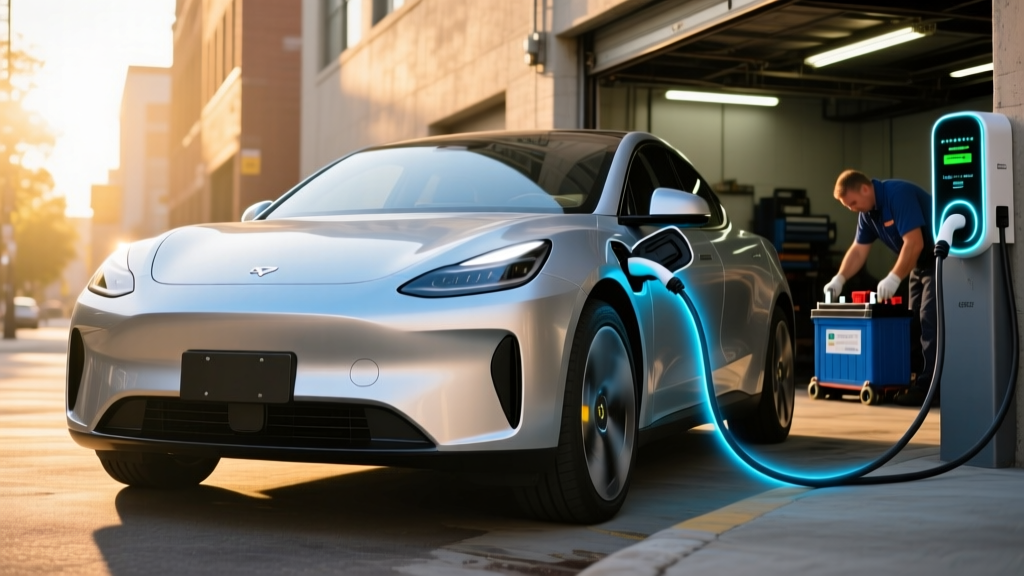
In an EV, there is no alternator. Instead, a DC-DC converter steps down the high-voltage traction battery (typically 400V or 800V) to 13.8–14.4V to maintain the 12V battery. This happens whenever the car is "on" (ready to drive, not just accessory mode). Most EV DC-DC converters output 1.5–3.0 kW to the 12V system, meaning a depleted 12V battery can be substantially recharged in 15–30 minutes of driving. However, if the 12V battery is sulfated or end-of-life (typical lead-acid 12V lifespan is 3–5 years; lithium 12V packs last 6–8+ years), no amount of driving will save it.
EV Traction Batteries Don't Need "Driving to Charge" — They Need Plug-In Charging
Unlike a gas car's 12V battery, which the alternator replenishes during every drive, an EV's traction battery is charged exclusively through external power: Level 1 (120V household outlet, ~1.4 kW), Level 2 (240V home or public charger, 7–19 kW), or DC fast charging (50–350+ kW at public stations). Regenerative braking recovers some energy during deceleration — typically 15–30% of the energy used in stop-and-go driving — but this is recapture, not a primary charging method.
The real question behind the search is usually: how long does an EV battery last before it needs replacement? That's a function of chemistry, usage patterns, and time. Let's break it down with actual data.
Battery Chemistry: LFP vs NMC/NCA Trade-Offs
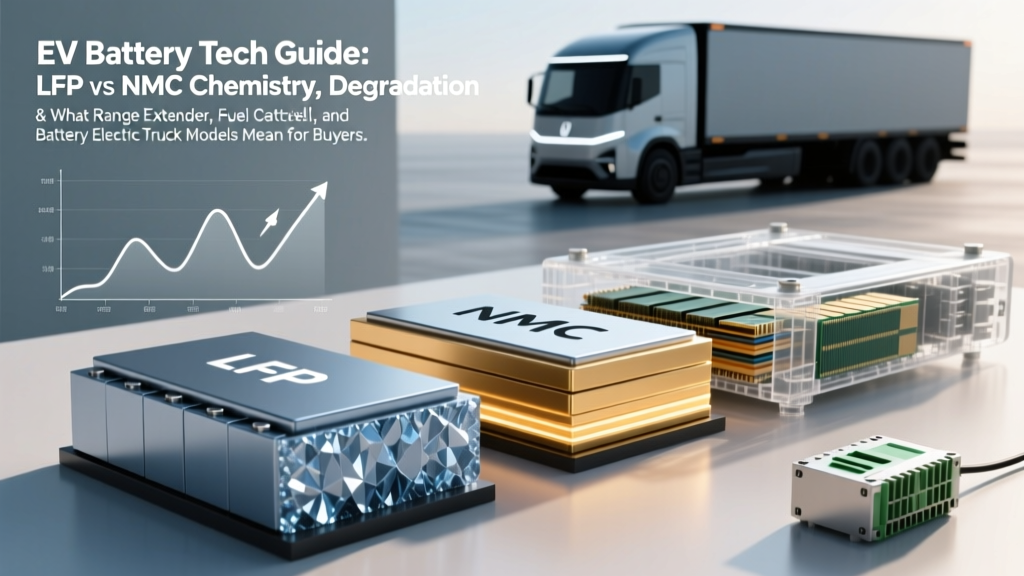
Not all EV batteries are the same. The two dominant chemistries in 2026 passenger EVs are LFP (lithium iron phosphate) and NMC/NCA (nickel manganese cobalt / nickel cobalt aluminum). The chemistry in your car fundamentally shapes its energy density, cycle life, cold-weather behavior, and cost.
| Attribute | LFP (LiFePO₄) | NMC / NCA |
|---|---|---|
| Energy density | ~160–180 Wh/kg (cell level) | ~220–300 Wh/kg (cell level) |
| Cycle life | 3,000–6,000+ cycles to 80% SoH | 1,000–2,500 cycles to 80% SoH |
| Cold performance | More range loss below 32°F; slower charge acceptance when cold | Better low-temp performance; preconditioning still recommended |
| Recommended SoC range | Can charge to 100% regularly (BMS calibrates better at full) | Daily charge to 80%; 100% for trips only |
| Cost per kWh (pack level) | ~$90–$115/kWh | ~$120–$150/kWh |
| Thermal stability | Excellent — higher thermal runaway threshold (~270°C) | Good — lower runaway threshold (~210°C); requires robust BMS |
| Common in (2026 models) | Tesla Model 3/Y RWD, Ford Mustang Mach-E Select (some trims), BYD models | Hyundai Ioniq 5/6, Kia EV6/EV9, Chevy Equinox EV, BMW iX, Tesla Long Range/Performance |
Which is better? It depends on your use case. LFP wins on longevity, cost, and safety — ideal for daily commuters who charge at home and can accept slightly less range per kWh. NMC/NCA wins on energy density and cold-weather performance — better for long-range models, cold-climate drivers, and buyers who need maximum miles from a smaller, lighter pack. Neither is universally superior; the right choice depends on your driving pattern and climate.
How Long Do EV Batteries Actually Last? Degradation Data
The fear that EV batteries "won't last" is one of the most persistent myths in the transition to electric. Real-world fleet data tells a different story. According to data aggregated from Tesla's Impact Reports and independent fleet analyses, the average EV battery retains approximately 85–90% of its original capacity after 150,000 miles. Most modern packs are engineered to outlast the vehicle's economic life.
Here's what degradation typically looks like over time, based on fleet data from sources including fueleconomy.gov and manufacturer-reported fleet statistics:
- Year 1 / 15,000 mi: ~2–4% loss (initial "break-in" drop)
- Year 3 / 45,000 mi: ~5–8% total loss
- Year 5 / 75,000 mi: ~8–12% total loss
- Year 8 / 120,000 mi: ~10–15% total loss
- Year 10 / 150,000 mi: ~12–18% total loss
LFP packs typically show slower degradation, often losing only 5–10% over 150,000 miles. Degradation is non-linear — steepest in the first year, then flattening to a slow, linear decline.
A concrete example: a 2024 Tesla Model 3 Long Range with a 75 kWh usable NMC pack and an EPA range of 341 miles. After 100,000 miles and 6 years, real-world data suggests the pack would retain roughly 85–88% of its capacity — about 64–66 kWh usable — translating to approximately 290–300 miles of EPA-equivalent range. That's a noticeable reduction, but far from "dead."
What Does the Battery Warranty Actually Cover?
Federal law in the United States mandates that EV batteries carry a minimum warranty of 8 years or 100,000 miles (whichever comes first). In California Air Resources Board (CARB) states — which include CA, CO, CT, ME, MA, NJ, NY, OR, RI, VT, WA, and others — that extends to 10 years or 150,000 miles. Most manufacturers exceed these minimums or match them with a capacity retention guarantee.
| Manufacturer | Warranty Period | Capacity Threshold | Notes |
|---|---|---|---|
| Tesla | 8 yr / 120,000 mi (Model 3/Y LR); 8 yr / 100,000 mi (RWD) | 70% retention | May replace with remanufactured pack of equal or greater capacity |
| Hyundai / Kia | 10 yr / 100,000 mi | 70% retention | Among the longest standard warranties in the US market |
| General Motors (Chevy/Cadillac) | 8 yr / 100,000 mi | 70% retention (some Ultium models: 60% for commercial) | Ultium platform packs; module-level repair possible |
| Ford | 8 yr / 100,000 mi | 70% retention | Covers Mustang Mach-E, F-150 Lightning |
| BMW | 8 yr / 100,000 mi | 70% retention | Covers i4, i5, i7, iX; module replacement available |
| Rivian | 8 yr / 175,000 mi (R1T/R1S) | 70% retention | Higher mileage threshold reflects adventure-use positioning |
What triggers a warranty claim? If your battery's State of Health (SoH) drops below the stated threshold (typically 70% of original capacity) within the warranty period, the manufacturer will repair or replace it — often with a remanufactured pack that meets or exceeds the threshold. The warranty covers defects and abnormal degradation; it does not cover damage from accidents, flooding, or unauthorized modifications.
How Much Does an EV Battery Replacement Cost?
This is where fear-mongering runs rampant. Yes, out-of-warranty battery replacements are expensive. But the context matters: the vast majority of EV batteries never need replacement during typical ownership. Data from warranty providers and fleet operators suggests fewer than 2–5% of EV batteries are replaced under warranty, and the failure rate outside warranty is low for packs that survived the early "infant mortality" period.
That said, here are realistic replacement cost ranges for 2026, based on manufacturer service bulletins, independent shop data, and industry reports:
| Vehicle / Pack Size | Chemistry | Estimated Cost (Parts + Labor) | When Typically Needed |
|---|---|---|---|
| Tesla Model 3 RWD (~57 kWh) | LFP | $8,000–$12,000 | Rarely before 200,000+ mi |
| Tesla Model Y Long Range (~75 kWh) | NMC | $12,000–$16,000 | Rarely before 180,000+ mi |
| Hyundai Ioniq 5 (~77 kWh) | NMC | $10,000–$15,000 | Rarely before 180,000+ mi |
| Ford F-150 Lightning Ext. Range (~131 kWh) | NMC | $18,000–$28,000 | Rarely before 150,000+ mi |
| Chevy Equinox EV (~85 kWh) | NMC (Ultium) | $12,000–$18,000 | Rarely before 170,000+ mi |
Several factors are driving these costs down year over year. Pack-level pricing has fallen from over $200/kWh in 2020 to roughly $100–$140/kWh in 2026 for most chemistries. Additionally, many shops now offer module-level repairs — replacing only the degraded or failed modules within a pack rather than the entire assembly — for $2,000–$6,000, depending on the number of modules affected. GM's Ultium platform and BMW's Neue Klasse architecture are specifically designed for module-level serviceability.
Factors That Accelerate Battery Degradation (and How to Minimize Them)
EV batteries degrade through two mechanisms: calendar aging (chemical changes over time, regardless of use) and cycle aging (wear from charge/discharge cycles). You can't stop calendar aging, but you can significantly slow cycle aging by managing five key factors:
- Avoid chronic 100% charges (NMC/NCA): Set your daily charge limit to 80%. Charge to 100% only before long trips. LFP owners can charge to 100% regularly — in fact, periodic full charges help the BMS calibrate.
- Minimize DC fast charging frequency: Occasional DCFC is fine, but daily 150–350 kW sessions accelerate degradation. Studies show packs that rely primarily on Level 2 charging degrade ~2–3% less over 100,000 miles than those DCFC-heavy. Use fast charging for road trips; use Level 2 at home for daily needs.
- Avoid extreme State of Charge storage: Don't leave the car sitting at 100% or below 10% for weeks. If storing for extended periods, target 40–60% SoC.
- Use preconditioning: In cold weather, precondition the battery (most EVs do this automatically when you set a departure time or navigate to a charger). Charging a cold battery — especially DC fast charging — causes lithium plating, a permanent degradation mechanism.
- Limit exposure to extreme heat: Parking in shade or a garage when ambient temps exceed 95°F reduces calendar aging. Batteries degrade faster at high SoH and high temperatures simultaneously — avoid parking at 100% charge in summer heat.
- Drive moderately: Aggressive acceleration and sustained high-speed driving generate more heat in the pack. The thermal management system handles this, but chronic high-load driving in hot climates adds stress.
How to Check Your EV Battery's State of Health
State of Health (SoH) is the percentage of a battery's original capacity that remains usable. A new EV has 100% SoH; a pack that originally held 75 kWh but now holds 67.5 kWh is at 90% SoH. Monitoring SoH is essential for understanding your battery's condition, planning for warranty claims, and assessing resale value.
Method 1: In-car diagnostics. Many 2025–2026 EVs now display SoH or a battery health indicator directly in the infotainment system. Tesla added a battery health metric in software updates; Hyundai/Kia displays it in the EV menu; BMW's iDrive includes a battery health report. Check your owner's manual for the exact path.
Method 2: Third-party OBD-II apps. Apps like OBDeleven, Leaf Spy (for Nissan Leaf), and Scan My Tesla (via OBD-II dongle) can read the battery management system's internal SoH estimate, cell voltage variance, and pack temperature data. A $20–$40 Bluetooth OBD-II dongle paired with these apps gives you dealer-level insight.
Method 3: Dealer service check. Request a battery health report during scheduled service. Dealerships can pull detailed SoH data, cell balancing status, and thermal management logs. This documentation is valuable for warranty claims and resale.
Method 4: Manual calculation. Charge to 100% (or a known SoC), drive a measured distance, note the energy consumed (kWh from the trip computer), and compare to the pack's original usable capacity. If your 75 kWh pack uses 70 kWh to go from 100% to 5%, your usable capacity is roughly 71 kWh — an SoH of ~95%.
Emerging Battery Tech: Solid-State and Silicon Anodes
Several next-generation battery technologies are in development that could reshape EV battery longevity and performance. It's important to separate what's real today from what's on the horizon.
Solid-state batteries replace the liquid electrolyte in current lithium-ion cells with a solid material (ceramic, sulfide, or polymer). The theoretical advantages are significant: higher energy density (potentially 400–500 Wh/kg at the cell level), faster charging, improved safety (no flammable electrolyte), and longer cycle life. Toyota, Samsung SDI, and QuantumScape are among the companies with active development programs. However, as of 2026, solid-state batteries remain in limited production or pilot phases. Toyota has announced solid-state-equipped vehicles for limited release around 2027–2028, but mass-market availability at competitive pricing is not expected until the early 2030s. Manufacturing challenges — particularly achieving consistent solid-electrolyte interfaces at scale — remain significant.
Silicon anode technology is closer to market. Companies like Sila Nanotechnologies and Group14 Technologies are supplying silicon-dominant anode materials that boost energy density by 20–40% compared to graphite anodes. These are appearing in some 2025–2026 model-year cells (notably in partnerships with Mercedes-Benz and Panasonic). Silicon anodes don't fundamentally change the charging or longevity equation for owners, but they do enable more range from a smaller, lighter pack.
Sodium-ion batteries are also entering the conversation for lower-cost, entry-level EVs. CATL has begun mass production of sodium-ion cells for use in Chinese-market vehicles, with energy densities around 140–160 Wh/kg. These offer excellent cycle life and cold-weather performance at lower cost, but their lower energy density limits them to shorter-range applications. US-market adoption remains announced but not yet available as of 2026.
Frequently Asked Questions
How long do EV batteries last in years and miles?
Based on fleet data across multiple manufacturers, modern EV batteries (both LFP and NMC) typically retain 80–90% of their original capacity after 150,000 miles or 10+ years. Many packs will outlast the vehicle's usable life. LFP chemistry tends to show even slower degradation, with some fleet data suggesting 90%+ retention at 200,000 miles.
How much does an EV battery cost to replace out of warranty?
Full pack replacement costs range from approximately $8,000 for smaller LFP packs (e.g., Tesla Model 3 RWD, ~57 kWh) to $18,000–$28,000 for large NMC packs (e.g., Ford F-150 Lightning Extended Range, ~131 kWh). Module-level repairs can reduce this to $2,000–$6,000. However, the vast majority of EV batteries never require replacement during normal ownership.
What does the federal battery warranty cover?
US federal law mandates a minimum 8-year/100,000-mile battery warranty (10 years/150,000 miles in CARB states). Most manufacturers guarantee the battery will retain at least 70% of its original capacity during this period. If SoH drops below the threshold, the manufacturer will repair or replace the pack. The warranty covers defects and abnormal degradation, not accident damage or unauthorized modifications.
How do I check my EV battery's State of Health?
Check the in-car battery health display (available on most 2025–2026 models), use a third-party OBD-II app like Scan My Tesla or OBDeleven, request a health report from your dealer during service, or manually calculate SoH by comparing measured energy consumption against the pack's original usable capacity.
LFP vs NMC — which battery chemistry should I choose?
Choose LFP if you prioritize longevity, lower cost, and plan to charge at home daily (you can charge to 100% regularly). Choose NMC/NCA if you need maximum range, live in a cold climate, or frequently take long road trips. Both chemistries are proven and will comfortably last 150,000+ miles with proper care.
Does fast charging damage my EV battery?
Occasional DC fast charging is not harmful. However, daily reliance on high-power DCFC (150–350 kW) accelerates degradation compared to primarily Level 2 charging. Studies suggest a 2–3% additional capacity loss over 100,000 miles for DCFC-heavy usage patterns. Use fast charging for road trips and rely on Level 2 home charging for daily needs.
Sources: US Department of Energy / fueleconomy.gov, IRS §30D Clean Vehicle Credit, manufacturer warranty documentation (Tesla, Hyundai, GM, Ford, BMW, Rivian). Battery cost estimates reflect 2026 industry data from BloombergNEF and manufacturer service bulletins. Always verify warranty terms with your specific dealer, as terms may vary by model year and trim.