If you've ever searched "how long to drive a car to charge the battery," you're likely dealing with one of two very different scenarios: a dead 12-volt auxiliary battery in a conventional or electrified car, or a question about how the high-voltage traction battery in an electric vehicle replenishes itself. These are fundamentally different systems with completely different answers — and confusing them is one of the most common mistakes new EV owners make.
This guide untangles both questions, then goes deep on what actually matters for EV buyers and owners: how long EV batteries last, what degradation looks like in real data, what warranties cover, what replacement costs, and how to maximize the lifespan of the most expensive component in your vehicle.
The 12V Battery Question: How Long to Drive to Recharge
In a conventional gasoline car, the 12V battery powers the starter motor, lights, and electronics. Once the engine is running, the alternator recharges it. A typical alternator outputs 80–150 amps at ~14 volts, delivering roughly 1.1 to 2.1 kW of charging power to a 12V lead-acid or AGM battery (usually 45–70 Ah capacity).
Practical answer: After a jump-start, driving for 20–30 minutes at highway speeds will typically restore enough charge to reliably restart the vehicle. However, a deeply depleted 12V battery may need several hours of driving — or better yet, a dedicated 12V trickle charger — to reach full capacity. Idling in the driveway is far less effective than sustained driving, because alternator output drops significantly at low RPM.
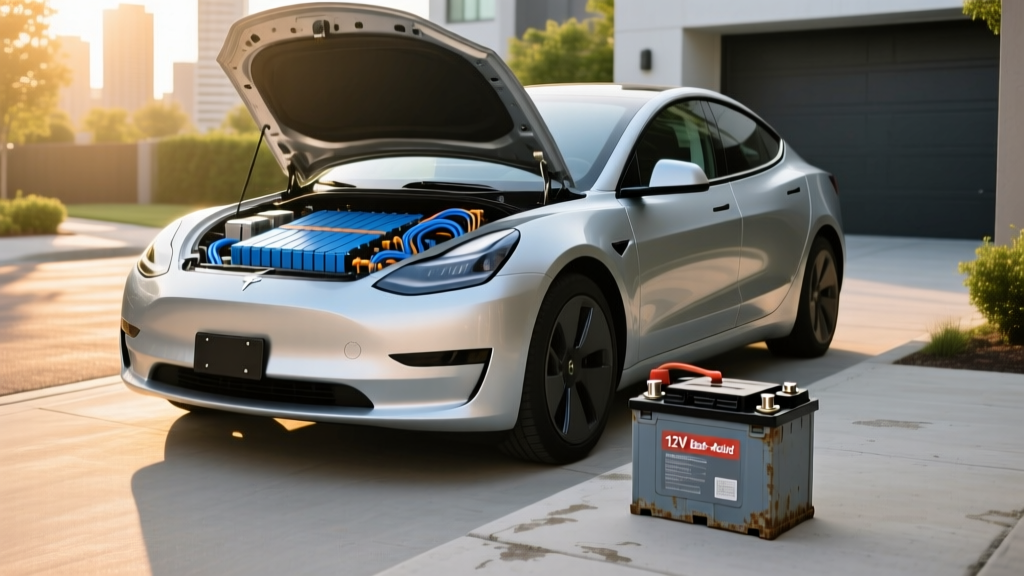
Important for EV owners: Electric vehicles also have a 12V auxiliary battery (often lithium-ion in newer models, lead-acid in older ones). This battery powers the computers, door handles, displays, and safety systems — and it's charged by a DC-DC converter that steps down the high-voltage traction battery. If your EV's 12V battery dies, the car won't start even if the main battery is full. Most modern EVs automatically top up the 12V from the traction battery when plugged in or periodically when parked, but if the 12V is failing, no amount of driving will fix it — it needs replacement.
How an EV Traction Battery Actually Charges
Unlike a 12V battery replenished by an alternator, an EV's high-voltage traction battery charges from an external power source — the grid. The time required depends entirely on the power level (measured in kW, or kilowatts) and the battery's energy capacity (measured in kWh, or kilowatt-hours).
Think of it this way: kW is the speed of water flowing through a hose; kWh is the size of the bucket. A 75 kWh battery charged at 7.2 kW (a typical Level 2 home charger) takes roughly 10.4 hours from empty to full. That same battery at a 150 kW DC fast charger can go from 10% to 80% in about 25–30 minutes — though the rate tapers significantly above 80% to protect cell health.
| Level | Voltage / Power | Miles of Range per Hour | Best For |
|---|---|---|---|
| Level 1 (120V) | 1.0–1.4 kW | 3–5 mi/hr | Overnight trickle, PHEVs, emergencies |
| Level 2 (240V) | 3.3–19.2 kW (typical home: 7.2–11.5 kW) | 12–44 mi/hr | Daily home charging, workplace |
| DC Fast Charge | 50–350 kW | 100–1,000+ mi/hr (at peak) | Road trips, rapid top-ups |
Source: fueleconomy.gov — EV Technology
Battery Chemistry: LFP vs. NMC/NCA and What It Means for Longevity
The two dominant lithium-ion chemistries in 2026 EVs are LFP (lithium iron phosphate) and NMC/NCA (nickel manganese cobalt / nickel cobalt aluminum). Your car's chemistry affects energy density, cold-weather performance, cycle life, and how you should manage daily charging.
| Attribute | LFP (LiFePO₄) | NMC / NCA |
|---|---|---|
| Energy Density | Lower (~160–180 Wh/kg cell-level) | Higher (~220–300 Wh/kg cell-level) |
| Cycle Life | 3,000–5,000+ cycles to 80% SoH | 1,000–2,000 cycles to 80% SoH |
| Cold Performance | Weaker — greater range loss below freezing | Better — retains more capacity in cold |
| Recommended Daily SoC | 100% OK (Tesla/BYD recommend periodic full charges) | 80% daily; 100% for trips only |
| Cost | Lower (no cobalt or nickel) | Higher (commodity-linked) |
| Thermal Stability | Excellent — very low thermal runaway risk | Good — requires robust BMS/cooling |
| Common In (2026) | Tesla Model 3/Y RWD, BYD, Ford Mustang Mach-E Select (LFP option) | Hyundai Ioniq 5/6, Kia EV6/EV9, Tesla Long Range, Rivian, GM Ultium |
Which is better? For daily commuters who can charge at home and want maximum calendar life, LFP's 3,000+ cycle rating and 100% charging tolerance make it the longevity winner. For drivers who need maximum range per charge, tow frequently, or live in cold climates, NMC/NCA's superior energy density and cold-weather performance justify the trade-off in cycle life — which still translates to 200,000+ miles before hitting 80% capacity in most real-world use.
How Long Do EV Batteries Actually Last? Degradation Data
The fear that EV batteries will "die" like a phone battery after a few years is not supported by fleet data. Modern liquid-cooled battery packs degrade slowly and predictably.
Real-world degradation data points from major fleets and studies:
- Tesla fleet data (2025 Impact Report): Model 3/Y batteries retain approximately ~85% capacity at 150,000 miles, with the degradation curve flattening significantly after the initial 10–15% drop in the first 30,000 miles.
- Geotab fleet study (6,300+ EVs): Average annual degradation across all brands was ~1.8% per year, meaning a typical EV retains roughly 82% capacity after 10 years at average mileage.
- Taxi/ride-share high-mileage data: Tesla Model 3 vehicles used in ride-hailing have been documented exceeding 300,000 miles on the original battery pack with 70–80% remaining capacity, largely because high-mileage driving keeps cells in the mid-SoC "sweet spot" and thermal management systems stay active.
Year 1: ~3–5% loss (initial formation period)
Years 2–5: ~1.5–2% per year
Years 6–10: ~1–1.5% per year (curve flattens)
Expected at 200,000 miles / 10 years: ~80–88% original capacity
LFP packs generally exceed these figures by 5–10 percentage points at equivalent mileage.
For context, the EPA defines end-of-life for an EV battery as the point where it drops below 70% of original capacity — and most modern packs will outlast the vehicle's body, suspension, and interior before reaching that threshold. Battery replacement before 200,000 miles is the exception, not the rule.
What Does the EV Battery Warranty Cover?
Federal law mandates a minimum battery warranty of 8 years / 100,000 miles for EVs sold in the United States (10 years / 150,000 miles in California Air Resources Board states). Most manufacturers exceed this floor. The warranty guarantees that the battery will retain a minimum percentage of its original capacity — typically 70%.
| Manufacturer | Coverage Period | Minimum Capacity Retention |
|---|---|---|
| Tesla | 8 yr / 120,000 mi (Model 3/Y RWD); 8 yr / 150,000 mi (Long Range/Performance) | 70% |
| Hyundai / Kia (E-GMP) | 10 yr / 100,000 mi | 70% |
| GM (Ultium platform) | 8 yr / 100,000 mi | 70% (some models: 60% on specific trims) |
| Ford | 8 yr / 100,000 mi | 70% |
| Rivian | 8 yr / 175,000 mi | 70% |
| BMW | 8 yr / 100,000 mi | 70% |
Source: EPA — Electric Vehicle Myths
What triggers a warranty claim: If your battery's State of Health (SoH) drops below the guaranteed threshold within the coverage period, the manufacturer will repair or replace the battery (often replacing individual modules rather than the entire pack). Normal degradation above the threshold is not covered. Damage from accidents, flooding, or unauthorized modifications voids the warranty.
EV Battery Replacement Cost: What It Actually Takes
Out-of-warranty battery replacement is the number-one fear for prospective EV buyers. Here are the real numbers — and the context that makes them less alarming.
| Vehicle / Pack Size | Battery Capacity | Estimated Replacement Cost |
|---|---|---|
| Tesla Model 3 RWD (LFP) | ~60 kWh | $8,000–$12,000 |
| Tesla Model Y Long Range | ~75 kWh | $12,000–$16,000 |
| Hyundai Ioniq 5 / Kia EV6 | ~77.4 kWh | $11,000–$15,000 |
| Ford F-150 Lightning (Extended) | ~131 kWh | $18,000–$28,000 |
| Rivian R1T / R1S (Large Pack) | ~128 kWh | $18,000–$25,000 |
| Chevrolet Equinox EV | ~85 kWh | $12,000–$16,000 |
These figures include the pack and labor but not potential ancillary work (coolant flush, BMS reprogramming). Module-level repairs — where only the degraded or failed modules are swapped — can cost $2,000–$6,000 depending on the vehicle architecture.
When is replacement actually needed? In practice, very few EVs need a full battery replacement within the first 15 years. The data from Recurrent Auto, Geotab, and manufacturer warranty claims consistently shows that fewer than 1–2% of EV battery packs require replacement due to premature failure, and the vast majority of those are covered under warranty. The battery will almost certainly outlast the car's useful economic life.
Factors That Accelerate (or Slow) Battery Degradation
Not all miles are created equal. How you charge, drive, and store your EV has a measurable impact on how fast the battery loses capacity. Here are the factors ranked by impact:
- Avoid sustained 100% SoC (NMC/NCA): Set your daily charge limit to 80%. Reserve 100% for road trips. LFP owners: periodic 100% charges are recommended for cell balancing.
- Minimize DC fast charging frequency: Frequent 150+ kW charging sessions accelerate degradation. Data from Geotab's fleet study shows vehicles that fast-charged more than 3x per month lost capacity roughly 1.5x faster than those using primarily Level 2.
- Precondition before fast charging: Most EVs do this automatically when a charger is set as a navigation destination. Cold batteries charged at high power suffer lithium plating — a permanent capacity loss mechanism.
- Avoid deep discharges: Try not to regularly drop below 10–15% SoC. The buffer at the bottom of the pack exists to protect cells, but repeatedly hitting it stresses chemistry.
- Park in moderate temperatures when possible: Sustained exposure to 95°F+ ambient heat (e.g., outdoor parking in Phoenix) is more damaging than cold. If you live in a hot climate, a garage and a charge limit of 80% significantly extend pack life.
- Use scheduled charging: Plug in when you get home but set charging to finish just before departure. This minimizes time spent at high SoC.
- Keep the vehicle plugged in during extreme cold: The thermal management system will use grid power (not battery energy) to maintain pack temperature.
Monitoring Battery Health: How to Check State of Health (SoH)
State of Health (SoH) is the percentage of original battery capacity remaining. A new EV has 100% SoH; at 85% SoH, a 75 kWh pack effectively holds ~63.75 kWh.
OEM apps and in-car displays: Tesla provides a battery health percentage in the vehicle settings (added in software updates from 2024 onward). Hyundai/Kia's Bluelink/UVO apps show estimated range at full charge, which indirectly reflects SoH. GM's myChevrolet/myCadillac apps include battery health indicators on Ultium vehicles.
Third-party tools:
- Recurrent Auto: Free service that connects to your EV's telematics and provides detailed SoH reports, degradation curves, and comparisons against similar vehicles in their 15,000+ EV fleet.
- OBD-II scanners with EV support: Tools like the OBDeleven (VW/Audi/Porsche), ScanGauge (Toyota/Hyundai), or dedicated EV scanners can read the BMS-reported SoH directly.
- Dealer diagnostic check: Any authorized service center can run a full battery health report — useful before buying a used EV or before a warranty claim.
DIY estimation: Charge to 100% (or your known max) and note the displayed range. Compare it to the EPA-rated range when new. A 310-mile EPA vehicle now showing 270 miles at full charge is at roughly 87% SoH. This method is approximate — displayed range factors in recent driving efficiency — but it's directionally useful.
What's Next: Solid-State and Silicon-Anode Batteries
Two technologies are frequently cited as the next leap in EV battery performance. Here's where they actually stand as of 2026:
Solid-state batteries: These replace the liquid electrolyte with a solid material (ceramic, sulfide, or polymer), promising higher energy density (~400–500 Wh/kg at cell level), faster charging, and improved safety. Toyota has announced limited production of solid-state-equipped vehicles for 2027–2028, and Samsung SDI targets 2027 for mass production. However, these remain announced/preliminary timelines. Manufacturing yield, cost, and scalability challenges have repeatedly delayed commercialization. Widespread availability in mainstream, sub-$50,000 EVs is not expected before 2030.
Silicon-anode batteries: By replacing some or all of the graphite anode with silicon, these cells can store significantly more lithium ions — boosting energy density by 20–40%. Companies like Sila Nanotechnologies and Group14 are supplying silicon-anode materials to manufacturers, and limited deployments are appearing in premium vehicles (e.g., Mercedes-Benz EQG concept applications). Expect incremental adoption through 2026–2029, primarily in performance-oriented or long-range trims before reaching mass-market models.
Frequently Asked Questions
How long do I need to drive to charge an EV battery?
You don't charge an EV's traction battery by driving — it charges from the grid via a plug. Driving consumes battery energy. If you're asking about a 12V auxiliary battery in any car, 20–30 minutes of highway driving after a jump-start typically restores enough charge for reliable restarts, though a dedicated trickle charger is more reliable.
How long do EV batteries last in years and miles?
Based on fleet data, most modern liquid-cooled EV batteries retain 80–88% of original capacity at 200,000 miles or 10 years. LFP chemistries often exceed this. The battery typically outlasts the vehicle's economic life. Fewer than 2% of packs require warranty replacement.
How much does it cost to replace an EV battery?
Full pack replacement ranges from roughly $8,000 for smaller packs (Tesla Model 3 RWD, ~60 kWh) to $28,000 for large truck packs (F-150 Lightning Extended, ~131 kWh). Module-level repairs cost $2,000–$6,000. In practice, the vast majority of replacements are covered under the 8-year/100,000-mile minimum warranty.
What does the battery warranty actually cover?
EV battery warranties guarantee a minimum capacity retention — typically 70% of original capacity — for 8 years/100,000 miles (10/150,000 in CARB states). If SoH drops below the threshold within the coverage period, the manufacturer repairs or replaces the battery. Normal degradation above the threshold, accident damage, and unauthorized modifications are not covered.
LFP vs. NMC — which battery chemistry should I choose?
Choose LFP if you prioritize longevity, can charge at home daily, and don't need maximum range per charge — its 3,000+ cycle life and 100% charge tolerance are significant advantages. Choose NMC/NCA if you need longer range, tow frequently, or live in a cold climate — its higher energy density and better cold-weather performance are worth the slightly shorter cycle life.
Does fast charging damage my EV battery?
Occasional DC fast charging is fine and accounted for in battery design. However, fleet data from Geotab shows that vehicles fast-charging more than three times per month experienced roughly 1.5x the degradation rate of those primarily using Level 2. The heat and high current at 150+ kW stress cell chemistry over time. Use fast charging for road trips; rely on Level 2 for daily needs.
How can I check my EV battery's State of Health?
Check via your vehicle's app (Tesla, Bluelink, myChevrolet), use a third-party service like Recurrent Auto, scan with an OBD-II EV-compatible tool, or request a dealer diagnostic report. For a quick estimate, charge to full and compare displayed range to the original EPA rating.